Focal Point
Interested in sharing your handiwork? Visit www.ModelAviation.com for submission guidelines.

Phoenix Models Corsair
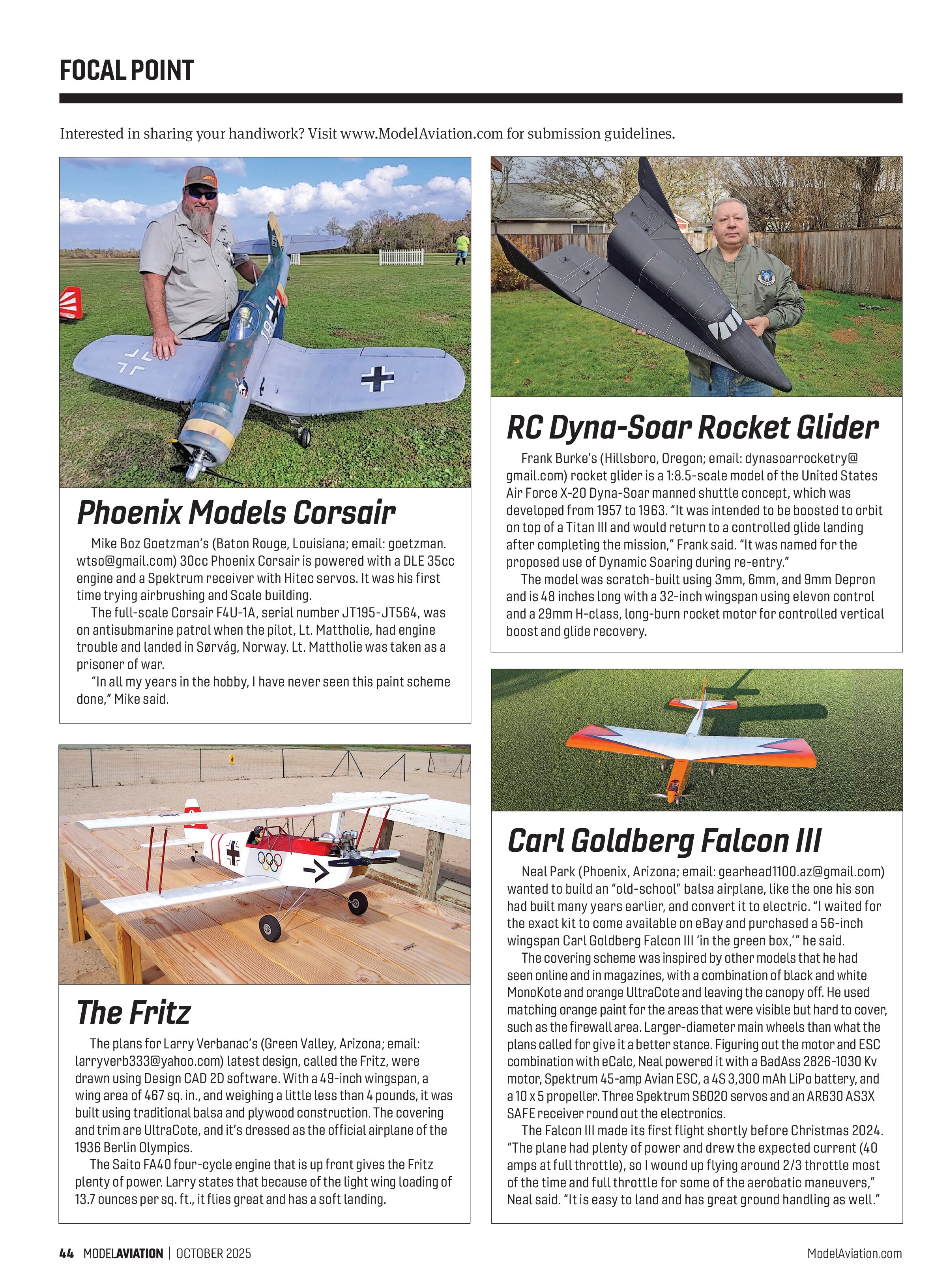
Mike Boz Goetzman’s (Baton Rouge, Louisiana; email: goetzman.wtso@gmail.com) 30cc Phoenix Corsair is powered with a DLE 35cc engine and a Spektrum receiver with Hitec servos. It was his first time trying airbrushing and Scale building.
The full-scale Corsair F4U-1A, serial number JT195-JT564, was on antisubmarine patrol when the pilot, Lt. Mattholie, had engine trouble and landed in Sørvåg, Norway. Lt. Mattholie was taken as a prisoner of war.
“In all my years in the hobby, I have never seen this paint scheme done,” Mike said.

The Fritz
The plans for Larry Verhanac’s (Green Valley, Arizona; email: larryverb333@yahoo.com) latest design, called the Fritz, were drawn using Design CAD 2D software. With a 49-inch wingspan, a wing area of 467 sq. in., and weighing a little less than 4 pounds, it was built using traditional balsa and plywood construction. The covering and trim are UltraCote, and it’s dressed as the official airplane of the 1936 Berlin Olympics.
The Saito FA40 four-cycle engine that up front gives the Fritz plenty of power. Larry states that because of the light wing loading of 13.7 ounces per sq. ft., it flies great and has a soft landing.

RC Dyna-Soar Rocket Glider
Frank Burke’s (Hillsboro, Oregon; email: dynas oarro cketry@gmail.com) rocket glider is a 1:8.5-scale model of the United States Air Force X-20 Dyna-Soar manned shuttle concept, which was developed from 1957 to 1963. “It was intended to be boosted to orbit on top of a Titan III and would return to a controlled glide landing after completing the mission,” Frank said. “It was named for the proposed use of Dynamic Soaring during re-entry.”
The model was scratch-built using 3mm, 6mm, and 9mm Depron and is 48 inches long with a 32-inch wingspan using elevon control and a 29mm H-class, long-burn rocket motor for controlled vertical boost and glide recovery.

Carl Goldberg Falcon III
Neal Park (Phoenix, Arizona; email: gearhead1100.az@gmail.com) wanted to build an “old-school” balsa airplane, like the one his son had built many years earlier, and convert it to electric. “I waited for the exact kit to come available on eBay and purchased a 56-inch wingspan Carl Goldberg Falcon III ‘in the green box,’” he said.
The covering scheme was inspired by other models that he had seen online and in magazines, with a combination of black and white MonoKote and orange UltraCote and leaving the canopy off. He used matching orange paint for the areas that were visible but hard to cover, such as the firewall area. Larger-diameter main wheels than what the plans called for give it a better stance. Figuring out the motor and ESC combination with eCalc, Neal powered it with a BadAss 2826-1030 Kv motor, Spektrum 45-amp Avian ESC, a 4S 3,300 mAh LiPo battery, and a 10 x 5 propeller. Three Spektrum S6020 servos and an AR630 AS3X SAFE receiver round out the electronics.
The Falcon III made its first flight shortly before Christmas 2024. “The plane had plenty of power and drew the expected current (40 amps at full throttle), so I wound up flying around 2/3 throttle most of the time and full throttle for some of the aerobatic maneuvers,” Neal said. “It is easy to land and has great ground handling as well.”

Ziroli Turbinator
Jim O’Brien (Tampa Bay, Florida; email: ama8932@gmail.com) is a member of the Bay City Flyers in Land-O-Lakes, Florida. His friend, Brandel Quinta, an accomplished RC jet pilot, urged him to get into jet flying, so he contacted Nick Ziroli for advice. “I visited him at his home and he told me all about one of his many designs, the Turbinator,” Jim said. “We have been friends for over 60 years, and it didn’t take him long to convince me that the Turbinator would be my first ‘scratch-built’ jet. He even gave me the plans. So, off I went into the build.”
A KingTech K100 turbine engine was installed, as well as a 100-ounce Kevlar tank, with a Spektrum redundant 12-channel radio control. Pro-Link electric gear from DreamWorks was also added. The finished model came in at a little less than 22 pounds.
Another friend, Gary West, maidened the jet. It flew beautifully, without any trim adjustment. “It is a great-flying machine,” Jim said. “The Turbinator is very stable and predictable and a great first jet. On this design, there is typically some dihedral in the stabilizer, so I flipped it to create an anhedral stabilizer. It looks sexy. As a gas-engine flier, it is still hard for me to come to grips with an engine revving at nearly 100,000 rpm!”
“Thank you, Nick, for autographing my Turbinator, and for all of your advice along the way.”

Extreme Flight NG
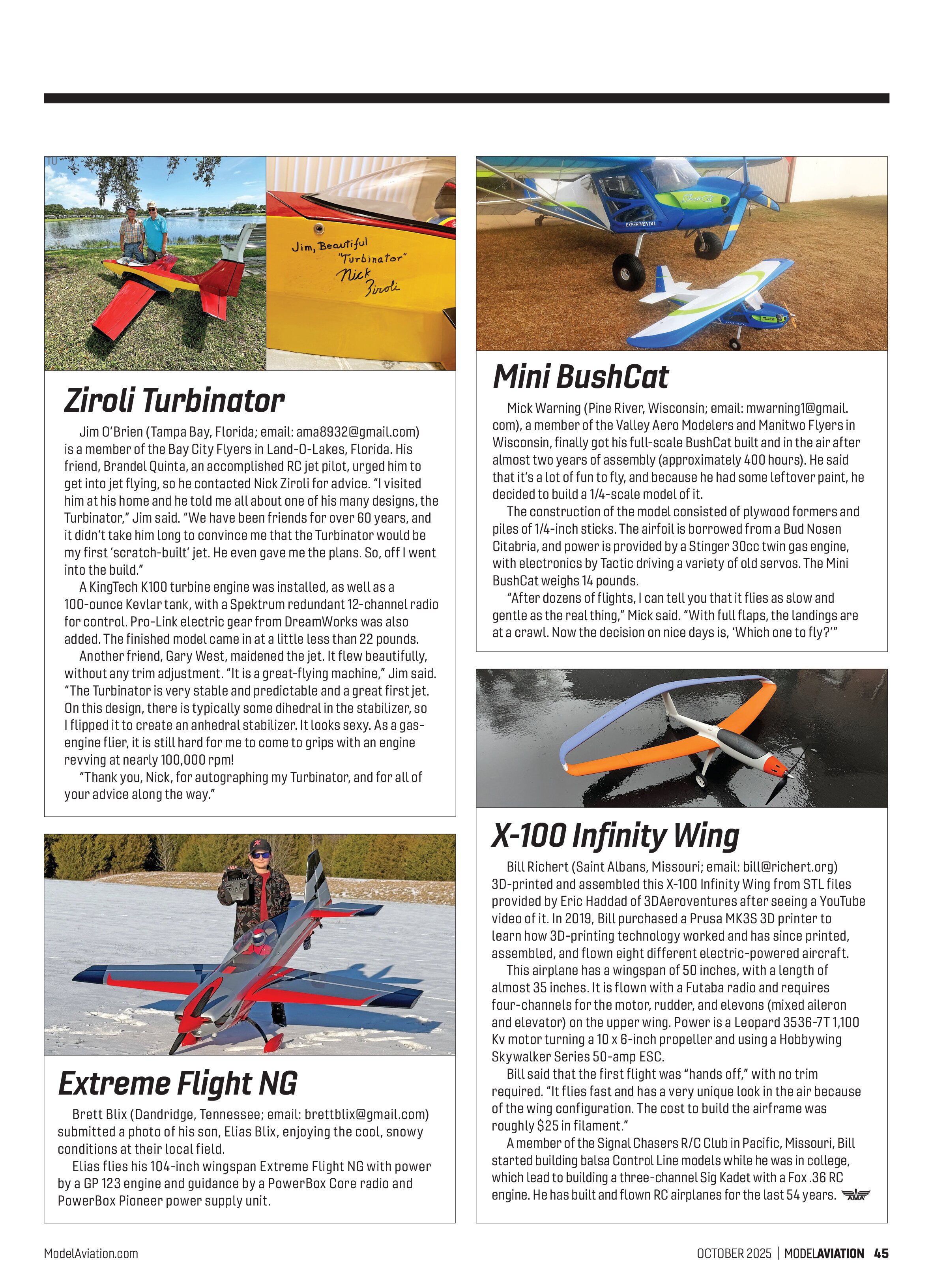
Brett Blix (Dandridge, Tennessee; email: brettblix@gmail.com) submitted a photo of his son, Elias Blix, enjoying the cool, snowy conditions at their local field.
Elias flies his 104-inch wingspan Extreme Flight NG with power by a GP 123 engine and guidance by a PowerBox Core radio and PowerBox Pioneer power supply unit.

Mini BushCat
Mick Warning (Pine River, Wisconsin; email: mwarning1@gmail.com), a member of the Valley Aero Modelers and Manitowoc Flyers in Wisconsin, finally got his full-scale BushCat built and in the air after almost two years of assembly (approximately 400 hours). He said that it’s a lot of fun to fly, and because he had some leftover paint, he decided to build a 1/4-scale model of it.
The construction of the model consisted of plywood formers and piles of 1/4-inch sticks. The airfoil is borrowed from a Bud Nosen Citabria, and power is provided by a Stinger 30cc twin gas engine, with electronics by Tactic driving a variety of old servos. The Mini BushCat weighs 14 pounds.
“After dozens of flights, I can tell you that it flies as slow and gentle as the real thing,” Mick said. “With full flaps, the landings are at a crawl. Now the decision on nice days is, ‘Which one to fly?’”

X-100 Infinity Wing
Bill Riechert (Saint Albans, Missouri; email: bill@riechert.org) 3D-printed and assembled this X-100 Infinity Wing from STL files provided by Eric Haddad of 3DAeventures after seeing a YouTube video of it. In 2019, Bill purchased a Prusa MK3S 3D printer to learn how 3D-printing technology worked and has since printed, assembled, and flown eight different electric-powered aircraft.
This airplane has a wingspan of 50 inches, with a length of almost 35 inches. It is flown with a Futaba radio and requires four channels for the motor, rudder, and elevons (mixed aileron and elevator) on the upper wing. Power is a Leopard 3536-7T 1,100 Kv motor turning a 10 x 6-inch propeller and using a Hobbywing Skywalker Series 50-amp ESC.
Bill said that the first flight was “hands off,” with no trim required. “It flies fast and has a very unique look in the air because of the wing configuration. The cost to build the airframe was roughly $25 in filament.”
A member of the Signal Chasers R/C Club in Pacific, Missouri, Bill started building balsa Control Line models while he was in college, which lead to building a three-channel Sig Kadet with a Fox .36 RC engine. He has built and flown RC airplanes for the last 54 years.