FLIGHT SCHOOL
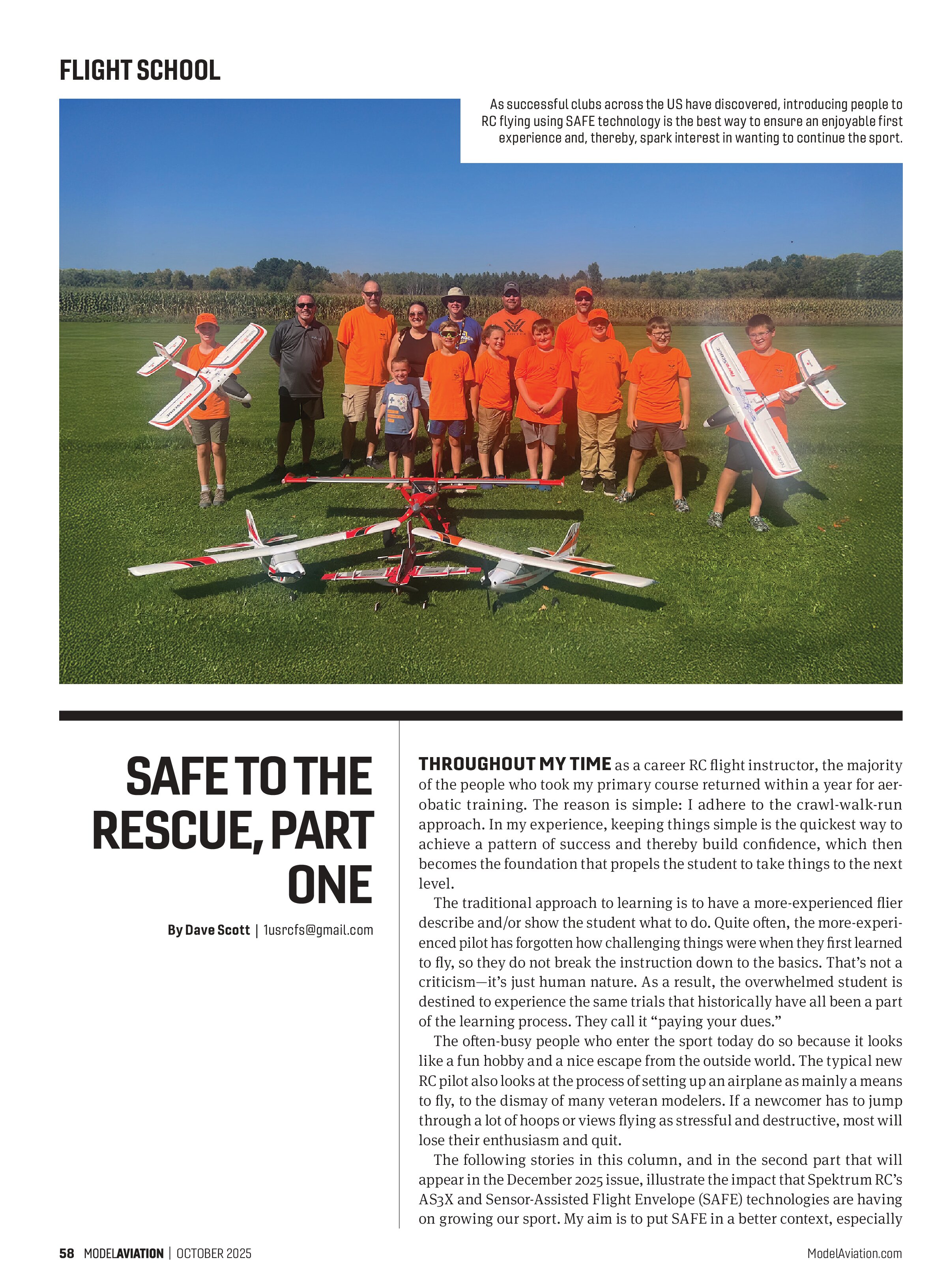
As successful clubs across the US have discovered, introducing people to RC flying using SAFE technology is the best way to ensure an enjoyable first experience and, thereby, spark interest in wanting to continue the sport.

SAFE TO THE RESCUE, PART ONE
By Dave Scott | 1usrcfs@gmail.com
THROUGHOUT MY TIME as a career RC flight instructor, the majority of the people who took my primary course returned within a year for aerobatic training. The reason is simple: I adhere to the crawl-walk-run approach. In my experience, keeping things simple is the quickest way to achieve a pattern of success and thereby build confidence, which then becomes the foundation that propels the student to take things to the next level.
The traditional approach to learning is to have a more-experienced flier describe and/or show the student what to do. Quite often, the more-experienced pilot has forgotten how challenging things were when they first learned to fly, so they do not break the instruction down to the basics. That’s not a criticism—it’s just human nature. As a result, the overwhelmed student is destined to experience the same trials that historically have all been a part of the learning process. They call it “paying your dues.”
The often-busy people who enter the sport today do so because it looks like a fun hobby and a nice escape from the outside world. The typical new RC pilot also looks at the process of setting up an airplane as mainly a means to fly, to the dismay of many veteran modelers. If a newcomer has to jump through a lot of hoops or views flying as stressful and destructive, most will lose their enthusiasm and quit.
The following stories in this column, and in the second part that will appear in the December 2025 issue, illustrate the impact that Spektrum RC’s AS3X and Sensor-Assisted Flight Envelope (SAFE) technologies are having on growing our sport. My aim is to put SAFE in a better context, especially with those who embrace all other technologies that improve flying and make it easier to use SAFE, yet they still discourage it.
Turning Reluctance to Joy
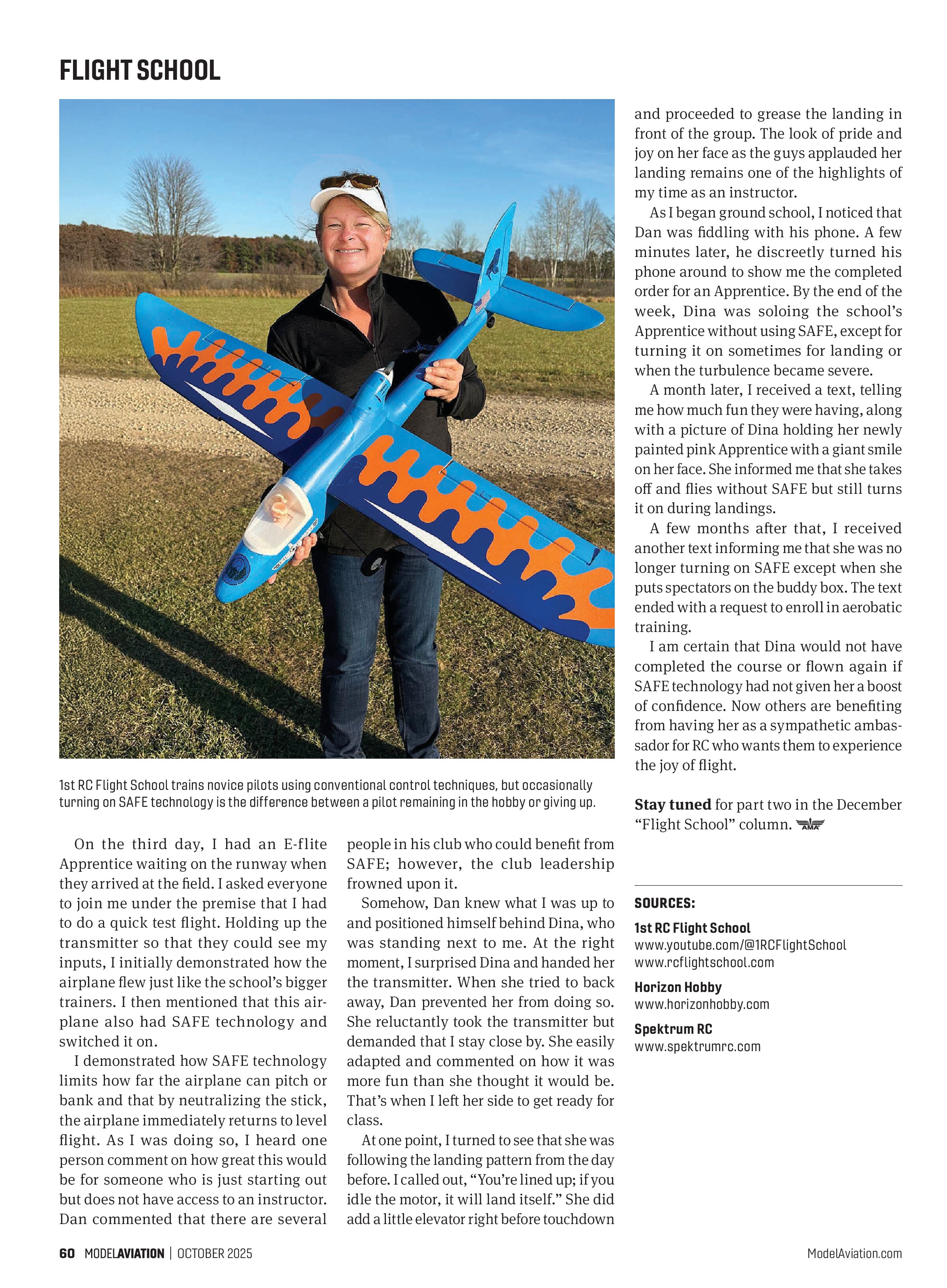
I train novice pilots on aircraft with conventional controls (no SAFE technology) while relying on AS3X to stabilize the model in persistent turbulence. It’s like shocks on a car: You still have to fly the airplane, but the ride is smoother. There are, however, occasions when SAFE saves the day.
Several years ago, a very nice, retired couple, Dan and Dina, attended my solo course. Although Dina was doing fine and had several landings under her belt by the second day, the three guys in the course were progressing a bit faster. It didn’t help that the week was particularly windy. As a result, she began dropping hints that she wasn’t cut out to be a pilot and would be happy just to be company to Dan when he flew.

On the third day, I had an E-flite Apprentice waiting on the runway when they arrived at the field. I asked everyone to join me under the premise that I had to do a quick test flight. Holding up the transmitter so that they could see my inputs, I initially demonstrated how the airplane flew just like the school’s bigger trainers. I then mentioned that this airplane also had SAFE technology and switched it on.
I demonstrated how SAFE technology limits how far the airplane can pitch or bank and that by neutralizing the stick, the airplane immediately returns to level flight. As I was doing so, I heard one person comment on how great this would be for someone who is just starting out but does not have access to an instructor. Dan commented that there are several people in his club who could benefit from SAFE; however, the club leadership frowned upon it.
Somehow, Dan knew what I was up to and positioned himself behind Dina, who was standing next to me. At the right moment, I surprised Dina and handed her the transmitter. When she tried to back away, Dan prevented her from doing so. She reluctantly took the transmitter but demanded that I stay close by. She easily adapted and commented on how it was more fun than she thought it would be. That’s when I left her side to get ready for class.
At one point, I turned to see that she was following the landing pattern from the day before. I called out, “You’re lined up; if you idle the motor, it will land itself.” She did add a little elevator right before touchdown and proceeded to grease the landing in front of the group. The look of pride and joy on her face as the guys applauded her landing remains one of the highlights of my time as an instructor.
As I began ground school, I noticed that Dan was fiddling with his phone. A few minutes later, he discreetly turned his phone around to show me the completed order for an Apprentice. By the end of the week, Dina was soloing the school’s Apprentice without using SAFE, except for turning it on sometimes for landing or when the turbulence became severe.
A month later, I received a text, telling me how much fun they were having, along with a picture of Dina holding her newly painted pink Apprentice with a giant smile on her face. She informed me that she takes off and flies without SAFE but still turns it on during landings.
A few months after that, I received another text informing me that she was no longer turning on SAFE except when she puts spectators on the buddy box. The text ended with a request to enroll in aerobatic training.
I am certain that Dina would not have completed the course or flown again if SAFE technology had not given her a boost of confidence. Now others are benefiting from having her as a sympathetic ambassador for RC who wants them to experience the joy of flight.
Stay tuned for part two in the December “Flight School” column.
SOURCES:
1st RC Flight School
www.youtube.com/@1RCFlightSchool
www.rcflightschool.com
Horizon Hobby
www.horizonhobby.com
Spektrum RC
www.spektrumrc.com