
WIRE SIZING BASICS
By Terry Dunn | terrydunn74@gmail.com
YOU HAVE PROBABLY figured out by now that I do not have all of the answers. I still make plenty of mistakes with this electric power stuff. I’m just lucky enough to be surrounded by some very smart people who do not seem to mind my questions.
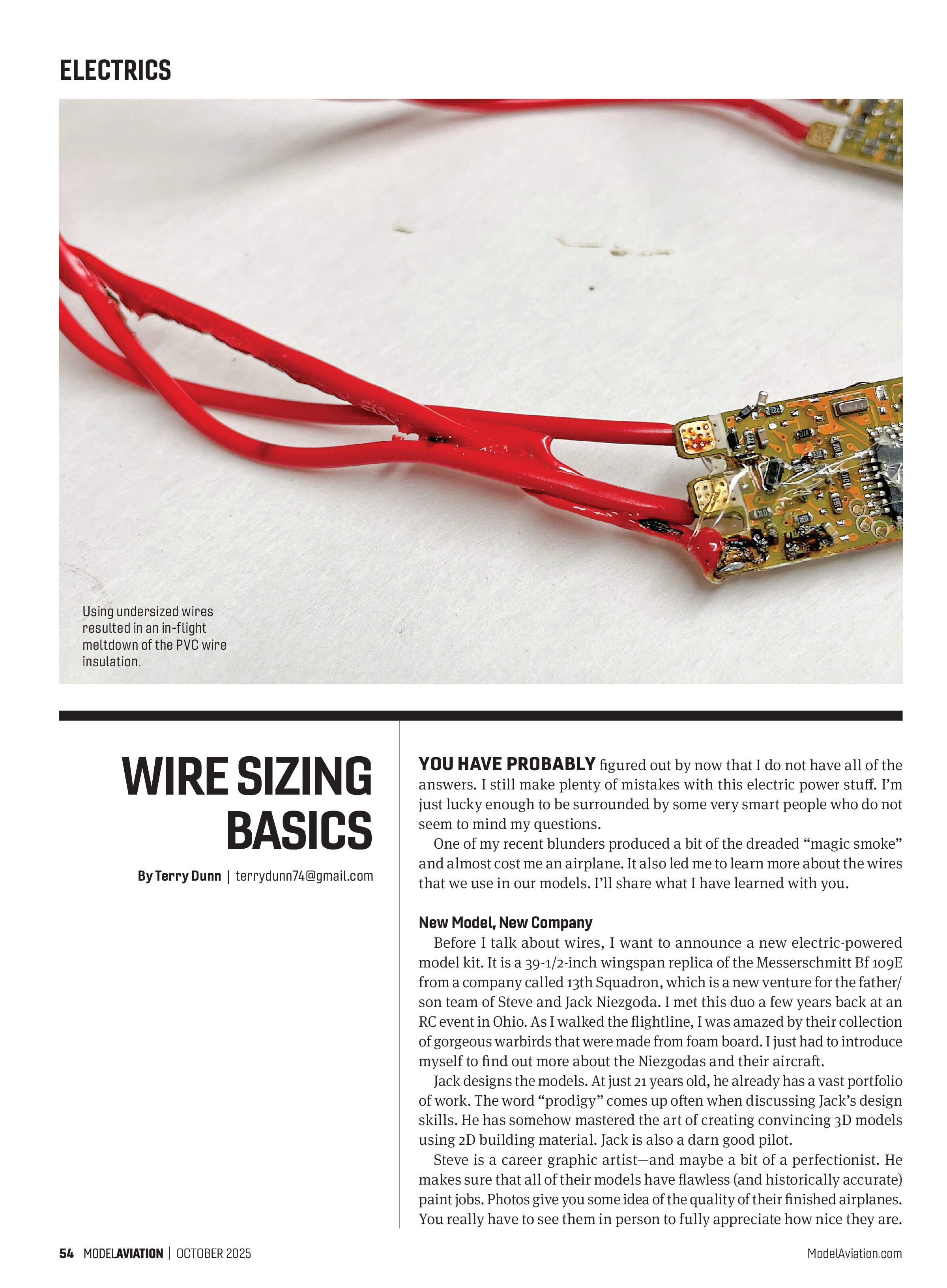
One of my recent blunders produced a bit of the dreaded “magic smoke” and almost cost me an airplane. It also led me to learn more about the wires that we use in our models. I’ll share what I have learned with you.
New Model, New Company
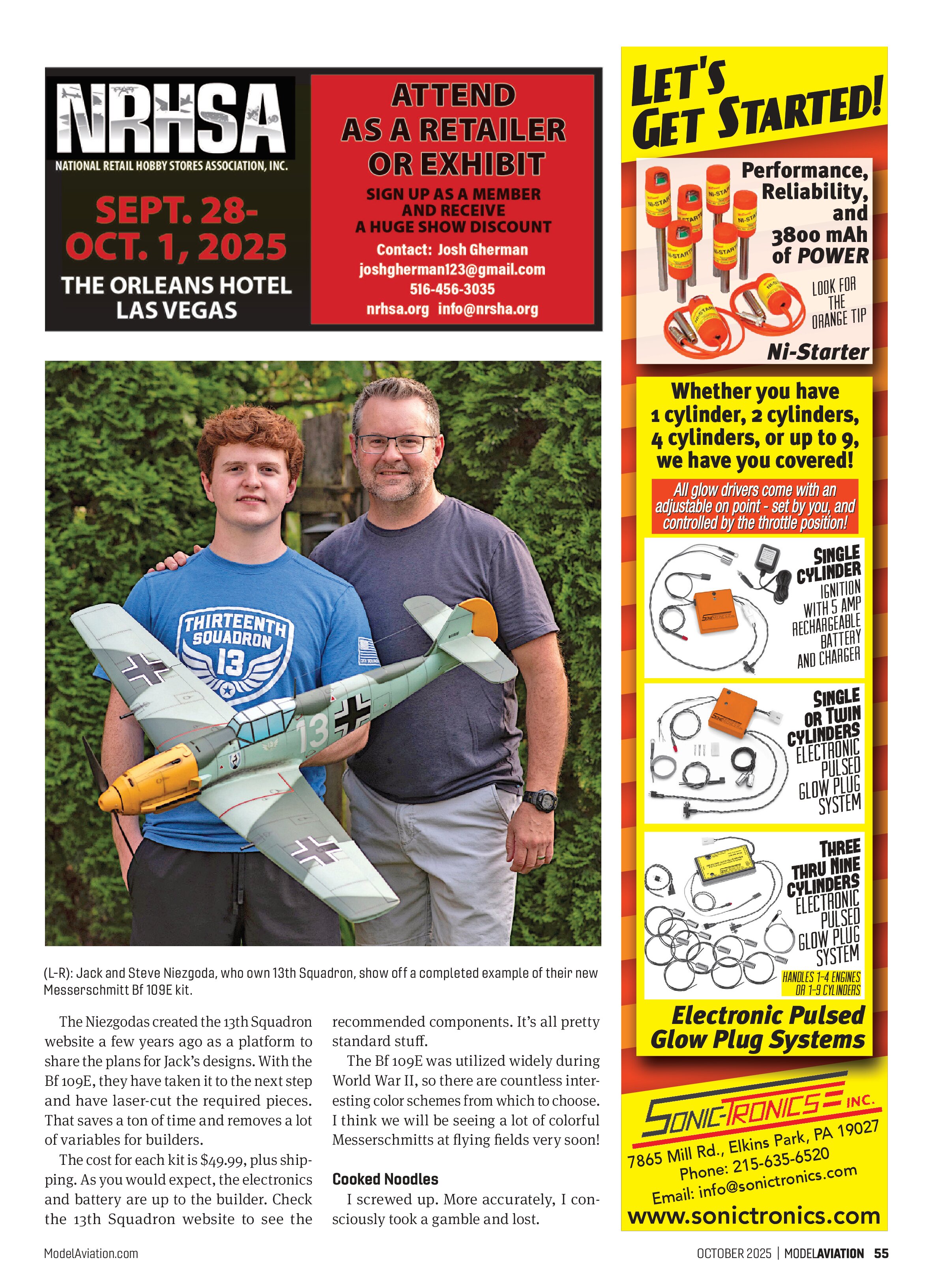
Before I talk about wires, I want to announce a new electric-powered model kit. It is a 39-1/2-inch wingspan replica of the Messerschmitt Bf 109E from a company called 13th Squadron, which is a new venture for the father/son team of Steve and Jack Niezgoda. I met this duo a few years back at an RC event in Ohio. As I walked the flightline, I was amazed by their collection of gorgeous warbirds that were made from foam board. I just had to introduce myself to find out more about the Niezgodas and their aircraft.
Jack designs the models. At just 21 years old, he already has a vast portfolio of work. The word “prodigy” comes up often when discussing Jack’s design skills. He has somehow mastered the art of creating convincing 3D models using 2D building material. Jack is also a darn good pilot.
Steve is a career graphic artist—and maybe a bit of a perfectionist. He makes sure that all of their models have flawless (and historically accurate) paint jobs. Photos give you some idea of the quality of their finished airplanes. You really have to see them in person to fully appreciate how nice they are.

Cooked Noodles
I screwed up. More accurately, I consciously took a gamble and lost.
The Niezgodas created the 13th Squadron website a few years ago as a platform to share the plans for Jack’s designs. With the Bf 109E, they have taken it to the next step and have laser-cut the required pieces. That saves a ton of time and removes a lot of variables for builders.
The cost for each kit is $49.99, plus shipping. As you would expect, the electronics and battery are up to the builder. Check the 13th Squadron website to see the recommended components. It’s all pretty standard stuff.
The Bf 109E was utilized widely during World War II, so there are countless interesting color schemes from which to choose. I think we will be seeing a lot of colorful Messerschmitts at flying fields very soon!

I decided to upgrade from a brushed to a brushless power system on an old foamie model of a PBY Catalina. The specific components of the power system aren’t important for this discussion. What does matter is that I knew each motor would pull 12 amps at full throttle.
The two ESCs I used on this twin-motored project do not have integrated motor wires. They have solder pads where you connect your own motor wires. For a 12-amp application, I would normally use 18 American Wire Gauge (AWG) stranded wire. So, that’s what I did here ... sort of.
The wire I used came from a spool that is clearly marked as 18 AWG. Yet, when I stripped away the insulation, the conductive wire was obviously smaller than any other 18 AWG wire I have. Much smaller.
I didn’t want to believe that the wire was mislabeled, so I convinced myself that it was probably a special, superconductive, small-diameter 18-gauge wire. I was trying to save weight anyway. How lucky I was to find this extra-small, extra-lightweight 18 AWG wire. They should call it “Immaculate Wire!”
I got the power system wired up without any issues. My ground tests confirmed that everything was operating as expected. In fact, the remotered Catalina flew great off of water and grass.
On my fourth outing with the Catalina, I was well into my second flight of the day when one of the motors abruptly stopped. Despite the unplanned asymmetric thrust, I was able to safely land my model beside the runway. As I walked out to retrieve the airplane, I noticed something that none of us ever likes to see: smoke!
I removed the battery hatch, expecting to find a smoldering LiPo or a toasty ESC. Instead, I found that the insulation was melting off of my motor wires! Okay ... fine. Now I accept that the wire spool was mislabeled.
Whatever gauge this wire actually is, it clearly isn’t sufficient for the Catalina. So much for my “Immaculate Wire” theory.
Phone a Friend
Knowing that I would have to confess my wiring sin in this column, I thought it would also be prudent to include some rules of thumb for choosing wire, so I called the most proficient power system expert I know: Lucien Miller at Innov8tive Designs.
Throughout the course of that phone call and some follow-up emails, Lucien gave me a thorough education on choosing the proper wire for any RC application. A lot of that conversation was too in-depth for the scope of this article, but I will share some useful high points.
For power system applications in RC aircraft, we should always use stranded wire with silicone insulation. Why use stranded wire? Because it is more flexible than solid wire. The more strands a given gauge of wire has, the more flexible it will be.
The primary advantage of using wire with silicone insulation is that it will not melt. The PVC insulation commonly used for things such as speaker wire can melt at temperatures as low as 160°F. In addition to creating a sticky, smelly mess, melted insulation can lead to short circuits. Can you guess which type of insulation was on my Catalina’s motor wires?
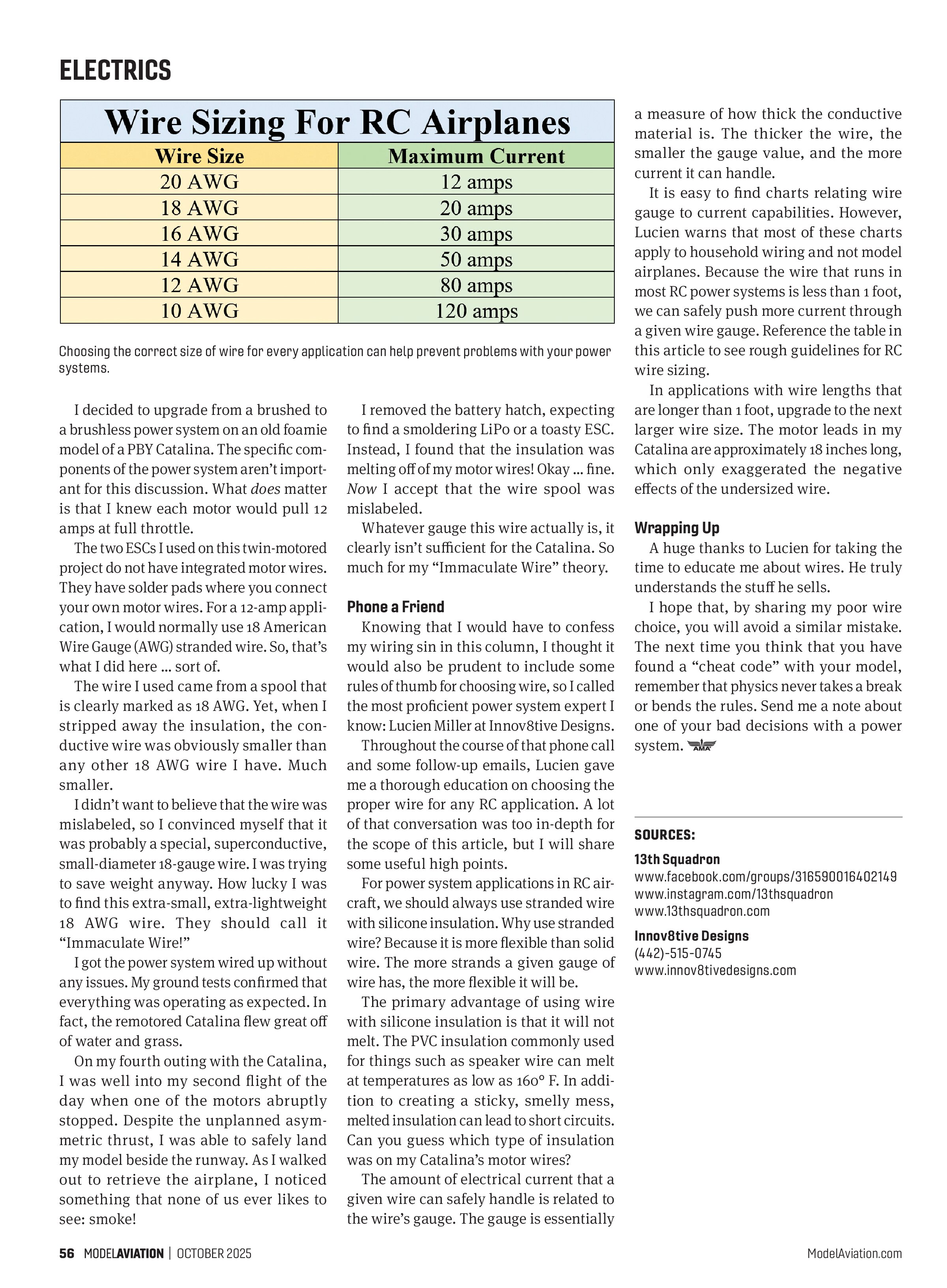
The amount of electrical current that a given wire can safely handle is related to the wire’s gauge. The gauge is essentially a measure of how thick the conductive material is. The thicker the wire, the smaller the gauge value, and the more current it can handle.
It is easy to find charts relating wire gauge to current capabilities. However, Lucien warns that most of these charts apply to household wiring and not model airplanes. Because the wire that runs in most RC power systems is less than 1 foot, we can safely push more current through a given wire gauge. Reference the table in this article to see rough guidelines for RC wire sizing.
In applications with wire lengths that are longer than 1 foot, upgrade to the next larger wire size. The motor leads in my Catalina are approximately 18 inches long, which only exaggerated the negative effects of the undersized wire.
Wrapping Up
A huge thanks to Lucien for taking the time to educate me about wires. He truly understands the stuff he sells.
I hope that, by sharing my poor wire choice, you will avoid a similar mistake. The next time you think that you have found a “cheat code” with your model, remember that physics never takes a break or bends the rules. Send me a note about one of your bad decisions with a power system.
SOURCES:
13th Squadron
www.facebook.com/groups/316590016402149
www.instagram.com/13thsquadron
www.13thsquadron.com
Innov8tive Designs
(442)-515-0745
www.innov8tivedesigns.com