SAFETY COMES FIRST

RC SYSTEM SAYS, “I TOLD YOU SO!”
By Dave Gee | safetycolumn@cs.com
JERRY NEUBERGER is an experienced and skilled pilot. He is also a cautious fellow where flight operations are concerned. He wrote:
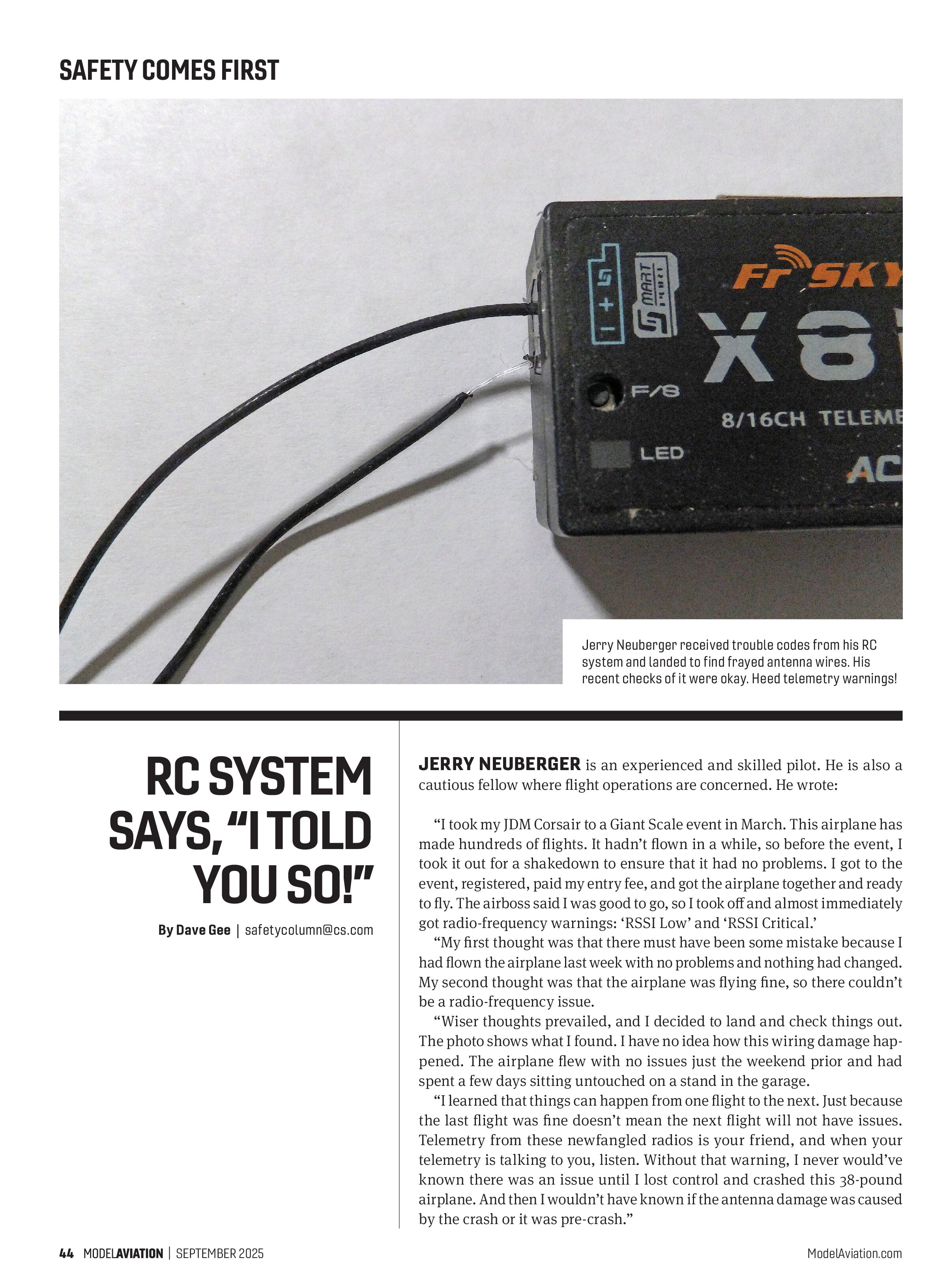
“I took my JDM Corsair to a Giant Scale event in March. This airplane has made hundreds of flights. It hadn’t flown in a while, so before the event, I took it out for a shakedown to ensure that it had no problems. I got to the event, registered, paid my entry fee, and got the airplane together and ready to fly. The airboss said I was good to go, so I took off and almost immediately got radio-frequency warnings: ‘RSSI Low’ and ‘RSSI Critical.’
“My first thought was that there must have been some mistake because I had flown the airplane last week with no problems and nothing had changed. My second thought was that the airplane was flying fine, so there couldn’t be a radio-frequency issue.
“Wiser thoughts prevailed, and I decided to land and check things out. The photo shows what I found. I have no idea how this wiring damage happened. The airplane flew with no issues just the weekend prior and had spent a few days sitting untouched on a stand in the garage.
“I learned that things can happen from one flight to the next. Just because the last flight was fine doesn’t mean the next flight will not have issues. Telemetry from these newfangled radios is your friend, and when your telemetry is talking to you, listen. Without that warning, I never would’ve known there was an issue until I lost control and crashed this 38-pound airplane. And then I wouldn’t have known if the antenna damage was caused by the crash or it was pre-crash.”
Old-timers (such as I) are dazzled by all of the great, new options that are available on modern RC systems. Real-time telemetry data is a major step forward for flight safety!
Quad With Feedback
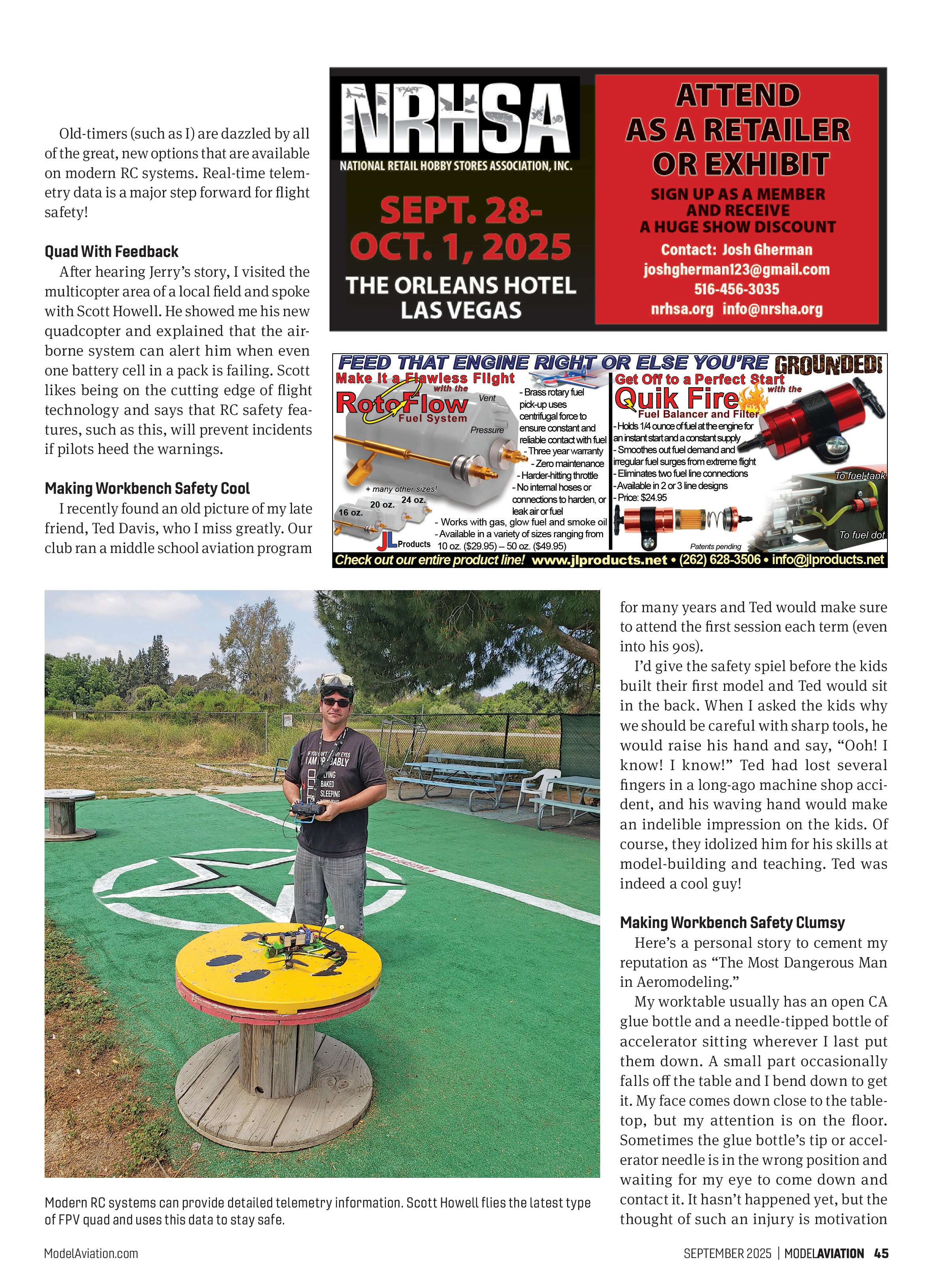
After hearing Jerry’s story, I visited the multicopter area of a local field and spoke with Scott Howell. He showed me his new quadcopter and explained that the airborne system can alert him when even one battery cell in a pack is failing. Scott likes being on the cutting edge of flight technology and says that RC safety features, such as this, will prevent incidents if pilots heed the warnings.
Making Workbench Safety Cool
I recently found an old picture of my late friend, Ted Davis, who I miss greatly. Our club ran a middle school aviation program

for many years and Ted would make sure to attend the first session each term (even into his 90s).
I’d give the safety spiel before the kids built their first model and Ted would sit in the back. When I asked the kids why we should be careful with sharp tools, he would raise his hand and say, “Ooh! I know! I know!” Ted had lost several fingers in a long-ago machine shop accident, and his waving hand would make an indelible impression on the kids. Of course, they idolized him for his skills at model-building and teaching. Ted was indeed a cool guy!
Making Workbench Safety Clumsy
Here’s a personal story to cement my reputation as “The Most Dangerous Man in Aeromodeling.”
My worktable usually has an open CA glue bottle and a needle-tipped bottle of accelerator sitting wherever I last put them down. A small part occasionally falls off the table and I bend down to get it. My face comes down close to the tabletop, but my attention is on the floor. Sometimes the glue bottle’s tip or accelerator needle is in the wrong position and waiting for my eye to come down and contact it. It hasn’t happened yet, but the thought of such an injury is motivation
to wear eye protection while I’m at the workbench!
I’m at the age where I need reading glasses for model building, so I got some that have safety-rated lenses. That way I can keep them on while using small power tools and, of course, if I’m ever foolish enough to poke my eye with the CA needle, the glasses will save me from my own careless ways—I hope.
Secret Shopper Scheme?
We all want to keep our hobby growing, so recruitment and training of new pilots is vital. When visiting various RC fields, I find that each one has a unique vibe. Occasionally, there is a flying site that doesn’t feel as welcoming as most, and that’s a shame. I wonder what data could be gathered if a club tried sending a polite but incognito “newcomer” to one with an unflown RTF model to see what kind of reception they would get. The results would make an interesting presentation at the next business meeting.
I generally get greeted and “chatted up” soon after arrival, and sometimes I’m offered a chance to “try the sticks,” even though I’m seen as a total stranger with no flight skills. (My cover is quickly blown because they realize that nobody could be that bad at RC flying without long practice.) This level of friendliness is common to our sport and helps to make pilots out of visitors. How would your local field do in such a blind test?
Mystery Airplane
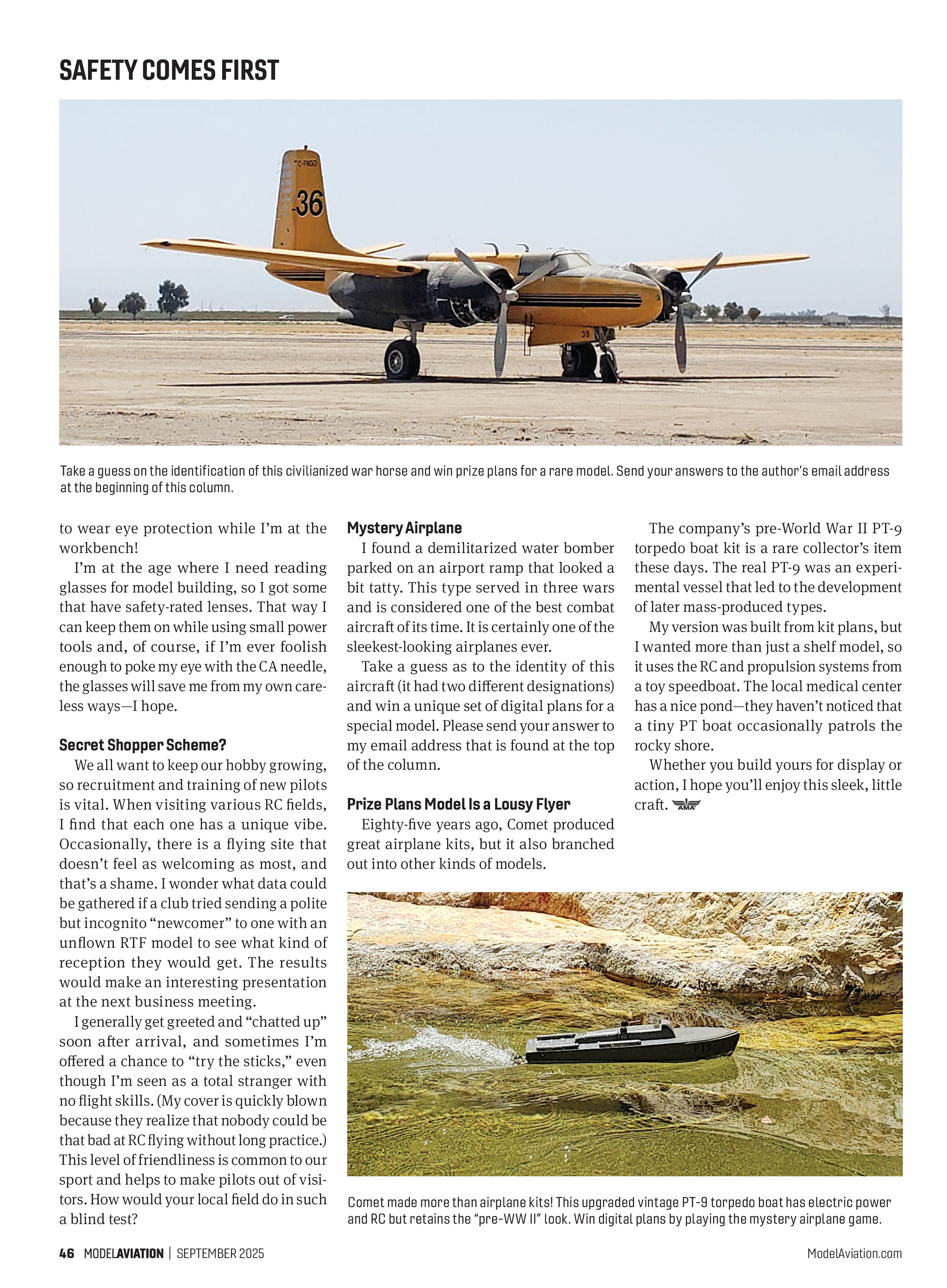
I found a demilitarized water bomber parked on an airport ramp that looked a bit tatty. This type served in three wars and is considered one of the best combat aircraft of its time. It is certainly one of the sleekest-looking airplanes ever.
Take a guess as to the identity of this aircraft (it had two different designations) and win a unique set of digital plans for a special model. Please send your answer to my email address that is found at the top of the column.
Prize Plans Model Is a Lousy Flyer
Eighty-five years ago, Comet produced great airplane kits, but it also branched out into other kinds of models.

The company’s pre-World War II PT-9 torpedo boat kit is a rare collector’s item these days. The real PT-9 was an experimental vessel that led to the development of later mass-produced types.
My version was built from kit plans, but I wanted more than just a shelf model, so it uses the RC and propulsion systems from a toy speedboat. The local medical center has a nice pond—they haven’t noticed that a tiny PT boat occasionally patrols the rocky shore.
Whether you build yours for display or action, I hope you’ll enjoy this sleek, little craft.