FINDING THREE-VIEWS FOR COMPETITION STATIC JUDGING
By Stan Alexander | onawing4602@att.net

IM MY LAST COLUMN, I discussed three-view drawings and their general outlines. It’s sometimes difficult to find a three-view drawing that fits your model, especially if your only source is the internet!
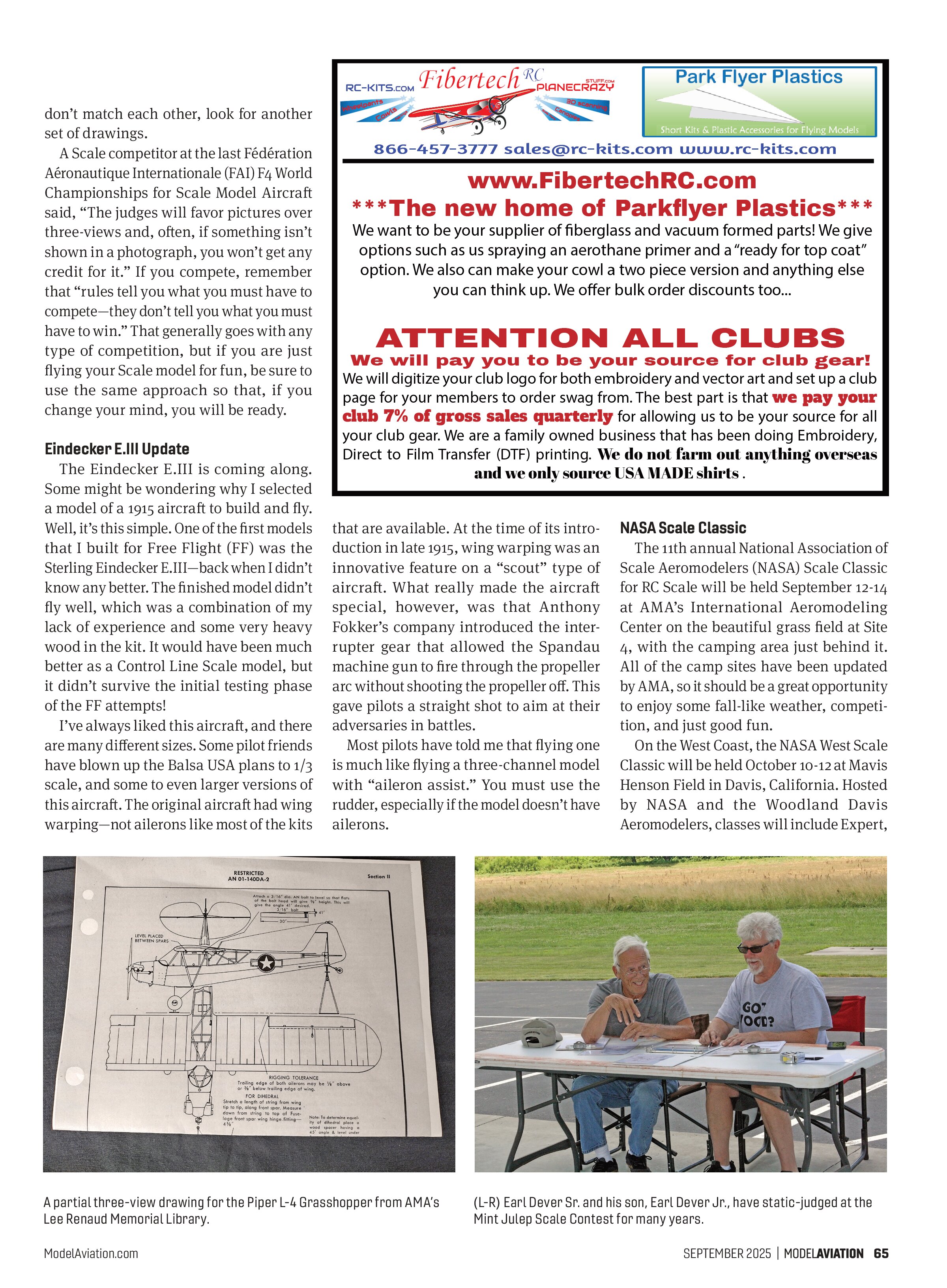
Last year, a friend who was working on a Piper L-4 Grasshopper for competition was stumped on finding a good set of three-views for that particular aircraft. He found many different three-views online for Piper J-3 Cubs (the civilian version) but nothing on the L-4. We found a Piper manual in AMA’s Lee Renaud Memorial Library, and National Model Aviation Museum Director Michael Smith made copies of it for us. The three-views not only matched the L-4, but there was also some additional information on the “Rigging Diagram” about the full-scale aircraft that I hadn’t seen before:
“For Dihedral: Stretch a length of string from wing tip to tip, along the front spar. Measure down from string to top of Fuselage front spar wing hinge fitting—4-3/8 [inch].”
These old manuals are sometimes written in English. I have a manual in German for one model, a Henschel Hs 123. Sometimes the Japanese book Famous Airplanes of the World has some really interesting drawings and color side-views, but, of course, it’s all in Japanese. Sources are out there, so utilize them, and by all means, gather all of your documentation before you start building the model.
If you have a poor three-view, check the panel lines, rivets, and markings to make sure that they are in the correct place and match the photos. If they don’t match each other, look for another set of drawings.
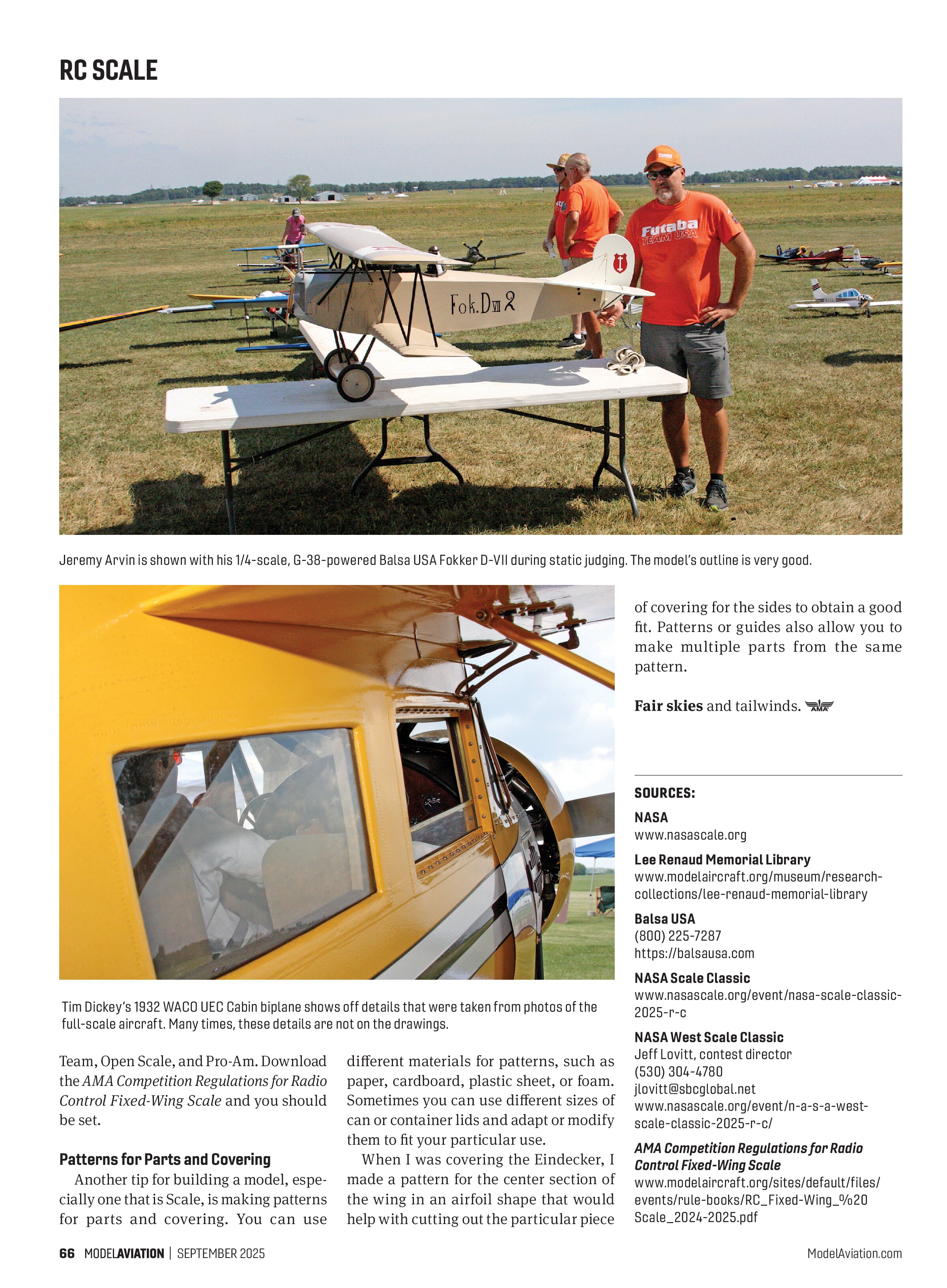
A Scale competitor at the last Fédération Aéronautique Internationale (FAI) F4 World Championships for Scale Model Aircraft said, “The judges will favor pictures over three-views and, often, if something isn’t shown in a photograph, you won’t get any credit for it.” If you compete, remember that “rules tell you what you must have to compete—they don’t tell you what you must have to win.” That generally goes with any type of competition, but if you are just flying your Scale model for fun, be sure to use the same approach so that, if you change your mind, you will be ready.
Eindecker E.III Update
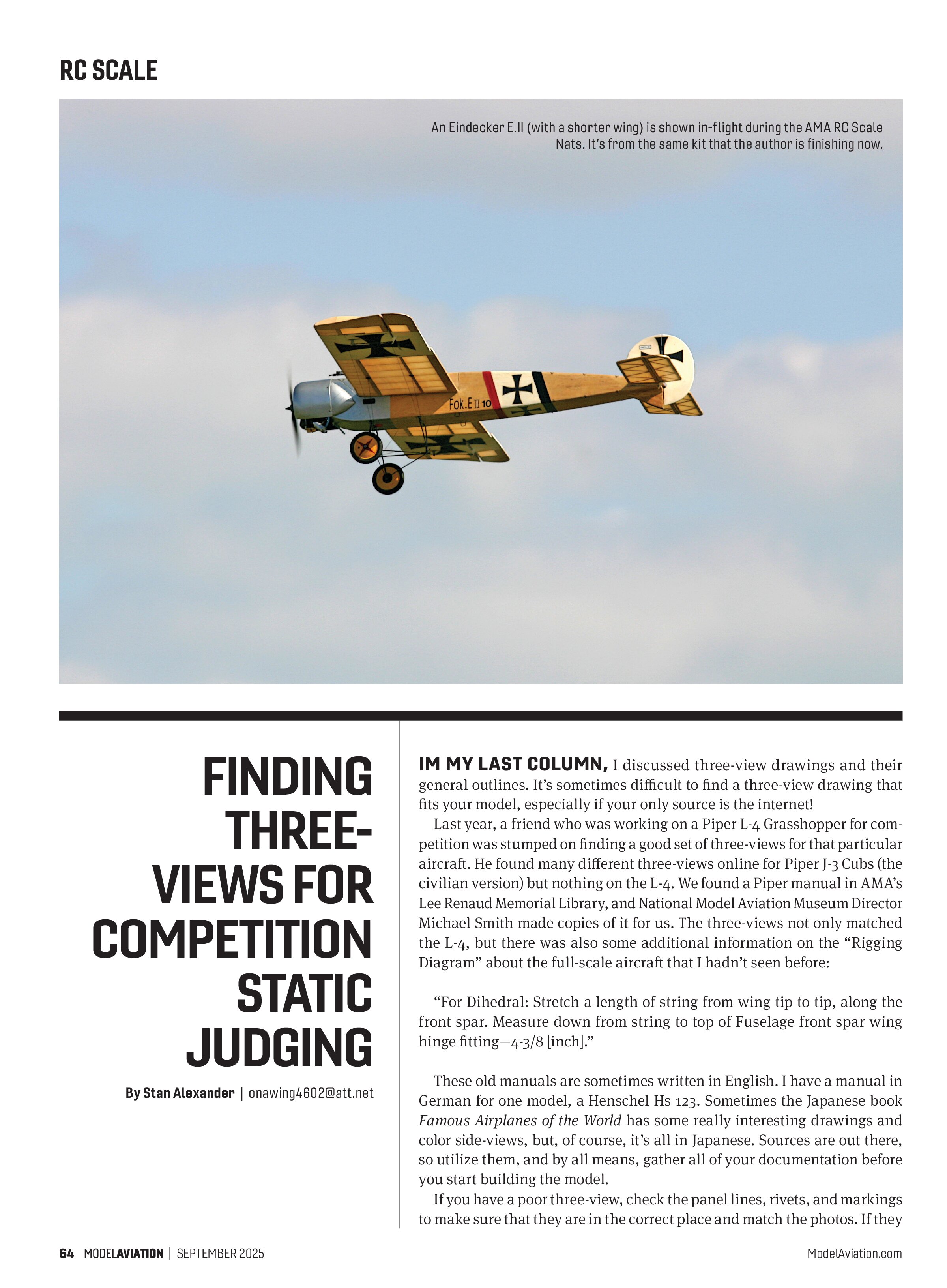
The Eindecker E.III is coming along. Some might be wondering why I selected a model of a 1915 aircraft to build and fly. Well, it’s this simple. One of the first models that I built for Free Flight (FF) was the Sterling Eindecker E.III—back when I didn’t know any better. The finished model didn’t fly well, which was a combination of my lack of experience and some very heavy wood in the kit. It would have been much better as a Control Line Scale model, but it didn’t survive the initial testing phase of the FF attempts!
I’ve always liked this aircraft, and there are many different sizes. Some pilot friends have blown up the Balsa USA plans to 1/3 scale, and some to even larger versions of this aircraft. The original aircraft had wing warping—not ailerons like most of the kits that are available.
At the time of its introduction in late 1915, wing warping was an innovative feature on a “scout” type of aircraft. What really made the aircraft special, however, was that Anthony Fokker’s company introduced the interrupter gear that allowed the Spandau machine gun to fire through the propeller arc without shooting the propeller off. This gave pilots a straight shot to aim at their adversaries in battles.
Most pilots have told me that flying one is much like flying a three-channel model with “aileron assist.” You must use the rudder, especially if the model doesn’t have ailerons.


NASA Scale Classic
The 11th annual National Association of Scale Aeromodelers (NASA) Scale Classic for RC Scale will be held September 12-14 at AMA’s International Aeromodeling Center on the beautiful grass field at Site 4, with the camping area just behind it. All of the camp sites have been updated by AMA, so it should be a great opportunity to enjoy some fall-like weather, competition, and just good fun.
On the West Coast, the NASA West Scale Classic will be held October 10-12 at Mavis Henson Field in Davis, California. Hosted by NASA and the Woodland Davis Aeromodelers, classes will include Expert,


Team, Open Scale, and Pro-Am. Download the AMA Competition Regulations for Radio Control Fixed-Wing Scale and you should be set.
Patterns for Parts and Covering
Another tip for building a model, especially one that is Scale, is making patterns for parts and covering. You can use different materials for patterns, such as paper, cardboard, plastic sheet, or foam. Sometimes you can use different sizes of can or container lids and adapt or modify them to fit your particular use. When I was covering the Eindecker, I made a pattern for the center section of the wing in an airfoil shape that would help with cutting out the particular piece of covering for the sides to obtain a good fit. Patterns or guides also allow you to make multiple parts from the same pattern.
Fair skies and tailwinds.
SOURCES:
Lee Renaud Memorial Library
www.modelaircraft.org/museum/research-collections/lee-renaud-memorial-li...
Balsa USA
(800) 225-7287
https://balsa usa.com
NASA Scale Classic
www.nasascale.org/event/nasa-scale-classic-2025-r-c
NASA West Scale Classic
Jeff Lovitt, contest director
(530) 304-4780
jlovitt@sb cglobal.net
www.nasascale.org/event/n-a-s-a-west-scale-classic-2025-r-c/
AMA Competition Regulations for Radio Control Fixed-Wing Scale
www.modelaircraft.org/sites/default/files/events/rule-books/RC_Fixed-Win...