RC JETS
SMALLER
SPORT JETS
By Jim Hiller | jetmodeler@earthlink.net
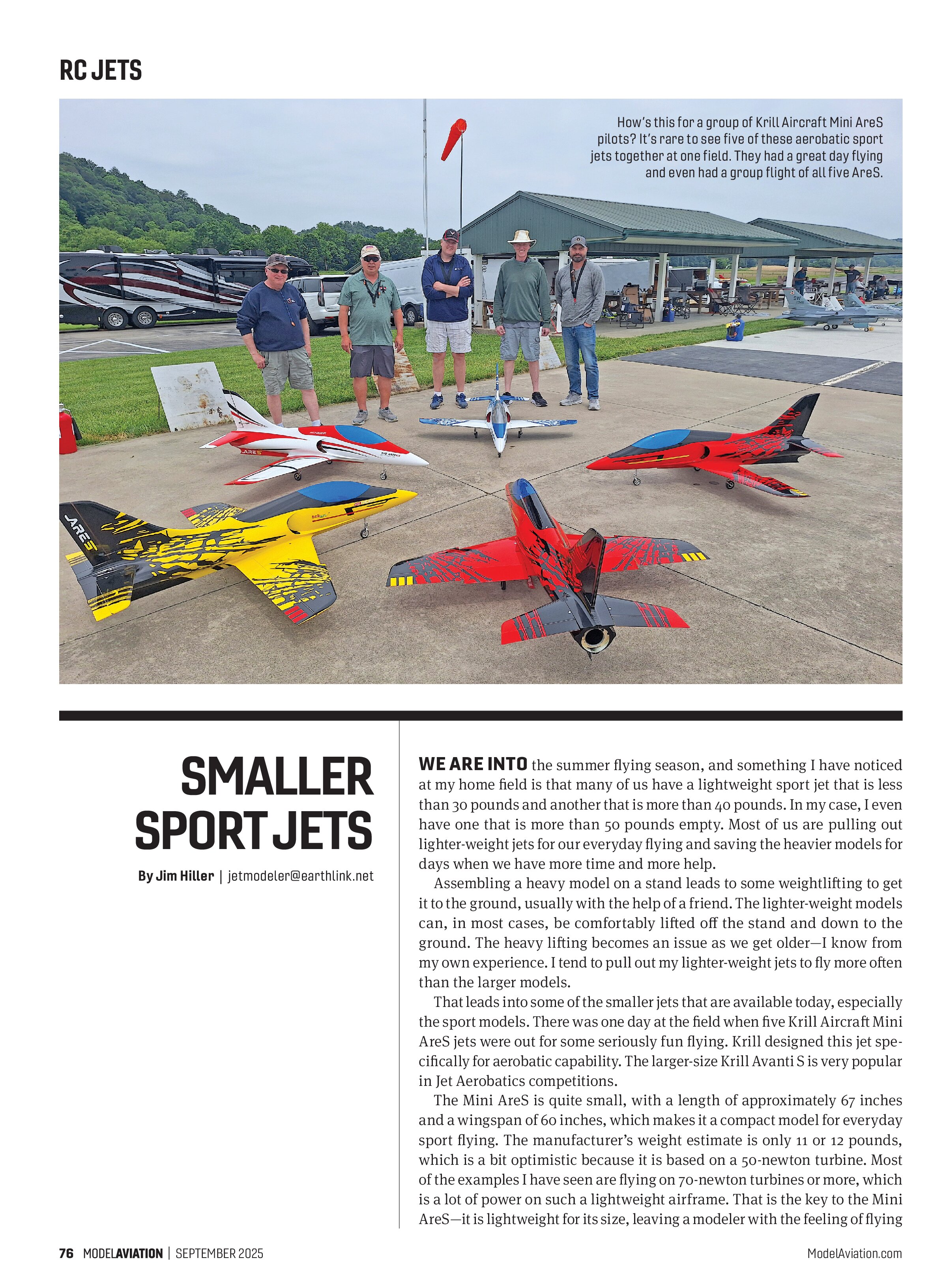
How’s this for a group of Krill Aircraft Mini AreS pilots? It’s rare to see five of these acrobatic sport jets together at one field. They had a great day flying and even had a group flight of all five AreS.
WE ARE INTO the summer flying season, and something I have noticed at my home field is that many of us have a lightweight sport jet that is less than 30 pounds and another that is more than 40 pounds. In my case, I even have one that is more than 50 pounds empty. Most of us are pulling out lighter-weight jets for our everyday flying and saving the heavier models for days when we have more time and more help.
Assembling a heavy model on a stand leads to some weightlifting to get it to the ground, usually with the help of a friend. The lighter-weight models can, in most cases, be comfortably lifted off the stand and down to the ground. The heavy lifting becomes an issue as we get older—I know from my own experience. I tend to pull out my lighter-weight jets to fly more often than the larger models.
That leads into some of the smaller jets that are available today, especially the sport models. There was one day at the field when five Krill Aircraft Mini AreS jets were out for some seriously fun flying. Krill designed this jet specifically for aerobatic capability. The larger-size Krill Avanti S is very popular in Jet Aerobatics competitions.
The Mini AreS is quite small, with a length of approximately 67 inches and a wingspan of 60 inches, which makes it a compact model for everyday sport flying. The manufacturer’s weight estimate is only 11 or 12 pounds, which is a bit optimistic because it is based on a 50-newton turbine. Most of the examples I have seen are flying on 70-newton turbines or more, which is a lot of power on such a lightweight airframe. That is the key to the Mini AreS—it is lightweight for its size, leaving a modeler with the feeling of flying a larger airplane without the high landing speeds of a typical small jet.

The Krill lineup includes various sizes of AreS jets to suit your desired turbine size. The next larger version is the AreS L, a 102-inch-long model with an 86-inch wingspan that is sized for 130-newton to 220-newton turbines. More power is required for 3D thrust-nozzle flying. This again is a rather lightweight model for its size, which has become typical of today’s sport jets.
The largest version of the AreS at this time is the XL. It is almost 130 inches in length with a 106-inch wingspan. In the non-vectored-thrust setup, this model is sized for 200-newton to 250-newton turbines; however, with the 3D vector nozzle, the recommended turbine is up to 400 newtons. It’s a big jet with the need for big power.
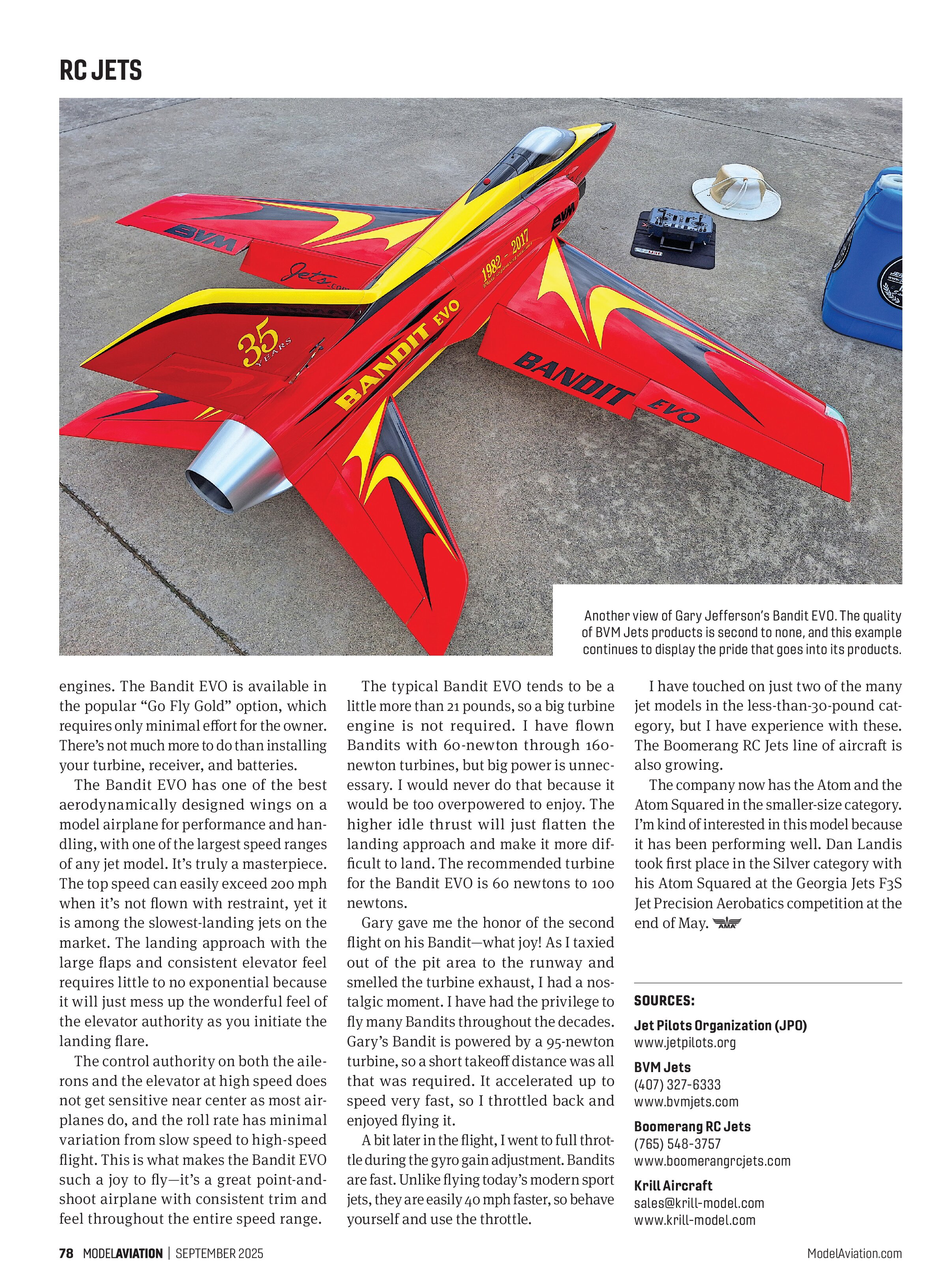
Moving along, longtime jet pilot Gary Jefferson showed up at the field this season with a classic smaller, lighter-weight BVM Bandit EVO jet. The Bandit series of models has been around for a long time and was introduced at about the same time as the first commercially available turbine

Gary Jefferson is the proud owner and pilot of this new BVM Jets Bandit EVO using 95-newton turbine power. With Gary’s experience, this jet is a joy to fly.

engines. The Bandit EVO is available in the popular “Go Fly Gold” option, which requires only minimal effort for the owner. There’s not much more to do than installing your turbine, receiver, and batteries.
The Bandit EVO has one of the best aerodynamically designed wings on a model airplane for performance and handling, with one of the largest speed ranges of any jet model. It’s truly a masterpiece. The top speed can easily exceed 200 mph when it’s not flown with restraint, yet it is among the slowest-landing jets on the market. The landing approach with the large flaps and consistent elevator feel requires little to no exponential because it will just mess up the wonderful feel of the elevator authority as you initiate the landing flare.
The control authority on both the ailerons and the elevator at high speed does not get sensitive near center as most airplanes do, and the roll rate has minimal variation from slow speed to high-speed flight. This is what makes the Bandit EVO such a joy to fly—it’s a great point-and-shoot airplane with consistent trim and feel throughout the entire speed range.
The typical Bandit EVO tends to be a little more than 21 pounds, so a big turbine engine is not required. I have flown Bandits with 60-newton through 160-newton turbines, but big power is unnecessary. I would never do that because it would be too overpowered to enjoy. The higher idle thrust will just flatten the landing approach and make it more difficult to land. The recommended turbine for the Bandit EVO is 60 newtons to 100 newtons.
Gary gave me the honor of the second flight on his Bandit—what joy! As I taxied out of the pit area to the runway and smelled the turbine exhaust, I had a nostalgic moment. I have had the privilege to fly many Bandits throughout the decades. Gary’s Bandit is powered by a 95-newton turbine, so a short takeoff distance was all that was required. It accelerated up to speed very fast, so I throttled back and enjoyed flying it.
A bit later in the flight, I went to full throttle during the gyro gain adjustment. Bandits are fast. Unlike flying today’s modern sport jets, they are easily 40 mph faster, so behave yourself and use the throttle.
I have touched on just two of the many jet models in the less-than-30-pound category, but I have experience with these. The Boomerang RC Jets line of aircraft is also growing.
The company now has the Atom and the Atom Squared in the smaller-size category. I’m kind of interested in this model because it has been performing well. Dan Landis took first place in the Silver category with his Atom Squared at the Georgia Jets F3S Jet Precision Aerobatics competition at the end of May.
SOURCES:
Jet Pilots Organization (JPO)
www.jetpilots.org
BVM Jets
(407) 327-6333
www.bvmjets.com
Boomerang RC Jets
(765) 548-3757
www.boomerangrcjets.com
Krill Aircraft
sales@krill-model.com
www.krill-model.com