RC AEROBATICS
DISTANCE OUT
By Justin Wells | justinwells@mac.com

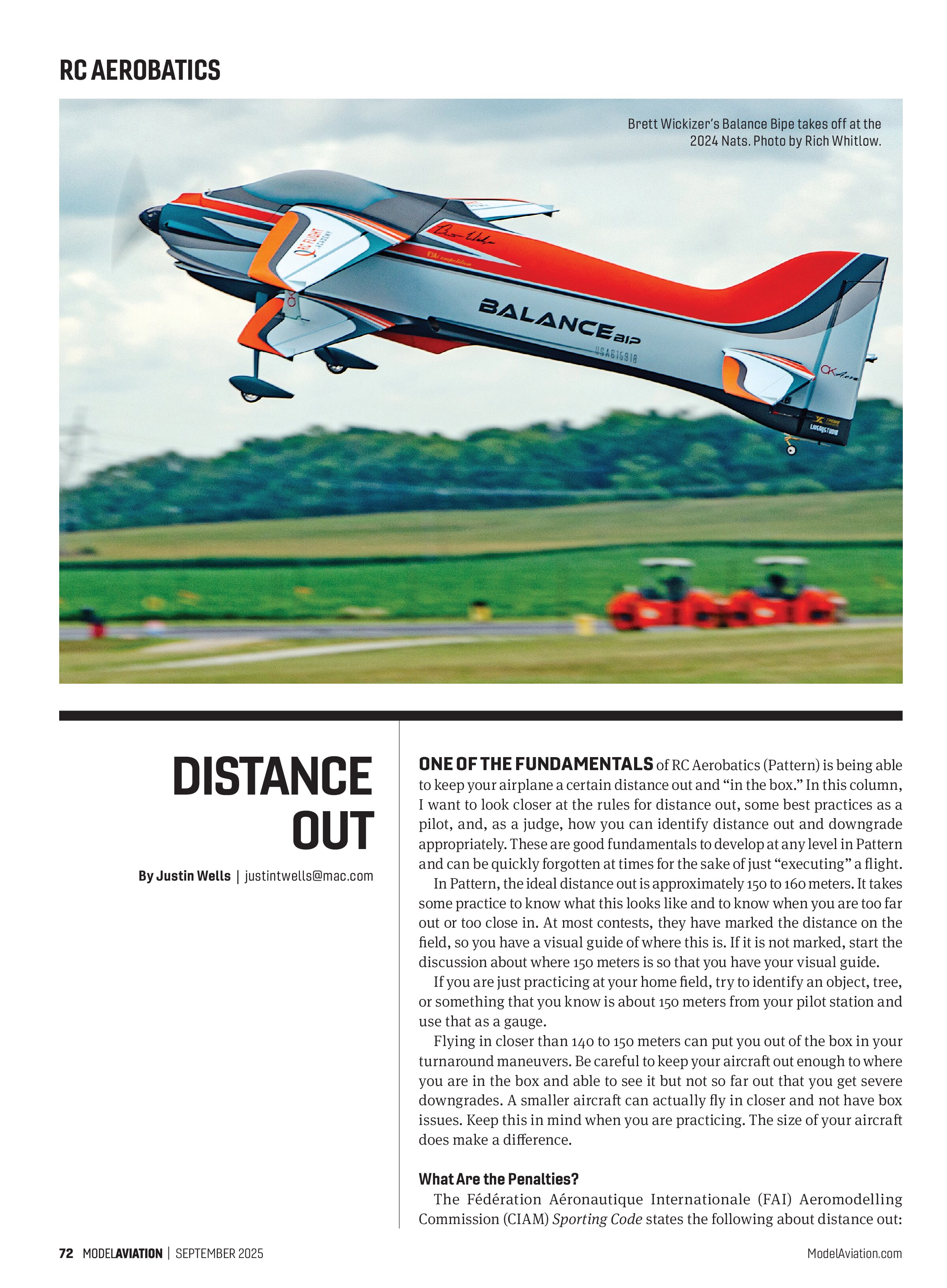
ONE OF THE FUNDAMENTALS of RC Aerobatics (Pattern) is being able to keep your airplane a certain distance out and “in the box.” In this column, I want to look closer at the rules for distance out, some best practices as a pilot, and, as a judge, how you can identify distance out and downgrade appropriately. These are good fundamentals to develop at any level in Pattern and can be quickly forgotten at times for the sake of just “executing” a flight.
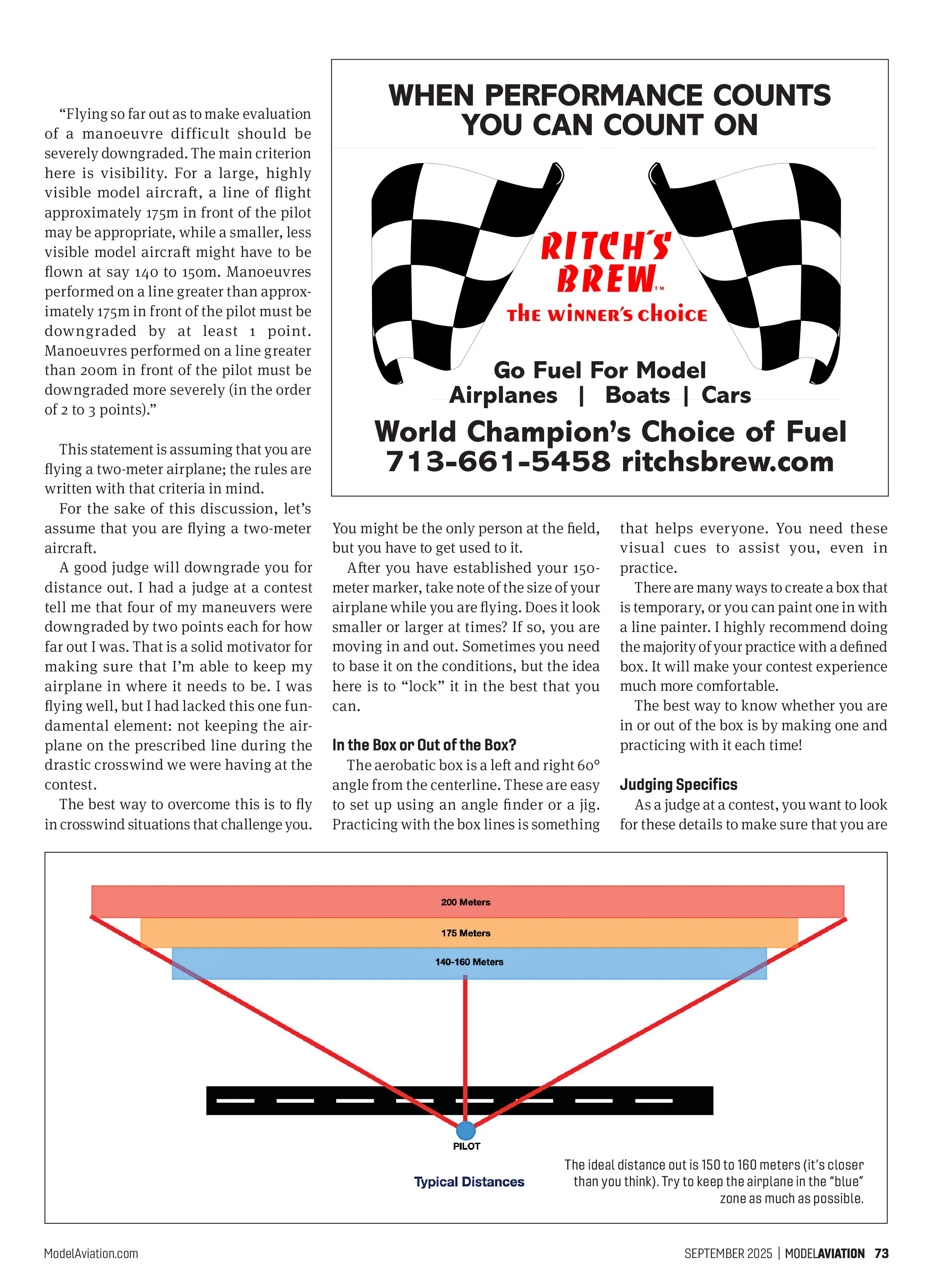
In Pattern, the ideal distance out is approximately 150 to 160 meters. It takes some practice to know what this looks like and to know when you are too far out or too close in. At most contests, they have marked the distance on the field, so you have a visual guide of where this is. If it is not marked, start the discussion about where 150 meters is so that you have your visual guide.
If you are just practicing at your home field, try to identify an object, tree, or something that you know is about 150 meters from your pilot station and use that as a gauge.
Flying in closer than 140 to 150 meters can put you out of the box in your turnaround maneuvers. Be careful to keep your aircraft out enough to where you are in the box and able to see it but not so far out that you get severe downgrades. A smaller aircraft can actually fly in closer and not have box issues. Keep this in mind when you are practicing. The size of your aircraft does make a difference.
What Are the Penalties?
The Fédération Aéronautique Internationale (FAI) Aeromodelling Commission (CIAM) Sporting Code states the following about distance out:
“Flying so far out as to make evaluation of a manoeuvre difficult should be severely downgraded. The main criterion here is visibility. For a large, highly visible model aircraft, a line of flight approximately 175m in front of the pilot may be appropriate, while a smaller, less visible model aircraft might have to be flown at say 140 to 150m. Manoeuvres performed on a line greater than approximately 175m in front of the pilot must be downgraded by at least 1 point. Manoeuvres performed on a line greater than 200m in front of the pilot must be downgraded more severely (in the order of 2 to 3 points).”
This statement is assuming that you are flying a two-meter airplane; the rules are written with that criteria in mind.
For the sake of this discussion, let’s assume that you are flying a two-meter aircraft.
A good judge will downgrade you for distance out. I had a judge at a contest tell me that four of my maneuvers were downgraded by two points each for how far out I was. That is a solid motivator for making sure that I’m able to keep my airplane in where it needs to be. I was flying well, but I had lacked this one fundamental element: not keeping the airplane on the prescribed line during the drastic crosswind we were having at the contest.
The best way to overcome this is to fly in crosswind situations that challenge you.
You might be the only person at the field, but you have to get used to it.
After you have established your 150-meter marker, take note of the size of your airplane while you are flying. Does it look smaller or larger at times? If so, you are moving in and out. Sometimes you need to base it on the conditions, but the idea here is to “lock” it in the best that you can.
In the Box or Out of the Box?
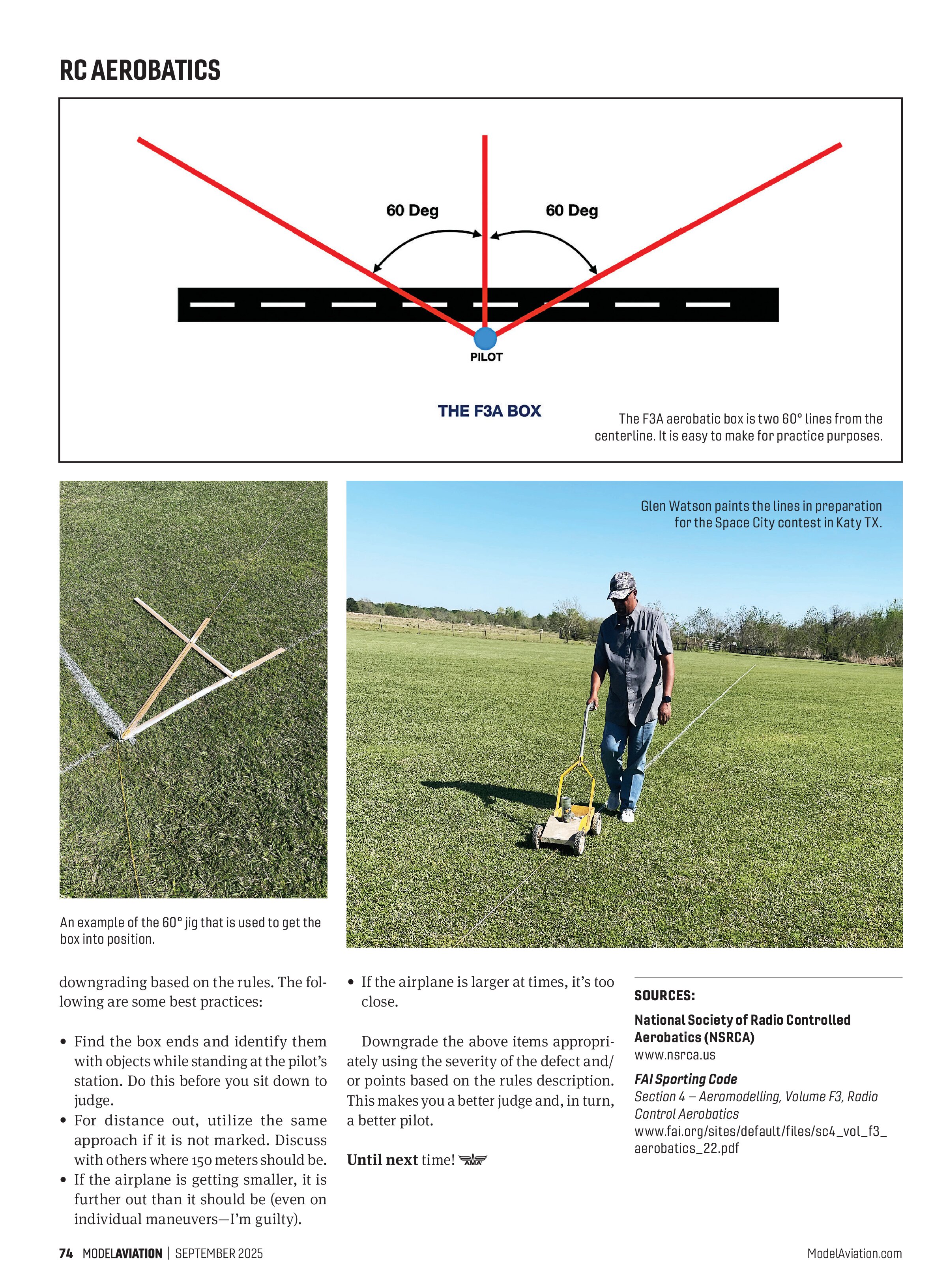
The aerobatic box is a left and right 60° angle from the centerline. These are easy to set up using an angle finder or a jig. Practicing with the box lines is something that helps everyone. You need these visual cues to assist you, even in practice.
There are many ways to create a box that is temporary, or you can paint one in with a line painter. I highly recommend doing the majority of your practice with a defined box. It will make your contest experience much more comfortable.
The best way to know whether you are in or out of the box is by making one and practicing with it each time!
Judging Specifics
As a judge at a contest, you want to look for these details to make sure that you are


downgrading based on the rules. The following are some best practices:
- Find the box ends and identify them with objects while standing at the pilot’s station. Do this before you sit down to judge.
- For distance out, utilize the same approach if it is not marked. Discuss with others where 150 meters should be.
- If the airplane is getting smaller, it is further out than it should be (even on individual maneuvers—I’m guilty).
- If the airplane is larger at times, it’s too close.
Downgrade the above items appropriately using the severity of the defect and/or points based on the rules description. This makes you a better judge and, in turn, a better pilot.
Until next time!
SOURCES:
National Society of Radio Controlled Aerobatics (NSRCA)
www.nsrca.us
FAI Sporting Code
Section 4 – Aeromodelling, Volume F3, Radio Control Aerobatics
www.fai.org/sites/default/files/sc4_vol_f3_aerobatics_22.pdf