FLYING FUN
WITH A UNIQUE
TYPE OF WING
By Tim Bailiff | casurfish@aol.com

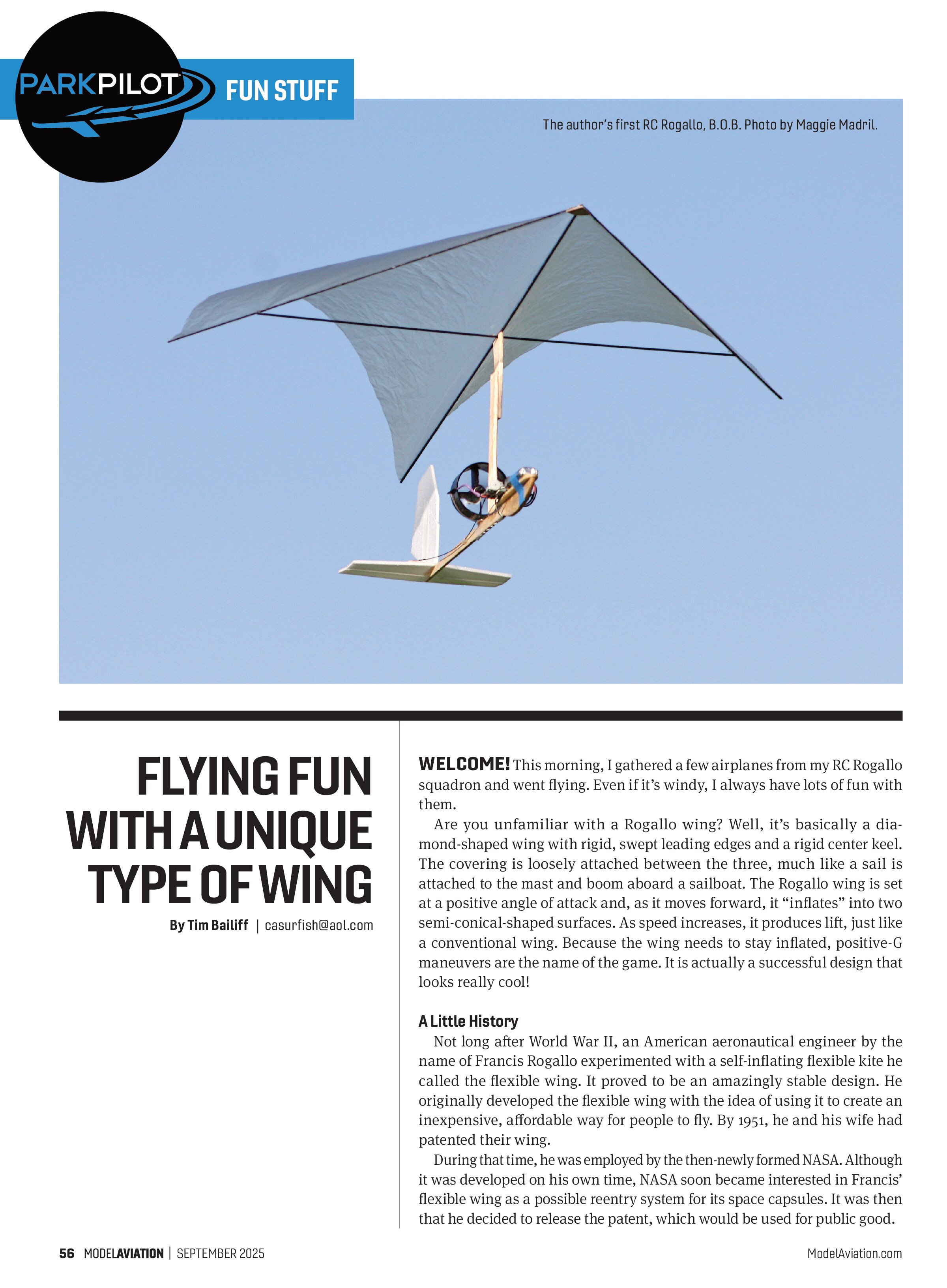
WELCOME! This morning, I gathered a few airplanes from my RC Rogallo squadron and went flying. Even if it’s windy, I always have lots of fun with them.
Are you unfamiliar with a Rogallo wing? Well, it’s basically a diamond-shaped wing with rigid, swept leading edges and a rigid center keel. The covering is loosely attached between the three, much like a sail is attached to the mast and boom aboard a sailboat. The Rogallo wing is set at a positive angle of attack and, as it moves forward, it “inflates” into two semi-conical-shaped surfaces. As speed increases, it produces lift, just like a conventional wing. Because the wing needs to stay inflated, positive-G maneuvers are the name of the game. It is actually a successful design that looks really cool!
A Little History
Not long after World War II, an American aeronautical engineer by the name of Francis Rogallo experimented with a self-inflating flexible kite he called the flexible wing. It proved to be an amazingly stable design. He originally developed the flexible wing with the idea of using it to create an inexpensive, affordable way for people to fly. By 1951, he and his wife had patented their wing.
During that time, he was employed by the then-newly formed NASA. Although it was developed on his own time, NASA soon became interested in Francis’ flexible wing as a possible reentry system for its space capsules. It was then that he decided to release the patent, which would be used for public good.
Although NASA experimented extensively with the idea, it was never employed, and in 1967, the flexible wing project was dropped. However, to this day, because of its predictable flying characteristics, Rogallo variations are used for ultralight aircraft and are the dominant form of hang glider designs.
My Rogallo Journey
My RC Rogallo journey started approximately 20 years ago, as a “proof-of-concept” project. I named my first airplane B.O.B., which is actually an acronym, meaning “Built Out of a Bag.” It was constructed of balsa, with a carbon-fiber-framed wing covered with produce bag material. I used micro-RC components, and after a few modifications and adjustments, I was finally successful. With its small 15-inch wingspan, it flew nicely indoors. Then, one day, I tried flying it outside in a slight breeze and it flew great. It turns out that Rogallos can handle wind really well!


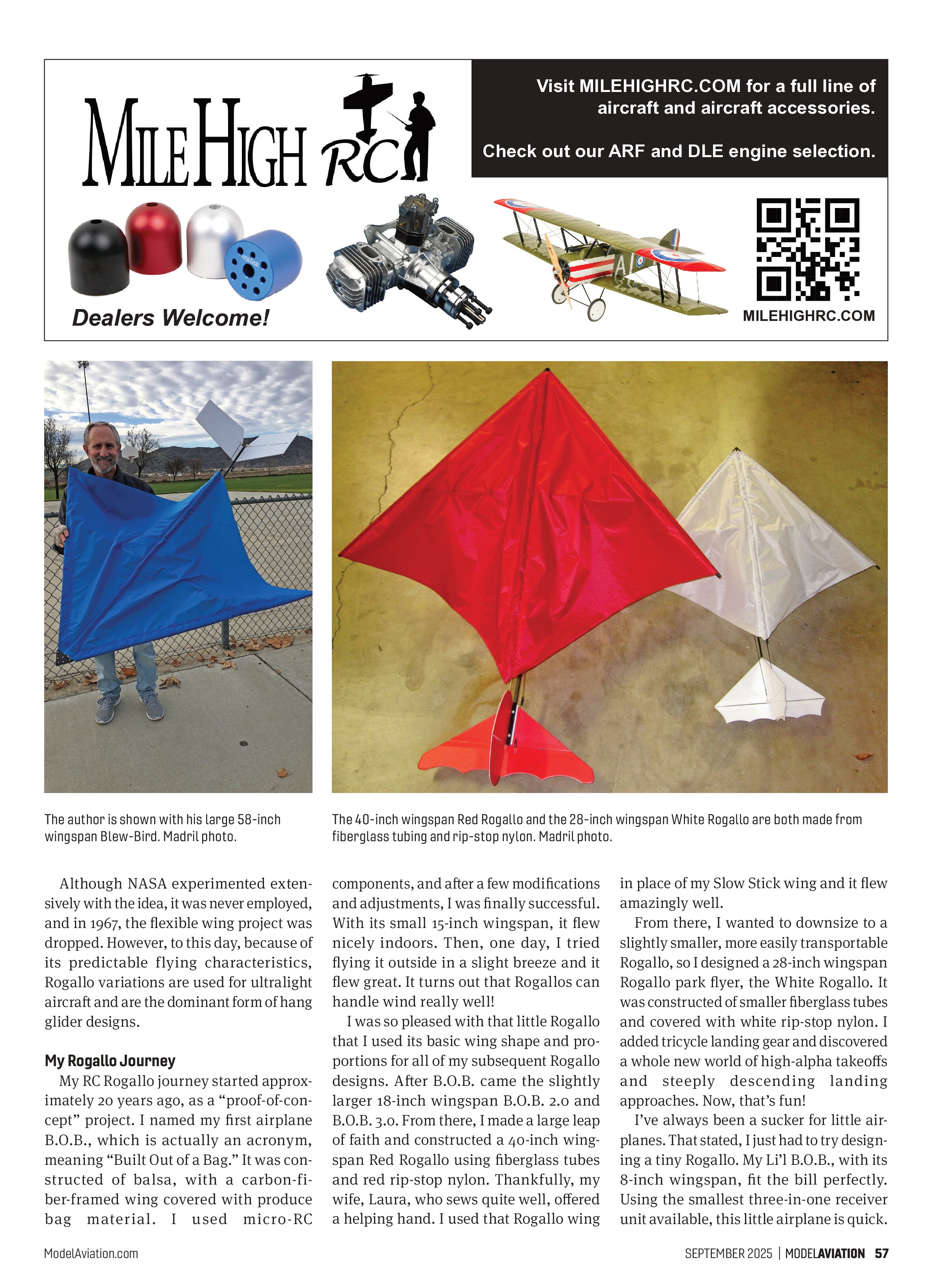
I was so pleased with that little Rogallo that I used its basic wing shape and proportions for all of my subsequent Rogallo designs. After B.O.B. came the slightly larger 18-inch wingspan B.O.B. 2.0 and B.O.B. 3.0. From there, I made a large leap of faith and constructed a 40-inch wingspan Red Rogallo using fiberglass tubes and red rip-stop nylon. Thankfully, my wife, Laura, who sews quite well, offered a helping hand. I used that Rogallo wing in place of my Slow Stick wing and it flew amazingly well.
From there, I wanted to downsize to a slightly smaller, more easily transportable Rogallo, so I designed a 28-inch wingspan Rogallo park flyer, the White Rogallo. It was constructed of smaller fiberglass tubes and covered with white rip-stop nylon. I added tricycle landing gear and discovered a whole new world of high-alpha takeoffs and steeply descending landing approaches. Now, that’s fun!
I’ve always been a sucker for little airplanes. That stated, I just had to try designing a tiny Rogallo. My Li’l B.O.B., with its 8-inch wingspan, fit the bill perfectly. Using the smallest three-in-one receiver unit available, this little airplane is quick.
FUN STUFF


It definitely flies faster than my other indoor Rogallos, yet it retains all of the stable flying characteristics of its bigger siblings. It is loads of fun and very maneuverable. It flies great outdoors as well, but because it’s covered with almost-transparent produce bag material, I really have to keep it in close!
Did I mention replacing an E-flite Vapor’s damaged wing with a Rogallo wing? Well, that was a fun project and resulted in a terrific indoor slow flyer. Talk about a stable-flying airplane!
Newer Rogallos
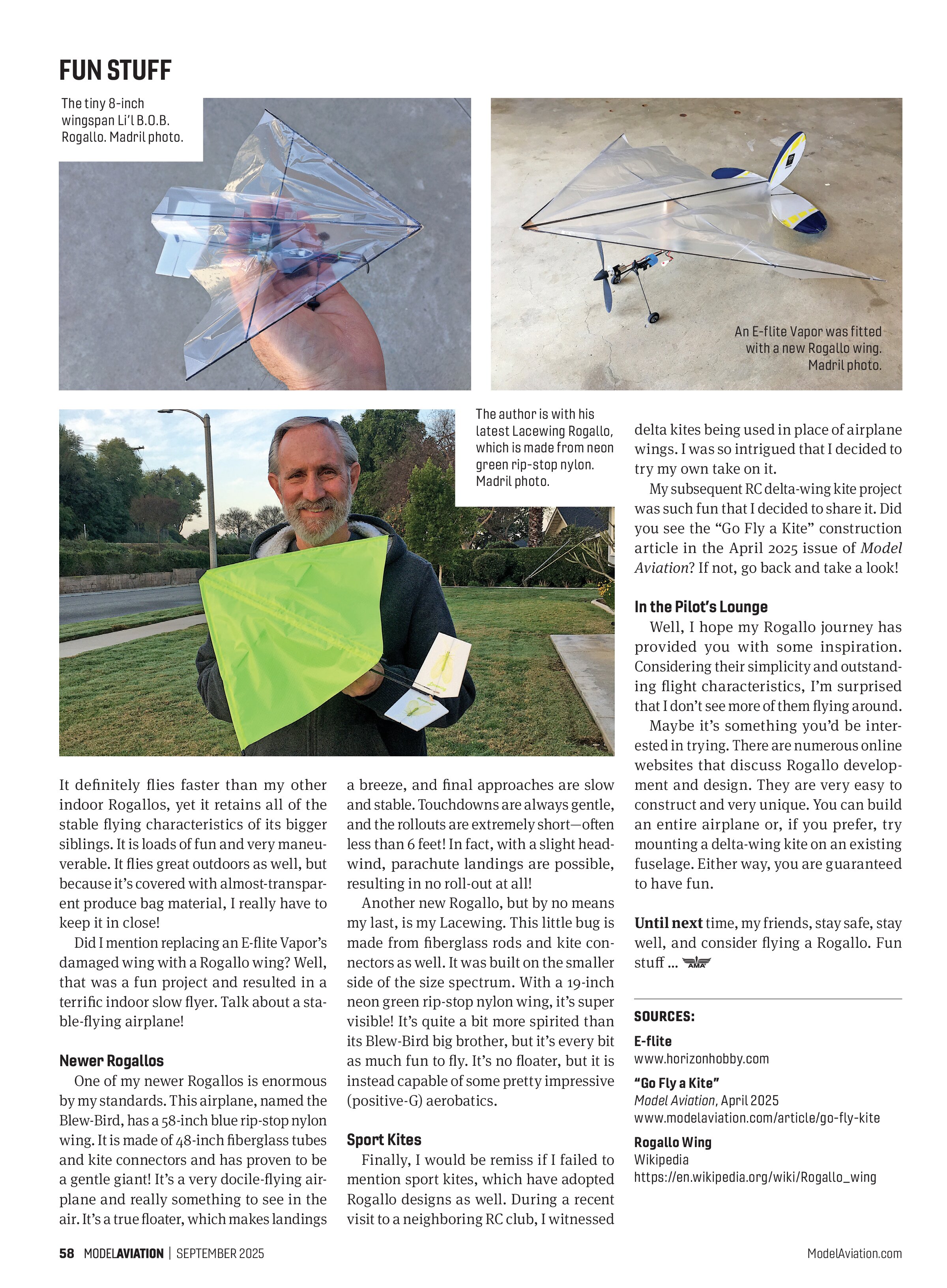
One of my newer Rogallos is enormous by my standards. This airplane, named the Blew-Bird, has a 58-inch blue rip-stop nylon wing. It is made of 48-inch fiberglass tubes and kite connectors and has proven to be a gentle giant! It’s a very docile-flying airplane and really something to see in the air. It’s a true floater, which makes landings a breeze, and final approaches are slow and stable. Touchdowns are always gentle, and the rollouts are extremely short—often less than 6 feet! In fact, with a slight headwind, parachute landings are possible, resulting in no roll-out at all!
Another new Rogallo, but by no means my last, is my Lacewing. This little bug is made from fiberglass rods and kite connectors as well. It was built on the smaller side of the size spectrum. With a 19-inch neon green rip-stop nylon wing, it’s super visible! It’s quite a bit more spirited than its Blew-Bird big brother, but it’s every bit as much fun to fly. It’s no floater, but it is instead capable of some pretty impressive (positive-G) aerobatics.
Sport Kites
Finally, I would be remiss if I failed to mention sport kites, which have adopted Rogallo designs as well. During a recent visit to a neighboring RC club, I witnessed delta kites being used in place of airplane wings. I was so intrigued that I decided to try my own take on it.
My subsequent RC delta-wing kite project was such fun that I decided to share it. Did you see the “Go Fly a Kite” construction article in the April 2025 issue of Model Aviation? If not, go back and take a look!
In the Pilot’s Lounge
Well, I hope my Rogallo journey has provided you with some inspiration. Considering their simplicity and outstanding flight characteristics, I’m surprised that I don’t see more of them flying around.
Maybe it’s something you’d be interested in trying. There are numerous online websites that discuss Rogallo development and design. They are very easy to construct and very unique. You can build an entire airplane or, if you prefer, try mounting a delta-wing kite on an existing fuselage. Either way, you are guaranteed to have fun.
Until next time, my friends, stay safe, stay well, and consider flying a Rogallo. Fun stuff ...
SOURCES:
E-flite
www.horizonhobby.com
“Go Fly a Kite”
Model Aviation, April 2025
www.modelaviation.com/article/go-fly-kite
Rogallo Wing
Wikipedia
https://en.wikipedia.org/wiki/Rogallo_wing