FOCAL POINT
Interested in sharing your handiwork? Visit www.ModelAviation.com for submission guidelines.
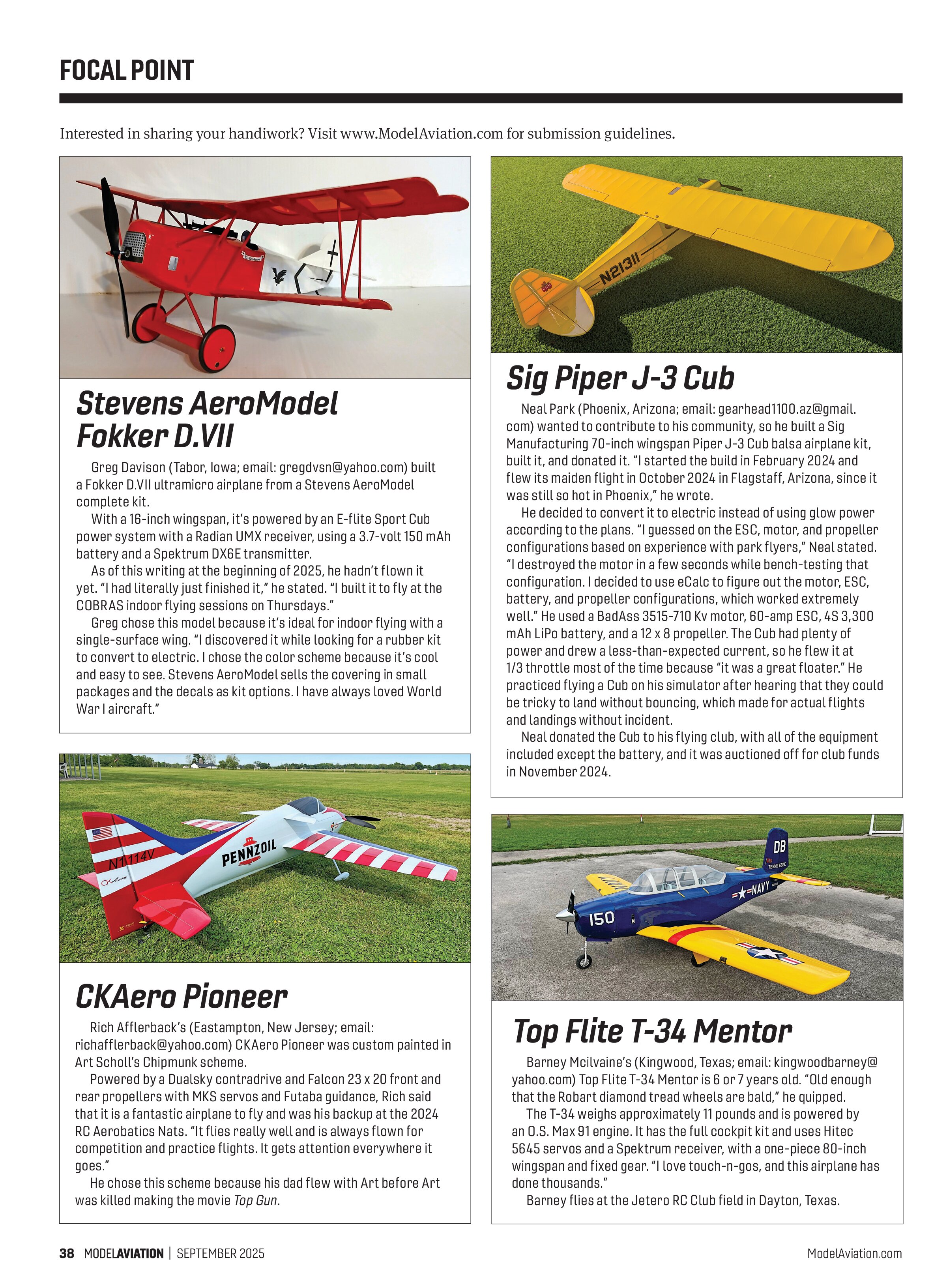
Stevens AeroModel
Fokker D.VII
Greg Davison (Tabor, Iowa; email: gregdv sn@yahoo.com) built a Fokker D.VII ultramicro airplane from a Stevens AeroModel complete kit.
With a 16-inch wingspan, it’s powered by an E-flite Sport Cub power system with a Radian UMX receiver, using a 3.7-volt 150 mAh battery and a Spektrum DX6E transmitter.
As of this writing at the beginning of 2025, he hadn’t flown it yet. “I had literally just finished it,” he stated. “I built it to fly at the COBRAS indoor flying sessions on Thursdays.”
Greg chose this model because it’s ideal for indoor flying with a single-surface wing. “I discovered it while looking for a rubber kit to convert to electric. I chose the color scheme because it’s cool and easy to see. Stevens AeroModel sells the covering in small packages and the decals as kit options. I have always loved World War I aircraft.”

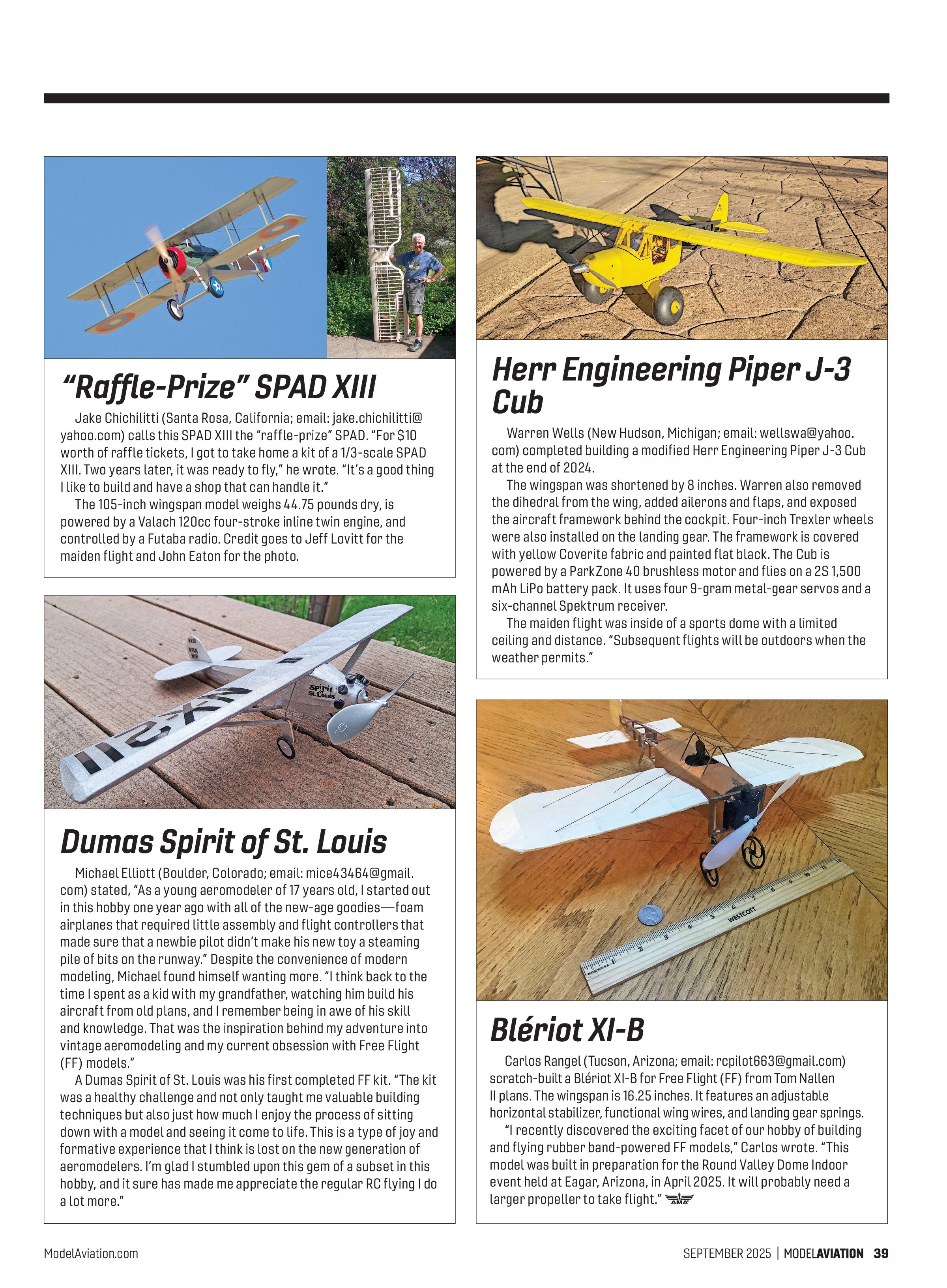
CKAero Pioneer
Rich Afflerback’s (Eastampton, New Jersey; email: richafflerback@yahoo.com) CKAero Pioneer was custom painted in Art Scholl’s Chipmunk scheme.
Powered by a Dualsky contradrive and Falcon 23 x 20 front and rear propellers with MKS servos and Futaba guidance, Rich said that it is a fantastic airplane to fly and was his backup at the 2024 RC Aerobatics Nats. “It flies really well and is always flown for competition and practice flights. It gets attention everywhere it goes.”
He chose this scheme because his dad flew with Art before Art was killed making the movie Top Gun.

“Raffle-Prize” SPAD XIII
Jake Chichilitti (Santa Rosa, California; email: jake.chichilitti@yahoo.com) calls this SPAD XIII the “raffle-prize” SPAD. “For $10 worth of raffle tickets, I got to take home a kit of a 1/3-scale SPAD XIII. Two years later, it was ready to fly,” he wrote. “It’s a good thing I like to build and have a shop that can handle it.”
The 105-inch wingspan model weighs 44.75 pounds dry, is powered by a Valach 120cc four-stroke inline twin engine, and controlled by a Futaba radio. Credit goes to Jeff Lovitt for the maiden flight and John Eaton for the photo.

Dumas Spirit of St. Louis
Michael Elliott (Boulder, Colorado; email: mice43464@gmail.com) stated, “As a young aeromodeler of 17 years old, I started out in this hobby one year ago with all of the new-age goodies—foam airplanes that required little assembly and flight controllers that made sure that a newbie pilot didn’t make his new toy a steaming pile of bits on the runway.” Despite the convenience of modern modeling, Michael found himself wanting more. “I think back to the time I spent as a kid with my grandfather, watching him build his aircraft from old plans, and I remember being in awe of his skill and knowledge. That was the inspiration behind my adventure into vintage aeromodeling and my current obsession with Free Flight (FF) models.”
A Dumas Spirit of St. Louis was his first completed FF kit. “The kit was a healthy challenge and not only taught me valuable building techniques but also just how much I enjoy the process of sitting down with a model and seeing it come to life. This is a type of joy and formative experience that I think is lost on the new generation of aeromodelers. I’m glad I stumbled upon this gem of a subset in this hobby, and it sure has made me appreciate the regular RC flying I do a lot more.”

Sig Piper J-3 Cub
Neal Park (Phoenix, Arizona; email: gearhead1100.az@gmail.com) wanted to contribute to his community, so he built a Sig Manufacturing 70-inch wingspan Piper J-3 Cub balsa airplane kit, built it, and donated it. “I started the build in February 2024 and flew its maiden flight in October 2024 in Flagstaff, Arizona, since it was still so hot in Phoenix,” he wrote.
He decided to convert it to electric instead of using glow power according to the plans. “I guessed on the ESC, motor, and propeller configurations based on experience with park flyers,” Neal stated. “I destroyed the motor in a few seconds while bench-testing that configuration. I decided to use Ecalc to figure out the motor, ESC, battery, and propeller configurations, which worked extremely well.” He used a BadAss 3515-710 Kv motor, 60-amp ESC, 4S 3,300 mAh LiPo battery, and a 12 x 8 propeller. The Cub had plenty of power and drew a less-than-expected current, so he flew it at 1/3 throttle most of the time because “it was a great floater.” He practiced flying a Cub on his simulator after hearing that they could be tricky to land without bouncing, which made for actual flights and landings without incident.
Neal donated the Cub to his flying club, with all of the equipment included except the battery, and it was auctioned off for club funds in November 2024.
Top Flite T-34 Mentor
Barney McIlvaine’s (Kingwood, Texas; email: kingwoodbarney@yahoo.com) Top Flite T-34 Mentor is 6 or 7 years old. “Old enough that the Robart diamond tread wheels are bald,” he quipped.
The T-34 weighs approximately 11 pounds and is powered by an O.S. Max 91 engine. It has the full cockpit kit and uses Hitec 5645 servos and a Spektrum receiver, with a one-piece 80-inch wingspan and fixed gear. “I love touch-n-gos, and this airplane has done thousands.”
Barney flies at the Jetero RC Club field in Dayton, Texas.
Herr Engineering Piper J-3 Cub
Warren Wells (New Hudson, Michigan; email: wellswa@yahoo.com) completed building a modified Herr Engineering Piper J-3 Cub at the end of 2024.
The wingspan was shortened by 8 inches. Warren also removed the dihedral from the wing, added ailerons and flaps, and exposed the aircraft framework behind the cockpit. Four-inch Trexler wheels were also installed on the landing gear. The framework is covered with yellow Coverite fabric and painted flat black. The Cub is powered by a ParkZone 40 brushless motor and flies on a 2S 1,500 mAh LiPo battery pack. It uses four 9-gram metal-gear servos and a six-channel Spektrum receiver.
The maiden flight was inside a sports dome with a limited ceiling and distance. “Subsequent flights will be outdoors when the weather permits.”
Blériot XI-B
Carlos Rangel (Tucson, Arizona; email: rcpilot663@gmail.com) scratch-built a Blériot XI-B for Free Flight (FF) from Tom Nallen II plans. The wingspan is 16.25 inches. It features an adjustable horizontal stabilizer, functional wing wires, and landing gear springs.
“I recently discovered the exciting facet of our hobby of building and flying rubber band-powered FF models,” Carlos wrote. “This model was built in preparation for the Round Valley Dome Indoor event held at Eagar, Arizona, in April 2025. It will probably need a larger propeller to take flight.”