AROUND THE PATCH

DESIGN STRATEGIES AND BUILDING TECHNIQUES
By Thayer Syme | thayer@flying-models.com
A FEW FRIENDS and I have had a number of discussions recently about basic design strategies and building techniques for our balsa models. These conversations have covered a lot of ground and have gotten me thinking about this very deep rabbit hole.
While it is impossible to cover in a single column, I do plan to discuss some basic building information going forward. Toward that end, I have saved quite a few notes for potential topics of interest and plan to include periodic building tidbits in future columns. By all means, let me know if you have any specific questions that you would like to have answered.
To get started this month, I offer a few thoughts about that most basic of tools, the workbench—or, more specifically in our case, the building board used to hold balsa structures in alignment while gluing them together.
The primary concerns for a proper building board are that it is flat, stable, and accommodates a practical method of securing parts throughout each stage of construction.
The Door
My first workbench was topped by a standard 32 x 80 hollow-core door that was procured during an after-school visit to our small town hardware store. After explaining what I wanted and why, I was offered a door with some minor corner damage. I never found out whether that was reason enough to prevent its sale to a “real” customer or simply, as I now suspect, that a local civic leader was offering a little support for my budding hobby. What I do know for sure is that I was all too happy to hand over my three crisp dollar bills and take the door off their hands.
I initially used that door as a bare work surface, although it didn’t really take pins well. I soon acquired a drywall offcut and laid that flat on the door.
The drywall actually worked well. It was much smoother than the unfinished door face, flexed less, and more readily accepted pins. I used it for a few years before moving on to a ceiling tile that was moisture-stained and missing a corner. But the price was right! That upgrade was a freebie, scrounged from my high school janitor.
Ceiling Tiles to the Rescue!
Ceiling tiles have been a favored building surface for decades. They are lightweight, readily accept pins, and are very affordable, even if your high school days are well-faded memories. They do have a few disadvantages though.
They measure 2 x 4 feet, which might be a limiting factor for larger projects. They also warp easily if they are stored propped up against a wall between projects and are susceptible to hangar rash.
Years later, I purchased another ceiling tile and wrapped its edges with a layer of duct tape. That tile served well for nearly 10 years before a cross-country move forced its retirement.
Balsa
Balsa building boards are another option, although they are not as prevalent as in years past. Guillows has offered a premium building board made from end-grain balsa wood. This surface readily accepts pins and is somewhat self-healing. The Guillows website showed it as out of stock as I wrote this in June—hopefully that is a temporary situation. It has a strong reputation among those who have one. Unfortunately, the price is significantly higher than a ceiling tile, which reflects the current demand for balsa.
Glass
At other times, a piece of a 1/4-inch tempered plate glass building surface has graced my workbench. I normally use glass when building smaller models, where even minor warps must be prevented.
Plate glass is obviously very smooth and flat, and you can protect your plans by laying it under the glass. While plate glass does not accept pins, I have successfully used small drops of CA, a light glue stick swipe, or simply tape, to secure parts on glass. Completed components are easily freed with a single-edged razor blade.
A glue stick or 3M 77 Spray Adhesive will also secure a freshly printed plans copy to the top surface of the glass. This all but guarantees that the plans will be as flat as possible and avoids any parallax concerns that can be induced when the plans are below the glass. This does require protecting the plans from excess glue, which is commonly accomplished with an overlay of waxed paper or parchment.
Foam Board
Foam board is also a suitable building surface, especially at times when portability is a significant concern. Readily available pink or blue extruded polystyrene foam (XPS) insulation works well. Do note that XPS sheets can have a bit of a bow. This is not a dealbreaker if you know to look for it.
I’ve never had much luck using beaded foam or a sheet of foam core. I don’t love the former’s beaded texture, and the latter is often far from flat. On top of that, it is most commonly available in thin sheets that don’t hold pins well.
The Magnet: King of the Workbench?
Now to my current favorite: A sheet of steel with a fist full of magnets to replace conventional pins.
At least a couple of variants of magnetic building boards have been offered commercially, typically with a wide range of accessories that are “stuck” to the building plate. I’ve had a great time dreaming up new magnetic fixtures, although I also use a lot of plain rare earth magnets to hold pieces in place.
Magnetic building systems are decidedly more expensive than even a pristine ceiling tile on the kitchen table, but many feel that they are well worth the investment. While I don’t feel magnetic building systems are any more precise than building with pins, they do offer a couple of significant advantages for my building process.
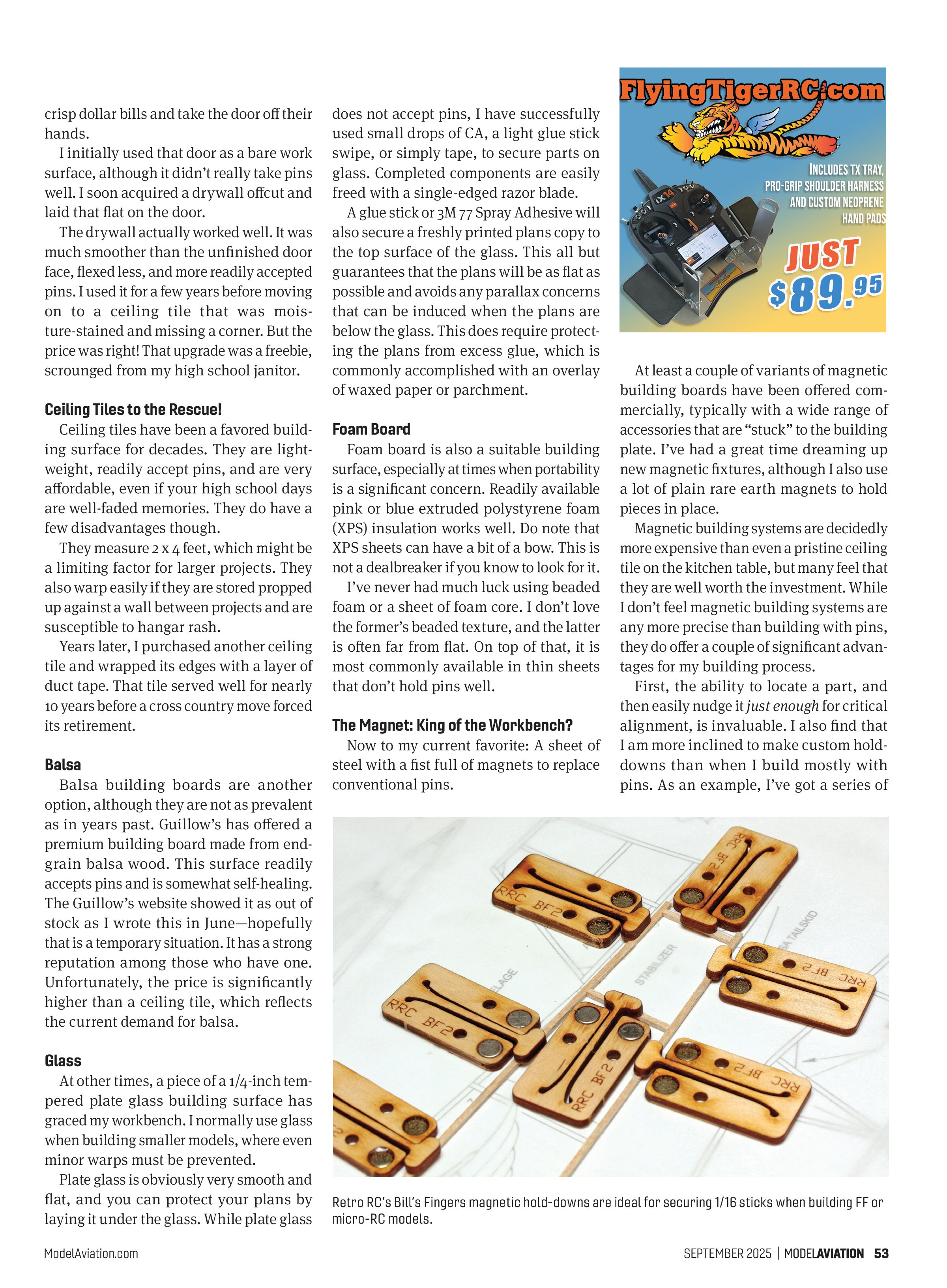
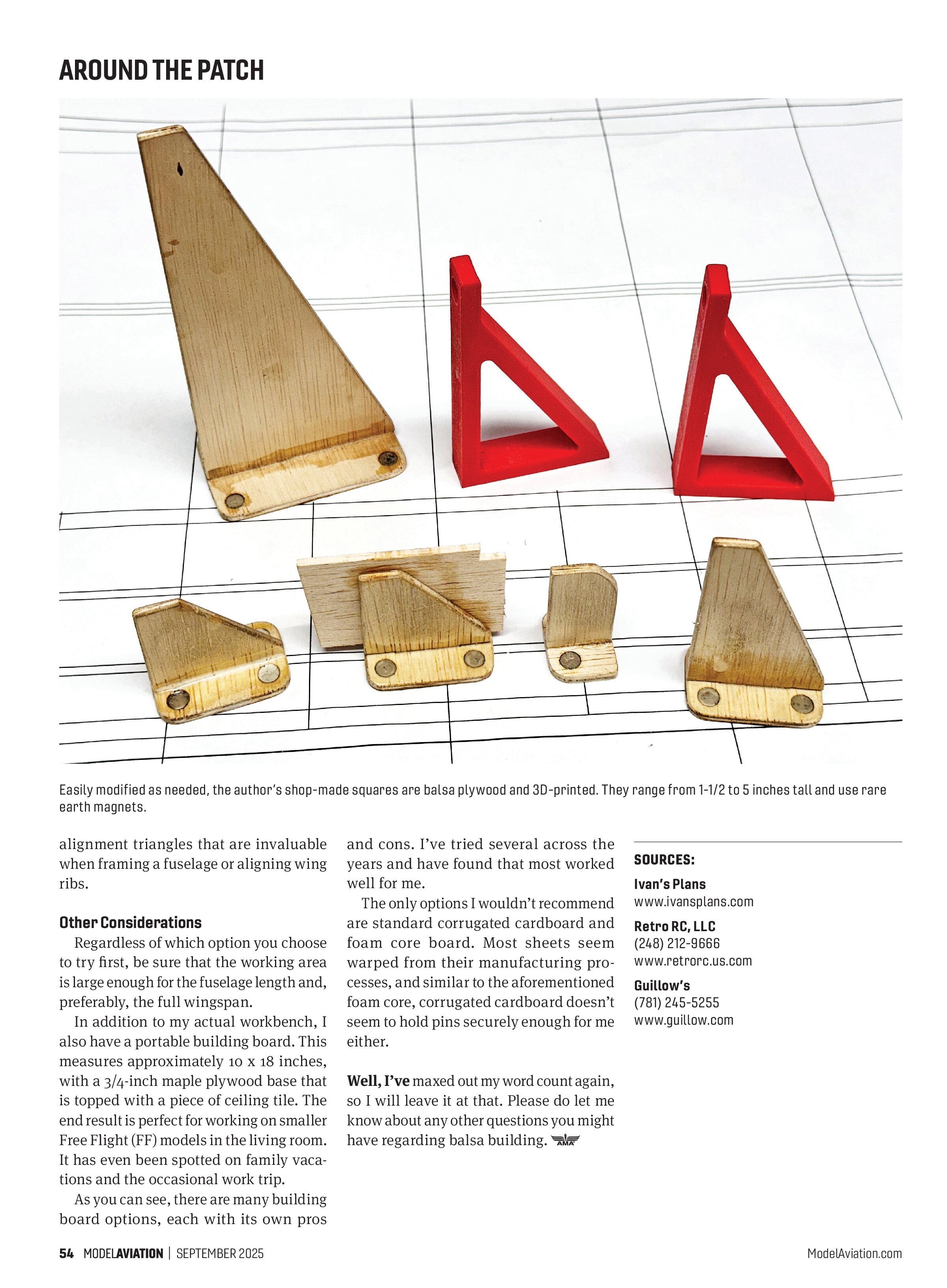
First, the ability to locate a part, and then easily nudge it just enough for critical alignment, is invaluable. I also find that I am more inclined to make custom hold-downs than when I build mostly with pins. As an example, I’ve got a series of

crisp dollar bills and take the door off their hands.
I initially used that door as a bare work surface, although it didn’t really take pins well. I soon acquired a drywall offcut and laid that flat on the door.
Retro RC’s Bill’s Fingers magnetic hold-downs are ideal for securing 1/16 sticks when building FF or micro-RC models.

alignment triangles that are invaluable when framing a fuselage or aligning wing ribs.
Other Considerations
Regardless of which option you choose to try first, be sure that the working area is large enough for the fuselage length and, preferably, the full wingspan.
In addition to my actual workbench, I also have a portable building board. This measures approximately 10 x 18 inches, with a 3/4-inch maple plywood base that is topped with a piece of ceiling tile. The end result is perfect for working on smaller Free Flight (FF) models in the living room. It has even been spotted on family vacations and the occasional work trip.
As you can see, there are many building board options, each with its own pros and cons. I’ve tried several across the years and have found that most worked well for me.
The only options I wouldn’t recommend are standard corrugated cardboard and foam core board. Most sheets seem warped from their manufacturing processes, and similar to the aforementioned foam core, corrugated cardboard doesn’t seem to hold pins securely enough for me either.
Well, I’ve maxed out my word count again, so I will leave it at that. Please do let me know about any other questions you might have regarding balsa building.
SOURCES:
Ivan’s Plans
www.ivansplans.com
Retro RC, LLC
(248) 212-9666
www.retrorc.us.com
Guillow’s
(781) 545-5255
www.guillow.com