ADVANCED FLIGHT TECHNOLOGIES
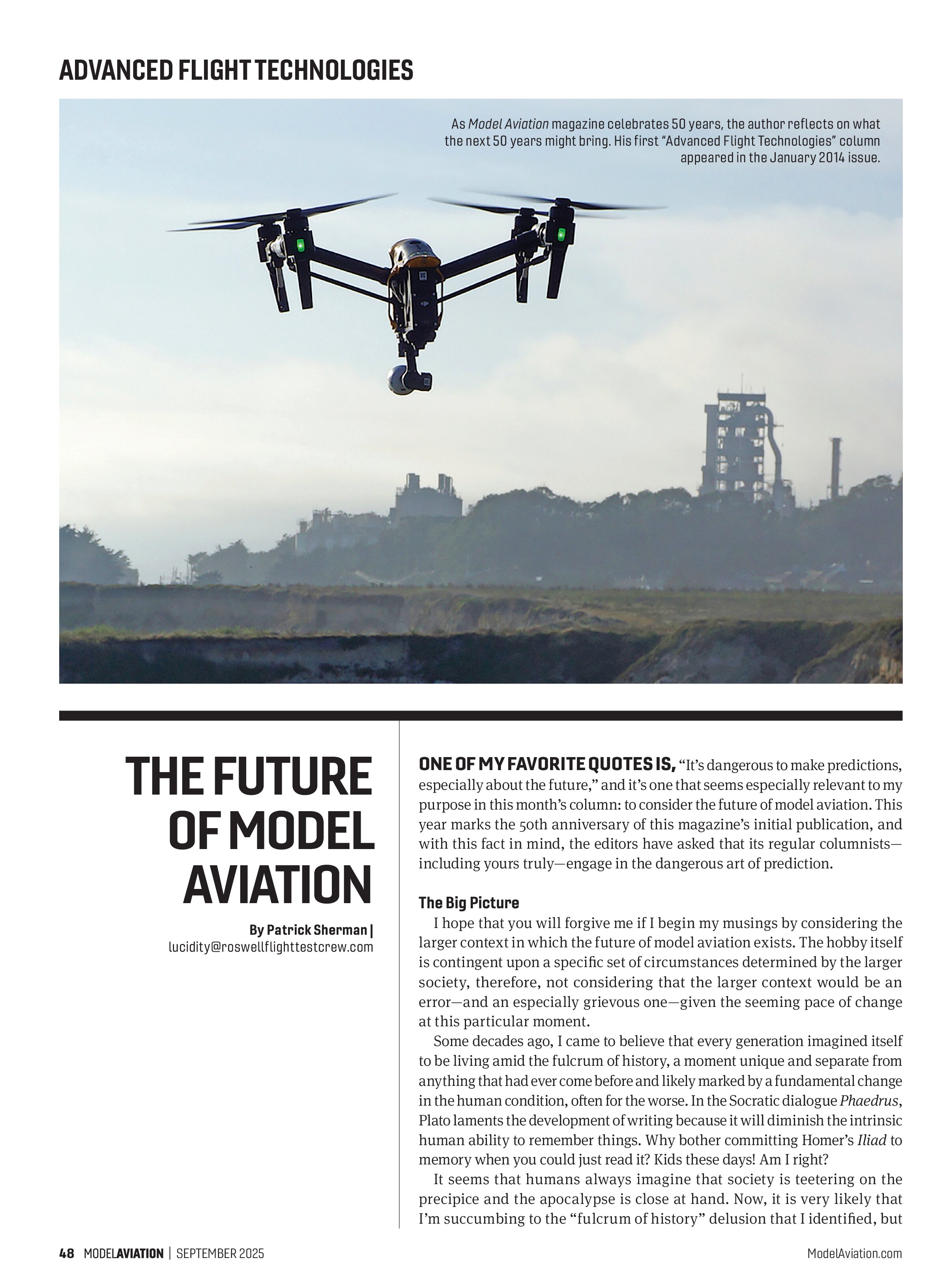
As Model Aviation magazine celebrates 50 years, the author reflects on what the next 50 years might bring. His first “Advanced Flight Technologies” column appeared in the January 2014 issue.
THE FUTURE
OF MODEL
AVIATION
By Patrick Sherman
lucidity@roswellflighttestcrew.com
ONE OF MY FAVORITE QUOTES IS, “It’s dangerous to make predictions, especially about the future,” and it’s one that seems especially relevant to my purpose in this month’s column: to consider the future of model aviation. This year marks the 50th anniversary of this magazine’s initial publication, and with this fact in mind, the editors have asked that its regular columnists—including yours truly—engage in the dangerous art of prediction.
The Big Picture
I hope that you will forgive me if I begin my musings by considering the larger context in which the future of model aviation exists. The hobby itself is contingent upon a specific set of circumstances determined by the larger society, therefore, not considering that the larger context would be an error—and an especially grievous one—given the seeming pace of change at this particular moment.
Some decades ago, I came to believe that every generation imagined itself to be living amid the fulcrum of history, a moment unique and separate from anything that had ever come before and likely marked by a fundamental change in the human condition, often for the worse. In the Socratic dialogue Phaedrus, Plato laments the development of writing because it will diminish the intrinsic human ability to remember things. Why bother committing Homer’s Iliad to memory when you could just read it? Kids these days! Am I right?
It seems that humans always imagine that society is teetering on the precipice and the apocalypse is close at hand. Now, it is very likely that I’m succumbing to the “fulcrum of history” delusion that I identified, but

it does seem like a lot of cultural and technological strands are being woven together these days at a pace never seen before, with the potential for unpredictable outcomes.
Science fiction author, entrepreneur, and futurist Raymond Kurzweil noted that there seems to be a moment that always causes our imagined futures to break down—a moment that no prophet or pundit can see beyond—and, therefore, one that they typically choose to ignore. Imagine the Starship Enterprise in all of its iterations. Setting aside its phasers, warp drive, and the computational resources that would be required to support them, its main computer interface is scarcely more capable than Amazon’s Alexa.
Raymond believes that it is inevitable that computer power will eventually surpass and far exceed the capabilities of the human mind and begin and launch into an exponential growth curve, and that what happens beyond this point is fundamentally unknowable. He refers to this moment as “the singularity.”
Of all of our great science fiction authors, in my estimation, only Frank Herbert has managed to weave a compelling vision of the distant future simply because he derailed the singularity (although he would not have been familiar with the term, even as he presaged the idea behind it) by introducing the concept of the Butlerian Jihad. However, unlike Frank, Raymond is an optimist and believes that we will merge with our own creation as immortal, hyper-intelligent beings who live in technological eutopia. By the way, he thinks that all of this will happen on or in approximately 2045, so maybe keep your calendar clear.
My fundamental point is this: If we are godlike entities with only ancestral memories of a flesh-and-blood world, living in a synthetic reality known as the Matrix to serve as a power source for our computer overlords, or hiding from Terminators in subway tunnels and storm drains, then flying model airplanes isn’t likely to be very high on our to-do list.
I don’t view any of these scenarios as particularly likely; however, it also seems perilous to make any prediction about what will be happening 50 years from now without at least considering the possibility that we are finally, at long last, living in the fulcrum of history.
The Professionals
As I have written numerous times throughout the years in this column, the advent of small, civilian UAS technology—otherwise known as drones—has created a new paradigm that would have been unthinkable only 20 years ago: professional remote pilots.
There are more and more people each year who go out every day and earn a good living by manipulating a pair of joysticks on a handheld controller, guiding the movement of an RC aircraft through the sky. Heck, I’m a professor at Embry-Riddle Aeronautical University who teaches the people who go out and get those jobs. Talk about future shock!
The point is that while model aviation hasn’t become the industry of the future, remote piloting certainly has—and the two share an awful lot in common. When I was invited to start writing for Model Aviation more than a decade ago (my goodness!), there was considerable animosity between the UAS community and traditional aeromodelers. The aeromodelers feared that
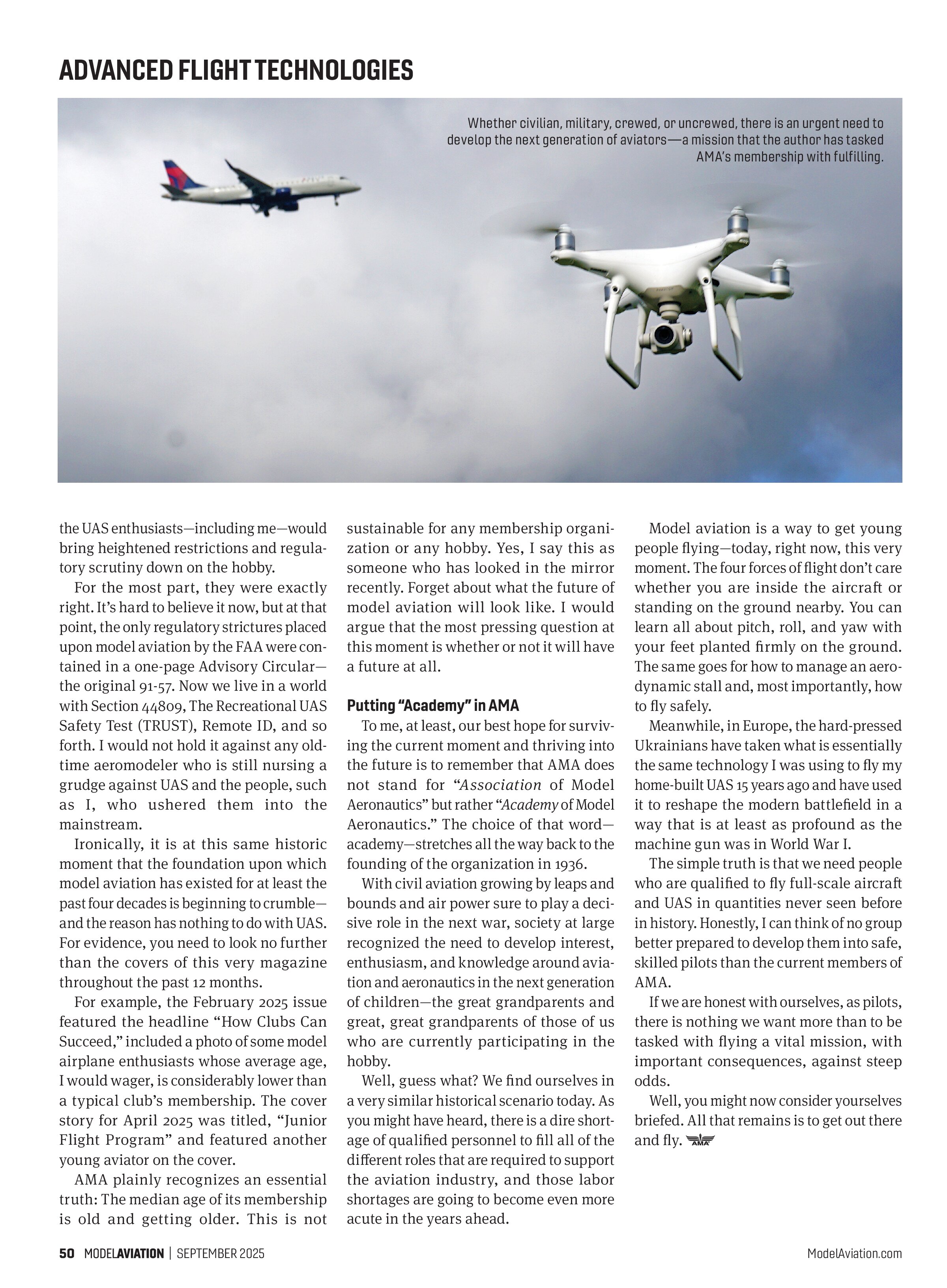
Whether civilian, military, crewed, or uncrewed, there is an urgent need to develop the next generation of aviators—a mission that the author has tasked AMA’s membership with fulfilling.

the UAS enthusiasts—including me—would bring heightened restrictions and regulatory scrutiny down on the hobby.
For the most part, they were exactly right. It’s hard to believe it now, but at that point, the only regulatory strictures placed upon model aviation by the FAA were contained in a one-page Advisory Circular—the original 91-57. Now we live in a world with Section 44809, The Recreational UAS Safety Test (TRUST), Remote ID, and so forth. I would not hold it against any old-time aeromodeler who is still nursing a grudge against UAS and the people, such as I, who ushered them into the mainstream.
Ironically, it is at this same historic moment that the foundation upon which model aviation has existed for at least the past four decades is beginning to crumble—and the reason has nothing to do with UAS. For evidence, you need to look no further than the covers of this very magazine throughout the past 12 months.
For example, the February 2025 issue featured the headline “How Clubs Can Succeed,” included a photo of some model airplane enthusiasts whose average age, I would wager, is considerably lower than a typical club’s membership. The cover story for April 2025 was titled, “Junior Flight Program” and featured another young aviator on the cover.
AMA plainly recognizes an essential truth: The median age of its membership is old and getting older. This is not sustainable for any membership organization or any hobby. Yes, I say this as someone who has looked in the mirror recently. Forget about what the future of model aviation will look like. I would argue that the most pressing question at this moment is whether or not it will have a future at all.
Putting “Academy” in AMA
To me, at least, our best hope for surviving the current moment and thriving into the future is to remember that AMA does not stand for “Association of Model Aeronautics” but rather “Academy of Model Aeronautics.” The choice of that word—academy—stretches all the way back to the founding of the organization in 1936.
With civil aviation growing by leaps and bounds and air power sure to play a decisive role in the next war, society at large recognized the need to develop interest, enthusiasm, and knowledge around aviation and aeronautics in the next generation of children—the great grandparents and great, great grandparents of those of us who are currently participating in the hobby.
Well, guess what? We find ourselves in a very similar historical scenario today. As you might have heard, there is a dire shortage of qualified personnel to fill all of the different roles that are required to support the aviation industry, and those labor shortages are going to become even more acute in the years ahead.
Model aviation is a way to get young people flying—today, right now, this very moment. The four forces of flight don’t care whether you are inside the aircraft or standing on the ground nearby. You can learn all about pitch, roll, and yaw with your feet planted firmly on the ground. The same goes for how to manage an aerodynamic stall and, most importantly, how to fly safely.
Meanwhile, in Europe, the hard-pressed Ukrainians have taken what is essentially the same technology I was using to fly my home-built UAS 15 years ago and have used it to reshape the modern battlefield in a way that is at least as profound as the machine gun was in World War I.
The simple truth is that we need people who are qualified to fly full-scale aircraft and UAS in quantities never seen before in history. Honestly, I can think of no group better prepared to develop them into safe, skilled pilots than the current members of AMA.
If we are honest with ourselves, as pilots, there is nothing we want more than to be tasked with flying a vital mission, with important consequences, against steep odds.
Well, you might now consider yourselves briefed. All that remains is to get out there and fly.