MODELS OF
FULL-SCALE
AIRPLANES
By Pat Tritle | patscustommodels@gmail.com

ALTHOUGH I’M NOT a licensed pilot, full-scale aviation has always played a big part in my modeling endeavors. Being a huge fan of the civilian two-seater aircraft, small airports have been a great source to me for researching various projects throughout the years. I’ve also met a number of full-scale pilots and, as a result, I have managed to hitch a ride or two in various types of classic, old airplanes—not the least of which were the Ryan PT-22 and Pietenpol Air Camper. I also believe that the more you know about full-scale airplanes and how they’re built, the better the model you can build.
In the late 1980s to early ’90s, I was working on a series of 1:32-scale scratch-built, plastic models and found the full-scale airplane owners of those that I was modeling to be extremely helpful. They were more than happy to allow access to their airplanes to be used as references for the projects and, more often than not, they included some airtime as well.
One in particular was Stan Johnson, the former owner of Hobbies-N-Stuff, which was the best hobby shop that I’ve ever set foot in. When Stan closed up shop, one of his goals was to earn his private pilot’s license and, if possible, to own his own airplane at some point. After earning his wings in a Cessna 170 and doing time in a few other types, I’m happy to say that Stan has achieved both of those goals.
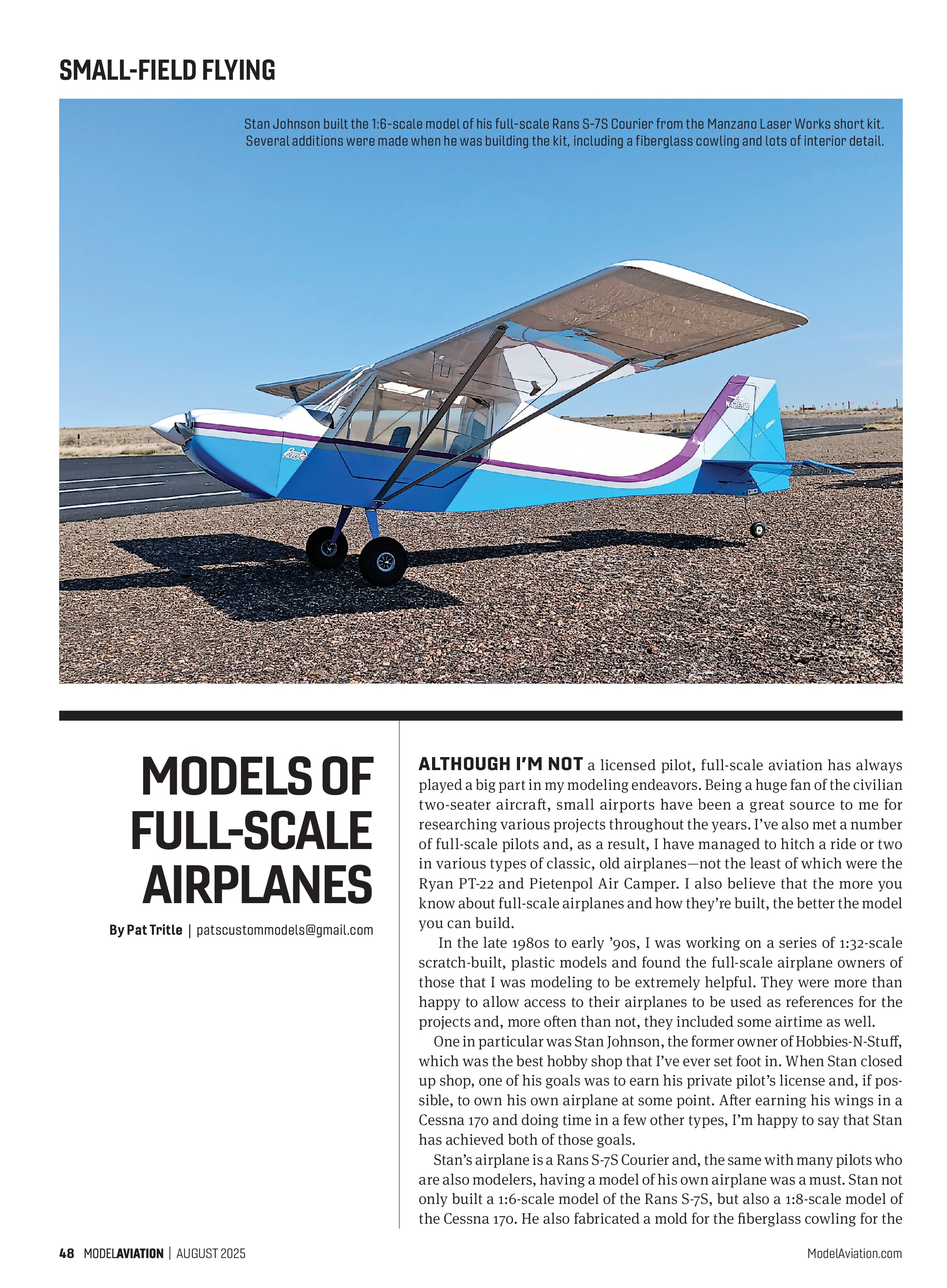
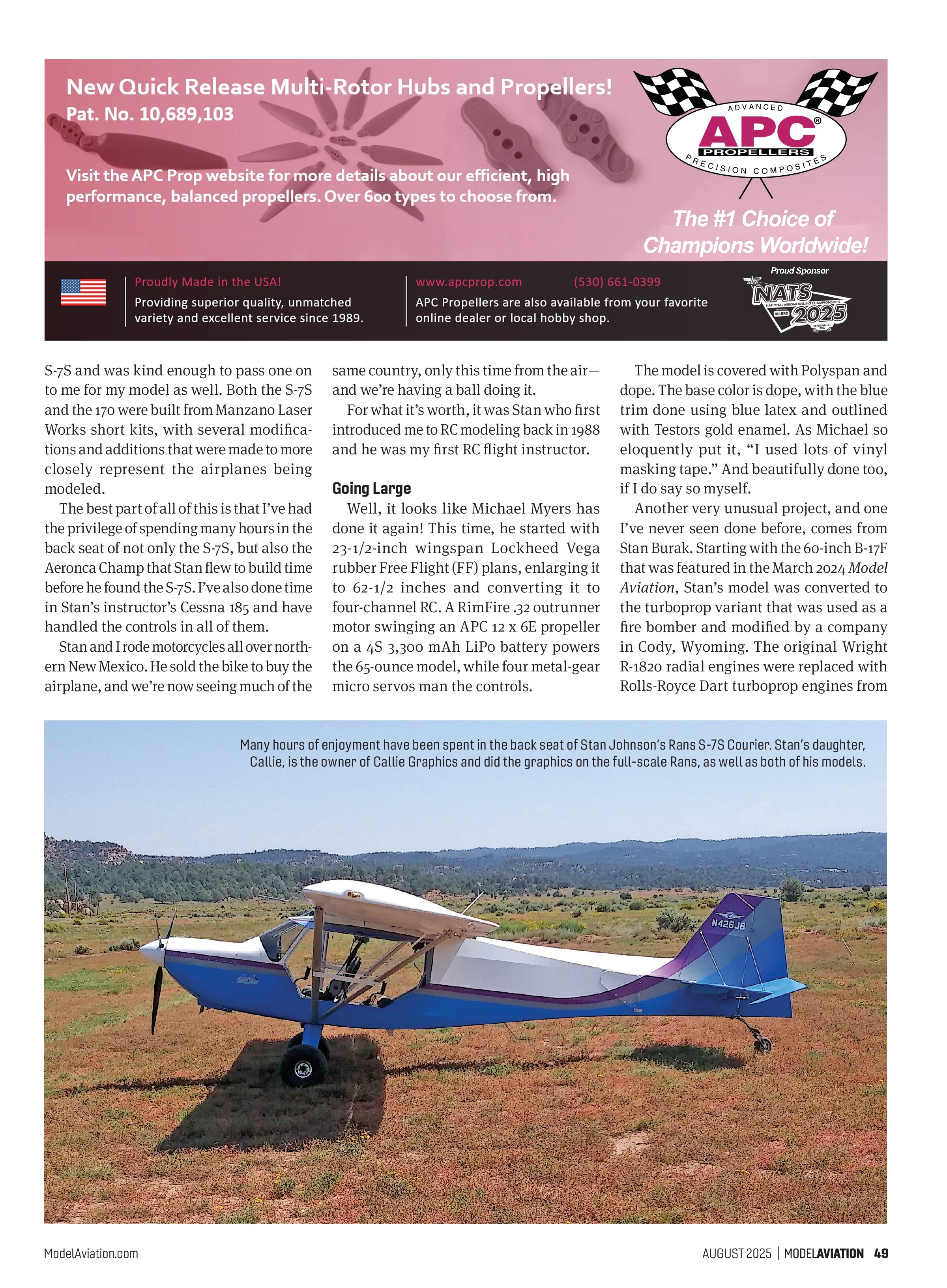
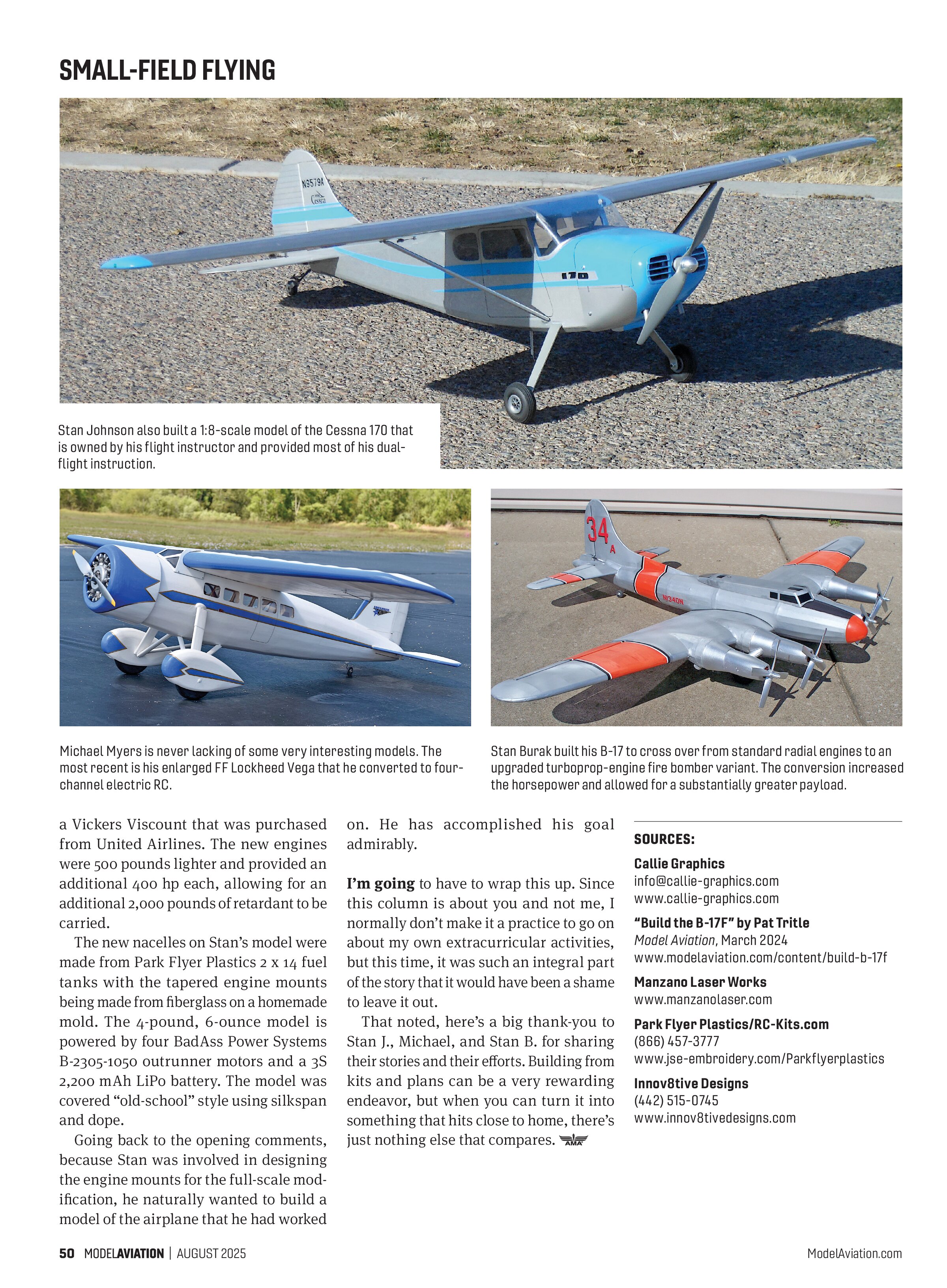
Stan’s airplane is a Rans S-7S Courier and, the same with many pilots who are also modelers, having a model of his own airplane was a must. Stan not only built a 1:6-scale model of the Rans S-7S, but also a 1:8-scale model of the Cessna 170. He also fabricated a mold for the fiberglass cowling for the S-7S and was kind enough to pass one on to me for my model as well. Both the S-7S and the 170 were built from Manzano Laser Works short kits, with several modifications and additions that were made to more closely represent the airplanes being modeled.
The best part of all of this is that I’ve had the privilege of spending many hours in the back seat of not only the S-7S, but also the Aeronca Champ that Stan flew to build time before he found the S-7S. I’ve also done time in Stan’s instructor’s Cessna 185 and have handled the controls in all of them.
Stan and I rode motorcycles all over northern New Mexico. He sold the bike to buy the airplane, and we’re now seeing much of the same country, only this time from the air—and we’re having a ball doing it.
For what it’s worth, it was Stan who first introduced me to RC modeling back in 1988 and he was my first RC flight instructor.
Going Large
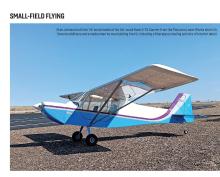
Well, it looks like Michael Myers has done it again! This time, he started with 23-1/2-inch wingspan Lockheed Vega rubber Free Flight (FF) plans, enlarging it to 62-1/2 inches and converting it to four-channel RC. A RimFire .32 outrunner motor swinging an APC 12 x 6E propeller on a 4S 3,300 mAh LiPo battery powers the 65-ounce model, while four metal-gear micro servos man the controls.
The model is covered with Polyspan and dope. The base color is dope, with the blue trim done using blue latex and outlined with Testors gold enamel. As Michael so eloquently put it, “I used lots of vinyl masking tape.” And beautifully done too, if I do say so myself.
Another very unusual project, and one I’ve never seen done before, comes from Stan Burak. Starting with the 60-inch B-17F that was featured in the March 2024 Model Aviation, Stan’s model was converted to the turboprop variant that was used as a fire bomber and modified by a company in Cody, Wyoming. The original Wright R-1820 radial engines were replaced with Rolls-Royce Dart turboprop engines from


a Vickers Viscount that was purchased from United Airlines. The new engines were 500 pounds lighter and provided an additional 400 hp each, allowing for an additional 2,000 pounds of retardant to be carried.
The new nacelles on Stan’s model were made from Park Flyer Plastics 2 x ¼ fuel tanks with the tapered engine mounts being made from fiberglass on a homemade mold. The 4-pound, 6-ounce model is powered by four BadAss Power Systems B-2305-1050 outrunner motors and a 3S 2,200 mAh LiPo battery. The model was covered “old-school” style using silkspan and dope.
Going back to the opening comments, because Stan was involved in designing the engine mounts for the full-scale modification, he naturally wanted to build a model of the airplane that he had worked
on. He has accomplished his goal admirably.
I’m going to have to wrap this up. Since this column is about you and not me, I normally don’t make it a practice to go on about my own extracurricular activities, but this time, it was such an integral part of the story that it would have been a shame to leave it out.
That noted, here’s a big thank-you to Stan J., Michael, and Stan B. for sharing their stories and their efforts. Building from kits and plans can be a very rewarding endeavor, but when you can turn it into something that hits close to home, there’s just nothing else that compares.
SOURCES:
Callie Graphics
info@callie-graphics.com
www.callie-graphics.com
“Build the B-17F” by Pat Tritle
Model Aviation, March 2024
www.modelaviation.com/content/build-b-17f
Manzano Laser Works
www.manzanolaser.com
Park Flyer Plastics/RC-Kits.com
(866) 457-3777
www.jse-embroidery.com/Parkflyerplastics
Innov8tive Designs
(442) 515-0745
www.innov8tivedesigns.com