RC SCALE AEROBATICS

PREPARING FOR IMAC COMPETITION
By John Glezellis | jglezellis@gmail.com
PREPARATION FOR the serious International Miniature Aerobatic Club (IMAC) competitor can take many forms. For example, you not only must be prepared to be able to fly a given routine and have a firm understanding of the rule book and of an aircraft that is built in a structurally sound manner that utilizes reliable equipment, but also have a surplus of spare items, should the need arise.
Throughout the course of this column, I will examine a few different forms of preparation and how you can address certain items in a timely manner so that you are not penalized during a competition.
Per section 13.1 in the AMA Competition Regulations for Radio Control Scale Aerobatics rule book, the contestant has 2 minutes to start the engine of the model and get the aircraft into the air. With all things that are mechanical in nature, failures can occur, but understanding how to address these items in a timely manner is critical when every second counts!
Without further delay, let’s begin!
Importance of Inspection
Before leaving for a competition, conduct a thorough inspection of the aircraft and bring spare items, if possible. Ultimately, you will have a spare aircraft that is equipped so that the engine, exhaust system, and all electronics are interchangeable between it and the primary model. However, if this is not possible, have on hand things such as spare servos, servo extensions, a receiver, main wheels, a tailwheel bracket, ignition, covering, adhesives, a propeller, miscellaneous hardware, and fuel lines.
You should periodically inspect all of the spare parts as well. I recently purchased a lightly used Desert Aircraft DA-35 engine, and in removing the engine propeller bolts from it, one bolt sheared off in such a way that it could not be easily removed. If this had occurred at the flying field, the once “spare” engine I thought I had would have been unusable for a direct engine swap. This showed me the importance of not only examining and being procedural with the inspection of my main aircraft but also performing periodic maintenance on any spares that I bring to the field. Although a few different techniques exist to remove a sheared bolt, performing this action at the flying field during a competition is not the ideal environment!
If you see a difference in the performance of the engine between a practice flight at the local flying field and the competition, something has changed if it worked well on one day and not the next. Begin by looking at the ignition connections, fuel tank, fuel lines, spark plugs, and battery voltage, and simply ensure that all components are properly secured and of the correct voltage, if applicable. Perhaps a connection became loose or a battery is approaching the time for replacement. Excessive carbon buildup within the spark plug can lead internally to poor engine performance.

If you are using a gasoline engine, the most common carburetors are either Walbro or Tillotson. Both have a pump that features two needles. The throttle transition from idle to maximum power must be
reliable. Should any doubt exist, quickly access the high and low needles and make all necessary adjustments. I say this because I have witnessed pilots claim that although the transition wasn’t perfect, it might become better after the airplane is in flight, given the need to begin flying as quickly as possible. For the utmost safety, take the needed time to adjust the needles and take to the sky once you are confident in the aircraft.
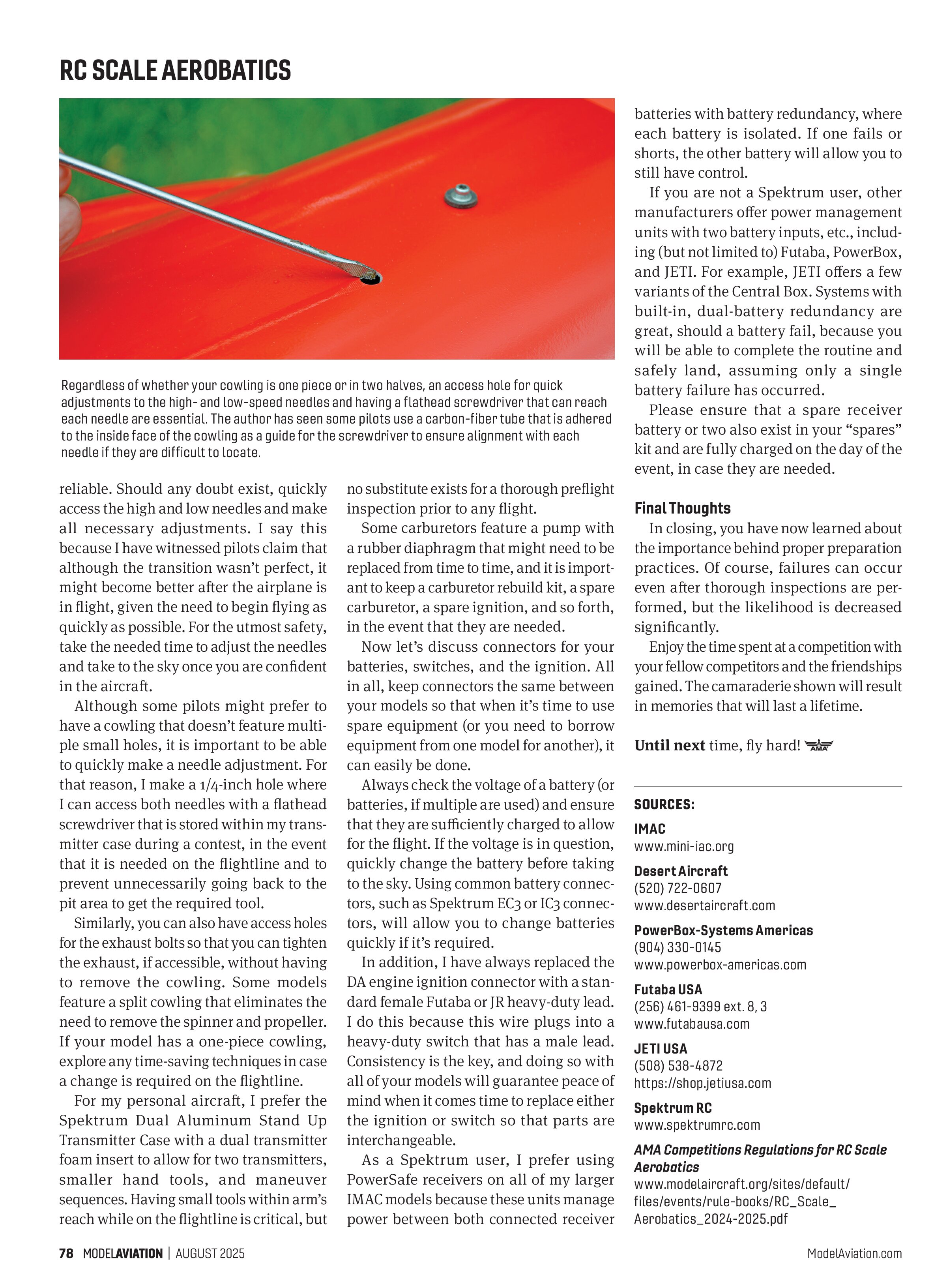
Although some pilots might prefer to have a cowling that doesn’t feature multiple small holes, it is important to be able to quickly make a needle adjustment. For that reason, I make a 1/4-inch hole where I can access both needles with a flathead screwdriver that is stored within my transmitter case during a contest, in the event that it is needed on the flightline and to prevent unnecessarily going back to the pit area to get the required tool.
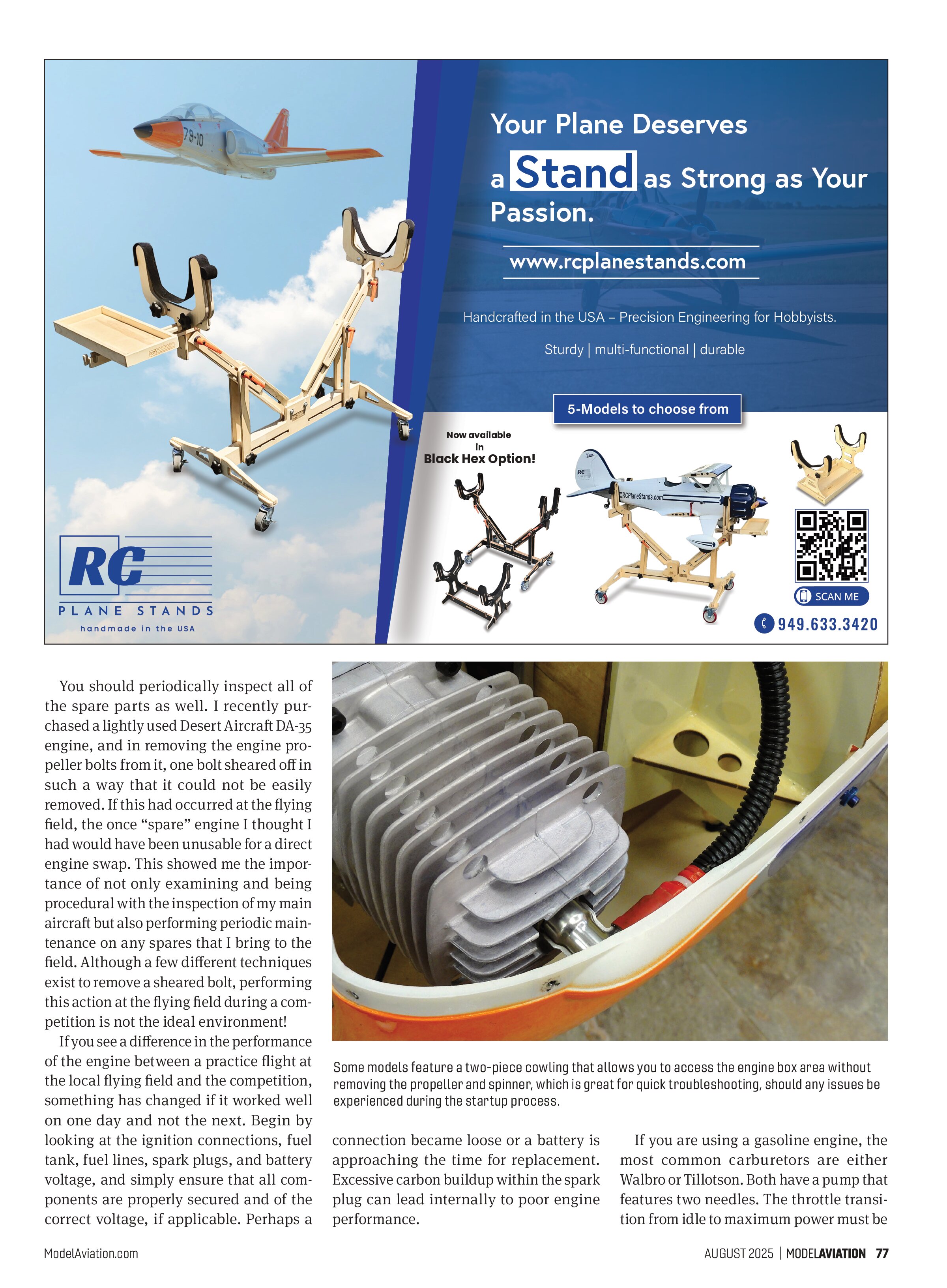
Similarly, you can also have access holes for the exhaust bolts so that you can tighten the exhaust, if accessible, without having to remove the cowling. Some models feature a split cowling that eliminates the need to remove the spinner and propeller. If your model has a one-piece cowling, explore any time-saving techniques in case a change is required on the flightline.
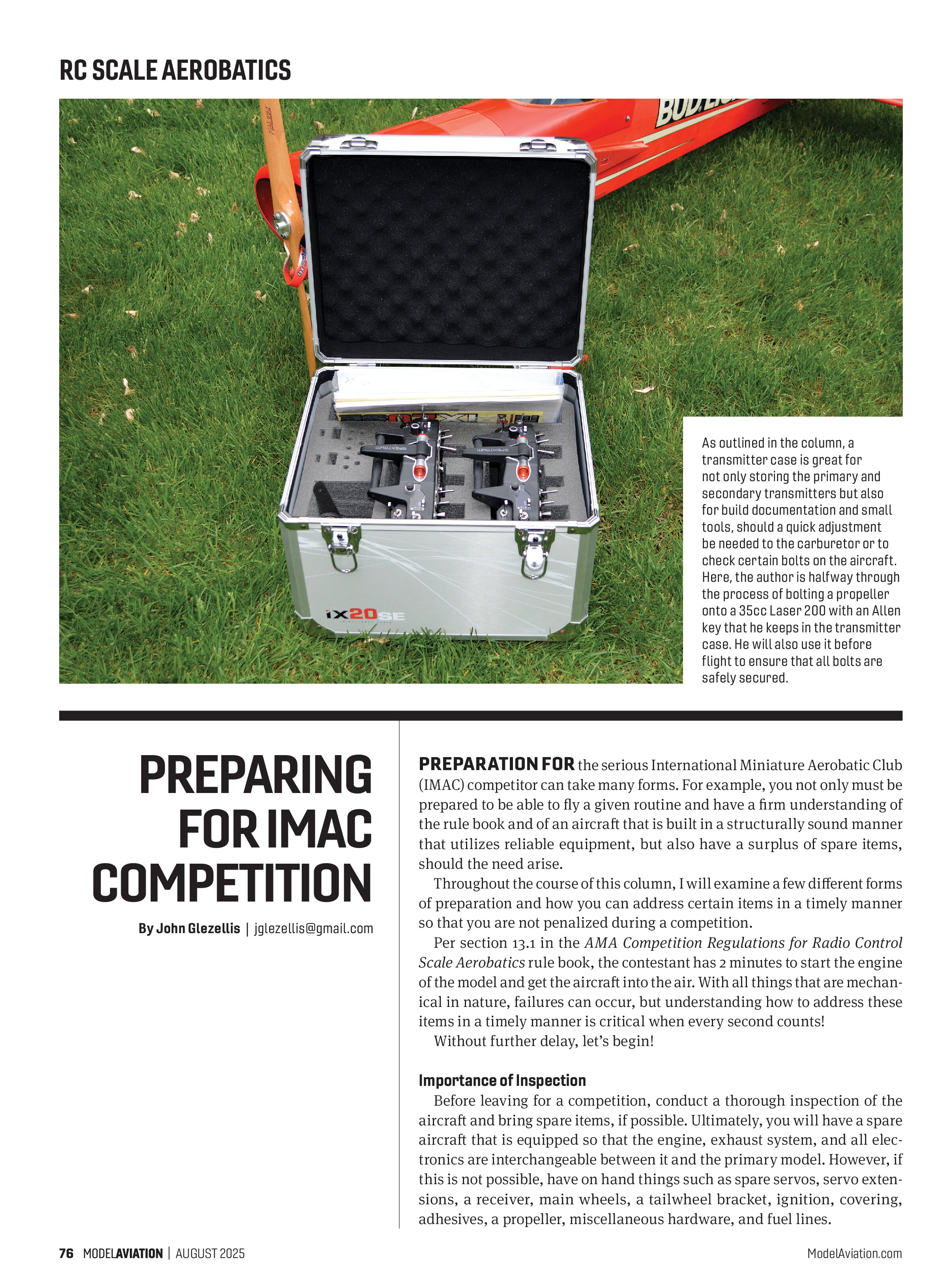
For my personal aircraft, I prefer the Spektrum Dual Aluminum Stand Up Transmitter Case with a dual transmitter foam insert to allow for two transmitters, smaller hand tools, and maneuver sequences. Having small tools within arm’s reach while on the flightline is critical, but

no substitute exists for a thorough preflight inspection prior to any flight.
Some carburetors feature a pump with a rubber diaphragm that might need to be replaced from time to time, and it is important to keep a carburetor rebuild kit, a spare carburetor, a spare ignition, and so forth, in the event that they are needed.
Now let’s discuss connectors for your batteries, switches, and the ignition. All in all, keep connectors the same between your models so that when it’s time to use spare equipment (or you need to borrow equipment from one model for another), it can easily be done.
Always check the voltage of a battery (or batteries, if multiple are used) and ensure that they are sufficiently charged to allow for the flight. If the voltage is in question, quickly change the battery before taking to the sky. Using common battery connectors, such as Spektrum EC3 or IC3 connectors, will allow you to change batteries quickly if it’s required.
In addition, I have always replaced the DA engine ignition connector with a standard female Futaba or JR heavy-duty lead. I do this because this wire plugs into a heavy-duty switch that has a male lead. Consistency is the key, and doing so with all of your models will guarantee peace of mind when it comes time to replace either the ignition or switch so that parts are interchangeable.
As a Spektrum user, I prefer using PowerSafe receivers on all of my larger IMAC models because these units manage power between both connected receiver batteries with battery redundancy, where each battery is isolated. If one fails or shorts, the other battery will allow you to still have control.
If you are not a Spektrum user, other manufacturers offer power management units with two battery inputs, etc., including (but not limited to) Futaba, PowerBox, and JETI. For example, JETI offers a few variants of the Central Box. Systems with built-in, dual-battery redundancy are great, should a battery fail, because you will be able to complete the routine and safely land, assuming only a single battery failure has occurred.
Please ensure that a spare receiver battery or two also exist in your “spares” kit and are fully charged on the day of the event, in case they are needed.
Final Thoughts
In closing, you have now learned about the importance behind proper preparation practices. Of course, failures can occur even after thorough inspections are performed, but the likelihood is decreased significantly.
Enjoy the time spent at a competition with your fellow competitors and the friendships gained. The camaraderie shown will result in memories that will last a lifetime.
Until next time, fly hard!
SOURCES:
IMAC
www.mini-iac.org
Desert Aircraft
(520) 722-0607
www.desertaircraft.com
PowerBox-Systems Americas
(904) 330-0145
www.powerbox-americas.com
Futaba USA
(256) 461-9399 ext. 8, 3
www.futabausa.com
JETI USA
(508) 538-4872
https://shop.jetiusa.com
Spektrum RC
www.spektrumrc.com
AMA Competitions Regulations for RC Scale Aerobatics
www.modelaircraft.org/sites/default/files/events/rule-books/RC_Scale_Aer...