WHAT’S IN
YOUR
TRANSMITTER
CASE?
By Tim DiPeri | timdíperi@caseco-inc.com

PRETTY MUCH since the start of when I began flying RC models, I’ve felt that it was critically important to protect the transmitter from being damaged. I remember holding in my Mattel single-channel transmitter using rubber bands surrounded by foam in my first field box.
Years later, when I could afford (slightly) better equipment (a Kraft three-channel transmitter), I continued to use that method. Once I moved to a more advanced radio (probably a Kraft five-channel), a friend suggested that I use a bag from a piece of Hewlett-Packard equipment.
Throughout the years, as transmitters began having more and more switches, a “bag” started to be less protective than what I felt was reasonable. I’m sure most of us have been to an event where someone has broken off a switch and had to deal with it later. This became especially evident when I took my first “long” business trip to the U.K. and chose to bring a model with me after my good friend, Len Mount, asked me to stay a few weekends with him and his wife to fly together.
For many years, I have used hardshell transmitter boxes and traveled with models and electronics. A good, sturdy box is one of the best investments that a modeler can make. The transmitter is the heart of our model experience, and taking care of it is of great importance, regardless of its value. When we expect it to work, nothing else will be acceptable.
My need for a transmitter “transport” has evolved throughout the past few years to include two transmitters and a handful of tools that I want to easily access rather than going to my normal field tool bag. The tools I like to keep in the transmitter case include items such as screwdrivers, ball link pliers, hex drives for normal handwear, light oil, a voltage tester, etc. The idea of this seemed easier than it was when I tried to come up with something myself.
While attending events the past few years, the overwhelming interest I have seen about a transmitter case is for one made in the USA by a small business! Creative Cutting and Engraving is operated by Mike Bargman and is based in Illinois.
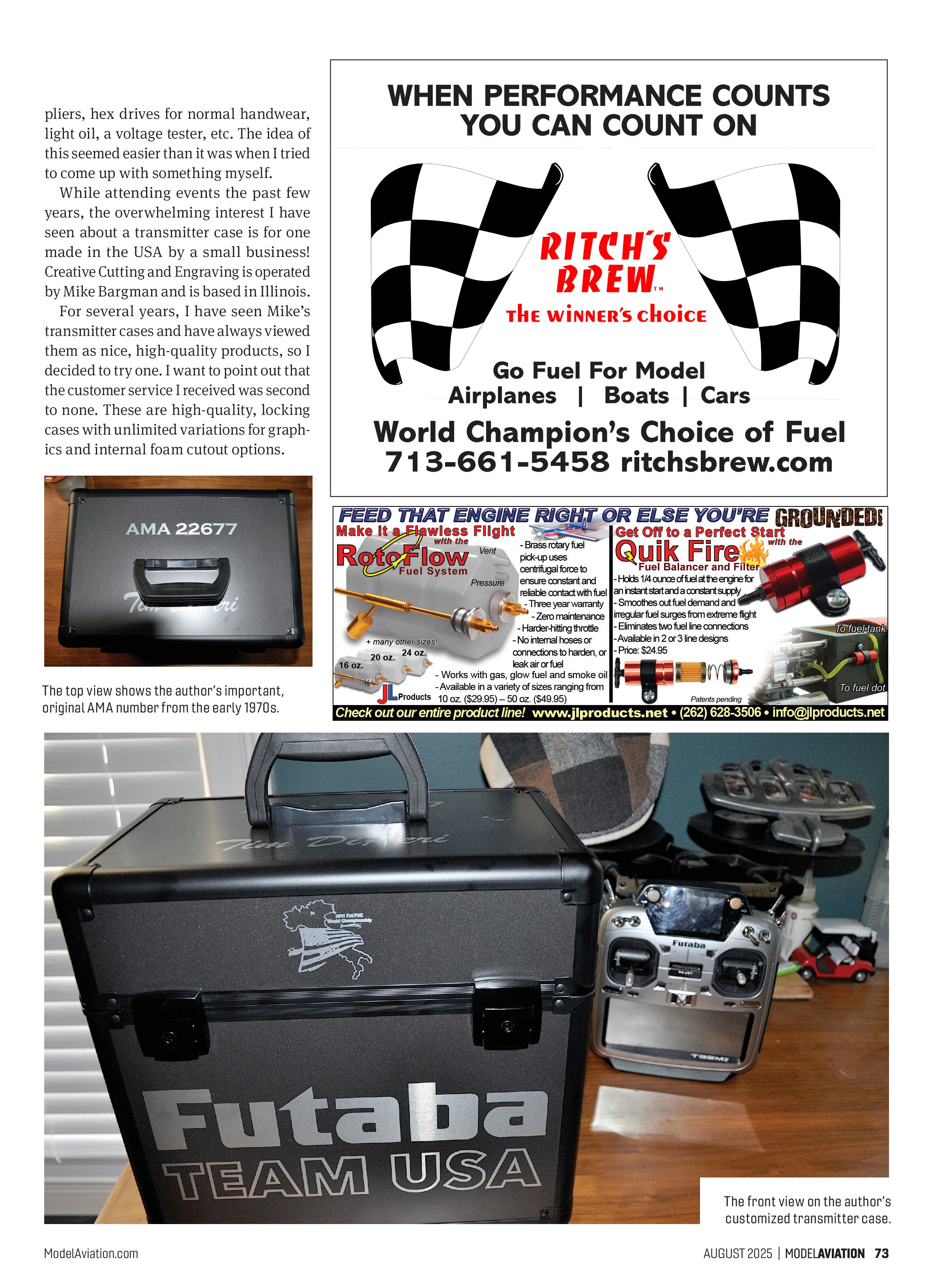
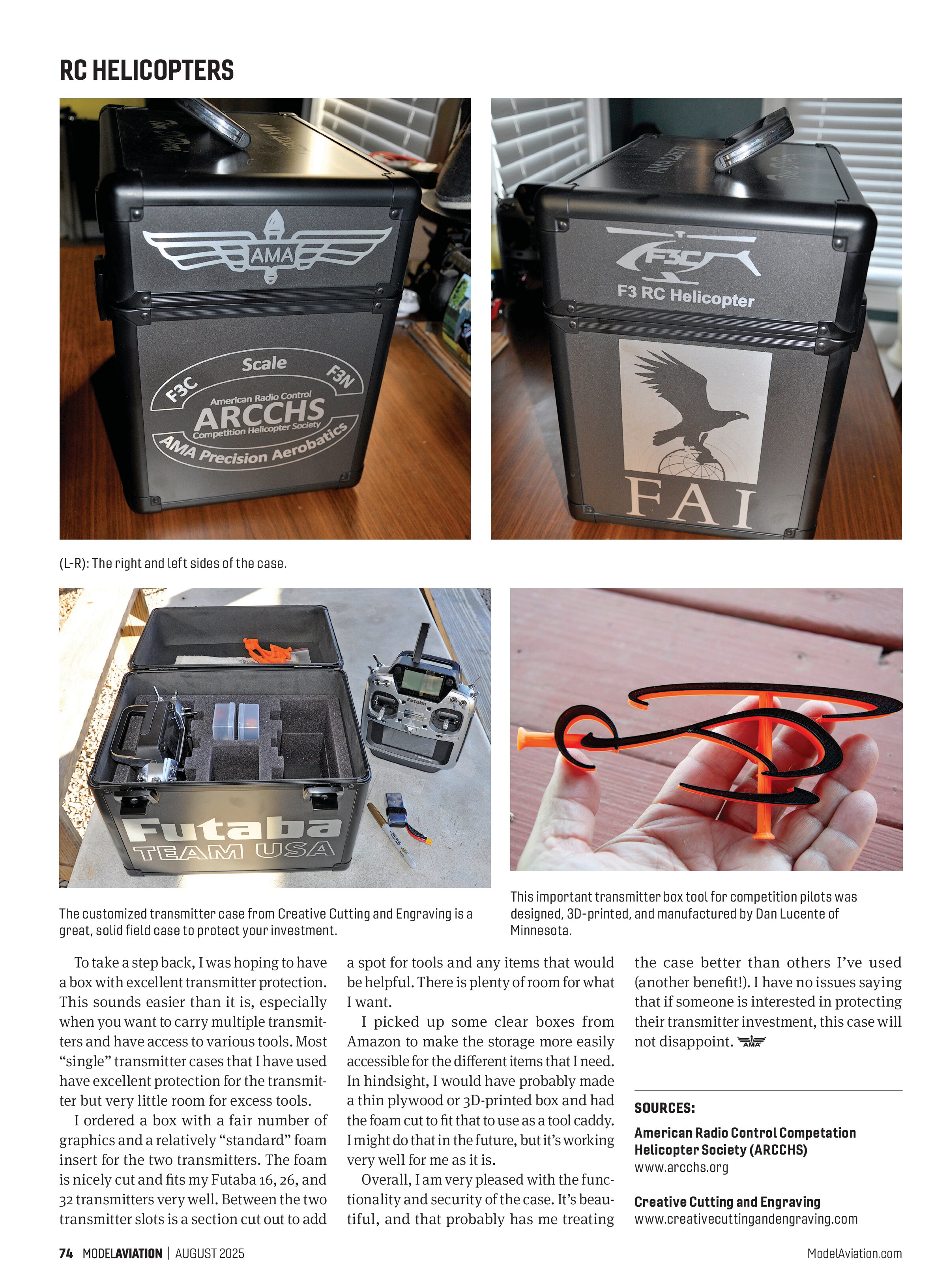
For several years, I have seen Mike’s transmitter cases and have always viewed them as nice, high-quality products, so I decided to try one. I want to point out that the customer service I received was second to none. These are high-quality, locking cases with unlimited variations for graphics and internal foam cutout options.


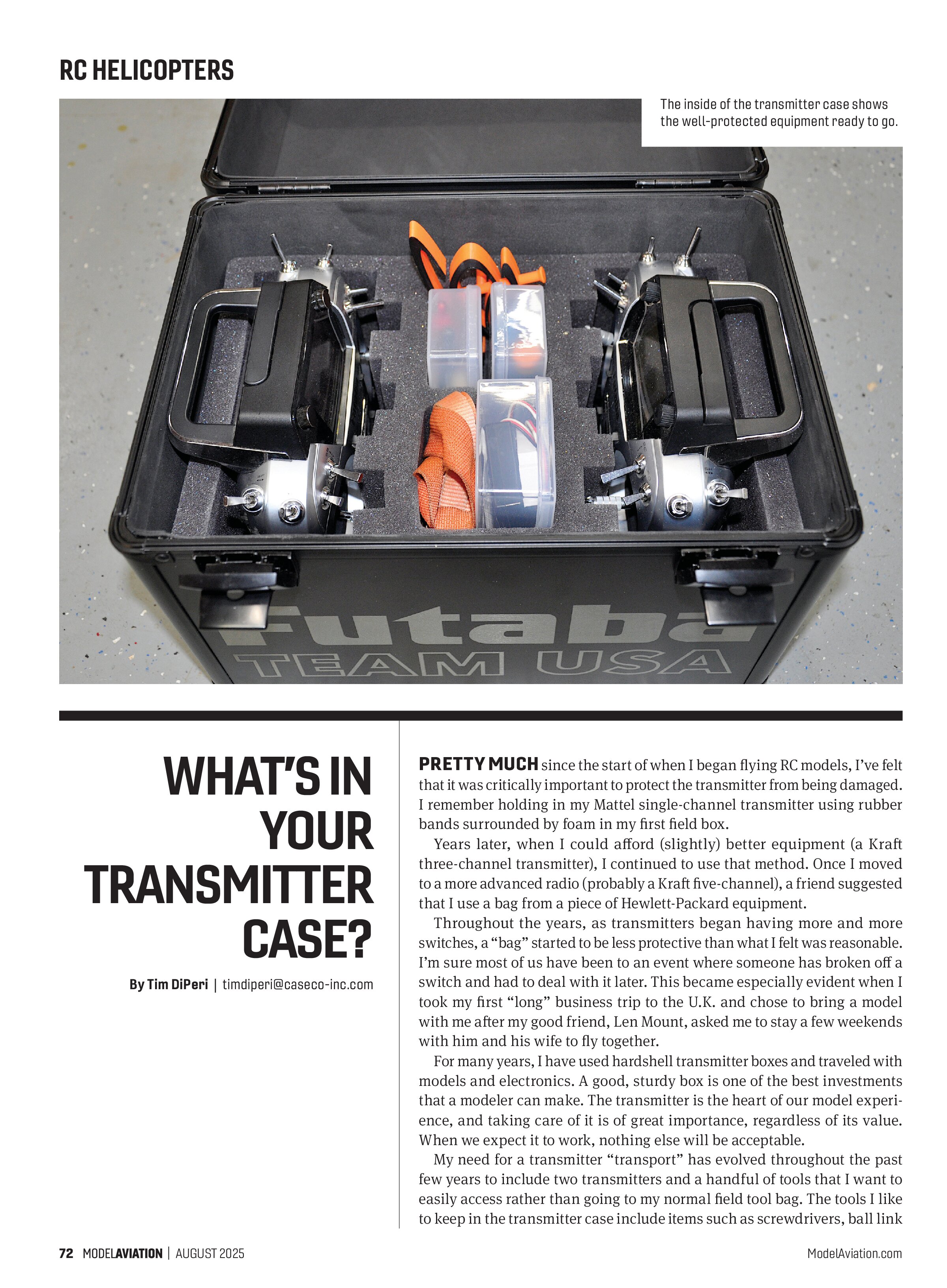
To take a step back, I was hoping to have a box with excellent transmitter protection. This sounds easier than it is, especially when you want to carry multiple transmitters and have access to various tools. Most “single” transmitter cases that I have used have excellent protection for the transmitter but very little room for excess tools.
I ordered a box with a fair number of graphics and a relatively “standard” foam insert for the two transmitters. The foam is nicely cut and fits my Futaba 16, 26, and 32 transmitters very well. Between the two transmitter slots is a section cut out to add
a spot for tools and any items that would be helpful. There is plenty of room for what I want.
I picked up some clear boxes from Amazon to make the storage more easily accessible for the different items that I need. In hindsight, I would have probably made a thin plywood or 3D-printed box and had the foam cut to fit that to use as a tool caddy. I might do that in the future, but it’s working very well for me as it is.
Overall, I am very pleased with the functionality and security of the case. It’s beautiful, and that probably has me treating the case better than others I’ve used (another benefit!). I have no issues saying that if someone is interested in protecting their transmitter investment, this case will not disappoint.
SOURCES:
American Radio Control Competition Helicopter Society (ARCCHS)
www.arcchs.org
Creative Cutting and Engraving
www.creativecuttingandengraving.com