New Products That Are Worth a Closer Look
GLIDERTHROW V3


At a Glance
Specifications
Single device dimensions: 17mm high; 17mm wide; 37mm deep
Single unit weight: 22 grams (with magnetic peg: 28 grams)
Resolution: 0.1˚; 0.1mm
Precision: Better than 0.3mm
Power: 150 mAh replaceable and rechargeable LiPo battery (approximately 2 hours of continuous operation)
Charging: Micro USB-C cable (not included)
Charging time: Approximately 1 hour
IN THE FEBRUARY 2025 issue of Model Aviation, we reviewed the GliderCG Standard v3 in “Worth a Closer Look.” Today, we are going to look at another product from GliderCG USA, the GliderThrow v3.
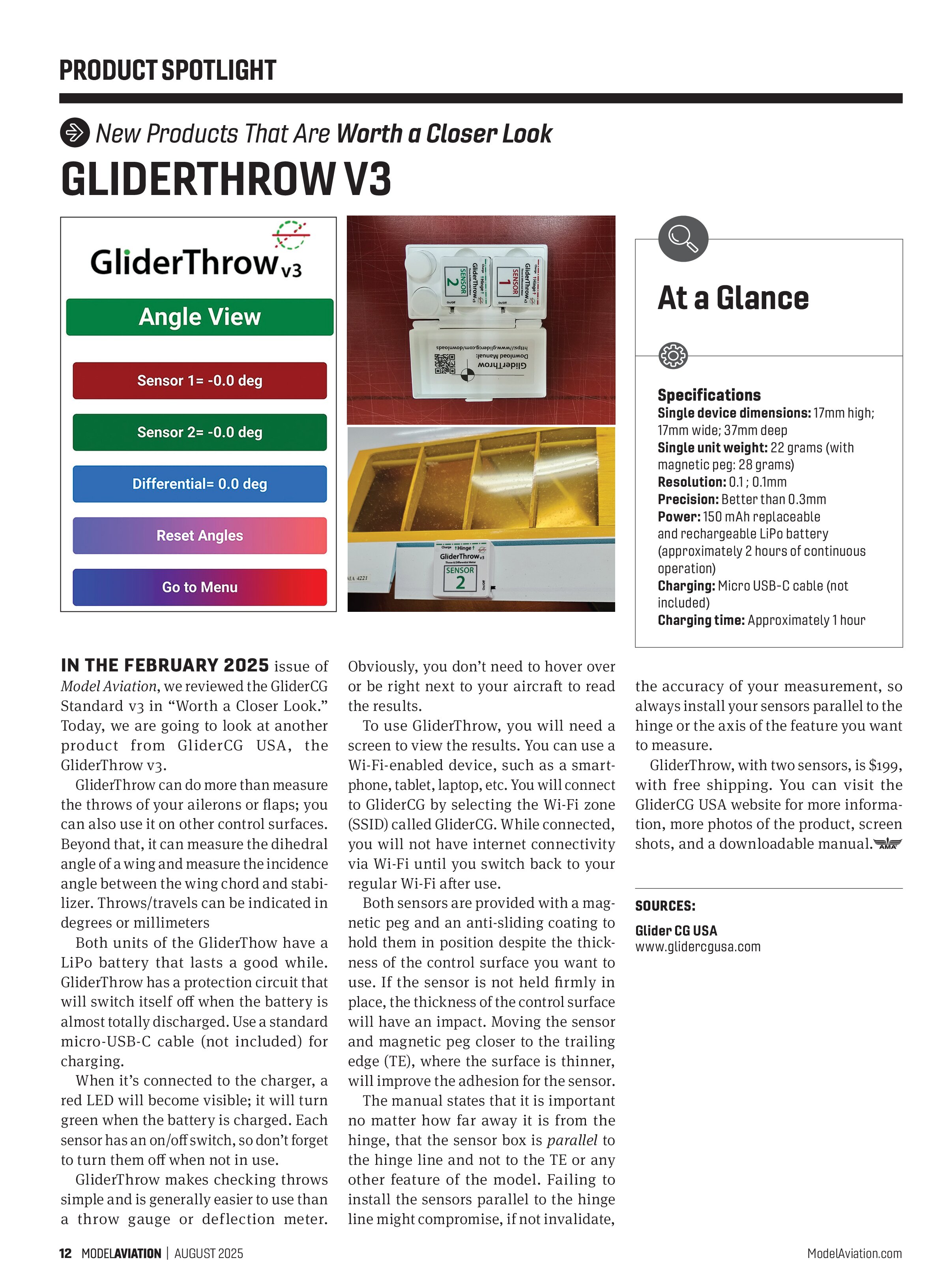
GliderThrow can do more than measure the throws of your ailerons or flaps; you can also use it on other control surfaces. Beyond that, it can measure the dihedral angle of a wing and measure the incidence angle between the wing chord and stabilizer. Throws/travels can be indicated in degrees or millimeters.
Both units of the GliderThrow have a LiPo battery that lasts a good while. GliderThrow has a protection circuit that will switch itself off when the battery is almost totally discharged. Use a standard micro-USB-C cable (not included) for charging.
When it’s connected to the charger, a red LED will become visible; it will turn green when the battery is charged. Each sensor has an on/off switch, so don’t forget to turn them off when not in use.
GliderThrow makes checking throws simple and is generally easier to use than a throw gauge or deflection meter.
Obviously, you don’t need to hover over or be right next to your aircraft to read the results.
To use GliderThrow, you will need a screen to view the results. You can use a Wi-Fi-enabled device, such as a smartphone, tablet, laptop, etc. You will connect to GliderCG by selecting the Wi-Fi zone (SSID) called GliderCG. While connected, you will not have internet connectivity via Wi-Fi until you switch back to your regular Wi-Fi after use.
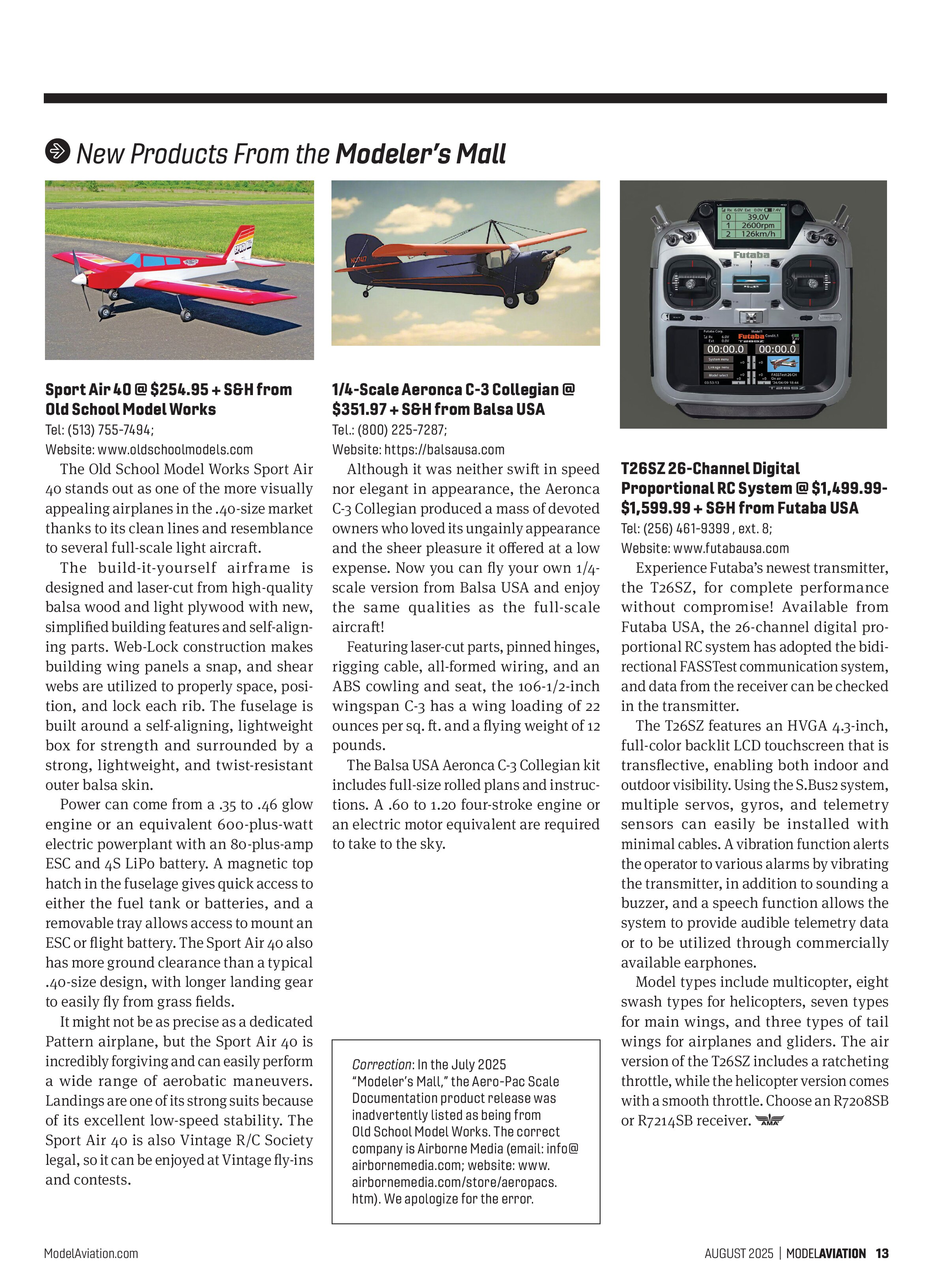
Both sensors are provided with a magnetic peg and an anti-sliding coating to hold them in position despite the thickness of the control surface you want to use. If the sensor is not held firmly in place, the thickness of the control surface will have an impact. Moving the sensor and magnetic peg closer to the trailing edge (TE), where the surface is thinner, will improve the adhesion for the sensor.
The manual states that it is important no matter how far away it is from the hinge, that the sensor box is parallel to the hinge line and not to the TE or any other feature of the model. Failing to install the sensors parallel to the hinge line might compromise, if not invalidate, the accuracy of your measurement, so always install your sensors parallel to the hinge or the axis of the feature you want to measure.
GliderThrow, with two sensors, is $199, with free shipping. You can visit the GliderCG USA website for more information, more photos of the product, screen shots, and a downloadable manual.
SOURCES:
Glider CG USA
www.glidercgusa.com
New Products From the Modeler’s Mall

Sport Air 40 @ $254.95 + S&H from Old School Model Works
Tel: (513) 755-7494;
Website: www.oldschoolmodels.com
The Old School Model Works Sport Air 40 stands out as one of the more visually appealing airplanes in the .40-size market thanks to its clean lines and resemblance to several full-scale light aircraft.
The build-it-yourself airframe is designed and laser-cut from high-quality balsa wood and light plywood with new, simplified building features and self-aligning parts. Web-Lock construction makes building wing panels a snap, and shear webs are utilized to properly space, position, and lock each rib. The fuselage is built around a self-aligning, lightweight box for strength and surrounded by a strong, lightweight, and twist-resistant outer balsa skin.
Power can come from a .35 to .46 glow engine or an equivalent 600-plus-watt electric powerplant with an 80-plus-amp ESC and 4S LiPo battery. A magnetic top hatch in the fuselage gives quick access to either the fuel tank or batteries, and a removable tray allows access to mount an ESC or flight battery. The Sport Air 40 also has more ground clearance than a typical .40-size design, with longer landing gear to easily fly from grass fields.
It might not be as precise as a dedicated Pattern airplane, but the Sport Air 40 is incredibly forgiving and can easily perform a wide range of aerobatic maneuvers. Landings are one of its strong suits because of its excellent low-speed stability. The Sport Air 40 is also Vintage R/C Society legal, so it can be enjoyed at Vintage fly-ins and contests.

1/4-Scale Aeronca C-3 Collegian @ $351.97 + S&H from Balsa USA
Tel.: (800) 225-7287;
Website: https://balsausa.com
Although it was neither swift in speed nor elegant in appearance, the Aeronca C-3 Collegian produced a mass of devoted owners who loved its ungainly appearance and the sheer pleasure it offered at a low expense. Now you can fly your own 1/4-scale version from Balsa USA and enjoy the same qualities as the full-scale aircraft!
Featuring laser-cut parts, pinned hinges, rigging cable, all-formed wiring, and an ABS cowling and seat, the 106-1/2-inch wingspan C-3 has a wing loading of 22 ounces per sq. ft. and a flying weight of 12 pounds.
The Balsa USA Aeronca C-3 Collegian kit includes full-size rolled plans and instructions. A .60 to 1.20 four-stroke engine or an electric motor equivalent are required to take to the sky.

T26SZ 26-Channel Digital Proportional RC System @ $1,499.99-$1,599.99 + S&H from Futaba USA
Tel: (256) 461-9399, ext. 8;
Website: www.futabausa.com
Experience Futaba’s newest transmitter, the T26SZ, for complete performance without compromise! Available from Futaba USA, the 26-channel digital proportional RC system has adopted the bidirectional FASSTest communication system, and data from the receiver can be checked in the transmitter.
The T26SZ features an HVGA 4.3-inch, full-color backlit LCD touchscreen that is transflective, enabling both indoor and outdoor visibility. Using the S.Bus2 system, multiple servos, gyros, and telemetry sensors can easily be installed with minimal cables. A vibration function alerts the operator to various alarms by vibrating the transmitter, in addition to sounding a buzzer, and a speech function allows the system to provide audible telemetry data or to be utilized through commercially available earphones.
Model types include multicopter, eight swash types for helicopters, seven types for main wings, and three types of tail wings for airplanes and gliders. The air version of the T26SZ includes a ratcheting throttle, while the helicopter version comes with a smooth throttle. Choose an R7208SB or R7214SB receiver.
Correction: In the July 2025 “Modeler’s Mall,” the Aero-Pac Scale Documentation product release was inadvertently listed as being from Old School Model Works. The correct company is Airborne Media (email: info@airbornemedia.com, website: www.airbornemedia.com/store/aeropacs.htm). We apologize for the error.