OLD-TIMERS

BILL BROWN
AND
MAXWELL
BASSETT
By Bob Angel | samrcflier@verizon.net
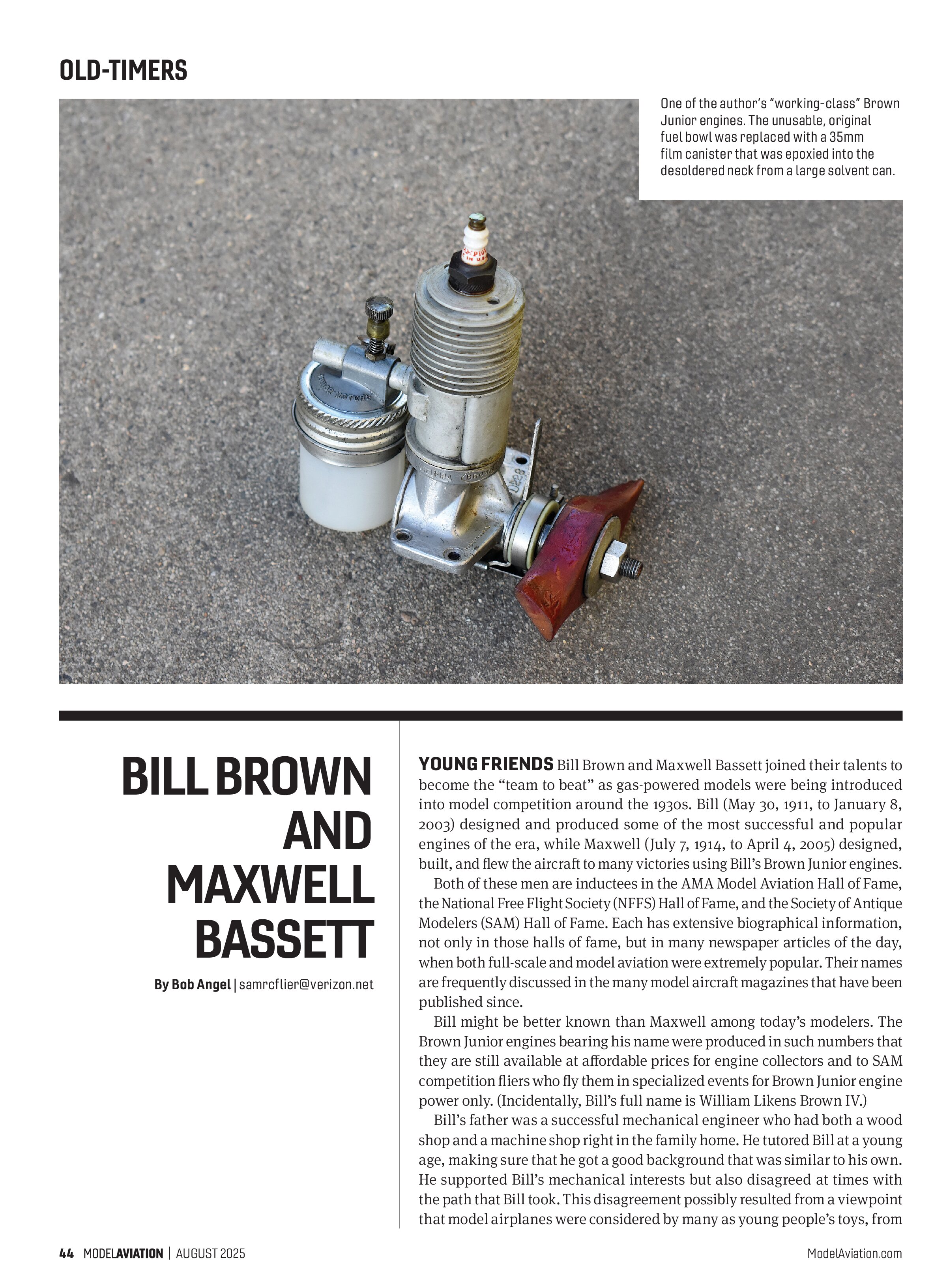
YOUNG FRIENDS Bill Brown and Maxwell Bassett joined their talents to become the “team to beat” as gas-powered models were being introduced into model competition around the 1930s. Bill (May 30, 1911, to January 8, 2003) designed and produced some of the most successful and popular engines of the era, while Maxwell (July 7, 1914, to April 4, 2005) designed, built, and flew the aircraft to many victories using Bill’s Brown Junior engines.
Both of these men are inductees in the AMA Model Aviation Hall of Fame, the National Free Flight Society (NFFS) Hall of Fame, and the Society of Antique Modelers (SAM) Hall of Fame. Each has extensive biographical information, not only in those halls of fame, but in many newspaper articles of the day, when both full-scale and model aviation were extremely popular. Their names are frequently discussed in the many model aircraft magazines that have been published since.
Bill might be better known than Maxwell among today’s modelers. The Brown Junior engines bearing his name were produced in such numbers that they are still available at affordable prices for engine collectors and to SAM competition fliers who fly them in specialized events for Brown Junior engine power only. (Incidentally, Bill’s full name is William Likens Brown IV.)
Bill’s father was a successful mechanical engineer who had both a wood shop and a machine shop right in the family home. He tutored Bill at a young age, making sure that he got a good background that was similar to his own. He supported Bill’s mechanical interests but also disagreed at times with the path that Bill took. This disagreement possibly resulted from a viewpoint that model airplanes were considered by many as young people’s toys, from which one was expected to graduate as they matured.
Bill started building rubber-powered models at seven years of age, but it wasn’t until he was 12 that he finally got one flying. It was a twin-pusher, rubber-powered model that, at the time, was one of the first successful flying model designs for many early modelers. He and neighborhood friend Maxwell began building and flying together.
As a high school student in his early teens, Bill began thinking about powering models with small gasoline engines. He studied his father’s outboard motor and began sketching plans. With access to machine tools, he soon began making parts, but spark ignition also required suitable spark plugs, coils, etc., which weren’t generally available in the small scale that was needed for these engines. Bill overcame these obstacles by designing and building his own miniature spark plugs and lightweight coils.
It was during those years that the Great Depression came along, which, among other things, resulted in Bill’s father losing his job and struggling to make a living. During that time, he didn’t see much future in his son playing with toy engines. According to his AMA History Project biography, young Bill finally got an engine running around late 1930, and his dad commented, “Now what does that prove?” Bill said that this put a lasting strain on their relationship, although his dad did later become active in contacting some financial “high rollers” and forming the successful Junior Motors Company, while even becoming president for a while.
The younger Bill attended Pennsylvania State College but dropped out and got a job as a machinist with Junior Motors. The company had become such a larger committee-run type of business with internal struggles that around 1939, both Bill and his dad were actually fired as the company slipped backward from outside competition.
Bill then began designing, constructing, and marketing CO2-powered engines, where the market was less crowded and didn’t require as large of an organization to be competitive. This era of smaller engine production was carried into Bill’s later years, which is well covered in an interesting addendum written by Evan Towne in his AMA biography.
Maxwell was a natural born competitor who entered to win in whatever courses he chose in life. While Bill might be better remembered today, Maxwell was the more-familiar name during those years since he was the flier most often listed high on contest results sheets.
Like most other boys at the time, Maxwell first built and competed with rubber-powered models, so he had a head start in learning to control the greater power as gas models became practical. Along the way, he designed a twin-pusher model, which escorted and released a piggybacked, single pusher in midair. He’s said to have won several contests with the combination until the rules were changed to disallow the dropping of parts in flight.
Interestingly, another part of modeling history surrounds that “no dropping of parts” rule. It was later applied to the Mystery Man design, as published by Elbert Weathers in the June 1939 edition of Air Trails.

This Brownie .29 was made later and in fewer numbers than were the original .60 engines. Its general appearance might have been copied in the design of some later cheap “slag” engines.

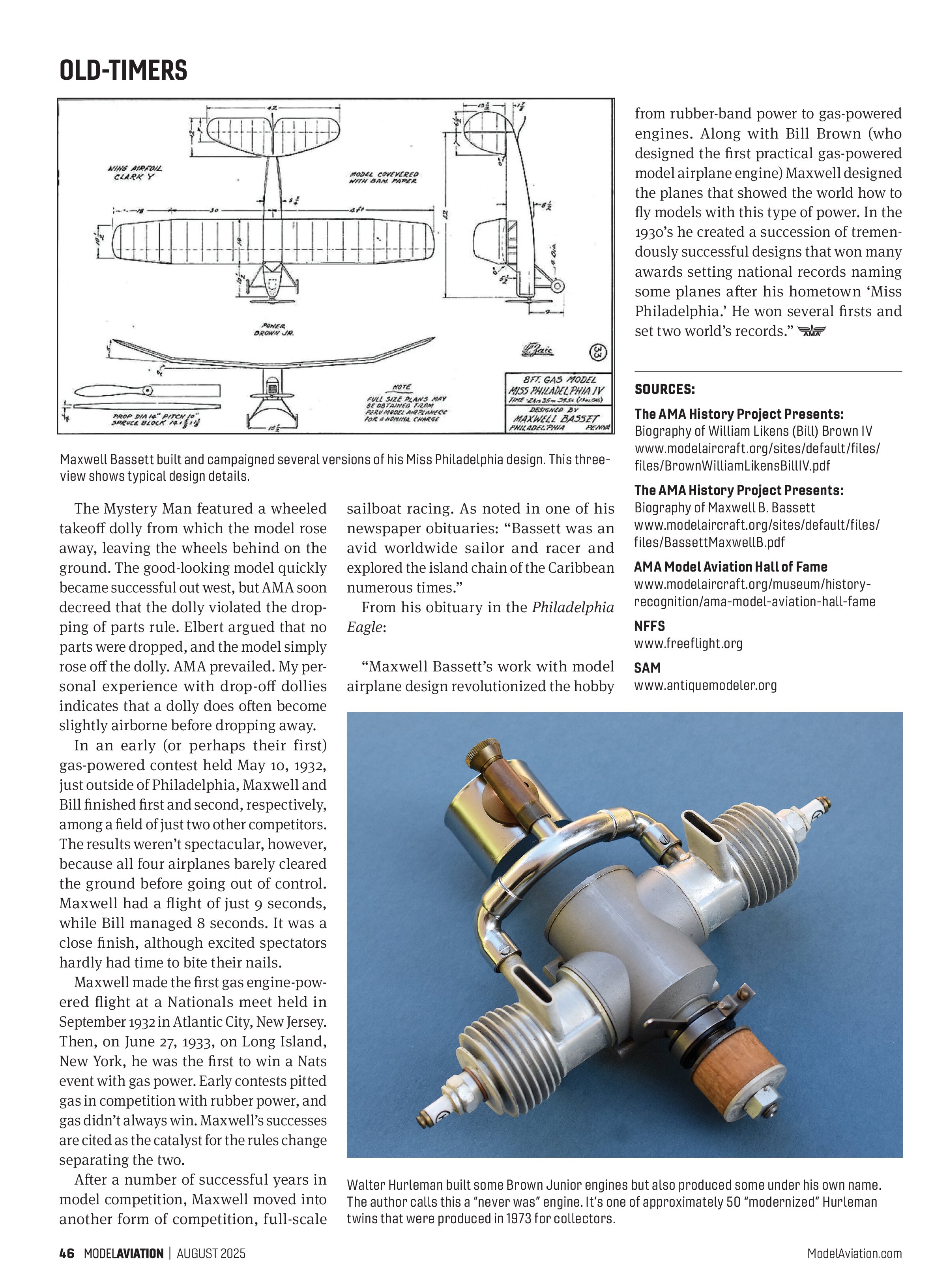
from rubber-band power to gas-powered engines. Along with Bill Brown (who designed the first practical gas-powered model airplane engine) Maxwell designed the planes that showed the world how to fly models with this type of power. In the 1930’s he created a succession of tremendously successful designs that won many awards setting national records naming some planes after his hometown ‘Miss Philadelphia.’ He won several firsts and set two world’s records.”
The Mystery Man featured a wheeled takeoff dolly from which the model rose away, leaving the wheels behind on the ground. The good-looking model quickly became successful out west, but AMA soon decreed that the dolly violated the dropping of parts rule. Elbert argued that no parts were dropped, and the model simply rose off the dolly. AMA prevailed. My personal experience with drop-off dollies indicates that a dolly does often become slightly airborne before dropping away.
In an early (or perhaps their first) gas-powered contest held May 10, 1932, just outside of Philadelphia, Maxwell and Bill finished first and second, respectively, among a field of just two other competitors. The results weren’t spectacular, however, because all four airplanes barely cleared the ground before going out of control. Maxwell had a flight of just 9 seconds, while Bill managed 8 seconds. It was a close finish, although excited spectators hardly had time to bite their nails.
Maxwell made the first gas engine-powered flight at a Nationals meet held in September 1932 in Atlantic City, New Jersey. Then, on June 27, 1933, on Long Island, New York, he was the first to win a Nats event with gas power. Early contests pitted gas in competition with rubber power, and gas didn’t always win. Maxwell’s successes are cited as the catalyst for the rules change separating the two.
After a number of successful years in model competition, Maxwell moved into another form of competition, full-scale sailboat racing. As noted in one of his newspaper obituaries: “Bassett was an avid worldwide sailor and racer and explored the island chain of the Caribbean numerous times.”
From his obituary in the Philadelphia Eagle:
“Maxwell Bassett’s work with model airplane design revolutionized the hobby

Maxwell Bassett built and campaigned several versions of his Miss Philadelphia design. This three-view shows typical design details.
SOURCES:
The AMA History Project Presents:
Biography of William Likens (Bill) Brown IV
www.modelaircraft.org/sites/default/files/files/BrownWilliamLikensBillIV...
The AMA History Project Presents:
Biography of Maxwell B. Bassett
www.modelaircraft.org/sites/default/files/files/BassettMaxwellB.pdf
AMA Model Aviation Hall of Fame
www.modelaircraft.org/museum/history-recognition/ama-model-aviation-hall...