FOCAL POINT
Interested in sharing your handiwork? Visit www.ModelAviation.com for submission guidelines.

CARF-Models Rebel Pro
Ken Bryant (Surprise, Arizona; email: bryant.kr@gmail.com), the secretary of Speedworld RC Flyers in Wittmann, Arizona, completed his CARF-Models Rebel Pro build and the maiden flight on October 13, 2024. The jet was ordered in a color swap of the infinity paint scheme.
The Rebel Pro is guided with a JR Elite transmitter, JR 11BPX receiver, a bavarianDEMON CORTEXpro gyro, MKS 599 servos on all flight controls, and Savox 2290 servos on the flaps. The landing gear is Electron Retracts ER-50s that were powder-coated by the late Joe Tamez. A Swiwin 190 turbine provides plenty of power. It came in at 38 pounds dry, 102 inches wide, and 113 inches long.
“To quote pilot Josh Clark, ‘It’s a cream puff to fly,’” Ken wrote. “I’ve logged several flights now, and I agree: It’s one of the smoothest planes I have ever flown. This is my third and biggest turbine-powered plane.”

Boxy Indoor HLG
AMA Hall of Famer Larry Renger (Rancho Santa Margarita, California; email: larry_renger@earthlink.net) provided a photo of the original model—and several replicas—of Boxy, a Category I Indoor Hand-Launch Glider (HLG).
The modelers are (L-R) Dave Ward, Larry (holding the 60-year-old original Boxy), Steve Killian, Ferrell Papic, and Clint Brooks. Larry stated, “These days, the gliders are catapult-launched to save aged arms. Currently, the best time in our 21-foot-high [flying] site is 20.5 seconds. The original glider was flown to a national record in 1964.”

DerJet F-35As
Mike Danielson (Saint Michael, Minnesota; email: michael@flysafejets.com) sent in a “Focal Point” submission of himself, Leo Spychalla (Waukesha, Wisconsin), and Zach Spychalla (Brownsville, Wisconsin) with the debut of their identical turbine-powered, 1/8-scale DerJet F-35A jets at the annual Northern Alliance Military Fly In event in Owatonna, Minnesota.
The paint schemes featured are (L-R): the Arctic Aggressor, the 100th Anniversary, and the Splinter Aggressor. These models can enough fuel for 11-plus minutes of flights, along with impressive smoke systems. They can easily reach 190 mph powered by 120- to 142-size turbines! Additionally, each is equipped with a scale unilight lighting system and a full telemetry suite with airspeed, GPS, engine data, air pressure, battery data, and more.
The three pilots fly together regularly with their jets as a mighty three-ship formation!

Brodak Ares CL Conversion to Electric RC
Jim Osborne (Oviedo, Florida; email: p51sailor@cfl.rr.com) recently acquired a Brodak Manufacturing Ares U-Control (Control Line; CL) kit that has been converted to electric RC using a four-cell 6,000 mAh LiPo battery swinging a 9 x 6 propeller. He noted that the battery is probably oversized, but it helps with the center of gravity.
The airplane was designed, built, and flown in 1959 by Bill Werwage. A 1959 CL competition was held at the Cleveland Airport model complex. Jim competed in that Stunt competition “but had fallen in love with [Bill’s] modern, sleek low-rider.”
He went on to state, “Honoring his 65-year-old project, my bucket list build is attached. I have programmed an AS3X receiver to help calm it down. We are now awaiting a calm Florida day for the maiden. My club, the DeLand Golden Hawks, has an asphalt runway. Wish my test pilot luck then me for flight two!”

Morris Hobbies Top Cap
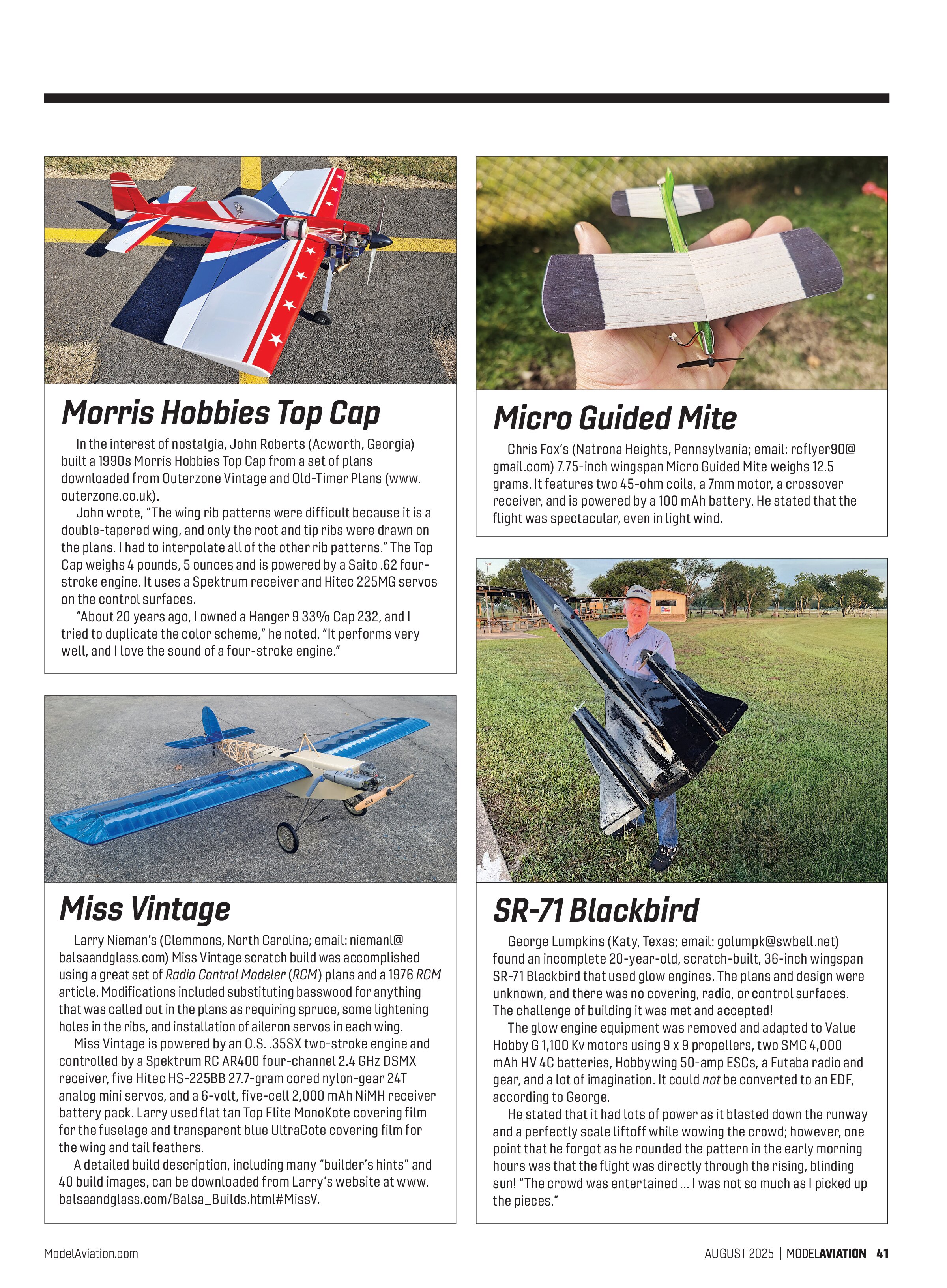
In the interest of nostalgia, John Roberts (Acworth, Georgia) built a 1990s Morris Hobbies Top Cap from a set of plans downloaded from Outerzone Vintage and Old-Timer Plans (www.outerzone.co.uk).
John wrote, “The wing rib patterns were difficult because it is a double-tapered wing, and only the root and tip ribs were drawn on the plans. I had to interpolate all of the other rib patterns.” The Top Cap weighs 4 pounds, 5 ounces and is powered by a Saito .62 four-stroke engine. It uses a Spektrum receiver and Hitec 225MG servos on the control surfaces.
“About 20 years ago, I owned a Hanger 9 33% Cap 232, and I tried to duplicate the color scheme,” he noted. “It performs very well, and I love the sound of a four-stroke engine.”

Miss Vintage
Larry Nieman’s (Clemmons, North Carolina; email: niemannl@balsaandglass.com) Miss Vintage scratch build was accomplished using a great set of Radio Control Modeler (RCM) plans and a 1976 RCM article. Modifications included substituting basswood for anything that was called out in the plans as requiring spruce, some lightening holes in the ribs, and installation of aileron servos in each wing.
Miss Vintage is powered by an O.S. .35SX two-stroke engine and controlled by a Spektrum RC AR400 four-channel 2.4 GHz DSMX receiver, five Hitec HS-225BB 27.7-gram cored nylon-gear 24T analog mini servos, and a 6-volt, five-cell 2,000 mAh NiMH receiver battery pack. Larry used flat tan Top Flite MonoKote covering film for the fuselage and transparent blue UltraCote covering film for the wing and tail feathers.
A detailed build description, including many “builder’s hints” and 40 build images, can be downloaded from Larry’s website at www.balsaandglass.com/Balsa_Builds.html#MissV.

Micro Guided Mite
Chris Fox’s (Natrona Heights, Pennsylvania; email: rcflyer90@gmail.com) 7.75-inch wingspan Micro Guided Mite weighs 12.5 grams. It features two 45-ohm coils, a 7mm motor, a crossover receiver, and is powered by a 100 mAh battery. He stated that the flight was spectacular, even in light wind.

SR-71 Blackbird
George Lumpkins (Katy, Texas; email: golumpk@swbell.net) found an incomplete 20-year-old, scratch-built, 36-inch wingspan SR-71 Blackbird that used glow engines. The plans and design were unknown, and there was no covering, radio, or control surfaces. The challenge of building it was met and accepted!
The glow engine equipment was removed and adapted to Value Hobby G1,100 Kv motors using 9 x 9 propellers, two SMC 4,000 mAh HV 4C batteries, Hobbywing 50-amp ESCs, a Futaba radio and gear, and a lot of imagination. It could not be converted to an EDF, according to George.
He stated that it had lots of power as it blasted down the runway and a perfectly scale liftoff while wowing the crowd; however, one point that he forgot as he rounded the pattern in the early morning hours was that the flight was directly through the rising, blinding sun! “The crowd was entertained…I was not so much as I picked up the pieces.”
Flair Stearman
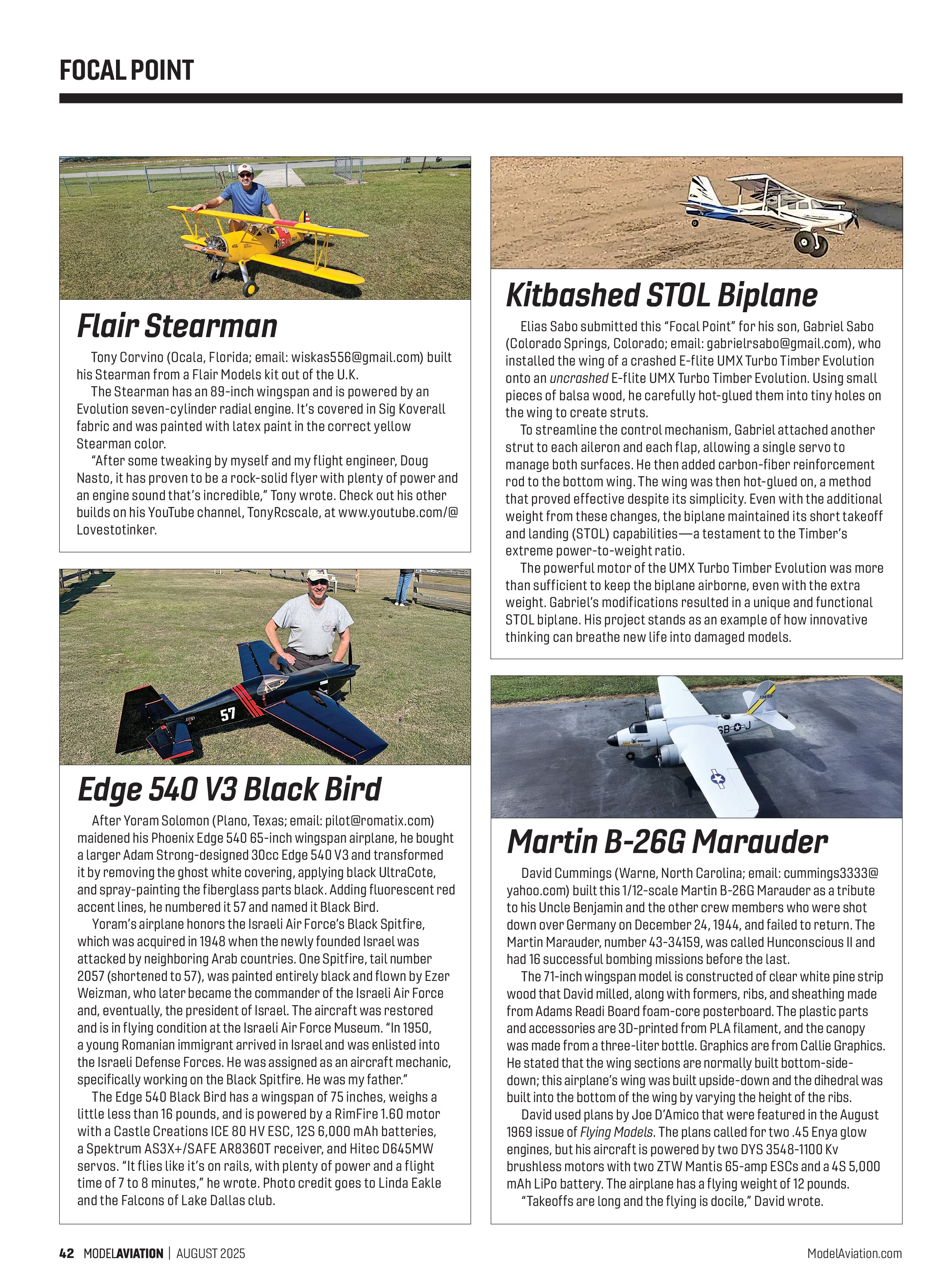
Tony Corvino (Ocala, Florida; email: wiskas556@gmail.com) built his Stearman from a Flair Models kit out of the U.K.
The Stearman has an 89-inch wingspan and is powered by an Evolution seven-cylinder radial engine. It’s covered in Sig Koverall fabric and was painted with latex paint in the correct yellow Stearman color.
“After some tweaking by myself and my flight engineer, Doug Nasto, it has proven to be a rock-solid flyer with plenty of power and an engine sound that’s incredible,” Tony wrote. Check out his other builds on his YouTube channel, TonyRscale, at www.youtube.com/@Lovestotinker.

Edge 540 V3 Black Bird
After Yoram Solomon (Plano, Texas; email: pilot@romatix.com) maidened his Phoenix Edge 540 65-inch wingspan airplane, he bought a larger Adam Strong-designed 30cc Edge 540 V3 and transformed it by removing the ghost white covering, applying black UltraCote, and spray-painting the fiberglass parts black. Adding fluorescent red accent lines, he numbered it 57 and named it Black Bird.
Yoram’s airplane honors the Israeli Air Force’s Black Spitfire, which was acquired in 1948 when the newly founded Israel was attacked by neighboring Arab countries. One Spitfire, tail number 2057 (shortened to 57), was painted entirely black and flown by Ezer Weizman, who later became the commander of the Israeli Air Force and, eventually, the president of Israel. The aircraft was restored and is in flying condition at the Israeli Air Force Museum. “In 1950, a young Romanian immigrant arrived in Israel and was enlisted into the Israeli Defense Forces. He was assigned as an aircraft mechanic, specifically working on the Black Spitfire. He was my father.”
The Edge 540 Black Bird has a wingspan of 75 inches, weighs a little less than 16 pounds, and is powered by a RimFire 1.60 motor with a Castle Creations ICE 80 HV ESC, 12S 6,000 mAh batteries, a Spektrum AS3X+/SAFE AR8360T receiver, and Hitec D645MW servos. “It flies like it’s on rails, with plenty of power and a flight time of 7 to 8 minutes,” he wrote. Photo credit goes to Linda Eakle and the Falcons of Lake Dallas club.

Kithashed STOL Biplane
Elias Sabo submitted this “Focal Point” for his son, Gabriel Sabo (Colorado Springs, Colorado; email: gabriel.sabo@gmail.com), who installed the wings of a crashed E-flite UMX Turbo Timber Evolution onto an uncrashed E-flite UMX Turbo Timber Evolution. Using small pieces of balsa wood, he carefully hot-glued them into tiny holes on the wing to create struts.
To streamline the control mechanism, Gabriel attached another strut to each aileron and each flap, allowing a single servo to manage both surfaces. He then added carbon-fiber reinforcement rod to the bottom wing. The wing was then hot-glued on, a method that proved effective despite its simplicity. Even with the additional weight from these changes, the biplane maintained its short takeoff and landing (STOL) capabilities—a testament to the Timber’s extreme power-to-weight ratio.
The powerful motor of the UMX Turbo Timber Evolution was more than sufficient to keep the biplane airborne, even with the extra weight. Gabriel’s modifications resulted in a unique and functional STOL biplane. His project stands as an example of how innovative thinking can breathe new life into damaged models.

Martin B-26G Marauder
David Cummings (Warne, North Carolina; email: cummings3333@yahoo.com) built this 1/12-scale Martin B-26G Marauder as a tribute to his Uncle Benjamin and the other crew members who were shot down over Germany on December 24, 1944, and failed to return. The Martin Marauder, number 43-34159, was called Hunsconscious II and had 16 successful bombing missions before the last.
The 71-inch wingspan model is constructed of clear white pine strip wood that David milled, along with formers, ribs, and sheathing made from Adams Readi Board foam-core posterboard. The plastic parts and accessories are 3D-printed from PLA filament, and the canopy was made from a three-liter bottle. Graphics are from Callie Graphics. He stated that the wing sections are normally built bottom-side-down; this airplane’s wing was built upside-down and the dihedral was built into the bottom of the wing by varying the height of the ribs.
David used plans by Joe D’Amico that were featured in the August 1969 issue of Flying Models. The plans called for two .45 Enya glow engines, but his aircraft is powered by two DYS 3548-1100 Kv brushless motors with two ZTW Mantis 65-amp ESCs and a 4S 5,000 mAh LiPo battery. The airplane has a flying weight of 12 pounds. “Takeoffs are long and the flying is docile,” David wrote.

Great Planes Piper Cub Special
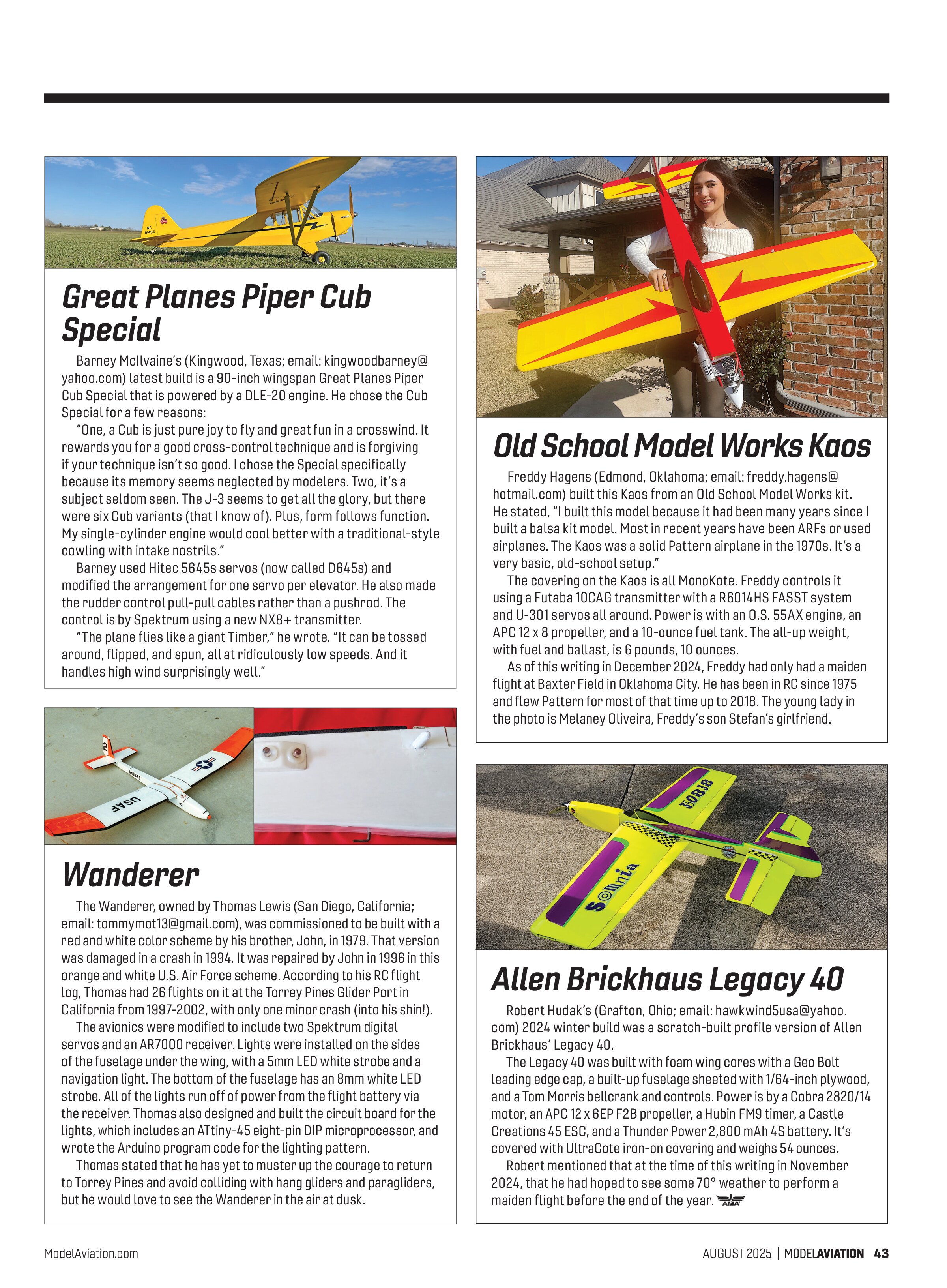
Barney McIlvaine’s (Kingwood, Texas; email: kingwoodbarney@yahoo.com) latest build is a 90-inch wingspan Great Planes Piper Cub Special that is powered by a DLE-20 engine. He chose the Cub Special for a few reasons:
“One, a Cub is just pure joy to fly and great fun in a crosswind. It rewards you for a good cross-control technique and is forgiving if your technique isn’t so good. I chose the Special specifically because its memory seems neglected by modelers. Two, it’s a subject seldom seen. The J-3 seems to get all the glory, but there were six Cub variants (that I know of). Plus, form follows function. My single-cylinder engine would cool better with a traditional-style cowling with intake nostrils.”
Barney used Hitec 5645s servos (now called D645s) and modified the arrangement for one servo per elevator. He also made the rudder control pull-pull cables rather than a pushrod. The control is by Spektrum using a new NX8+ transmitter.
“The plane flies like a giant Timber,” he wrote. “It can be tossed around, flipped, and spun, all at ridiculously low speeds. And it handles high wind surprisingly well.”

Old School Model Works Kaos
Freddy Hagens (Edmond, Oklahoma; email: freddy.hagens@hotmail.com) built this Kaos from an Old School Model Works kit. He stated, “I built this model because it had been many years since I built a balsa kit model. Most in recent years have been ARFs or used airplanes. The Kaos was a solid Pattern airplane in the 1970s. It’s a very basic, old-school setup.”
The covering on the Kaos is all MonoKote. Freddy controls it using a Futaba 10CAG transmitter with a R6014HS FASST system and U-301 servos all around. Power is with an O.S. 55AX engine, an APC 12 x 8 propeller, and a 10-ounce fuel tank. The all-up weight, with fuel and ballast, is 6 pounds, 10 ounces.
As of this writing in December 2024, Freddy had only had a maiden flight at Baxter Field in Oklahoma City. He has been in RC since 1975 and flew Pattern for most of that time up to 2018. The young lady in the photo is Melaney Oliveira, Freddy’s son Stefan’s girlfriend.

Wanderer
The Wanderer, owned by Thomas Lewis (San Diego, California; email: tommymot13@gmail.com), was commissioned to be built with a red and white color scheme by his brother, John, in 1979. That version was damaged in a crash in 1994. It was repaired by John in 1996 in this orange and white U.S. Air Force scheme. According to his RC flight log, Thomas had 26 flights on it at the Torrey Pines Glider Port in California from 1997-2002, with only one minor crash (into his shin!).
The avionics were modified to include two Spektrum digital servos and an AR7000 receiver. Lights were installed on the sides of the fuselage under the wing, with a 5mm LED white strobe and a navigation light. The bottom of the fuselage has an 8mm white LED strobe. All of the lights run off of power from the flight battery via the receiver. Thomas also designed and built the circuit board for the lights, which includes an ATtiny-45 eight-pin DIP microprocessor, and wrote the Arduino program code for the lighting pattern.
Thomas stated that he has yet to muster up the courage to return to Torrey Pines and avoid colliding with hang gliders and paragliders, but he would love to see the Wanderer in the air at dusk.

Allen Brickhaus Legacy 40
Robert Hudak’s (Grafton, Ohio; email: hawkwind5usa@yahoo.com) 2024 winter build was a scratch-built profile version of Allen Brickhaus’ Legacy 40.
The Legacy 40 was built with foam wing cores with a Geo Bolt leading edge cap, a built-up fuselage sheeted with 1/64-inch plywood, and a Tom Morris bellcrank and controls. Power is by a Cobra 2820/14 motor, an APC 12 x 6EP F2B propeller, a Hubin FM9 timer, a Castle Creations 45 ESC, and a Thunder Power 2,800 mAh 4S battery. It’s covered with UltraCote iron-on covering and weighs 54 ounces.
Robert mentioned that at the time of this writing in November 2024, that he had hoped to see some 70° weather to perform a maiden flight before the end of the year.