LESS IS MORE
By Dave Scott | 1usrcfs@gmail.com

THIS MONTH, I am sharing a short story that highlights a common airplane setup mindset that causes many RC pilots to unnecessarily struggle.
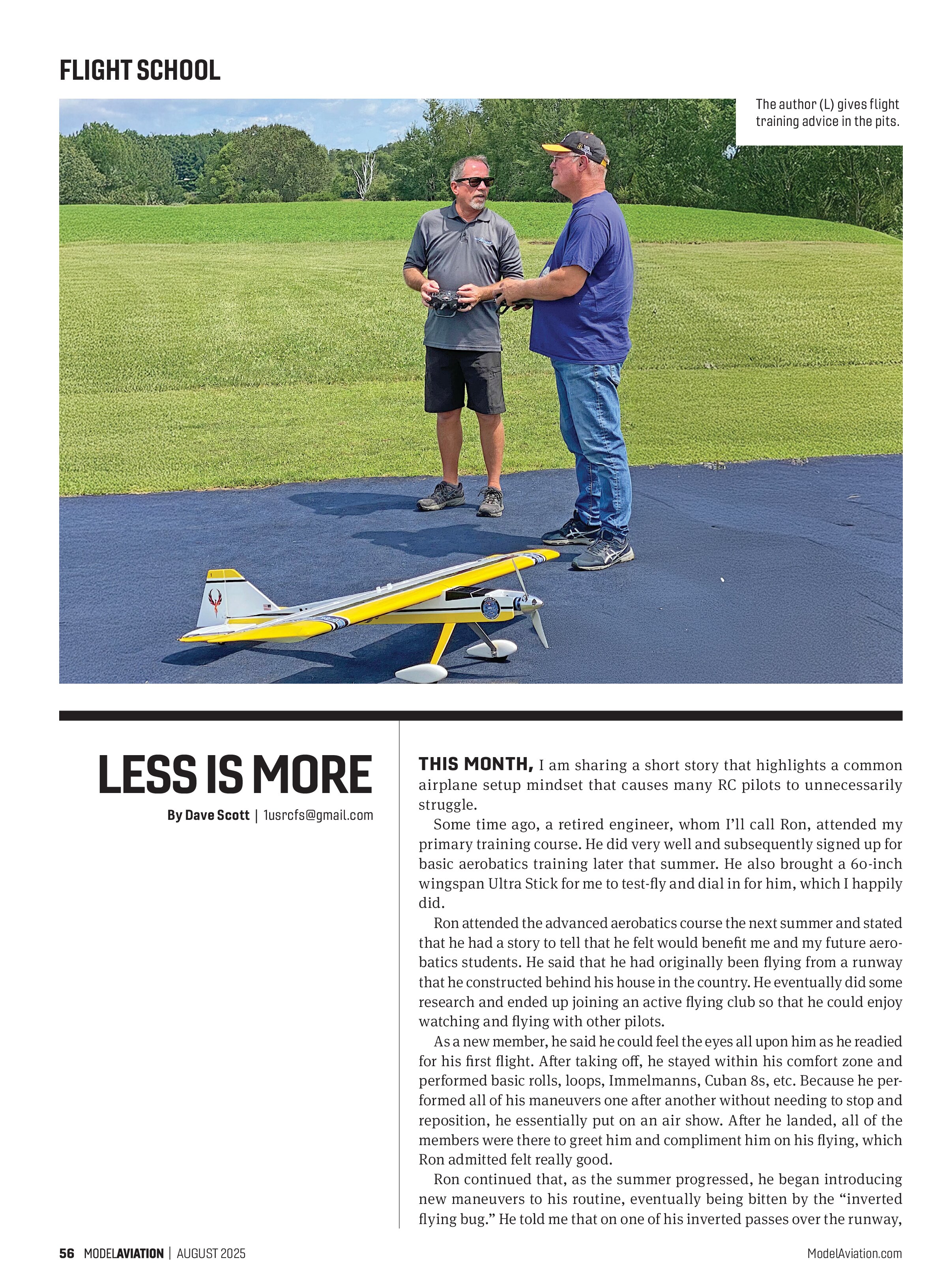
Some time ago, a retired engineer, whom I’ll call Ron, attended my primary training course. He did very well and subsequently signed up for basic aerobatics training later that summer. He also brought a 60-inch wingspan Ultra Stick for me to test-fly and dial in for him, which I happily did.
Ron attended the advanced aerobatics course the next summer and stated that he had a story to tell that he felt would benefit me and my future aerobatics students. He said that he had originally been flying from a runway that he constructed behind his house in the country. He eventually did some research and ended up joining an active flying club so that he could enjoy watching and flying with other pilots.
As a new member, he said he could feel the eyes all upon him as he readied for his first flight. After taking off, he stayed within his comfort zone and performed basic rolls, loops, Immelmanns, Cuban 8s, etc. Because he performed all of his maneuvers one after another without needing to stop and reposition, he essentially put on an air show. After he landed, all of the members were there to greet him and compliment him on his flying, which Ron admitted felt really good.
Ron continued that, as the summer progressed, he began introducing new maneuvers to his routine, eventually being bitten by the “inverted flying bug.” He told me that on one of his inverted passes over the runway, he got a little jumpy and pulled elevator instead of pushing up. As a result, with several people watching, he proceeded to disintegrate his Ultra Stick down the centerline of the runway. With this being his first crash, he was very disappointed in himself.
Of course, when this happened, everyone came out to help pick up the pieces. The members assumed that Ron was too good of a pilot to crash, so something must have failed on the model. He admitted however, that he had applied the elevator in the wrong direction. One of the members suggested that if his model had had more elevator travel, he could have recovered after his mistake. Everyone nodded in agreement, including Ron.
This was the advice that Ron offered me: “Dave, your instruction lays a foundation that results in your students, when they get home, advancing beyond what you teach us. Therefore, when you set up peoples’ planes in the future, you might want to consider setting them up with a little extra control throw in case they get into trouble and need to quickly recover.”
(Note: By that reasoning, we should put student drivers into Formula 1 cars in case they get into trouble and need to respond more quickly. I jest, of course.)
Ron then relaxed in his chair, confident that his suggestion would contribute to helping me be a more effective instructor. Although I credit a lot of my teaching ability to my exchanges with thousands of RC pilots of all skills levels and backgrounds, in this case, I had to inform Ron that the reality was just the opposite! Not expecting that response, I could see him trying to figure out what I meant. A few seconds later, he threw up his arms, realizing his mistake.
Before Ron had time to scrutinize events after the crash happened, he was given advice that seemed to make sense on the surface, and he never gave it another thought. So, I ask you, the reader: Do you understand why more travel would have made things worse for Ron and not better? If you don’t, I suggest that

you give it some thought before you read any further.
Obviously, if Ron’s Ultra Stick had more travel, it would have crashed more abruptly when he made his mistake. Because it would have happened so fast, he just might have attributed the crash to sudden turbulence or radio problems. With the way his airplane was set up, he at least had time to realize his mistake and switch elevator almost in time to save the model.
(Note: Space does not permit me to go into why adding significant amounts of exponential to offset lots of travel would have made things worse and not better. That will have to wait for another column.)
The most significant takeaway from this story isn’t Ron’s crash. It is this: By setting up his airplane to match his skill/comfort level, Ron hit the ground running after training with me and felt confident enough to start trying new maneuvers on his own.
The whole reason why he was doing low, inverted passes over the runway in the first place was because he felt super comfortable with his airplane. The reality is that if I would have set up his airplane with more travel than what he needed “in case” he made a mistake, he might still be stuck practicing basic aerobatics because the airplane was overly sensitive and prone to magnifying his mistakes.
After discussing it further, we diagnosed that the real reason for the crash was because he had been flying all day and had become tired.
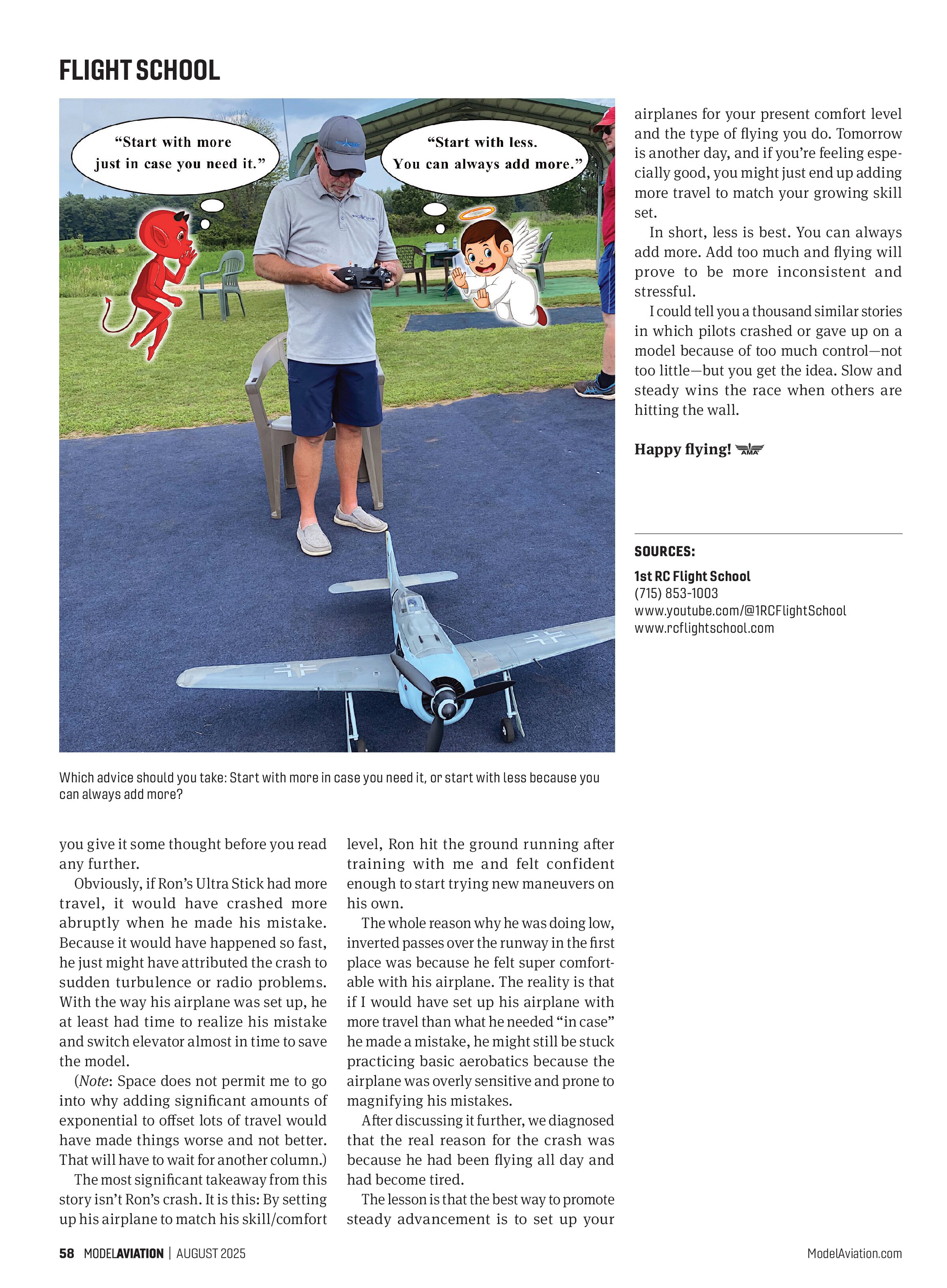
The lesson is that the best way to promote steady advancement is to set up your airplanes for your present comfort level and the type of flying you do. Tomorrow is another day, and if you’re feeling especially good, you might just end up adding more travel to match your growing skill set.
In short, less is best. You can always add more. Add too much and flying will prove to be more inconsistent and stressful.
I could tell you a thousand similar stories in which pilots crashed or gave up on a model because of too much control—not too little—but you get the idea. Slow and steady wins the race when others are hitting the wall.
Happy flying!
SOURCES:
1st RC Flight School
(715) 853-1003
www.youtube.com/@1RCFlightSchool
www.rcflightschool.com