ELECTRICS

READER RESPONSES
By Terry Dunn | terrydunn74@gmail.com
THANKS TO A SURGE of input from all of you, I have a lot of topics to cover this month, so I’ll dive right in.
Gary Jones, of San Angelo, Texas, is known for his collection of unique RC aircraft. Although Gary designs and builds most of his offbeat models himself, his latest oddity had a slightly different genesis. It was designed and built by Reegan May several years ago. Reegan recently gave the airframe to Gary, who then made it airworthy.
If you think this model looks like a spaceship straight from science fiction, that’s because it is! Reegan’s design is based on the Asgard O’Neill-class ships from the TV series Stargate. The completed foam model is 40 inches long, has a 36-inch wingspan, and weighs a little more than 11 ounces. It uses elevons for control. The power system consists of a SunnySky X2204-12 1,800 Kv motor with a 6 x 3 propeller, a SunnySky 18-amp ESC, and a three-cell 800 mAh LiPo battery.
Gary has successfully flown his TV spaceship. He is now working on getting the center of gravity dialed in. You can find video of the Stargate-inspired model on Gary’s YouTube channel, listed in “Sources.”
The next featured model comes from the fertile mind and talented hands of Keith Sparks. It is a Scale model of the McDonnell-Douglas MD-80. This is not Sparky’s first “Mad Dog” model. His previous version had a span of 84 inches. It was published in the November 2006 issue of Flying Models magazine. Plans are still available (see the “Sources” section). Keith downsized those plans to create the new model with just a 34-inch wingspan. He used 3mm and 6mm Depron foam for construction.
All of the electronics for the “fun-size” MD-80 were scavenged from an E-flite UMX A-10. In fact, the A-10’s twin 28mm EDF units and the foam housings were grafted right to the airliner’s fuselage. With a two-cell 800 mAh LiPo battery, the model’s flying weight is just shy of 9 ounces. Four-minute flights are the norm.
We have all come to expect exceptional models to emerge from Keith’s workshop. His mini MD-80 continues that legacy. What a beauty!
Lithium-Ion Info
I received several emails about the April 2025 column, where I discussed my recent trials using high-discharge Li-Ion battery cells. Thanks to all of you for that feedback. It is clear that some of you have been tuned into Li-Ion batteries for much longer than I have.
Several people pointed out that it is more common to use spot-welded nickel strips to connect Li-Ion battery cells, versus the soldered copper braid that I used. Numerous hobby-grade spot-welding tools are available for approximately $35.
The primary advantage of spot-welded connections instead of solder is that much less heat is transferred to the cell during the attachment process. Applying a significant amount of heat could cause damage to the battery. Even so, I found myself wondering whether a spot-welded connection would have higher electrical resistance than a soldered joint.
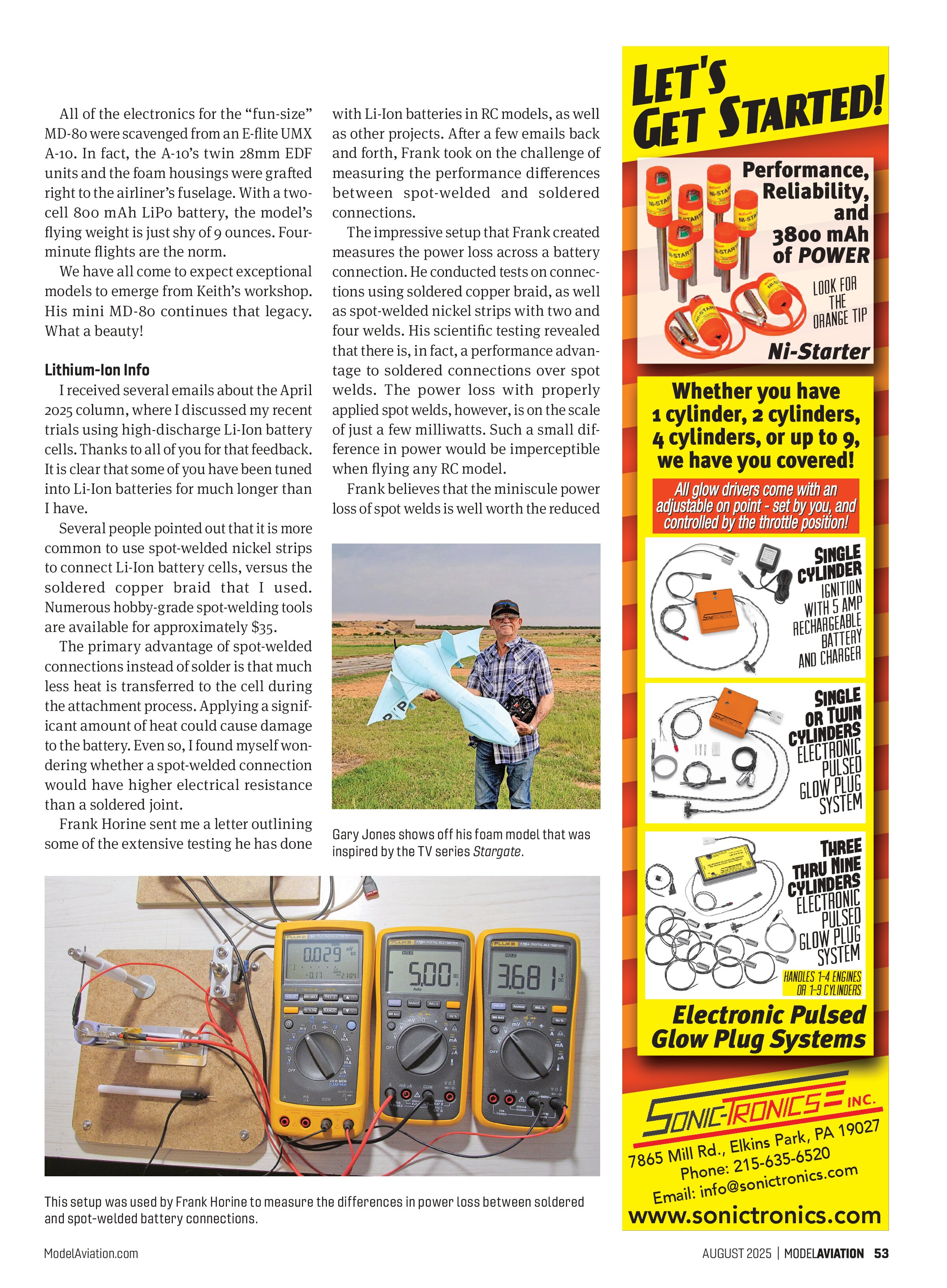
Frank Horine sent me a letter outlining some of the extensive testing he has done with Li-Ion batteries in RC models, as well as other projects. After a few emails back and forth, Frank took on the challenge of measuring the performance differences between spot-welded and soldered connections.
The impressive setup that Frank created measures the power loss across a battery connection. He conducted tests on connections using soldered copper braid, as well as spot-welded nickel strips with two and four welds. His scientific testing revealed that there is, in fact, a performance advantage to soldered connections over spot welds. The power loss with properly applied spot welds, however, is on the scale of just a few milliwatts. Such a small difference in power would be imperceptible when flying any RC model.
Frank believes that the miniscule power loss of spot welds is well worth the reduced


risk of damaging the cells while building a battery pack. Many thanks to Frank for lending his time and expertise to settle the debate.
Battery Spatula
Most of us use hook-and-loop tape to secure the flight battery in a model. While this works great in most cases, the battery can be difficult to remove in models with a confined battery compartment. Sometimes there just isn’t enough room to grab the battery and separate the hook-and-loop tape. I’m sure that none of us would ever pull on the power wires for a little extra leverage ... right?
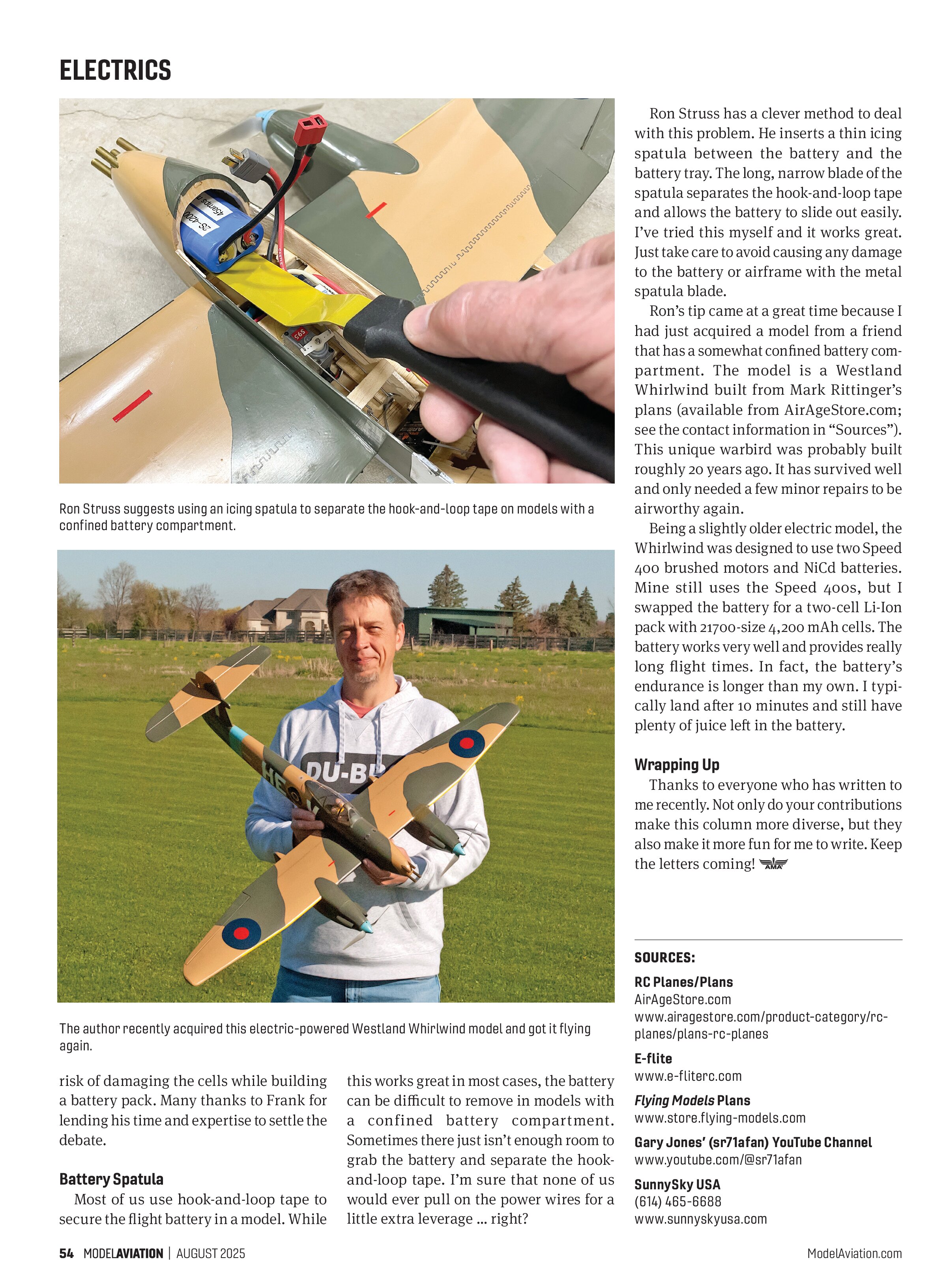
Ron Struss has a clever method to deal with this problem. He inserts a thin icing spatula between the battery and the battery tray. The long, narrow blade of the spatula separates the hook-and-loop tape and allows the battery to slide out easily. I’ve tried this myself and it works great. Just take care to avoid causing any damage to the battery or airframe with the metal spatula blade.
Ron’s tip came at a great time because I had just acquired a model from a friend that has a somewhat confined battery compartment. The model is a Westland Whirlwind built from Mark Rittinger’s plans (available from AirAgeStore.com; see the contact information in “Sources”).


Being a slightly older electric model, the Whirlwind was designed to use two Speed 400 brushed motors and NiCd batteries. Mine still uses the Speed 400s, but I swapped the battery for a two-cell Li-Ion pack with 21700-size 4,200 mAh cells. The battery works very well and provides really long flight times. In fact, the battery’s endurance is longer than my own. I typically land after 10 minutes and still have plenty of juice left in the battery.
Wrapping Up
Thanks to everyone who has written to me recently. Not only do your contributions make this column more diverse, but they also make it more fun for me to write. Keep the letters coming!
Sources:
RC Planes/Plans
AirAgeStore.com
www.airagestore.com/product-category/rc-planes/plans-rc-planes
E-flite
www.e-fliterc.com
Flying Models Plans
www.store.flying-models.com
Gary Jones’ (sr71afan) YouTube Channel
www.youtube.com/@sr71afan
SunnySky USA
(614) 465-6688
www.sunnyskyusa.com