REVISITING A CLASSIC: BUILDING A 1938 COMMODORE
Photos provided by Ryan Bollig | email: rcbollig@gmail.com
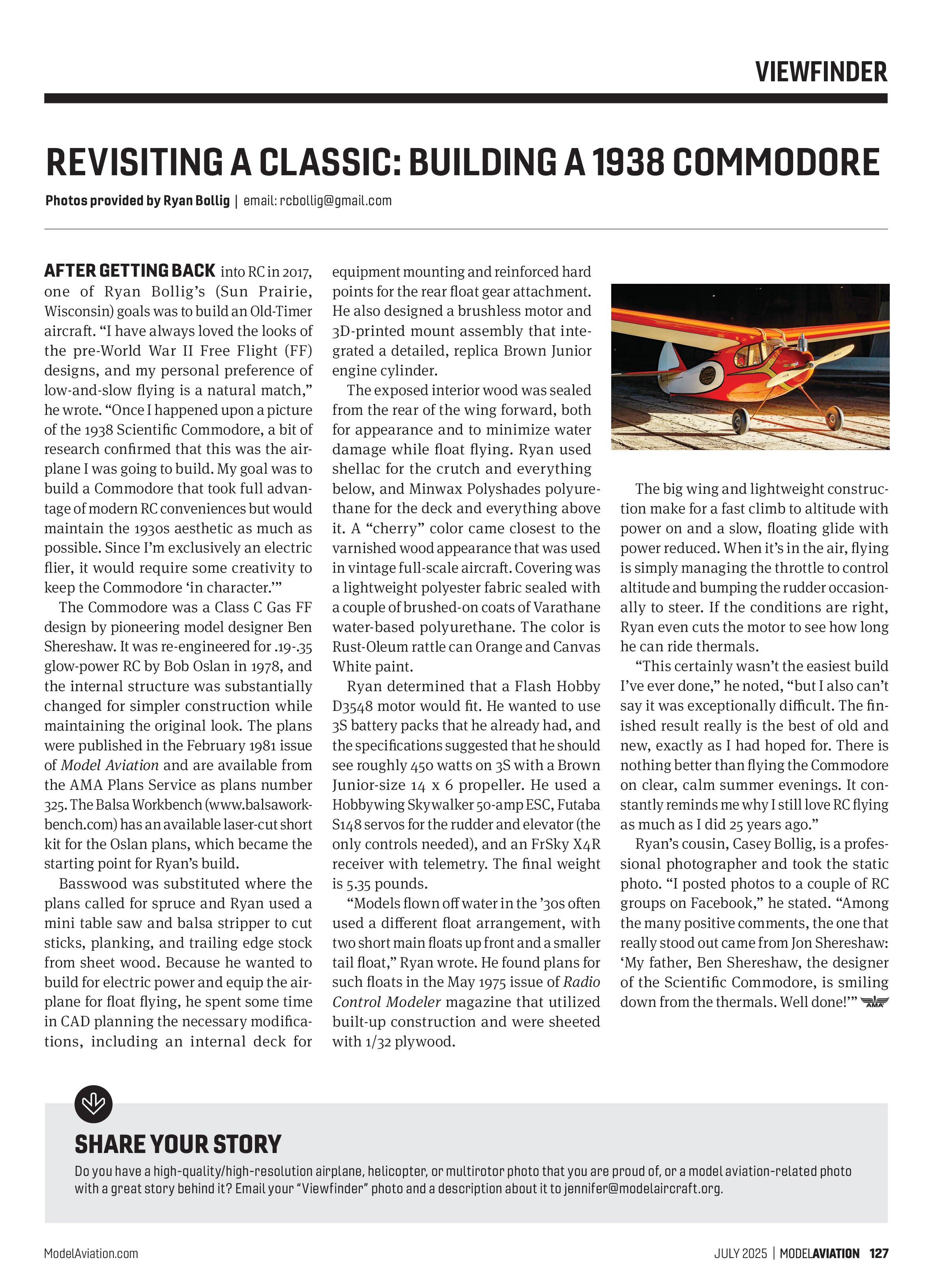
AFTER GETTING BACK into RC in 2017, one of Ryan Bollig’s (Sun Prairie, Wisconsin) goals was to build an Old-Timer aircraft. “I have always loved the looks of the pre-World War II Free Flight (FF) designs, and my personal preference of low-and-slow flying is a natural match,” he wrote. “Once I happened upon a picture of the 1938 Scientific Commodore, a bit of research confirmed that this was the airplane I was going to build. My goal was to build a Commodore that took full advantage of modern RC conveniences but would maintain the 1930s aesthetic as much as possible. Since I’m exclusively an electric flier, it would require some creativity to keep the Commodore ‘in character.’”
The Commodore was a Class C Gas FF design by pioneering model designer Ben Shereshaw. It was re-engineered for .19-.35 glow-power RC by Bob Oslan in 1978, and the internal structure was substantially changed for simpler construction while maintaining the original look. The plans were published in the February 1981 issue of Model Aviation and are available from the AMA Plans Service as plans number 325. The Balsa Workbench (www.balsaworkbench.com) has an available laser-cut short kit for the Oslan plans, which became the starting point for Ryan’s build.
Basswood was substituted where the plans called for spruce and Ryan used a mini table saw and balsa stripper to cut sticks, planking, and trailing edge stock from sheet wood. Because he wanted to build for electric power and equip the airplane for float flying, he spent some time in CAD planning the necessary modifications, including an internal deck for equipment mounting and reinforced hard points for the rear float gear attachment. He also designed a brushless motor and 3D-printed mount assembly that integrated a detailed, replica Brown Junior engine cylinder.
The exposed interior wood was sealed from the rear of the wing forward, both for appearance and to minimize water damage while float flying. Ryan used shellac for the crutch and everything below, and Minwax Polyshades polyure-thane for the deck and everything above it. A “cherry” color came closest to the varnished wood appearance that was used in vintage full-scale aircraft. Covering was a lightweight polyester fabric sealed with a couple of brushed-on coats of Varathane water-based polyurethane. The color is Rust-Oleum rattle can Orange and Canvas White paint.
Ryan determined that a Flash Hobby D3548 motor would fit. He wanted to use 3S battery packs that he already had, and the specifications suggested that he should see roughly 450 watts on 3S with a Brown Junior-size 14 x 6 propeller. He used a Hobbywing Skywalker 50-amp ESC, Futaba S148 servos for the rudder and elevator (the only controls needed), and an FrSky X4R receiver with telemetry. The final weight is 5.35 pounds.
“Models flown off water in the ’30s often used a different float arrangement, with two short main floats up front and a smaller tail float,” Ryan wrote. He found plans for such floats in the May 1975 issue of Radio Control Modeler magazine that utilized built-up construction and were sheeted with 1/32 plywood.

The big wing and lightweight construction make for a fast climb to altitude with power on and a slow, floating glide with power reduced. When it’s in the air, flying is simply managing the throttle to control altitude and bumping the rudder occasionally to steer. If the conditions are right, Ryan even cuts the motor to see how long he can ride thermals.
“This certainly wasn’t the easiest build I’ve ever done,” he noted, “but I also can’t say it was exceptionally difficult. The finished result really is the best of old and new, exactly as I had hoped for. There is nothing better than flying the Commodore on clear, calm summer evenings. It constantly reminds me why I still love RC flying as much as I did 25 years ago.”
Ryan’s cousin, Casey Bollig, is a professional photographer and took the static photo. “I posted photos to a couple of RC groups on Facebook,” he stated. “Among the many positive comments, the one that really stood out came from Jon Shereshaw: ‘My father, Ben Shereshaw, the designer of the Scientific Commodore, is smiling down from the thermals. Well done!’”
SHARE YOUR STORY
Do you have a high-quality/high-resolution airplane, helicopter, or multirotor photo that you are proud of, or a model aviation-related photo with a great story behind it? Email your “Viewfinder” photo and a description about it to jennifer@modelaircraft.org.