JOE WURTS: 2025 F5J WORLD CHAMPIONSHIP
By Gordon Buckland | gordon@gatorf3b.com

TWO AMAZING THINGS occurred during the 2025 Fédération Aéronautique Internationale (FAI) F5J World Championship for Electric Powered Thermal Duration Gliders, which was held in Argentina in March during the Southern Hemisphere’s late summer.
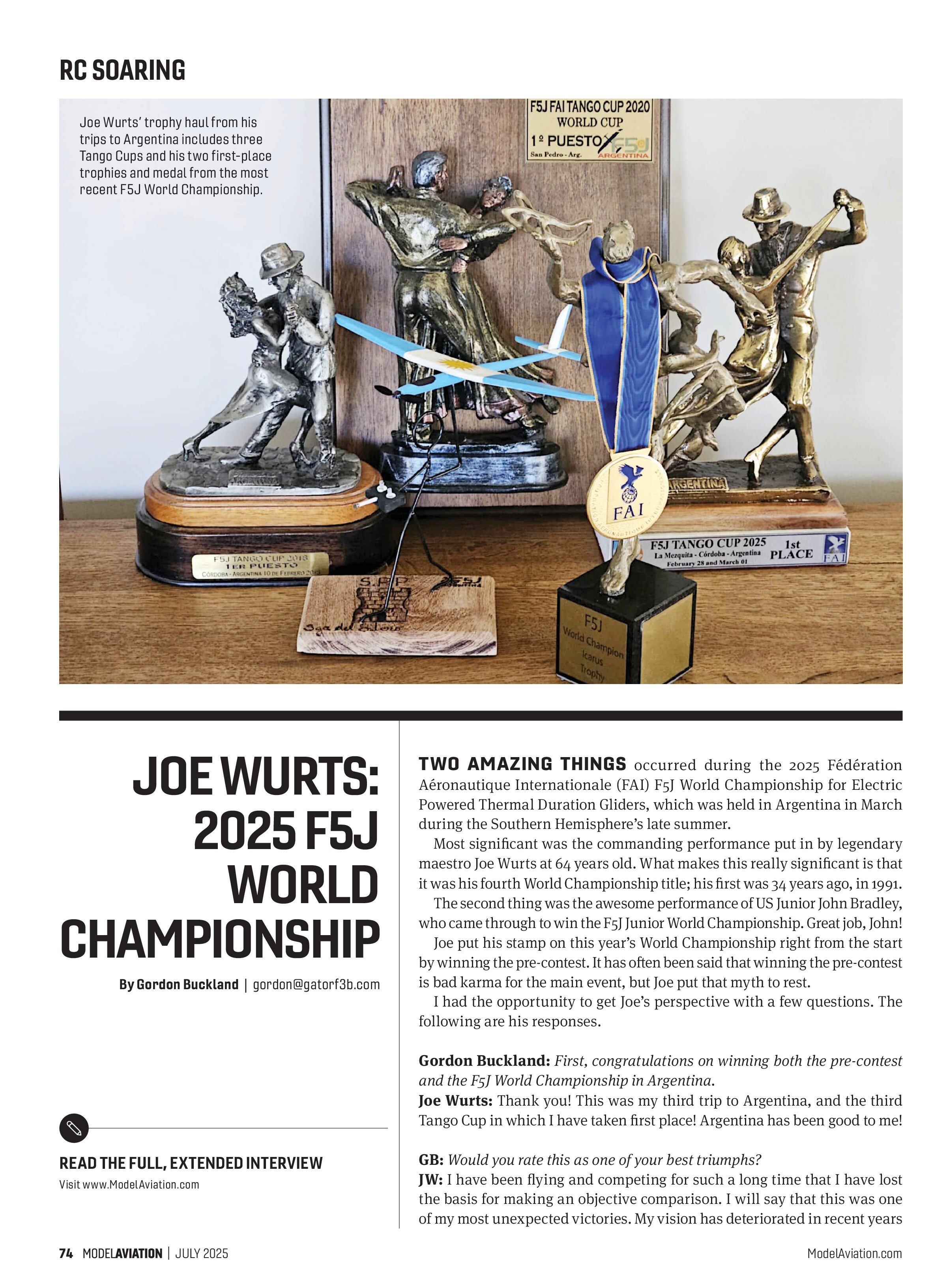
Most significant was the commanding performance put in by legendary maestro Joe Wurts at 64 years old. What makes this really significant is that it was his fourth World Championship title; his first was 34 years ago, in 1991.
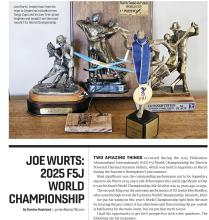
The second thing was the awesome performance of US Junior John Bradley, who came through to win the F5J Junior World Championship. Great job, John!
Joe put his stamp on this year’s World Championship right from the start by winning the pre-contest. It has often been said that winning the pre-contest is bad karma for the main event, but Joe put that myth to rest.
I had the opportunity to get Joe’s perspective with a few questions. The following are his responses.
Gordon Buckland: First, congratulations on winning both the pre-contest and the F5J World Championship in Argentina.
Joe Wurts: Thank you! This was my third trip to Argentina, and the third Tango Cup in which I have taken first place! Argentina has been good to me!
GB: Would you rate this as one of your best triumphs?
JW: I have been flying and competing for such a long time that I have lost the basis for making an objective comparison. I will say that this was one of my most unexpected victories. My vision has deteriorated in recent years because of asteroid hyalosis in my good eye and, more recently, macular degeneration. Because I require the need to fly closer, I had defined my odds of making it onto the podium as being rather low.
GB: What was your preparation in the months leading up to the Worlds?
JW: We had three weekend team training sessions in the six months prior to the World Championship. A bit of this training was focused on getting our newest team member, Pete McEvoy, prepared to fly at a world-class level. Kevin Botherway and I live only a half-hour apart, so we can practice together at short notice. Other than the team practices, I was getting out to fly once or twice a week. I did convert my fleet of Plus X models to DualSky direct-drive because we have had too many gearbox-related motor failures in the past.
The last two weeks prior to departure had bad weather, so I did not do any flying from early February until the 26th. After we arrived in Argentina, Rodrigo Salvador offered his private flying site for practice. This was greatly appreciated because the competition site was closed until the official practice day just prior to the Tango Cup. I had flown at this site once before on my first visit to Argentina, which was also my first Tango Cup.
GB: What was your most memorable flight during the World Championship campaign?
JW: I will start with my most satisfying flights, which might coincide with the most memorable flights! I had almost identical flights in the first round of the Tango Cup flyoff and the first round of the World Championship flyoff. I picked out a strong thermal in front of the building and south of the tents prior to launch, in both cases. All of the other 13 pilots in both slots went downwind of the building, which was typically where the thermals kicked off because of the influence of the building and trees. I had the best air of the bunch in both cases and could stay in it at low level without risk of a midair because I had the thermals to myself.
The second flight of the Tango Cup had an interesting read. The wind had picked up a bit and a thermal clearly blew through maybe a minute prior to the start of the slot. I had a second read that was slightly upwind and to the left and went there first. That tested negative, so my obvious choice was to run downwind to


tag the thermal that had passed a minute prior to launch.
While heading downwind under power, I passed a bunch of sailplanes that were sniffing air. My blind squirrel said to keep going downwind, and maybe 100 meters downwind of the gaggle, I contacted very good lift. Junior and I had the same launch height for the lowest of the group, 20 meters. I climbed out nicely but had to leave very good lift because I couldn’t see the airplane. I think I worked at least six thermals and was utterly shattered by the end of the flight.
The third round of flyoffs for the World Championship was a bit of a cliffhanger. I had a reasonable read upwind and to the left and went there initially. Three other pilots went to the same location but launched much higher than I did (I was the only sub-100-meter launch in the group). I did not contact anything worth stopping for and, again, went downwind to chase something that passed us by a minute prior to launch. This was where
luck came into play. I contacted the thermal with, at most, 30 meters of altitude, rather downwind with strong wind. Just a bit less altitude on launch, or a bit in error on thermal location, and I would have landed with a 2-minute flight.
That said, I hooked up and climbed quickly. Annoyingly, I also drifted downwind quickly. Within a few minutes, I was rather high, but, once again, I could not see my sailplane, so I had to leave the thermal.
As my caller, Kevin was extremely helpful, although I made him work very hard because I was nearly simultaneously asking him to help find my sailplane and to guide me to the next thermal. He was extremely patient and understanding, to say the least. Without him, I would have landed very far away on more than one flight!
The last flyoff round was once again an interesting slot. I went a bit less aggressive on my launch height than the third flyoff round with a 139-meter launch. That ended up being the lowest launch of the group, at least among the fliers who recorded a score. The majority of recorded launch heights were greater than 200 meters for this slot!
For this flyoff group, I started forward and left, did a bit of surfing, then shifted right (south) as others were showing a better corridor. I tried a couple of times to take lift downwind, but I was less than successful compared with the fliers who stayed upwind. Then there was some reasonably good lift and I saw that the upwind fliers were beginning to get punished, so I realized that this was the last train leaving the station and hopped aboard. It was amazing as to how quickly the forward fliers lost altitude. I had mild climb, although a rather fast downwind drift. Eventually, I shifted northward to work a different corridor.
Kev and I spotted a sailplane way south in very good air and I chased that. I contacted and worked it for a bit but decided that the climb versus drift was a losing proposition and left the white sailplane to work that lift without me. The ground signs then suggested another corridor north of the flightline and off I went to surf once again. I could see in my peripheral vision that other airplanes were landing and Kev eventually said that there was only one other sailplane in the air. He pushed me very hard and made me keep margin. Thanks, Kev!
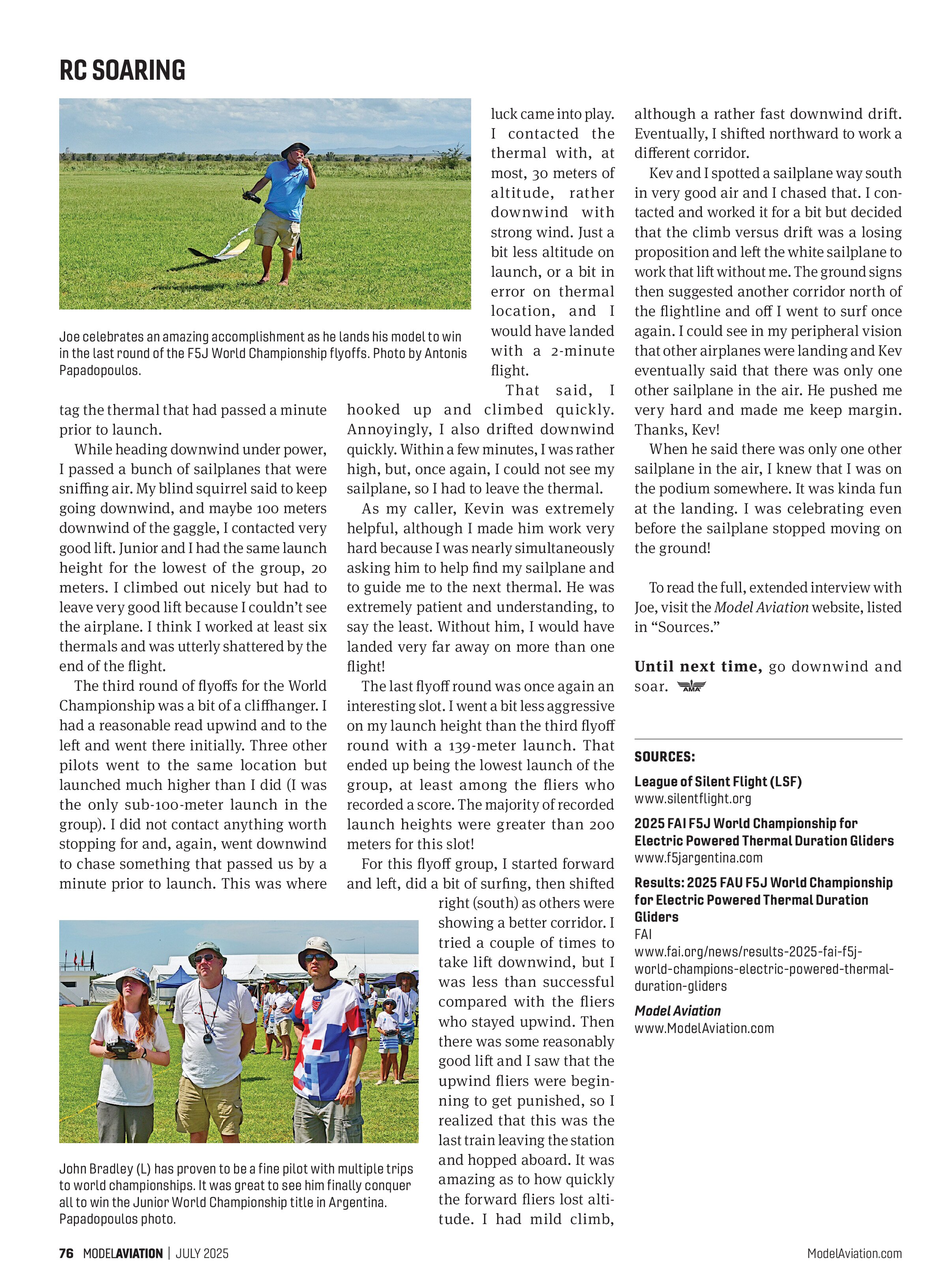
When he said there was only one other sailplane in the air, I knew that I was on the podium somewhere. It was kinda fun at the landing. I was celebrating even before the sailplane stopped moving on the ground!
To read the full, extended interview with Joe, visit the Model Aviation website, listed in “Sources.”
Until next time, go downwind and soar.
SOURCES:
League of Silent Flight (LSF)
www.silentflight.org
2025 FAI F5J World Championship for Electric Powered Thermal Duration Gliders
www.f5jargentina.com
Results: 2025 FAI F5J World Championship for Electric Powered Thermal Duration Gliders
FAI
www.fai.org/news/results-2025-fai-f5j-world-champions-electric-powered-thermal-duration-gliders
Model Aviation
www.ModelAviation.com