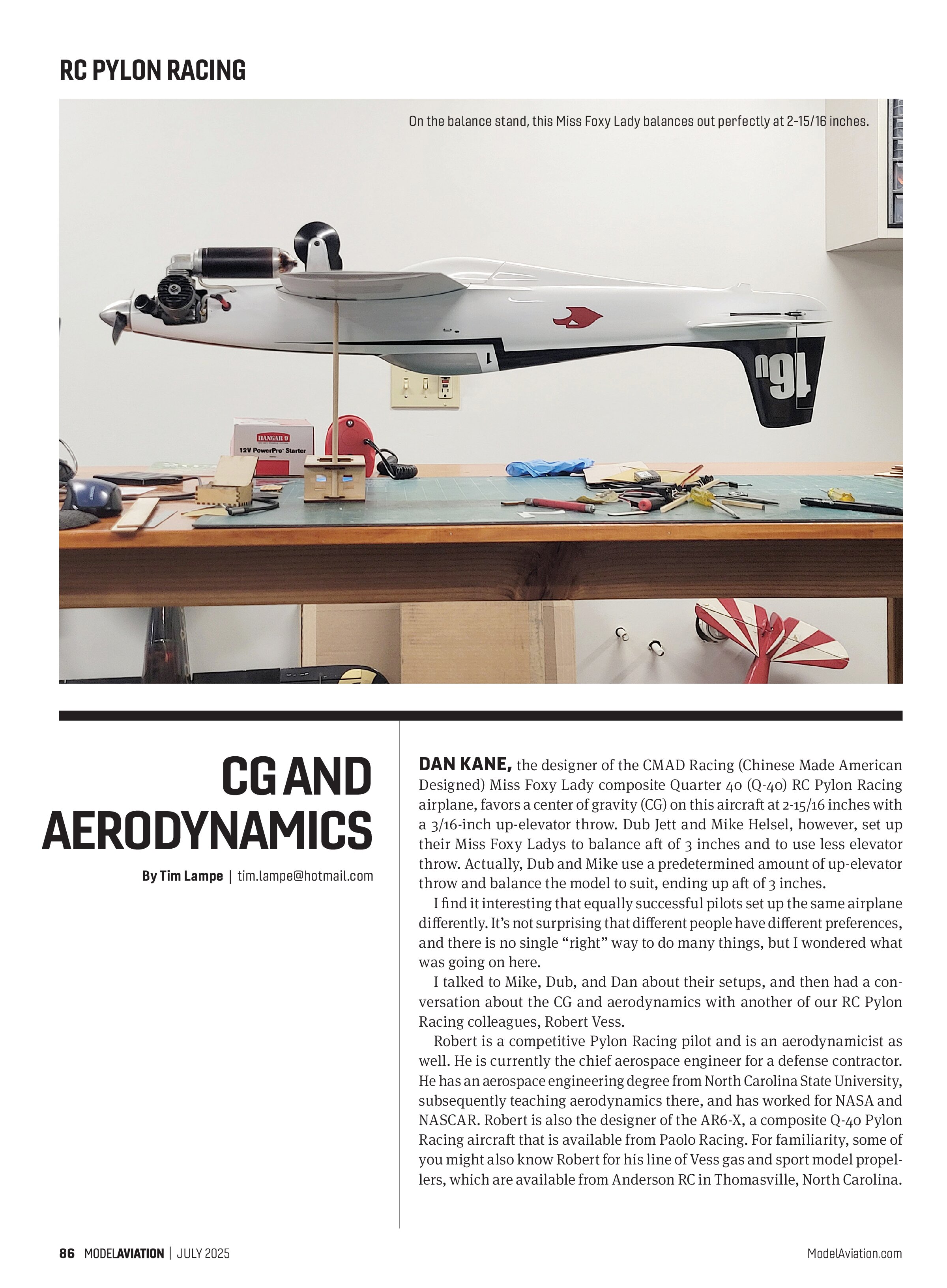
CG AND AERODYNAMICS
By Tim Lampe | tim.lampe@hotmail.com

Listening to Robert was like taking a crash course in aerodynamics. Hopefully what I gleaned from him can be translated into something tangible for this discussion.
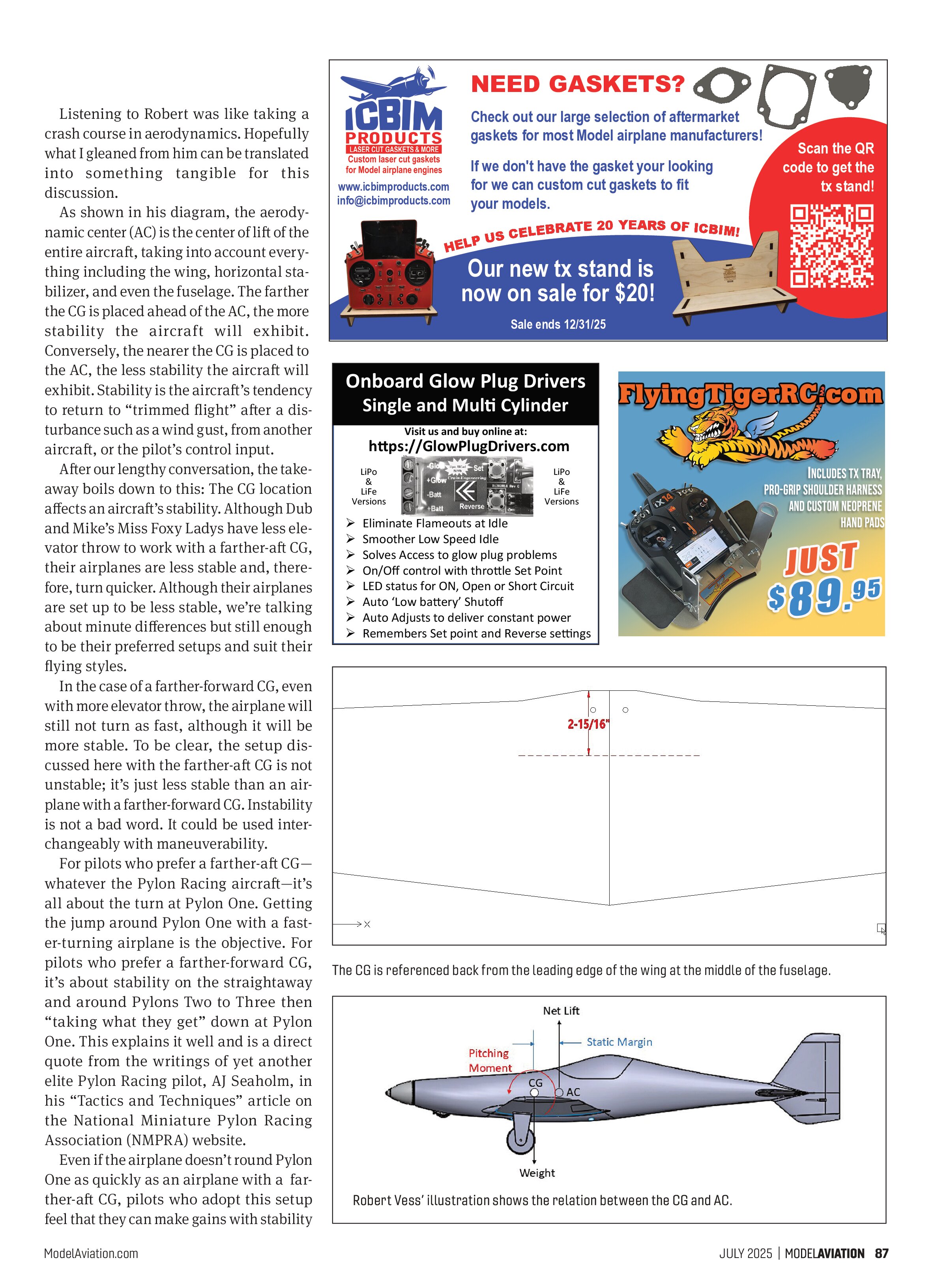
As shown in his diagram, the aerodynamic center (AC) is the center of lift of the entire aircraft, taking into account everything including the wing, horizontal stabilizer, and even the fuselage. The farther the CG is placed ahead of the AC, the more stability the aircraft will exhibit. Conversely, the nearer the CG is placed to the AC, the less stability the aircraft will exhibit. Stability is the aircraft’s tendency to return to “trimmed flight” after a disturbance such as a wind gust, from another aircraft, or the pilot’s control input.

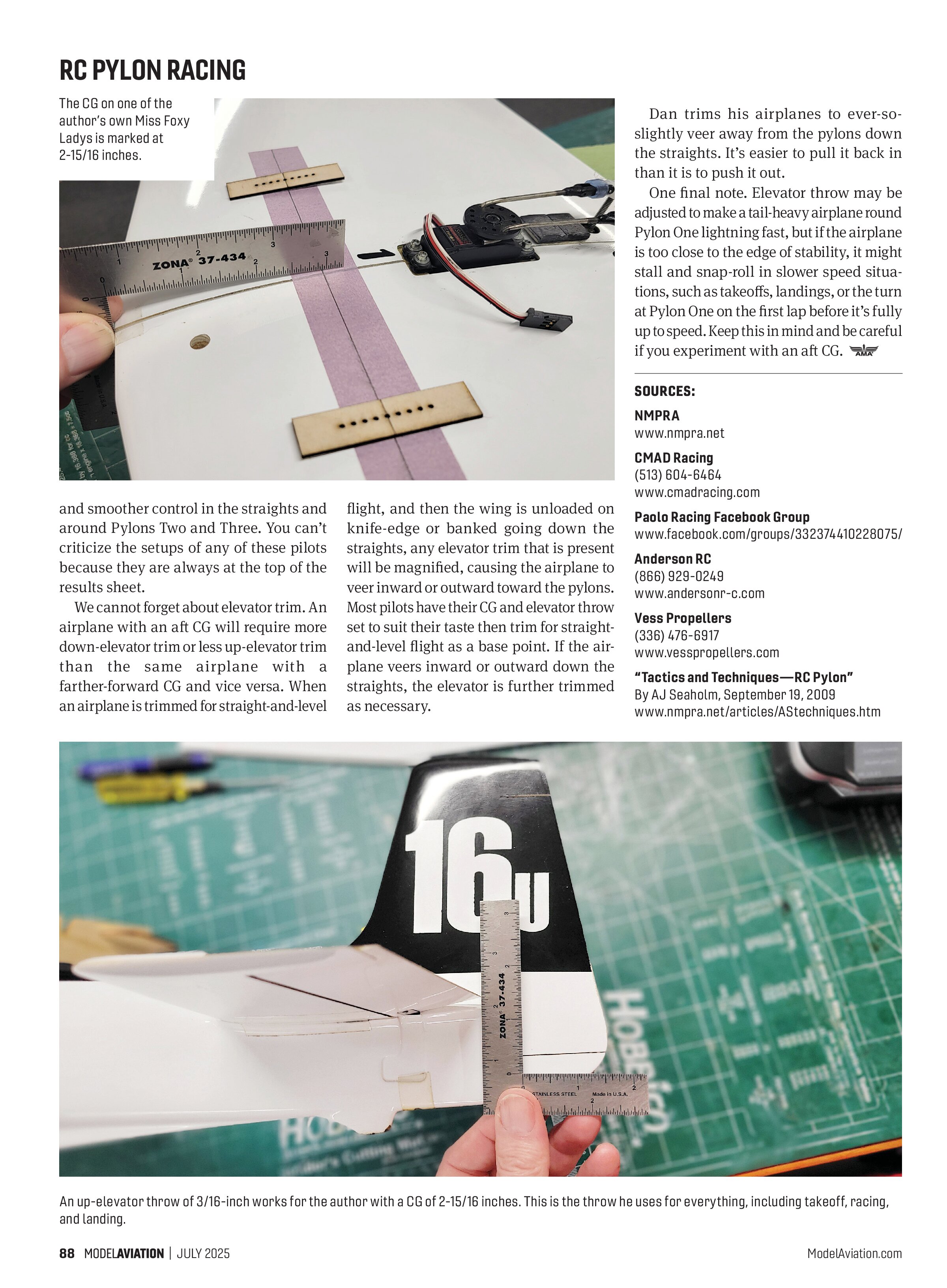
After our lengthy conversation, the takeaway boils down to this: The CG location affects an aircraft’s stability. Although Dub and Mike’s Miss Foxy Ladys have less elevator throw to work with a farther-aft CG, their airplanes are less stable and, therefore, turn quicker. Although their airplanes are set up to be less stable, we’re talking about minute differences but still enough to be their preferred setups and suit their flying styles.
In the case of a farther-forward CG, even with more elevator throw, the airplane will still not turn as fast, although it will be more stable. To be clear, the setup discussed here with the farther-aft CG is not unstable; it’s just less stable than an airplane with a farther-forward CG. Instability is not a bad word. It could be used interchangeably with maneuverability.
For pilots who prefer a farther-aft CG—whatever the Pylon Racing aircraft—it’s all about the turn at Pylon One. Getting the jump around Pylon One with a faster-turning airplane is the objective. For pilots who prefer a farther-forward CG, it’s about stability on the straightaway and around Pylons Two to Three then “taking what they get” down at Pylon One. This explains it well and is a direct quote from the writings of yet another elite Pylon Racing pilot, AJ Seaholm, in his “Tactics and Techniques” article on the National Miniature Pylon Racing Association (NMPRA) website.

Even if the airplane doesn’t round Pylon One as quickly as an airplane with a farther-aft CG, pilots who adopt this setup feel that they can make gains with stability

and smoother control in the straights and around Pylons Two and Three. You can’t criticize the setups of any of these pilots because they are always at the top of the results sheet.
We cannot forget about elevator trim. An airplane with an aft CG will require more down-elevator trim or less up-elevator trim than the same airplane with a farther-forward CG and vice versa. When an airplane is trimmed for straight-and-level flight, and then the wing is unloaded on knife-edge or banked going down the straights, any elevator trim that is present will be magnified, causing the airplane to veer inward or outward toward the pylons. Most pilots have their CG and elevator throw set to suit their taste then trim for straight-and-level flight as a base point. If the airplane veers inward or outward down the straights, the elevator is further trimmed as necessary.
Dan trims his airplanes to ever-so-slightly veer away from the pylons down the straights. It’s easier to pull it back in than it is to push it out.
One final note. Elevator throw may be adjusted to make a tail-heavy airplane round Pylon One lightning fast, but if the airplane is too close to the edge of stability, it might stall and snap-roll in slower speed situations, such as takeoffs, landings, or the turn at Pylon One on the first lap before it’s fully up to speed. Keep this in mind and be careful if you experiment with an aft CG.
SOURCES:
NMPRA
www.nmpra.net
CMAD Racing
(513) 604-6464
www.c-mad-racing.com
Paolo Racing Facebook Group
www.facebook.com/groups/332374410228075/
Anderson RC
(866) 929-0249
www.anderson-r-c.com
Vess Propellers
(336) 476-6917
www.vesspropellers.com
“Tactics and Techniques—RC Pylon”
By AJ Seaholm, September 19, 2009
www.nmpra.net/articles/ASTechniques.htm