Around the Patch
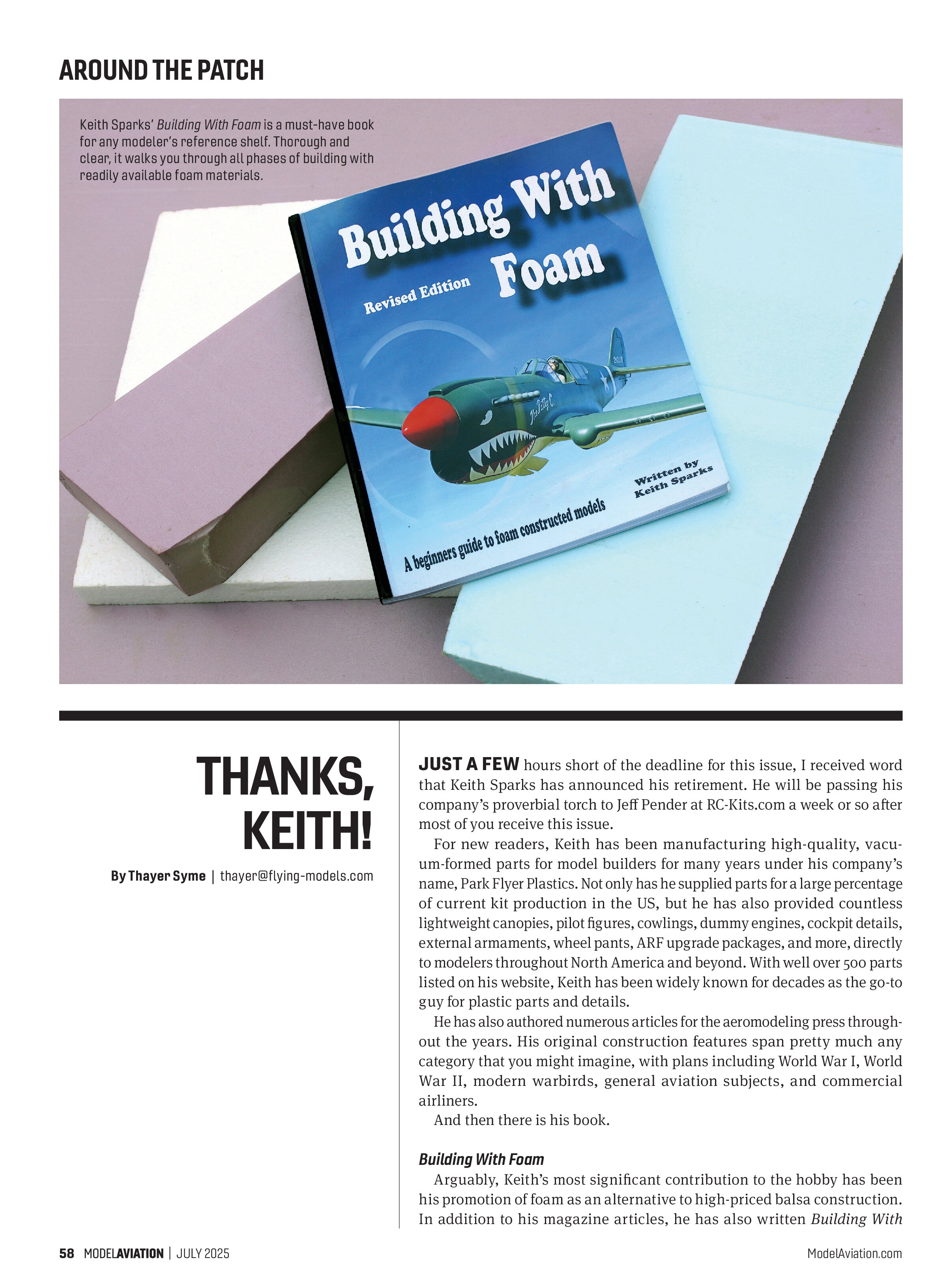
Keith Sparks’ Building With Foam is a must-have book for any modeler’s reference shelf. Thorough and clear, it walks you through all phases of building with readily available foam materials.

THANKS, KEITH!
By Thayer Syme | thayer@flying-models.com
JUST A FEW hours short of the deadline for this issue, I received word that Keith Sparks has announced his retirement. He will be passing his company’s proverbial torch to Jeff Pender at RC-Kits.com a week or so after most of you receive this issue.
For new readers, Keith has been manufacturing high-quality, vacuum-formed parts for model builders for many years under his company’s name, Park Flyer Plastics. Not only has he supplied parts for a large percentage of current kit production in the US, but he has also provided countless lightweight canopies, pilot figures, cowlings, dummy engines, cockpit details, external armaments, wheel pants, ARF upgrade packages, and more, directly to modelers throughout North America and beyond. With well over 500 parts listed on his website, Keith has been widely known for decades as the go-to guy for plastic parts and details.
He has also authored numerous articles for the aeromodeling press throughout the years. His original construction features span pretty much any category that you might imagine, with plans including World War I, World War II, modern warbirds, general aviation subjects, and commercial airliners.
And then there is his book.
Building With Foam
Arguably, Keith’s most significant contribution to the hobby has been his promotion of foam as an alternative to high-priced balsa construction. In addition to his magazine articles, he has also written Building With Foam, the definitive book on foam construction that covers all aspects of working with the wide variety of products that are available today.
If you have any interest in building from plans or from your own designs, foam can offer numerous advantages when compared with our more traditional and beloved balsa wood. It is more readily available and consistent, less expensive, and better suited for creating complex 3D shapes. It can be carved and sanded to shape using a variety of tools, from a humble X-Acto knife to a hot-wire bow or even a CNC mill.
Keith clearly explains the different types of foam that are available, how to work them, and how to select the right foam for each component. Assembly and finishing techniques are also covered, along with mounting equipment and addressing the inevitable repair concerns.
This volume is a must-have for your reference shelf, even among those who consider balsa the one true material for our models—perhaps especially so for that market segment. Many foam models can be built in hours rather than weeks or months, making it the ideal medium for prototyping and fine-tuning new designs. With little concern for water saturation, it is also the preferred material for seaplanes and flying boats—at least the parts that will be in contact with the water, intentionally or otherwise!
Keith still has a few copies of the book available. Email him at sparky2@att.net to buy yours before they’re all gone. Even the diehard “balsa butcher” will find

valuable information within its pages and perhaps a new way to enjoy the hobby.
For years, we have heard that “balsa is king,” and “balsa flies better,” along with many other statements that have tried to persuade us that there is only one route to a “proper” model. Don’t believe it. You can build great models with foam as well and save some money and time in the process.


Back to the Sticks
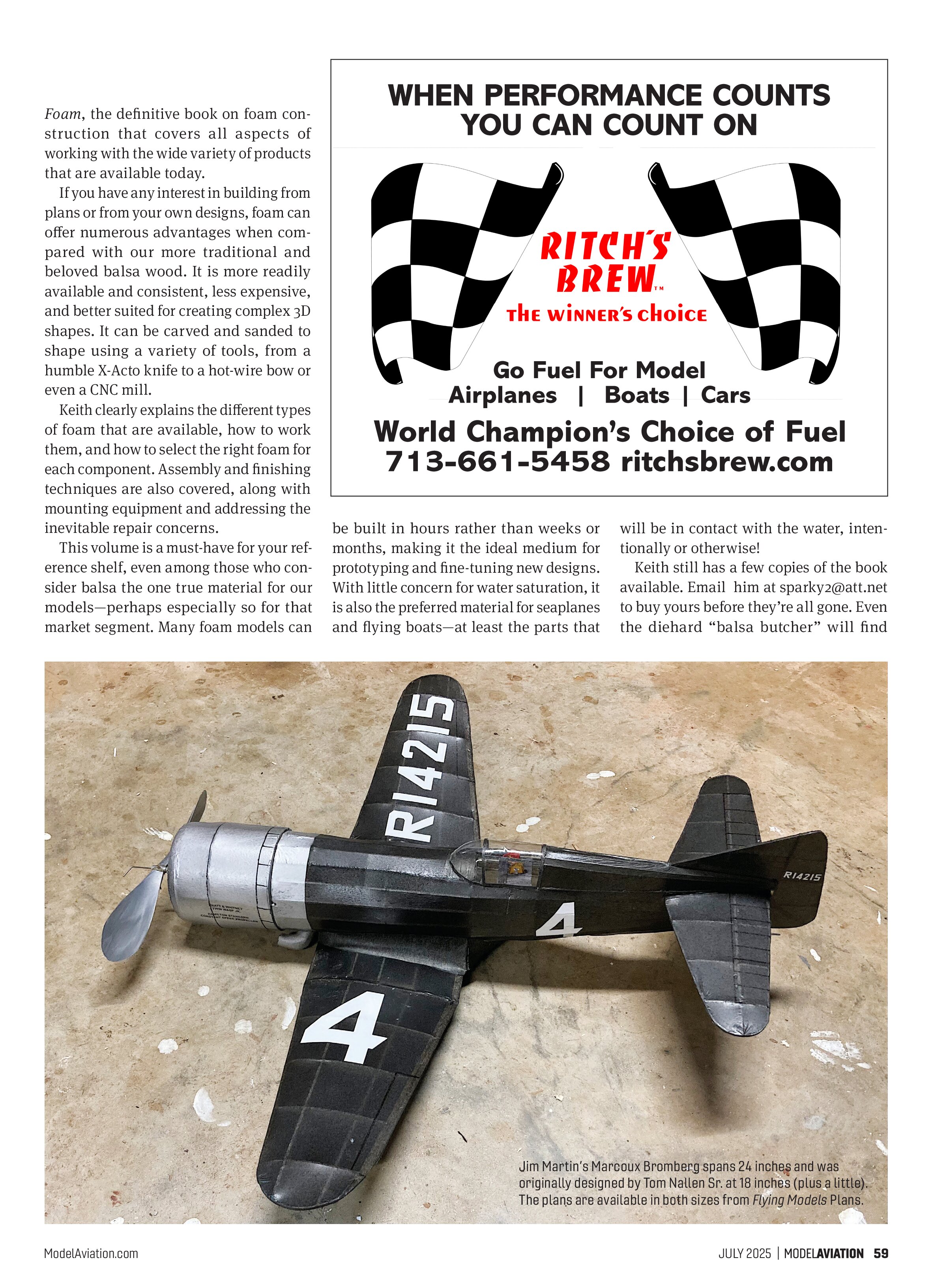
Several months back, James Martin, from Marietta, Georgia, reached out to see whether I could enlarge a set of plans for him from the Flying Models Plans catalog. More specifically, he was looking for Tom Nallen Sr.’s Marcoux Bromberg R3 plans.
Many of you know that I am a big fan of Golden Age air racers. Between that bias and having seen the original, full-scale aircraft during numerous visits to the New England Air Museum in East Granby, Connecticut, I was more than happy to help him out.
Tom originally drew the design at 18-3/4 inches for publication. Meanwhile, James was looking for a 24-inch wingspan model enlargement, which I was happy to provide. His model landed right at 54 grams as shown and should do quite well for him as spring weather allows his initial trim flights.
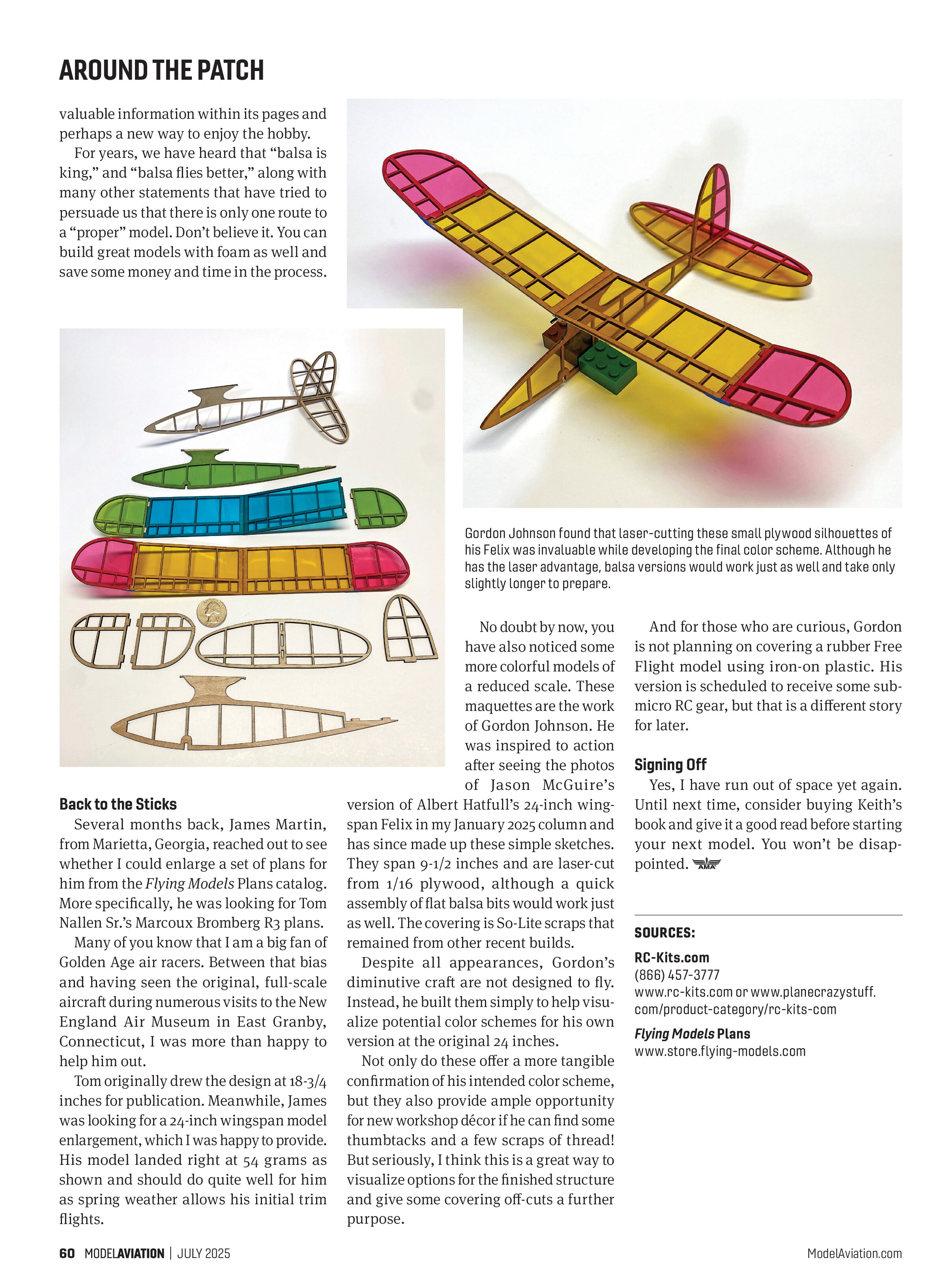
version of Albert Hatfull’s 24-inch wingspan Felix in my January 2025 column and has since made up these simple sketches. They span 9-1/2 inches and are laser-cut from 1/16 plywood, although a quick assembly of flat balsa bits would work just as well. The covering is So-Lite scraps that remained from other recent builds.
Despite all appearances, Gordon’s diminutive craft are not designed to fly. Instead, he built them simply to help visualize potential color schemes for his own version at the original 24 inches.
Not only do these offer a more tangible confirmation of his intended color scheme, but they also provide ample opportunity for new workshop décor if he can find some thumbtacks and a few scraps of thread! But seriously, I think this is a great way to visualize options for the finished structure and give some covering off-cuts a further purpose.
No doubt by now, you have also noticed some more colorful models of a reduced scale. These maquettes are the work of Gordon Johnson. He was inspired to action after seeing the photos of Jason McGuire’s
And for those who are curious, Gordon is not planning on covering a rubber Free Flight model using iron-on plastic. His version is scheduled to receive some sub-micro RC gear, but that is a different story for later.
Signing Off
Yes, I have run out of space yet again. Until next time, consider buying Keith’s book and give it a good read before starting your next model. You won’t be disappointed.
SOURCES:
RC-Kits.com
(866) 457-3777
www.rc-kits.com or www.planecrazystuff.com/product-category/rc-kits-com
Flying Models Plans
www.store.flying-models.com