LIFE FROM ABOVE (AND SLURPEES TOO)
By Patrick Sherman
lucidity@roswellflighttestcrew.com

ON DECEMBER 1, 2013, Jeff Bezos announced on the CBS news magazine 60 Minutes that Amazon would commence delivery to consumers using drones by 2018. Although that prediction has aged like organic milk stored in a kitchen cupboard, the company has continued to pursue the idea for the past 12 years. However, it has never really gotten off the ground—figuratively or literally.
A pilot program in College Station, Texas, that is making a mere 200 deliveries a day, has drawn noise complaints from the local community, which reports that the aircraft sound like “a giant hive of bees” and play havoc with the sleep of people who work at night, such as firefighters and nurses.
For all but the most dedicated techno-optimists, this should have been a foreseeable outcome. The US National Airspace System is the busiest and most complex of any nation on earth. Standing up a drone delivery business here would be like learning how to drive in the midst of the Daytona 500 NASCAR race. Therefore, it is fortunate for the whole idea of drone delivery that another company took a radically different approach to the problem.
In 2016, Zipline commenced its own drone delivery service—in Rwanda. As it happens, Rwanda has a much less complicated airspace than the US and also a pressing need for drone delivery. (Editor’s note: Read Rachelle Haughn’s “Raising Hope” article from the September 2016 issue of Model Aviation; the link is listed in “Sources.”)
The roads and other infrastructure in Rwanda are in such poor repair that it can take 24 hours or more to move supplies between cities using a truck, in a country roughly the size of West Virginia. This is inconvenient if you are looking forward to receiving your new dinette set, but it can be lethal if you are waiting for urgently needed medicines or blood products. Zipline can make the same delivery in 45 minutes. In terms of drone delivery, this is like learning to drive in the parking lot of a shuttered mall. Oh, and by the way, each trip past the old Sears storefront saves a life.
Medicines Away!
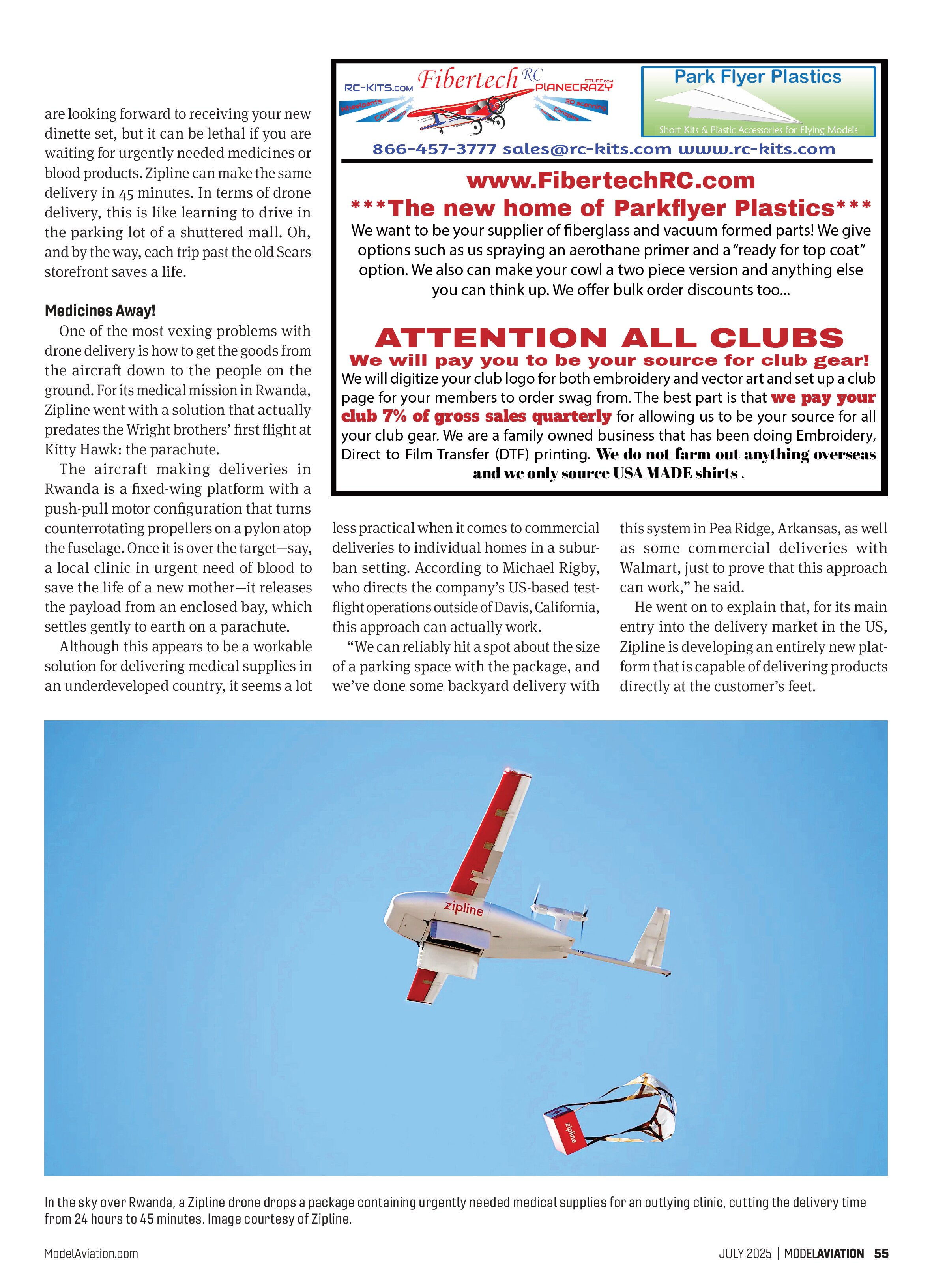
One of the most vexing problems with drone delivery is how to get the goods from the aircraft down to the people on the ground. For its medical mission in Rwanda, Zipline went with a solution that actually predates the Wright brothers’ first flight at Kitty Hawk: the parachute.
The aircraft making deliveries in Rwanda is a fixed-wing platform with a push-pull motor configuration that turns counterrotating propellers on a pylon atop the fuselage. Once it is over the target—say, a local clinic in urgent need of blood to save the life of a new mother—it releases the payload from an enclosed bay, which settles gently to earth on a parachute.
Although this appears to be a workable solution for delivering medical supplies in an underdeveloped country, it seems a lot less practical when it comes to commercial deliveries to individual homes in a suburban setting. According to Michael Rigby, who directs the company’s US-based test-flight operations outside of Davis, California, this approach can actually work.
“We can reliably hit a spot about the size of a parking space with the package, and we’ve done some backyard delivery with this system in Pea Ridge, Arkansas, as well as some commercial deliveries with Walmart, just to prove that this approach can work,” he said.
He went on to explain that, for its main entry into the delivery market in the US, Zipline is developing an entirely new platform that is capable of delivering products directly at the customer’s feet.


Enter the Droid
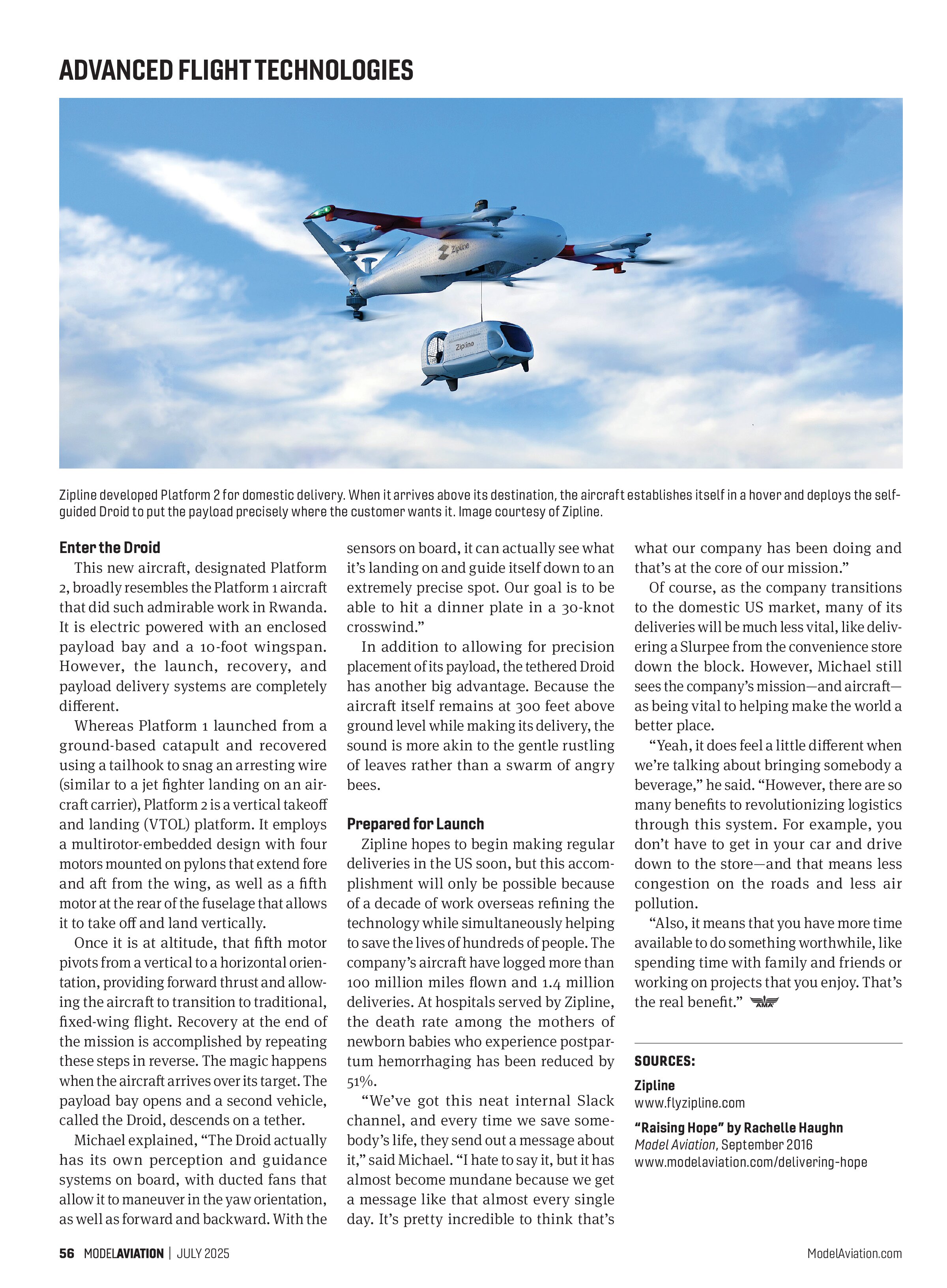
This new aircraft, designated Platform 2, broadly resembles the Platform 1 aircraft that did such admirable work in Rwanda. It is electric powered with an enclosed payload bay and a 10-foot wingspan. However, the launch, recovery, and payload delivery systems are completely different.
Whereas Platform 1 launched from a ground-based catapult and recovered using a tailhook to snag an arresting wire (similar to a jet fighter landing on an aircraft carrier), Platform 2 is a vertical takeoff and landing (VTOL) platform. It employs a multirotor-embedded design with four motors mounted on pylons that extend fore and aft from the wing, as well as a fifth motor at the rear of the fuselage that allows it to take off and land vertically.
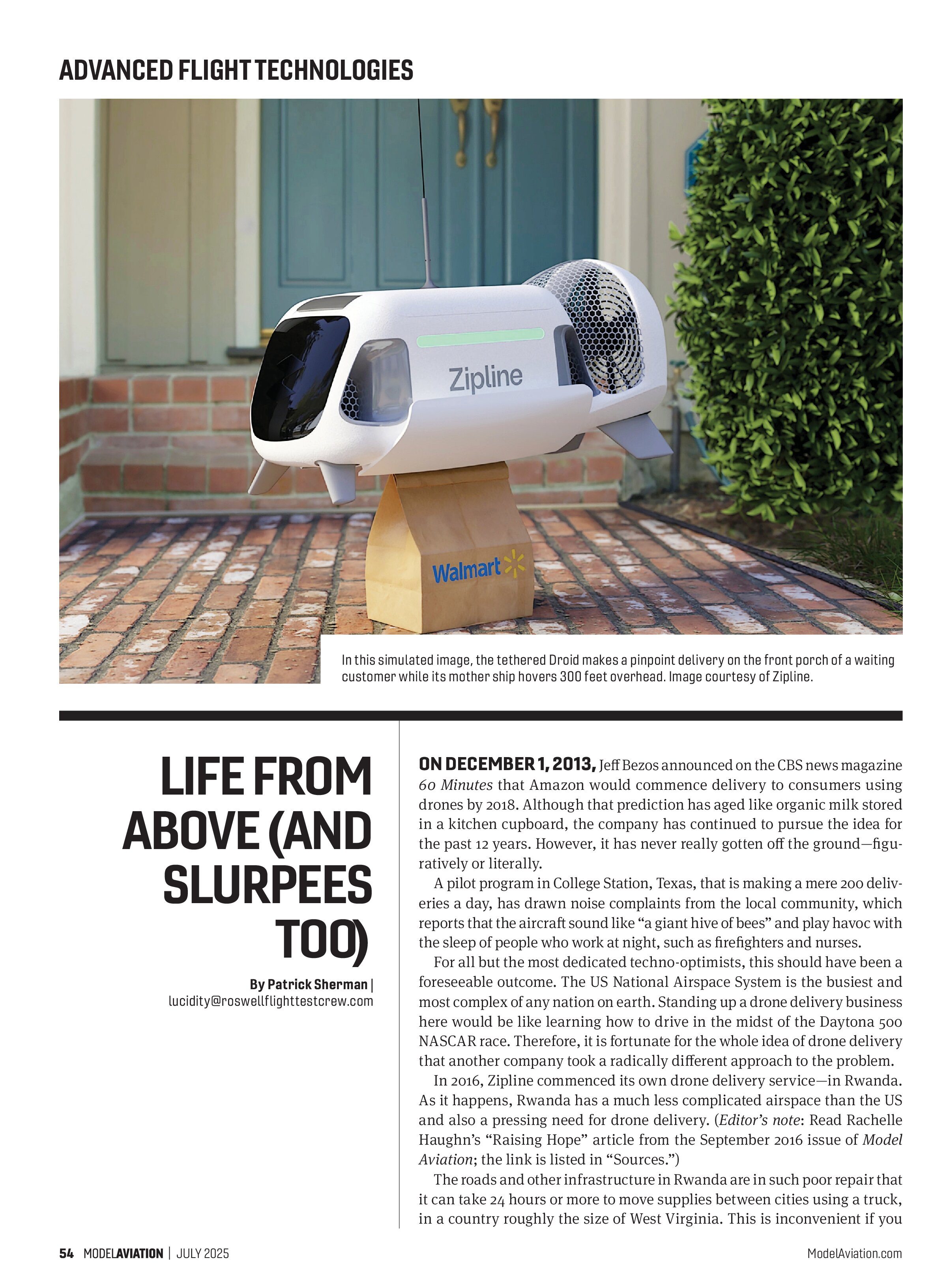
Once it is at altitude, that fifth motor pivots from a vertical to a horizontal orientation, providing forward thrust and allowing the aircraft to transition to traditional, fixed-wing flight. Recovery at the end of the mission is accomplished by repeating these steps in reverse. The magic happens when the aircraft arrives over its target. The payload bay opens and a second vehicle, called the Droid, descends on a tether.
Michael explained, “The Droid actually has its own perception and guidance systems on board, with ducted fans that allow it to maneuver in the yaw orientation, as well as forward and backward. With the sensors on board, it can actually see what it’s landing on and guide itself down to an extremely precise spot. Our goal is to be able to hit a dinner plate in a 30-knot crosswind.”
In addition to allowing for precision placement of its payload, the tethered Droid has another big advantage. Because the aircraft itself remains at 300 feet above ground level while making its delivery, the sound is more akin to the gentle rustling of leaves rather than a swarm of angry bees.
Prepared for Launch
Zipline hopes to begin making regular deliveries in the US soon, but this accomplishment will only be possible because of a decade of work overseas refining the technology while simultaneously helping to save the lives of hundreds of people. The company’s aircraft have logged more than 100 million miles flown and 1.4 million deliveries. At hospitals served by Zipline, the death rate among the mothers of newborn babies who experience postpartum hemorrhaging has been reduced by 51%.
“We’ve got this neat internal Slack channel, and every time we save somebody’s life, they send out a message about it,” said Michael. “I hate to say it, but it has almost become mundane because we get a message like that almost every single day. It’s pretty incredible to think that’s what our company has been doing and that’s at the core of our mission.”
Of course, as the company transitions to the domestic US market, many of its deliveries will be much less vital, like delivering a Slurpee from the convenience store down the block. However, Michael still sees the company’s mission—and aircraft—as being vital to helping make the world a better place.
“Yeah, it does feel a little different when we’re talking about bringing somebody a beverage,” he said. “However, there are so many benefits to revolutionizing logistics through this system. For example, you don’t have to get in your car and drive down to the store—and that means less congestion on the roads and less air pollution.
“Also, it means that you have more time available to do something worthwhile, like spending time with family and friends or working on projects that you enjoy. That’s the real benefit.”
SOURCES:
Zipline
www.flyzipline.com
“Raising Hope” by Rachelle Haughn
Model Aviation, September 2016
www.modelaviation.com/delivering-hope