SMALL-FIELD FLYING

Great Mix of Readers’ Models
Meanwhile, I have some great models to share this time around, with a nice mix of Free Flight (FF), RC, and even FF models converted to RC.
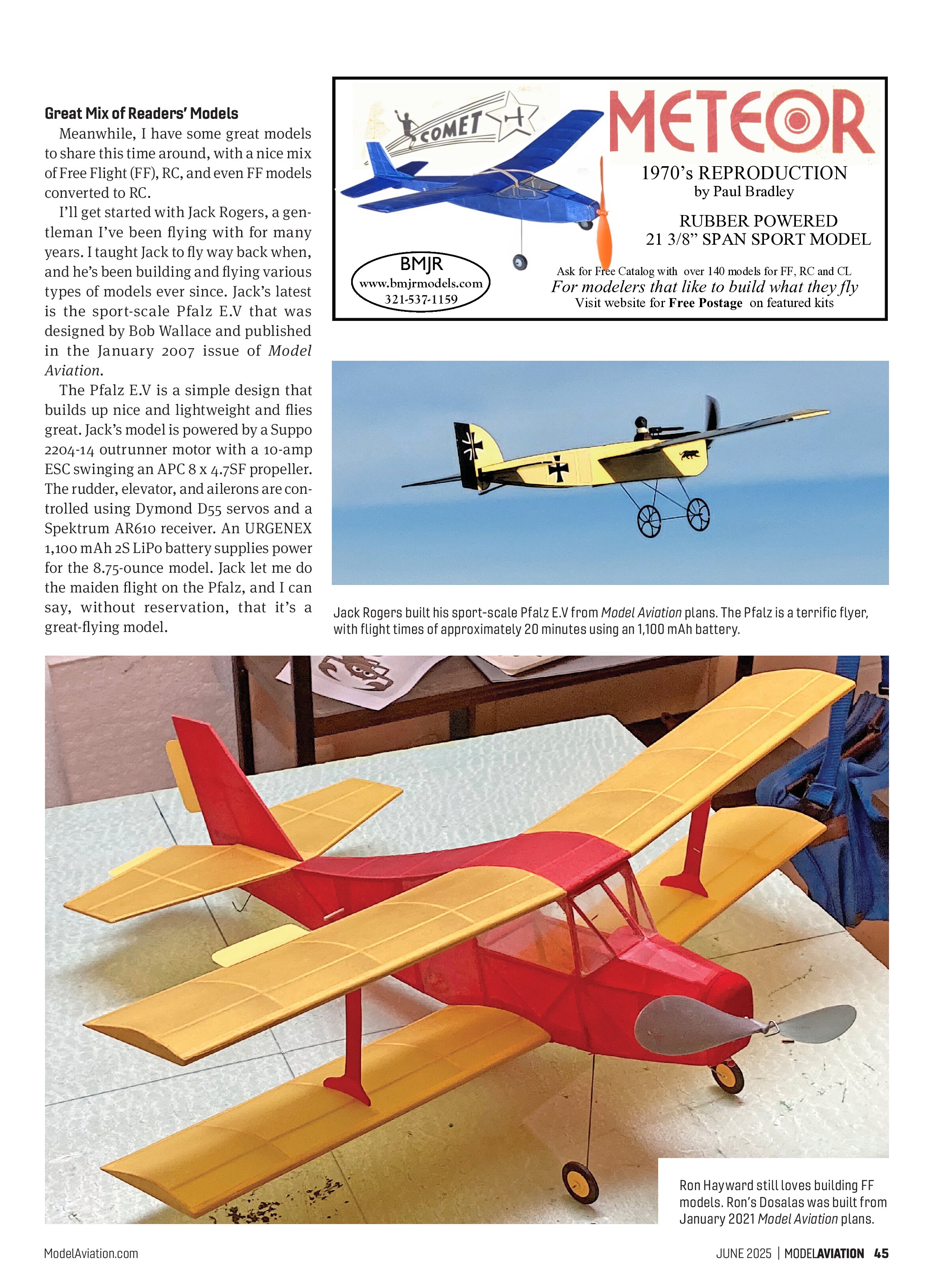
I’ll get started with Jack Rogers, a gentleman I’ve been flying with for many years. I taught Jack to fly way back when, and he’s been building and flying various types of models ever since. Jack’s latest is the sport-scale Pfalz E.V that was designed by Bob Wallace and published in the January 2007 issue of Model Aviation.
The Pfalz E.V is a simple design that builds up nice and lightweight and flies great. Jack’s model is powered by a Suppo 2204-14 outrunner motor with a 10-amp ESC swinging an APC 8 x 4.7SF propeller. The rudder, elevator, and ailerons are controlled using Dymond D55 servos and a Spektrum AR610 receiver. An URGENEX 1,100 mAh 2S LiPo battery supplies power for the 8.75-ounce model. Jack let me do the maiden flight on the Pfalz, and I can say, without reservation, that it’s a great-flying model.


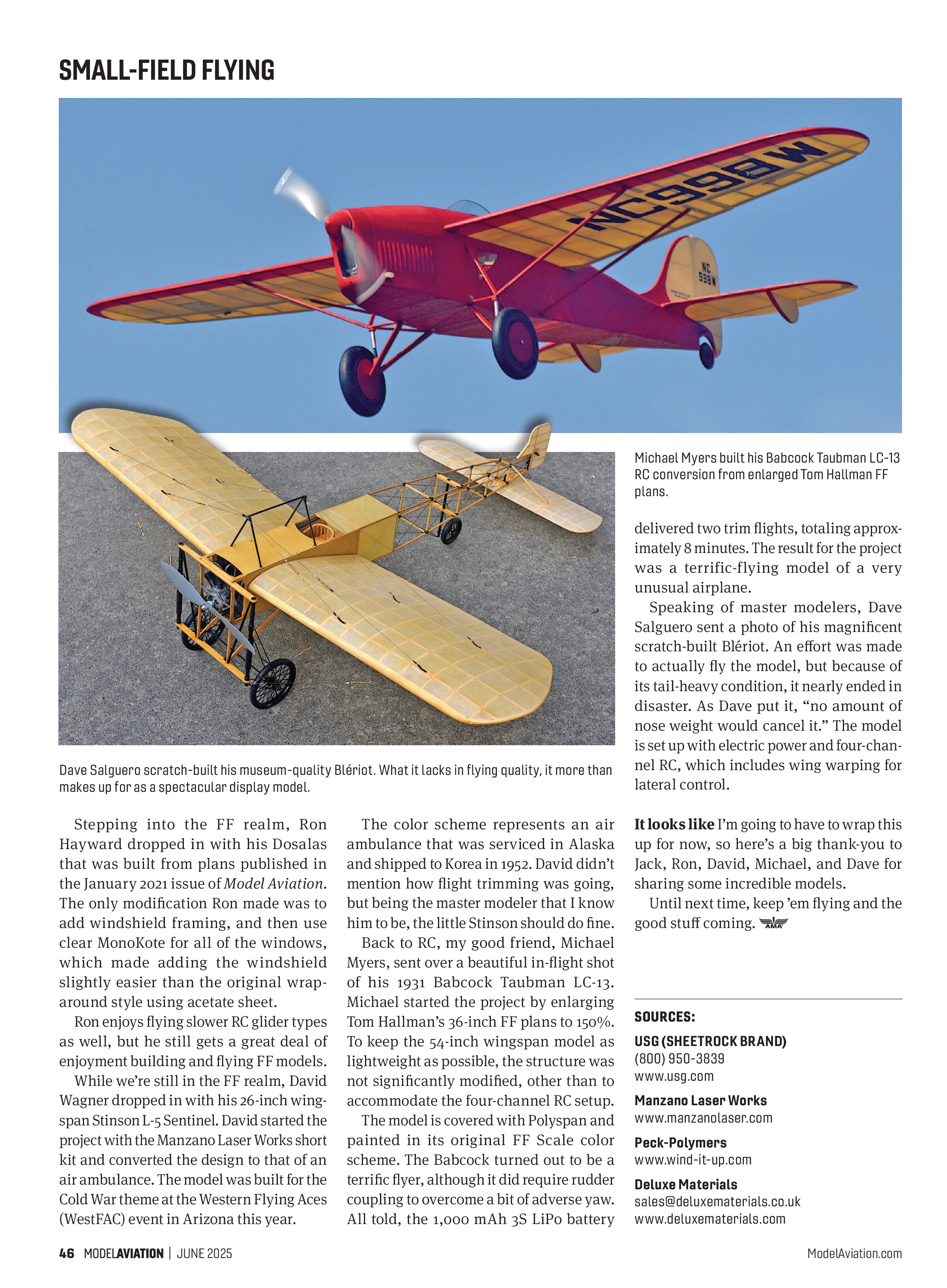
Stepping into the FF realm, Ron Hayward dropped in with his Dosalas that was built from plans published in the January 2021 issue of Model Aviation. The only modification Ron made was to add windshield framing, and then use clear MonoKote for all of the windows, which made adding the windshield slightly easier than the original wrap-around style using acetate sheet.
Ron enjoys flying slower RC glider types as well, but he still gets a great deal of enjoyment building and flying FF models.
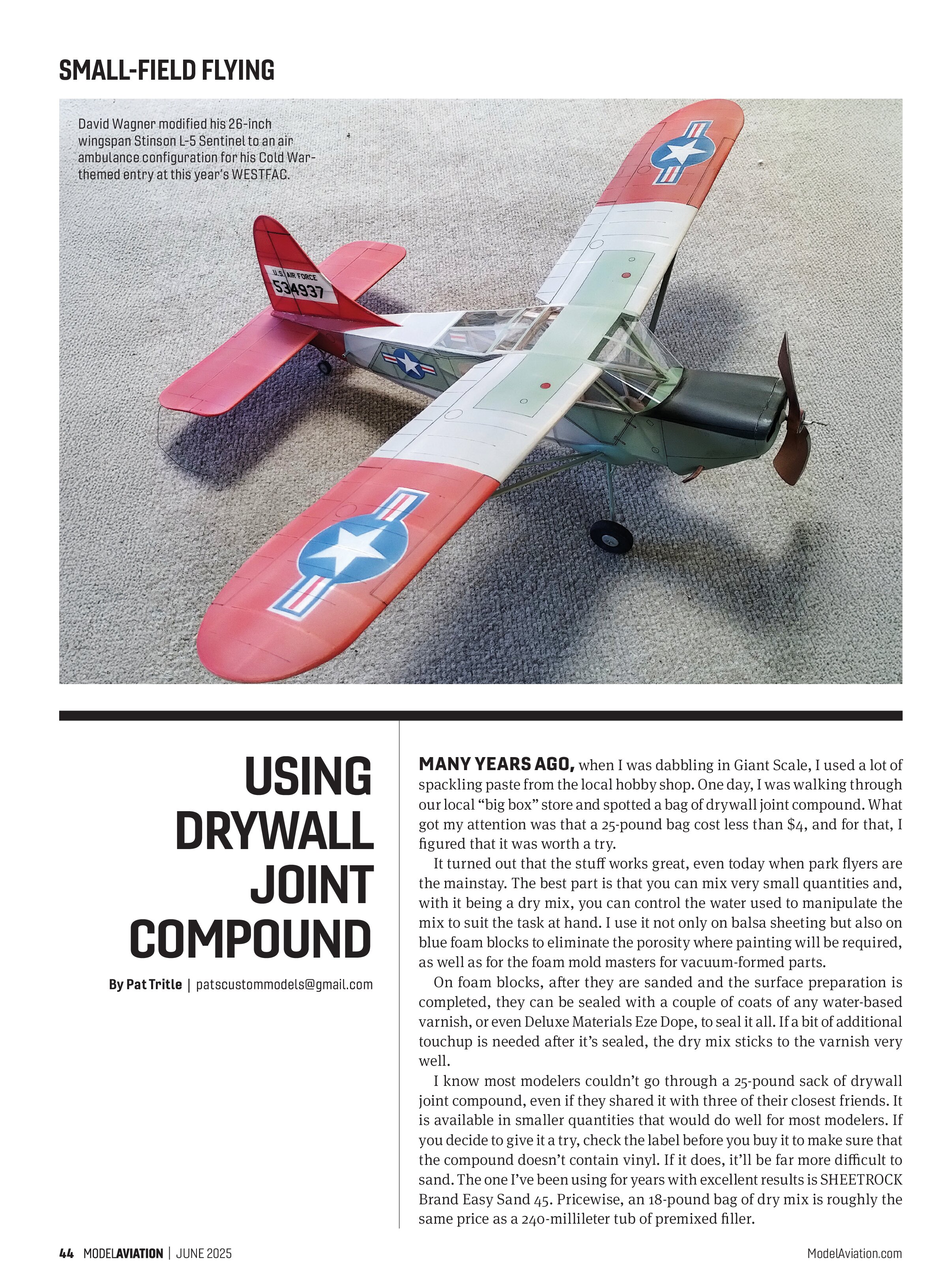
While we’re still in the FF realm, David Wagner dropped in with his 26-inch wingspan Stinson L-5 Sentinel. David started the project with the Manzano Laser Works short kit and converted the design to that of an air ambulance. The model was built for the Cold War theme at the Western Flying Aces (WestFAC) event in Arizona this year.
The color scheme represents an air ambulance that was serviced in Alaska and shipped to Korea in 1952. David didn’t mention how flight trimming was going, but being the master modeler that I know him to be, the little Stinson should do fine.
Back to RC, my good friend, Michael Myers, sent over a beautiful in-flight shot of his 1931 Babcock Taubman LC-13. Michael started the project by enlarging Tom Hallman’s 36-inch FF plans to 150%. To keep the 54-inch wingspan model as lightweight as possible, the structure was not significantly modified, other than to accommodate the four-channel RC setup.
The model is covered with Polyspan and painted in its original FF Scale color scheme. The Babcock turned out to be a terrific flyer, although it did require rudder coupling to overcome a bit of adverse yaw. All told, the 1,000 mAh 3S LiPo battery delivered two trim flights, totaling approximately 8 minutes. The result for the project was a terrific-flying model of a very unusual airplane.
Speaking of master modelers, Dave Salguero sent a photo of his magnificent scratch-built Blériot. An effort was made to actually fly the model, but because of its tail-heavy condition, it nearly ended in disaster. As Dave put it, “no amount of nose weight would cancel it.” The model is set up with electric power and four-channel RC, which includes wing warping for lateral control.
It looks like I’m going to have to wrap this up for now, so here’s a big thank-you to Jack, Ron, David, Michael, and Dave for sharing some incredible models.
Until next time, keep ’em flying and the good stuff coming.
SOURCES:
USG (SHEETROCK BRAND)
(800) 950-3839
www.usg.com
Manzano Laser Works
www.manzanolaser.com
Peck-Polymers
www.wind-it-up.com
Deluxe Materials
sales@deluxematerials.co.uk
www.deluxematerials.com