RC SLOPE SOARING
SPARROW REBIRTH
By Greg Schutte | gshooty@yahoo.com

WITH SUMMER getting close, I have a couple of new Slope Soaring gliders to add to the roster. My Sparrow is not one of them. I have always had one ready to fly, and it has been my go-to airplane for years. My Alula has recently had that job, but I do not want to wear that pretty bird out. I hot wire cut my own Sparrows, so I have many cores laying around. This time, I decided to rework one of my older Sparrows.
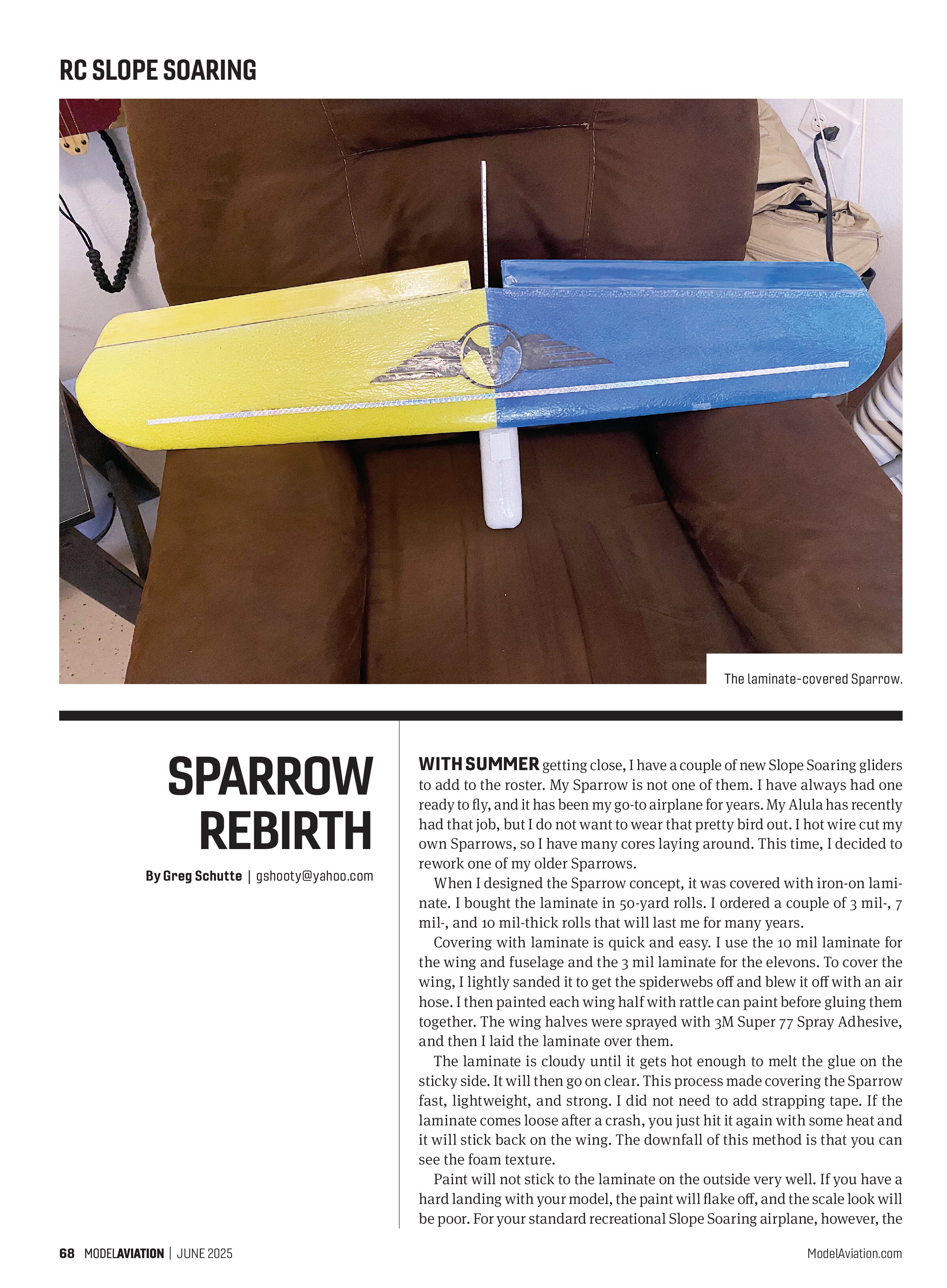
When I designed the Sparrow concept, it was covered with iron-on laminate. I bought the laminate in 50-yard rolls. I ordered a couple of 3 mil-, 7 mil-, and 10 mil-thick rolls that will last me for many years.
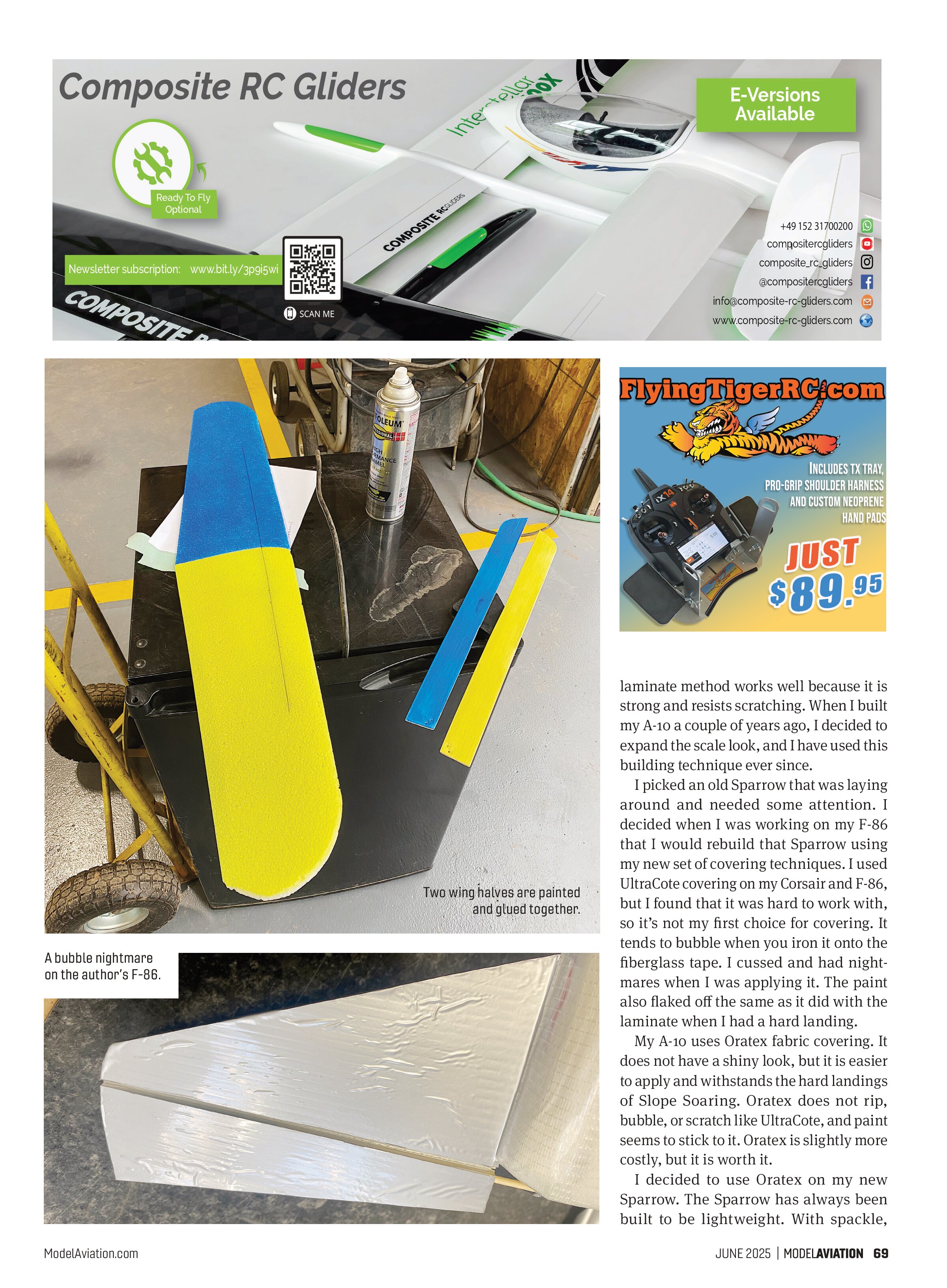
Covering with laminate is quick and easy. I use the 10 mil laminate for the wing and fuselage and the 3 mil laminate for the elevons. To cover the wing, I lightly sanded it to get the spiderwebs off and blew it off with an air hose. I then painted each wing half with rattle can paint before gluing them together. The wing halves were sprayed with 3M Super 77 Spray Adhesive, and then I laid the laminate over them.
The laminate is cloudy until it gets hot enough to melt the glue on the sticky side. It will then go on clear. This process made covering the Sparrow fast, lightweight, and strong. I did not need to add strapping tape. If the laminate comes loose after a crash, you just hit it again with some heat and it will stick back on the wing. The downfall of this method is that you can see the foam texture.
Paint will not stick to the laminate on the outside very well. If you have a hard landing with your model, the paint will flake off, and the scale look will be poor. For your standard recreational Slope Soaring airplane, however, the laminate method works well because it is strong and resists scratching. When I built my A-10 a couple of years ago, I decided to expand the scale look, and I have used this building technique ever since.

I picked an old Sparrow that was laying around and needed some attention. I decided when I was working on my F-86 that I would rebuild that Sparrow using my new set of covering techniques. I used UltraCote covering on my Corsair and F-86, but I found that it was hard to work with, so it’s not my first choice for covering. It tends to bubble when you iron it onto the fiberglass tape. I cussed and had nightmares when I was applying it. The paint also flaked off the same as it did with the laminate when I had a hard landing.

My A-10 uses Oratex fabric covering. It does not have a shiny look, but it is easier to apply and withstands the hard landings of Slope Soaring. Oratex does not rip, bubble, or scratch like UltraCote, and paint seems to stick to it. Oratex is slightly more costly, but it is worth it.
I decided to use Oratex on my new Sparrow. The Sparrow has always been built to be lightweight. With spackle,

fiberglass tape, and Oratex, it did come out heavier, so it fits more into the average weight of a Slope sailplane. It will fly in roughly the same wind—not 4- to 8-mph wind, but in anything higher than that, it will be good to go. My Alula will be flown in that lower wind range.
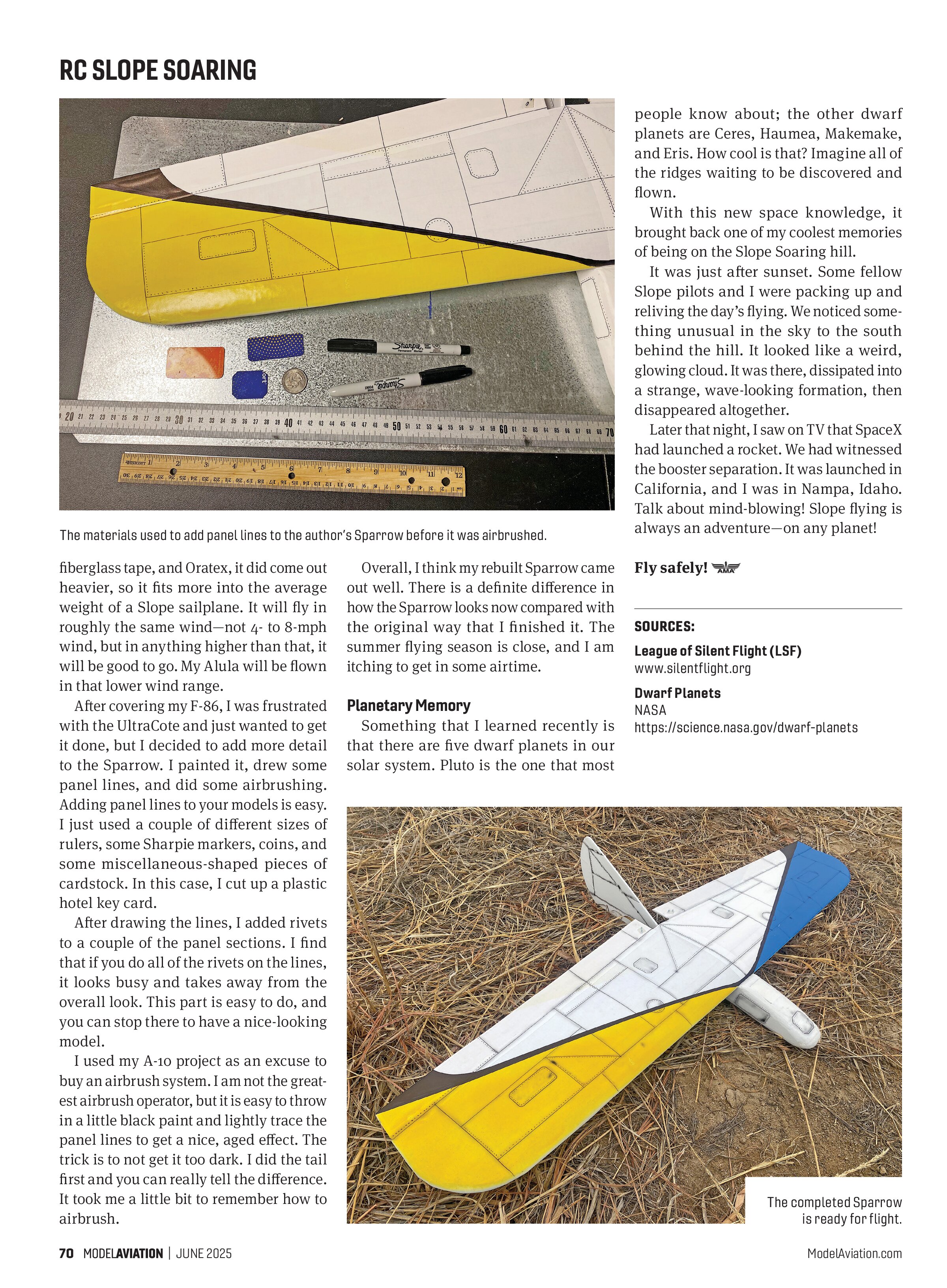
After covering my F-86, I was frustrated with the UltraCote and just wanted to get it done, but I decided to add more detail to the Sparrow. I painted it, drew some panel lines, and did some airbrushing. Adding panel lines to your models is easy. I just used a couple of different sizes of rulers, some Sharpie markers, coins, and some miscellaneous-shaped pieces of cardstock. In this case, I cut up a plastic hotel key card.
After drawing the lines, I added rivets to a couple of the panel sections. I find that if you do all of the rivets on the lines, it looks busy and takes away from the overall look. This part is easy to do, and you can stop there to have a nice-looking model.
I used my A-10 project as an excuse to buy an airbrush system. I am not the greatest airbrush operator, but it is easy to throw in a little black paint and lightly trace the panel lines to get a nice, aged effect. The trick is to not get it too dark. I did the tail first and you can really tell the difference. It took me a little bit to remember how to airbrush.
Overall, I think my rebuilt Sparrow came out well. There is a definite difference in how the Sparrow looks now compared with the original way that I finished it. The summer flying season is close, and I am itching to get in some airtime.
Planetary Memory
Something that I learned recently is that there are five dwarf planets in our solar system. Pluto is the one that most people know about; the other dwarf planets are Ceres, Haumea, Makemake, and Eris. How cool is that? Imagine all of the ridges waiting to be discovered and flown.
With this new space knowledge, it brought back one of my coolest memories of being on the Slope Soaring hill.
It was just after sunset. Some fellow Slope pilots and I were packing up and reliving the day’s flying. We noticed something unusual in the sky to the south behind the hill. It looked like a weird, glowing cloud. It was there, dissipated into a strange, wave-looking formation, then disappeared altogether.
Later that night, I saw on TV that SpaceX had launched a rocket. We had witnessed the booster separation. It was launched in California, and I was in Nampa, Idaho. Talk about mind-blowing! Slope flying is always an adventure—on any planet!

SOURCES:
League of Silent Flight (LSF)
www.silentflight.org
Dwarf Planets
NASA
https://science.nasa.gov/dwarf-planets