RC SCALE AEROBATICS
THE SPIN
By John Glezellis | jglezellis@gmail.com

IF YOU ARE an avid reader of my column, you are aware that I cover a wide variety of topics that are critical for an International Miniature Aerobatic Club (IMAC) competitor. This month, I will examine the spin maneuver, which can be both challenging to perform and judge. The first instance of the spin can be found in the 2025 IMAC Basic category, where the pilot will perform a 1-1/2-turn upright spin.
The competition pilot must know how to perform certain maneuvers, recognize the different areas in which they can tune their aircraft to minimize the need for corrective inputs, respond to their personal preferences, and understand the rule book.
Without further delay, let’s begin!
Considerations for Positioning Maneuvers
Before I begin, it is important to note that before entering the aerobatic airspace, a pilot can only perform specific positioning maneuvers, including turns, Half Cuban 8s or Reverse Cuban 8s (with or without a half roll), half loops (with or without a half roll), and single half rolls. The noted rolling elements only depend on whether you must enter the sequence inverted or upright.
No other aerobatic maneuvers are allowed after the aircraft is in the air, before it enters the aerobatic airspace, between sequences, or after completing a sequence, meaning no maneuvers are allowed between takeoff and landing. Prohibited maneuvers include spins! The reason why only certain figures can be flown is to prevent any maneuver from being viewed as “practice” and giving one pilot a competitive advantage over another.
Topic of the Month: Spins!
All spins begin from horizontal flight with a defined entry line. This entry line to the spin is judged and downgraded as required in the same manner as any other wind-corrected horizontal line where the track of the model is to be judged—not the attitude. Any deviation will result in a downgrade of 0.5 points per 5°.
The model’s wing is to remain level as the speed is decreased, and no change in altitude should exist. It is essential that you fully understand your aircraft and, should the model not perform as desired, what changes can be done to correct these undesirable traits.
For example, should you observe that your model is sensitive in pitch when small corrective elevator inputs are given as it slows down to approach a stall for the spin entry, you might need to explore less elevator travel or more exponential on the elevator control surface to soften the overall feel. Similarly, if the aircraft pitches and changes altitude when certain amounts of elevator are being held, you might have an excessive amount of exponential and might be approaching the inflection point in the exponential curve.
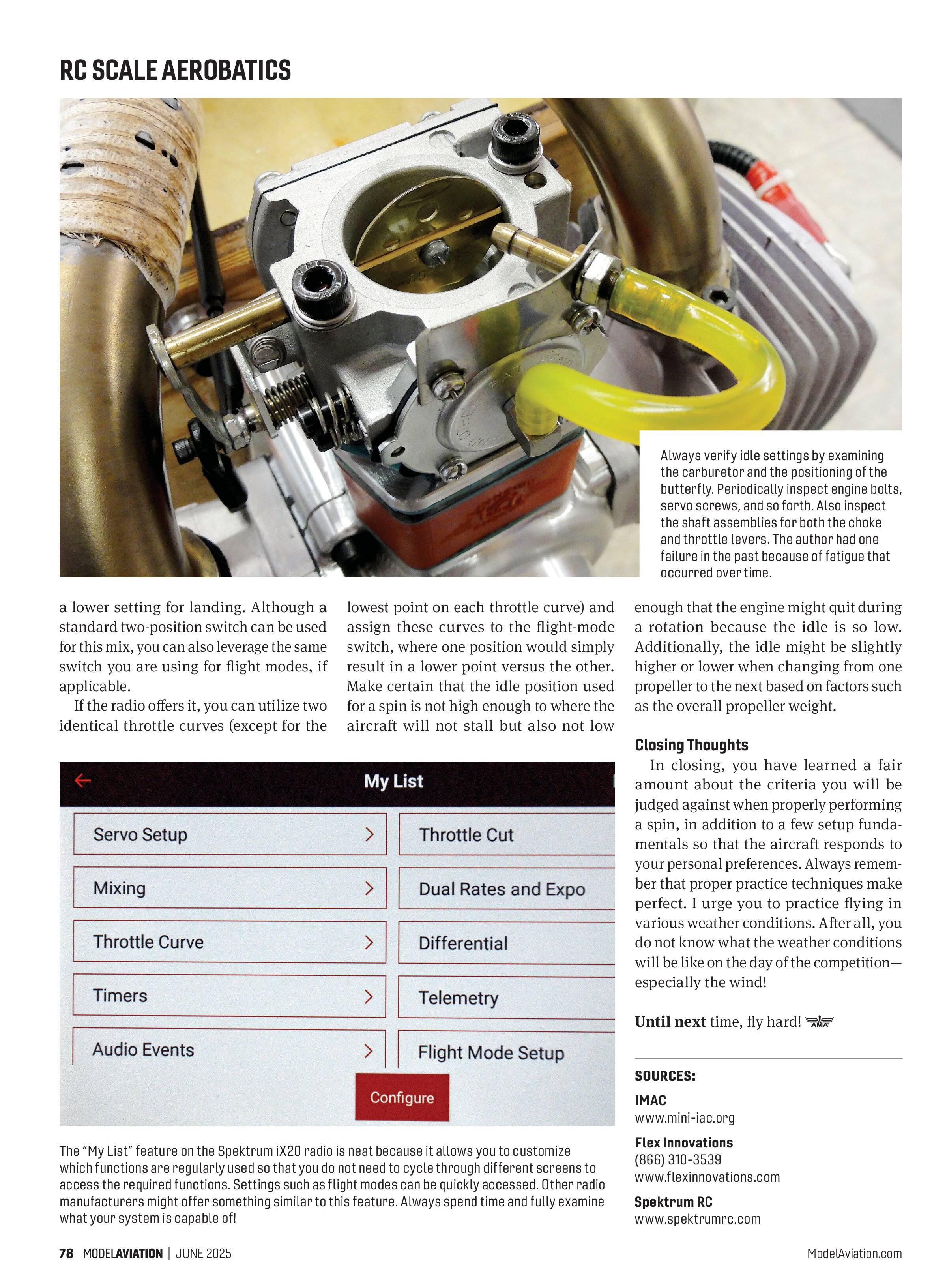
In my opinion, the use of flight modes is preferred, where one rate is used for spins and snap rolls and another for precision rolling figures.
As the aircraft approaches a stalled state, no penalty will exist for a deviation in yaw because of a crosswind. Contingent on the severity of the wind, the nose of the model will be oriented directly into the wind, which might result in the pilot performing spin rotations that are more or less than the required number, depending on which direction the rotation for the spin occurs.
In the case of the 1-1/2-turn spin found in the Basic class, if the nose yaws 15° into the wind and the model spins in a manner that is in that direction, less than 1-1/2 rotations will be performed and no penalty will exist for the effects of the wind on the spin entry.
At the time of the stall, judges look to see whether the airplane performed a clean break and a fully-stalled autorotation. To have a proper spin in a stall, one wingtip will drop to show the start of the autorotation. The stall and wingtip drop should occur at the same instance. If they don’t, a downgrade of 0.5 points for each 5° of movement that occurs in one movement before the other is shown will be applied.
If you are trying to stall your airplane and it begins to mush (starts to descend in altitude and not stall), it will not spin because it is not in a stalled state. If this happens, you might need to add more elevator throw or change the center of gravity point. Try adding a slight amount of tail weight and see whether the model will actually stall.
When the airplane is spinning, pay special attention to ensure that it is not “spiraling” downward at a fairly moderate descent rate. If this is the case, you might need to add more rudder throw and/or elevator throw to the rates you utilize to perform the spin.
The rotation speed of the spin is not a judged element, and the model must have visible yaw. If this isn’t the case, the aircraft might be performing an aileron roll spiral variation, where a zero will be given for the figure. The airplane must be stalled!
For the exit, it can be rather common to see the pilot stop the autorotation prematurely and use aileron input to precisely control the desired number of rotations. Should this be observed, a penalty of 0.5 points per 5° will be applied.
Finally, upon the completion of the required number of rotations, a vertical line segment must be shown before the pilot performs a quarter loop to upright, level flight. Should this line not be shown, a downgrade of one point will exist.
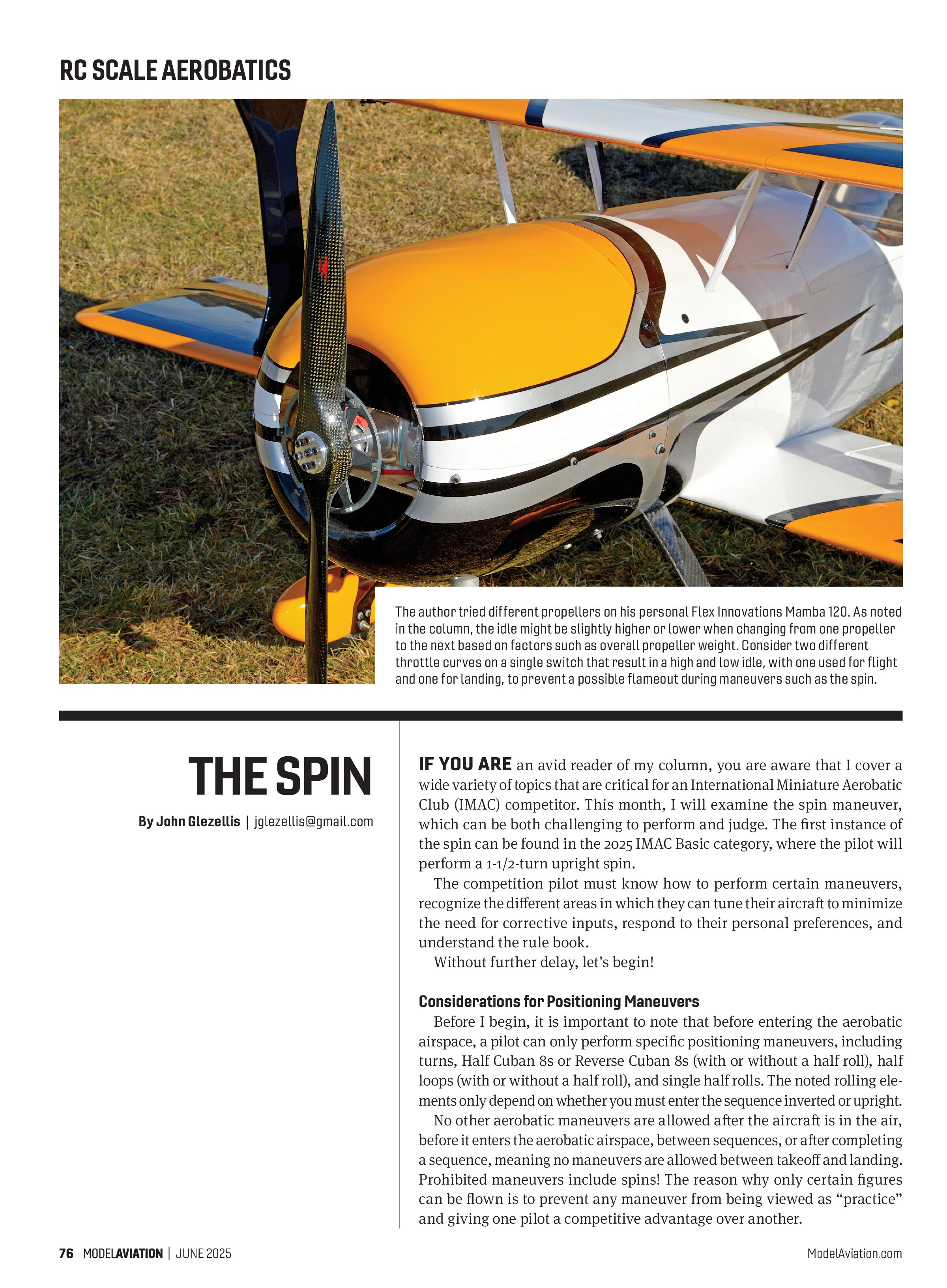
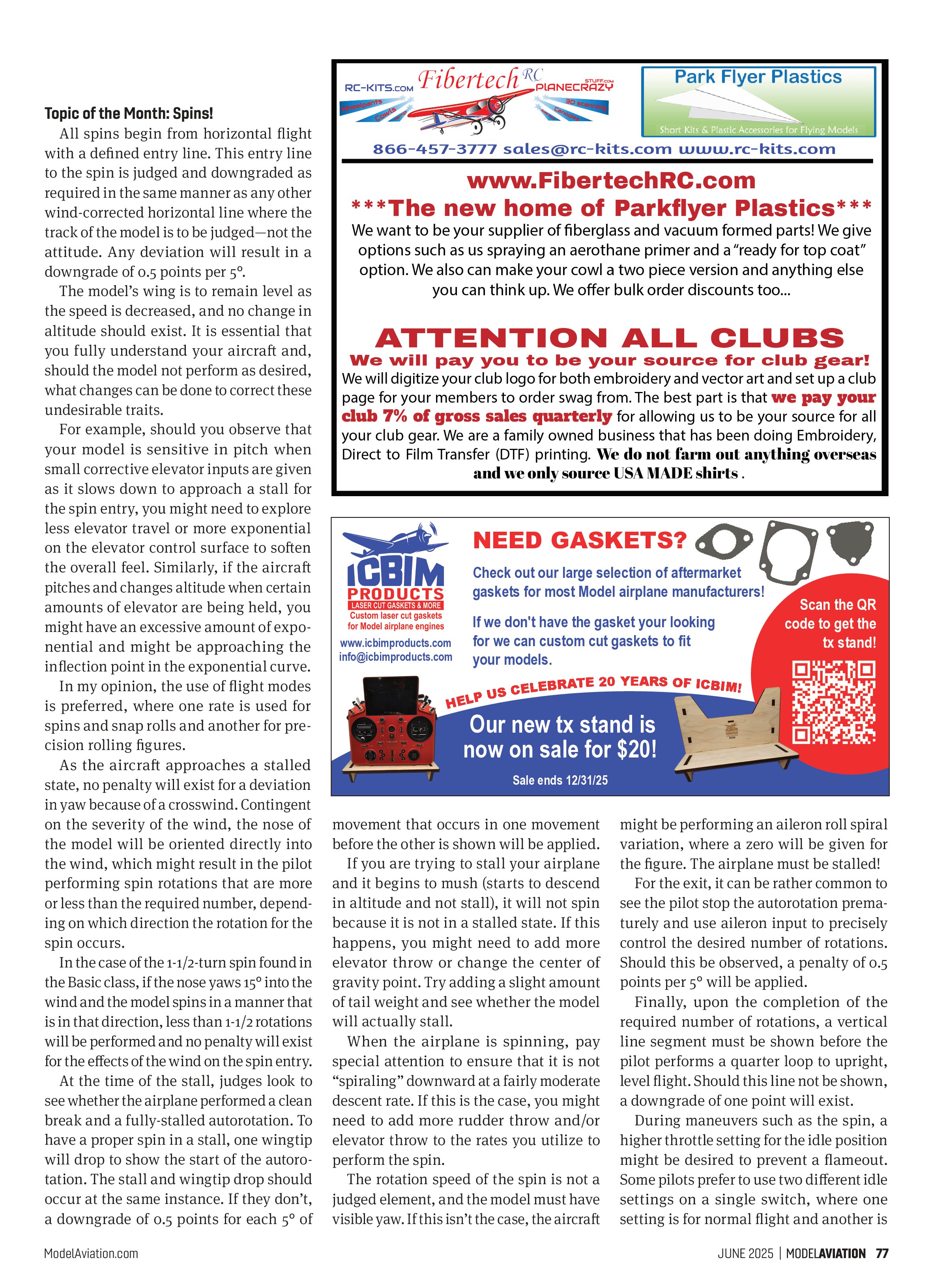
During maneuvers such as the spin, a higher throttle setting for the idle position might be desired to prevent a flameout. Some pilots prefer to use two different idle settings on a single switch, where one setting is for normal flight and another is
a lower setting for landing. Although a standard two-position switch can be used for this mix, you can also leverage the same switch you are using for flight modes, if applicable.
If the radio offers it, you can utilize two identical throttle curves (except for the lowest point on each throttle curve) and assign these curves to the flight-mode switch, where one position would simply result in a lower point versus the other. Make certain that the idle position used for a spin is not high enough to where the aircraft will not stall but also not low enough that the engine might quit during a rotation because the idle is so low. Additionally, the idle might be slightly higher or lower when changing from one propeller to the next based on factors such as the overall propeller weight.


Closing Thoughts
In closing, you have learned a fair amount about the criteria you will be judged against when properly performing a spin, in addition to a few setup fundamentals so that the aircraft responds to your personal preferences. Always remember that proper practice techniques make perfect. I urge you to practice flying in various weather conditions. After all, you do not know what the weather conditions will be like on the day of the competition—especially the wind!
Until next time, fly hard!
SOURCES:
IMAC
www.mini-iac.org
Flex Innovations
(866) 310-3539
www.flexinnovations.com
Spektrum RC
www.spektrumrc.com