PLANS-BUILT
HOWARD
PETE
By Sal Calvagna | rcgiants@optonline.net

WELCOME BACK. I am fortunate enough to belong to a prolific Giant Scale club, the Long Island Skyhawks, so all but one of the models featured in this month’s column are from its members. I hope you enjoy.
Howard DGA-3 Pete
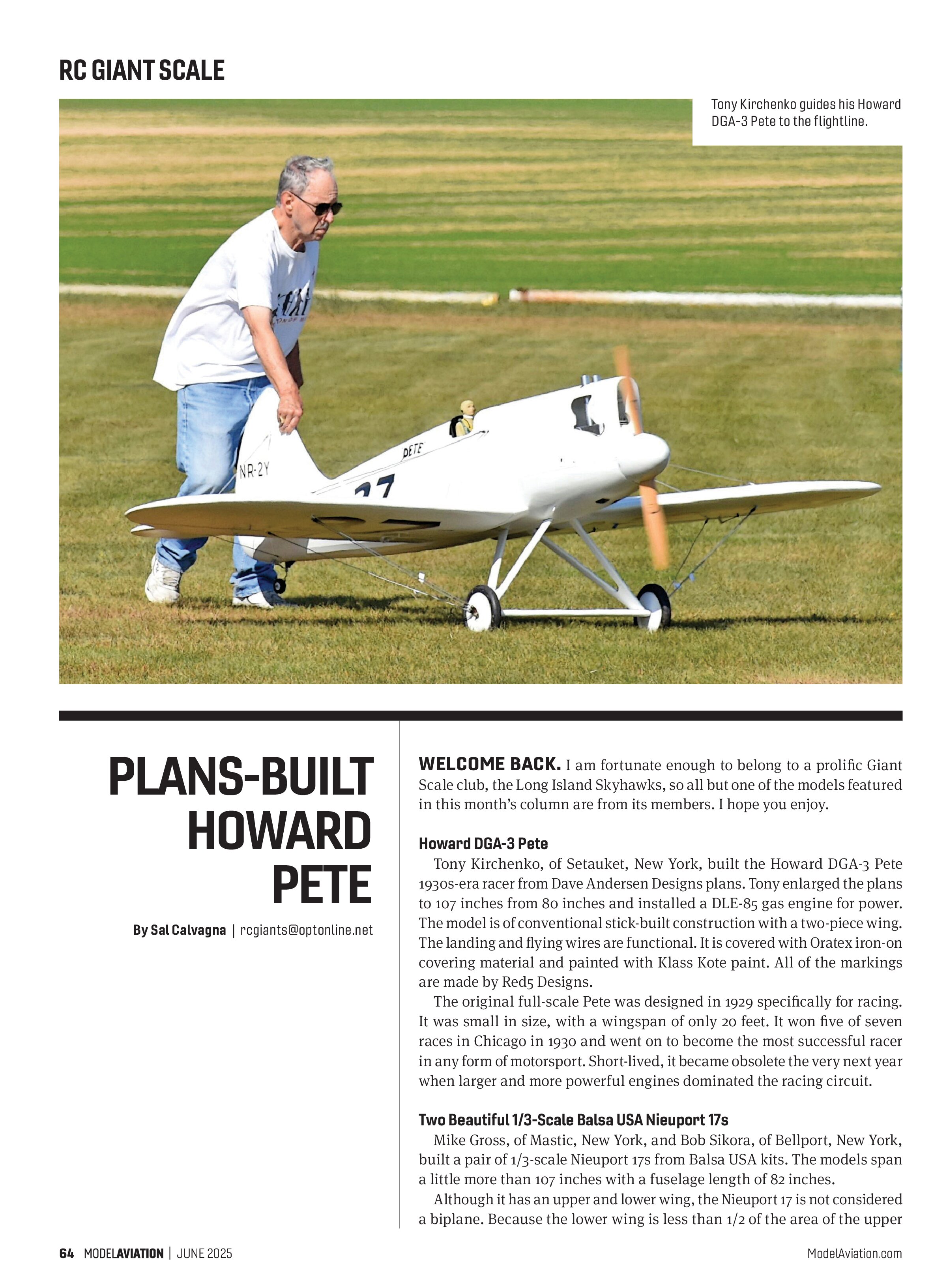
Tony Kirchenko, of Setauket, New York, built the Howard DGA-3 Pete 1930s-era racer from Dave Andersen Designs plans. Tony enlarged the plans to 107 inches from 80 inches and installed a DLE-85 gas engine for power. The model is of conventional stick-built construction with a two-piece wing. The landing and flying wires are functional. It is covered with Oratex iron-on covering material and painted with Klass Kote paint. All of the markings are made by Red5 Designs.
The original full-scale Pete was designed in 1929 specifically for racing. It was small in size, with a wingspan of only 20 feet. It won five of seven races in Chicago in 1930 and went on to become the most successful racer in any form of motorsport. Short-lived, it became obsolete the very next year when larger and more powerful engines dominated the racing circuit.
Two Beautiful 1/3-Scale Balsa USA Nieuport 17s
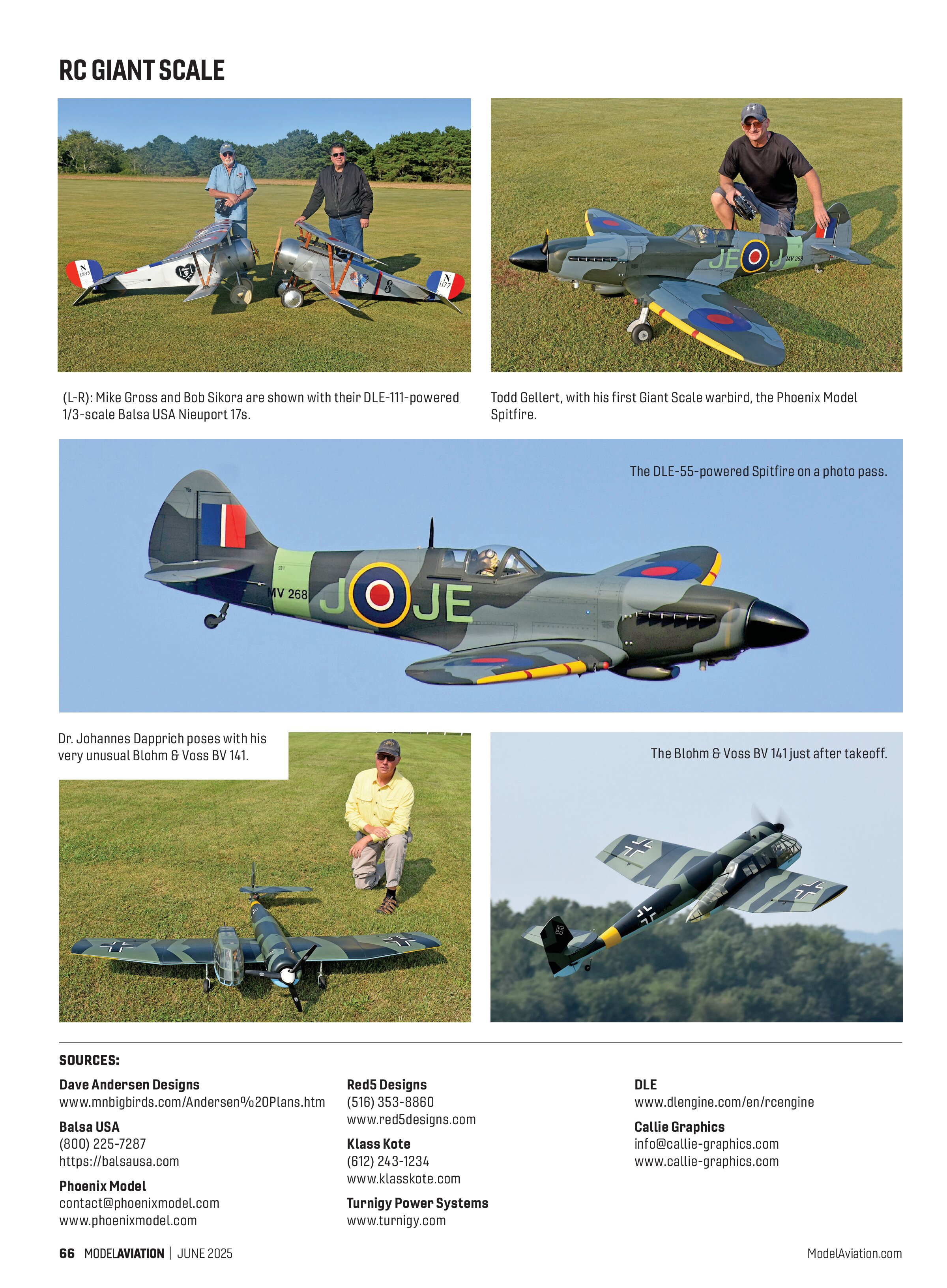
Mike Gross, of Mastic, New York, and Bob Sikora, of Bellport, New York, built a pair of 1/3-scale Nieuport 17s from Balsa USA kits. The models span a little more than 107 inches with a fuselage length of 82 inches.
Although it has an upper and lower wing, the Nieuport 17 is not considered a biplane. Because the lower wing is less than 1/2 of the area of the upper wing, it is classified as a sesquiplane.
Both models are powered by DLE-111 two-stroke, twin-cylinder gas engines. Mike covered his model with Oratex covering material and painted it with automotive, high-heat aluminum rattle can paint. Bob used silver Solartex material that he purchased years ago. Both models feature markings made by Red5 Designs. Of course, they both also fly extremely well, as do all Balsa USA designs.
The full-scale Nieuport 17 replaced the diminutive Nieuport 11 because it was a bit larger and had a more powerful engine. It also had a synchronized machine gun that allowed for firing through the propeller arc. Introduced in early 1916, the Nieuport 17 was maneuverable and had a robust rate of climb, which gave it an advantage of the Central Powers.
Phoenix Models Spitfire
Todd Gellert, of East Setauket, New York, is new to Giant Scale warbirds. His first is a Phoenix Model 95-inch wingspan ARF Spitfire. Todd’s choice of engine to power the Spit is a DLE-55 rear exhaust.
The model has a scale scheme printed on an iron-on-type film and sports a scale cockpit with a sliding canopy and hinged door just like the full-scale aircraft. It also comes with heavy-duty air retracts, split flaps, and a two-piece wing.
Of course, the Spitfire was made famous during World War II in the Battle of Britain, when England stood alone against the vaunted Luftwaffe and Axis partners.
A Rarely Modeled Blohm & Voss BV 141
Last but not least is a photo of Dr. Johannes Dapprich, of Lawrenceville, New Jersey, with his very unusual and rarely modeled Blohm & Voss BV 141.
The model spans 81 inches and is powered by a Turnigy S6364 290 Kv electric motor. It was originally built by Tony Jensen from a FlyBoy kit. The markings are from Callie Graphics. Johannes reports that the model is extremely stable and that he can achieve 10-minute flights with the current configuration.
In response to a requirement for a tactical reconnaissance aircraft, Richard Vogt, the chief designer at Blohm & Voss, took an unconventional approach and designed an asymmetrical aircraft. The full-scale aircraft first flew in February 1938. It was reported that it had relatively good performance, stability, control, and observational capabilities. Nonetheless, it never made it past testing, with only a limited number of prototypes made.
That’s all for this month. I wish you all gentle skies and soft landings.


SOURCES:
Dave Andersen Designs
www.mnbigbirds.com/Andersen%20Plans.htm
Balsa USA
(800) 225-7287
https://balsausa.com
Phoenix Model
contact@phoenixmodel.com
www.phoenixmodel.com
Red5 Designs
(516) 353-8860
www.red5designs.com
Klass Kote
(612) 243-1234
www.klasskote.com
Turnigy Power Systems
www.turnigy.com
DLE
www.dleng in e.com/en/rcengine
Callie Graphics
info@callie-graphics.com
www.callie-graphics.com