MY LOVE
AFFAIR WITH
SMALL RC
AIRPLANES
By Tim Bailiff | casurfis[email protected]

THERE’S NO DENYING that large RC airplanes are magnificent to see both in the air and up close on the ground. The skill it takes to build and fly those large, sophisticated models really is awe-inspiring. Truly, my hat is off to those accomplished modelers and pilots. But hey, small RC airplanes need love too!
As a Teenager
When I was a young teenager, I had the opportunity to travel to a neighboring town with a friend. Our destination was a renowned “mom-and-pop” hobby shop in Anaheim, California. Upon arriving, I was thrilled to find it packed with all varieties of model airplanes, cars, and trains. My friend was there for the trains, but not me. I wanted to see the airplanes!
At the time, I was a diehard Control Line guy, with only a slight curiosity about RC airplanes. Well, that store offered such a large selection of kits and other goodies that it boggled my mind. I’m sure I was quite the sight as I wandered the aisles with my mouth agape. After all, who wouldn’t have been astounded by the large number of beautiful aircraft that hung from the ceiling?
For some reason, what caught and held my attention was a display case along one wall. Within it, there were numerous small RC model airplanes. All were beautifully finished, and most were constructed from kits that were available in the store. However, the one model that intrigued me the most was a petite, little airplane that resembled a Blériot XI. That little flyer was powered by a tiny Cox .010 engine and for control, it used rudder only. Its small, metal RC transmitter was displayed next to it as well.
I remember that it had a long, collapsible antenna and, other than an on/off switch, it possessed but one other button. “How is that supposed to work?” I wondered. Ultimately, one of the shop employees worked their way over to me and asked whether I had any questions. Well, I had plenty, and thankfully, there were answers.
What I Learned
First, I learned that the little airplane was an original design and that the control


system used an “escapement.” I was surprised to find that the simple airborne equipment not only used a battery but also included a rubber band, which needed to be wound before each flight! What? I was told that it was actually the rubber band that provided the power to operate the escapement, which, in turn, moved the little rudder.
I learned that the internal workings were similar to a wind-up clock. Basically, the escapement controlled the release of energy provided by, in this case, a rubber band. Finally, I was told that the position of the rudder was determined by how many times the transmitter button was pressed! For example, one press would move the rudder to the right. When the button was released, the rudder would return to center. With two presses, the rudder would move left, and releasing the button would again center the rudder. All I could think was, “Wow, how cool!”
Fast-Forward
Today, there is an amazing variety of small, RTF RC park flyers from which to choose. This is made possible by current microelectronics, small LiPo batteries, and tiny electric motors. That stated, the same microcomponents can also be used to build fun and unique designs of our own. Gone are the days of escapements, but small airplanes can still be built as simply as we’d like and remain just as provocative as that little Blériot was for me.
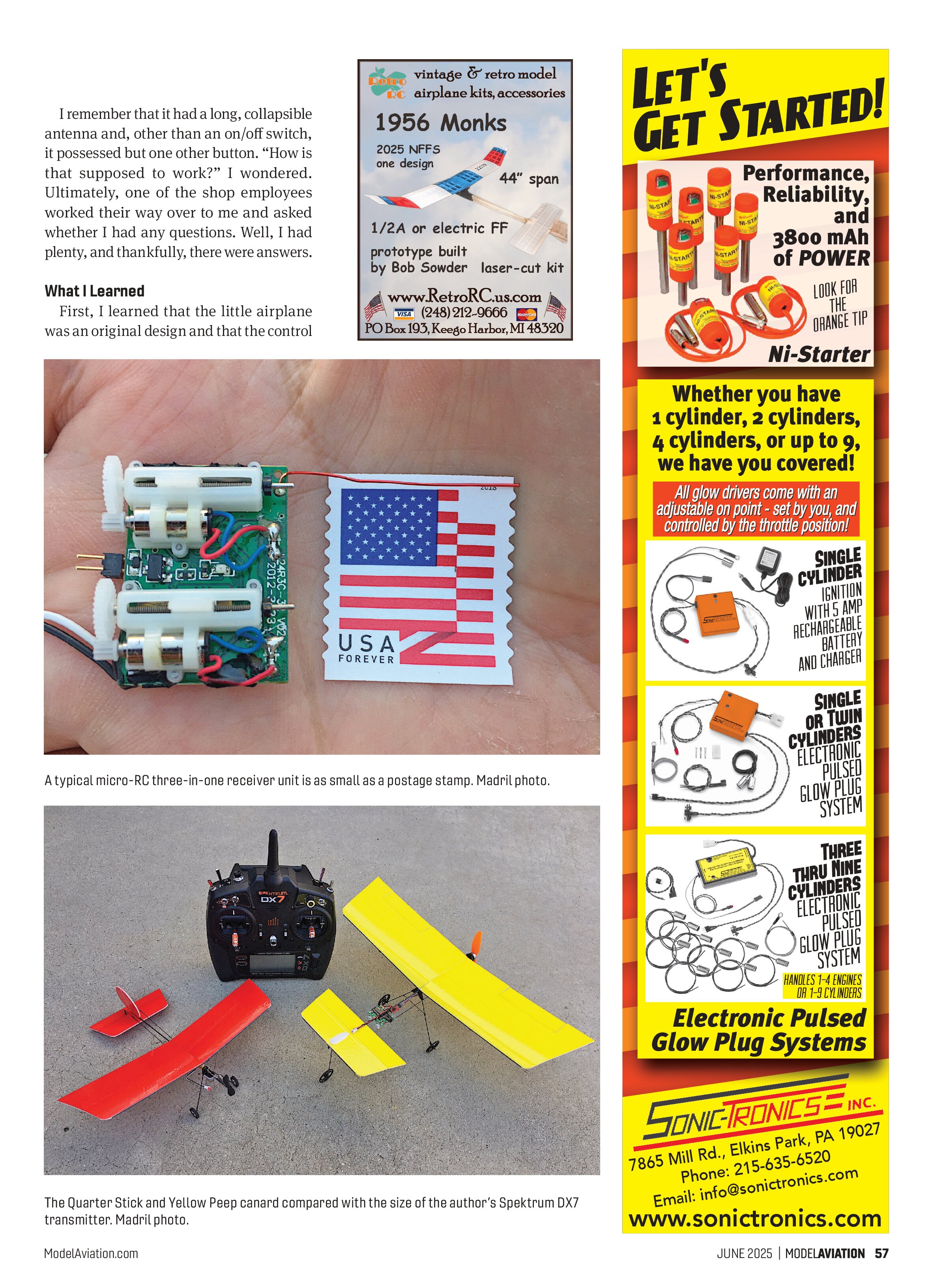
Currently, my squadron of small airplanes uses a number of Horizon Hobby three-in-one receiver units. The smallest is the size of a postage stamp! Each little unit combines a receiver, two linear servos, and an ESC. They are all DSM2- or DSMX-compatible and pair perfectly with my Spektrum transmitters.
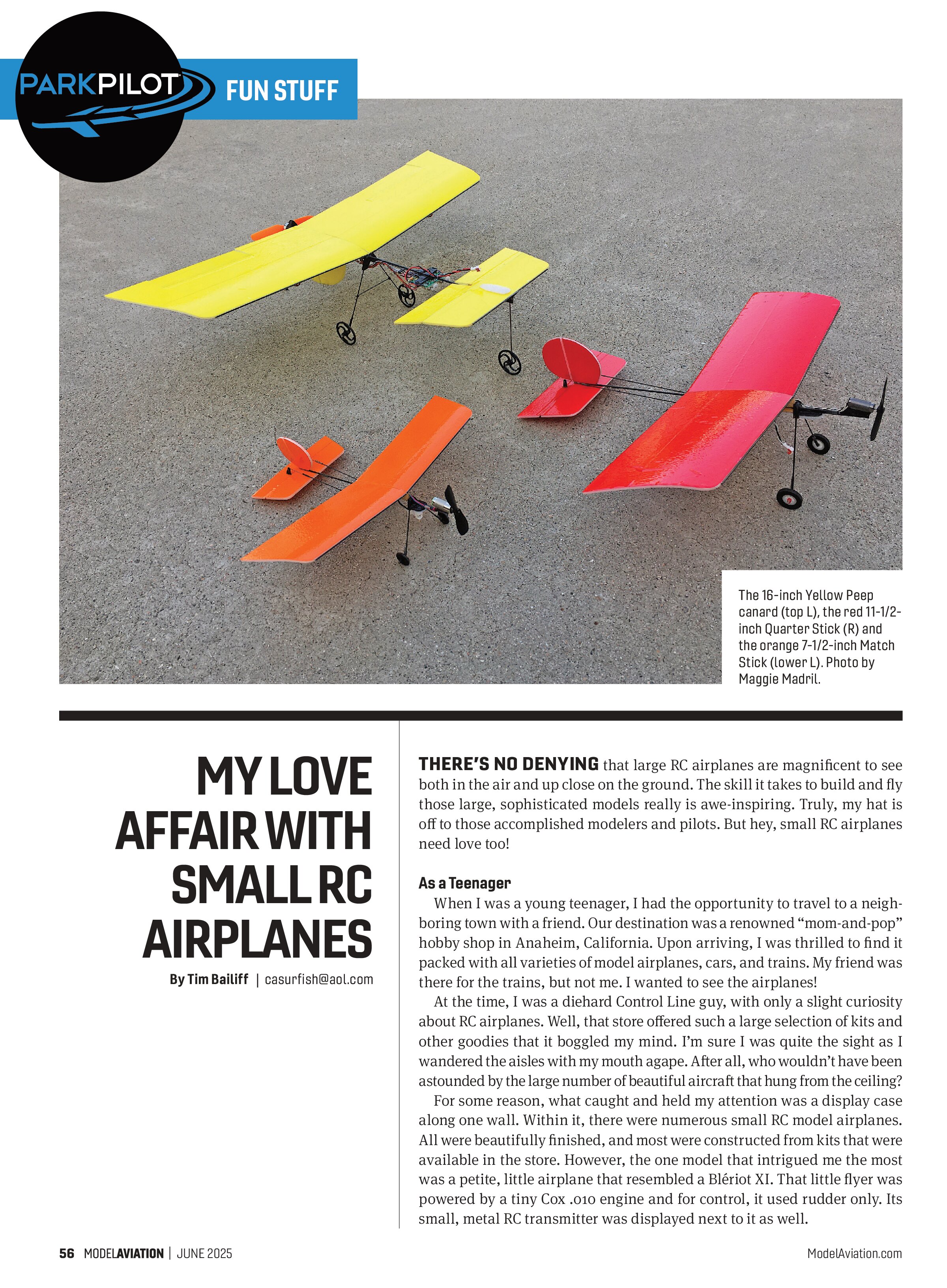
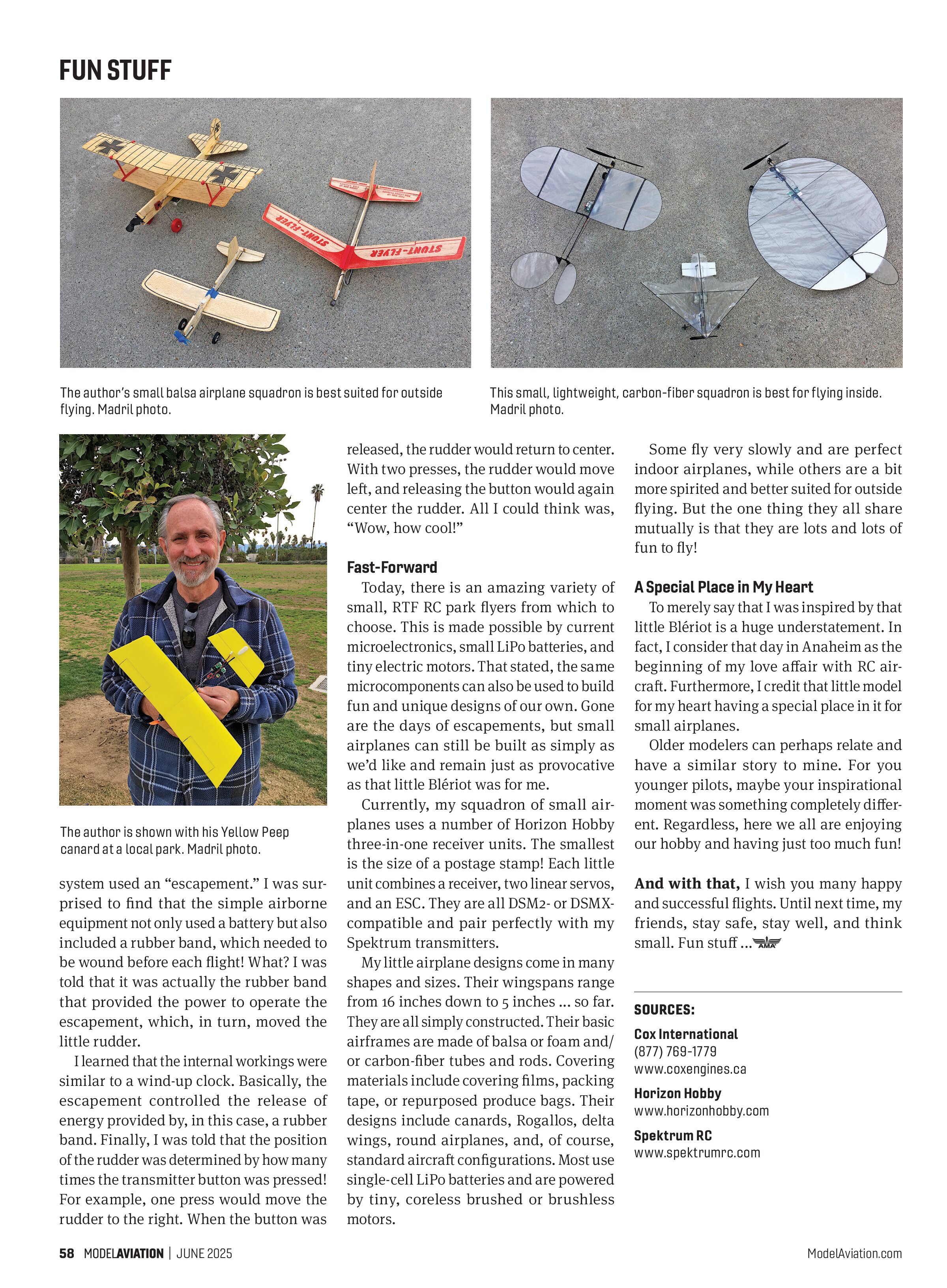
My little airplane designs come in many shapes and sizes. Their wingspans range from 16 inches down to 5 inches … so far. They are all simply constructed. Their basic airframes are made of balsa or foam and/or carbon-fiber tubes and rods. Covering materials include covering films, packing tape, or repurposed produce bags. Their designs include canards, Rogallos, delta wings, round airplanes, and, of course, standard aircraft configurations. Most use single-cell LiPo batteries and are powered by tiny, coreless brushed or brushless motors.
Some fly very slowly and are perfect indoor airplanes, while others are a bit more spirited and better suited for outside flying. But the one thing they all share mutually is that they are lots and lots of fun to fly!
A Special Place in My Heart
To merely say that I was inspired by that little Blériot is a huge understatement. In fact, I consider that day in Anaheim as the beginning of my love affair with RC aircraft. Furthermore, I credit that little model for my heart having a special place in it for small airplanes.
Older modelers can perhaps relate and have a similar story to mine. For you younger pilots, maybe your inspirational moment was something completely different. Regardless, here we all are enjoying our hobby and having just too much fun!
And with that, I wish you many happy and successful flights. Until next time, my friends, stay safe, stay well, and think small. Fun stuff …
SOURCES:
Cox International
(877) 769-1779
www.coxengines.ca
Horizon Hobby
www.horizonhobby.com
Spektrum RC
www.spektrumrc.com