
BUILDING CONFIDENCE,
ONE FF MODEL
AT A TIME
By Gwen Mathis | gwenm@modelaircraft.org
I DIDN’T BEGIN my career in aviation. My first 10 months out of college were spent in a classroom, teaching students reading, math, and science. When I transitioned to informal education at AMA, I found myself in a completely unfamiliar field. Everyone I spoke to about model airplanes had a wealth of aviation knowledge, but much of it went over my head. In the last 2-1/2 years, I’ve learned a lot, but my introduction came with a steep learning curve, of which I sometimes still feel the effects.
Without a background in model aviation, I admittedly had a difficult time getting a start in flying model aircraft. Education Director Kyle Jaracz has been nothing but unendingly patient while teaching me how to fly RC, but it just doesn’t click for me. To this day, I still struggle to get my brain and my fingers to communicate fast enough to successfully fly anything for longer than 30 seconds. I know which control stick adjusts the throttle and rudder and which controls the ailerons and elevator while on the ground, but as soon as I am up in the air, I can’t seem to put it into practice.
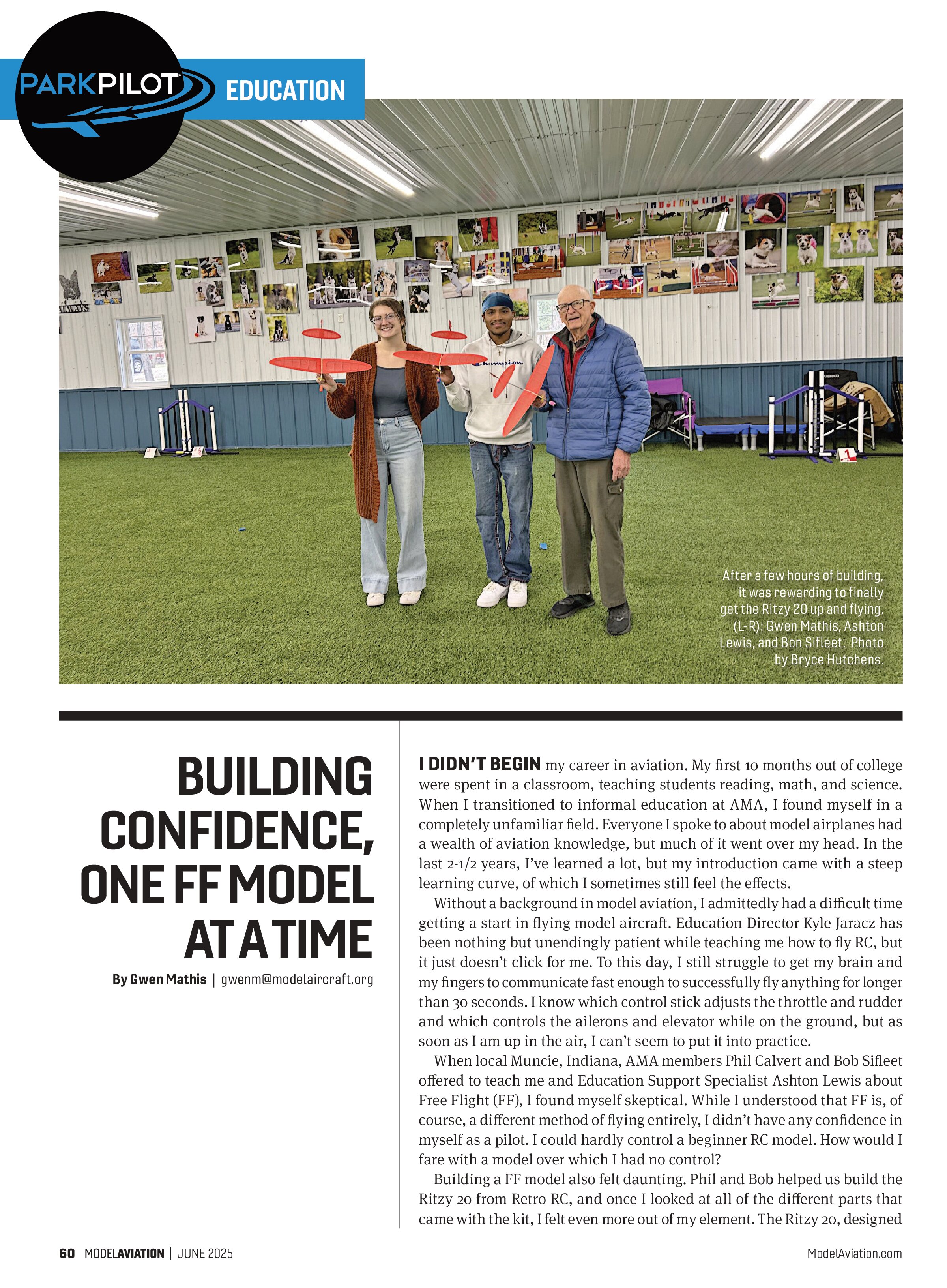
When local Muncie, Indiana, AMA members Phil Calvert and Bob Sifleet offered to teach me and Education Support Specialist Ashton Lewis about Free Flight (FF), I found myself skeptical. While I understood that FF is, of course, a different method of flying entirely, I didn’t have any confidence in myself as a pilot. I could hardly control a beginner RC model. How would I fare with a model over which I had no control?
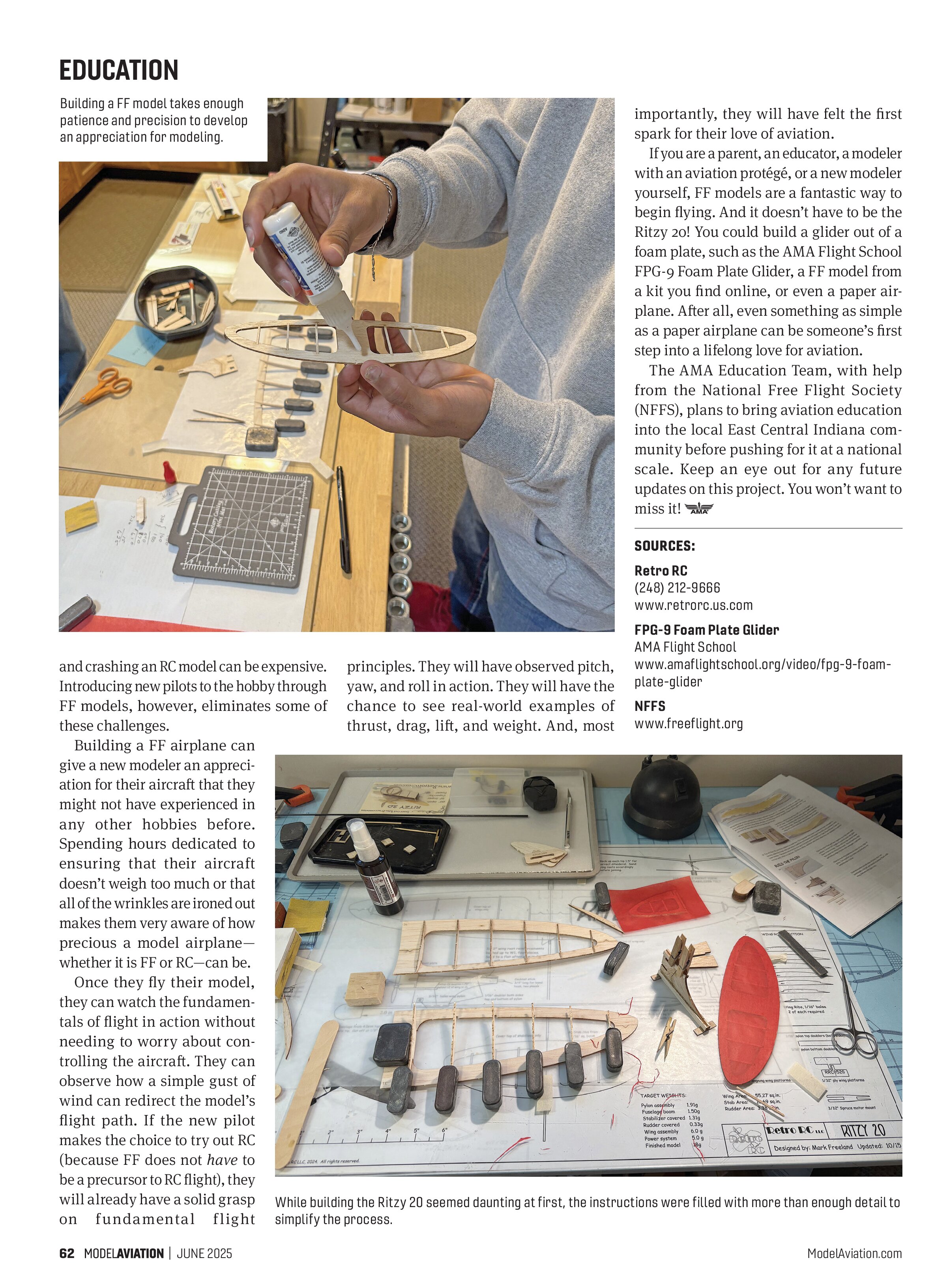
Building a FF model also felt daunting. Phil and Bob helped us build the Ritzy 20 from Retro RC, and once I looked at all of the different parts that came with the kit, I felt even more out of my element. The Ritzy 20, designed
EDUCATION

and crashing an RC model can be expensive. Introducing new pilots to the hobby through FF models, however, eliminates some of these challenges.
Building a FF airplane can give a new modeler an appreciation for their aircraft that they might not have experienced in any other hobbies before. Spending hours dedicated to ensuring that their aircraft doesn’t weigh too much or that all of the wrinkles are ironed out makes them very aware of how precious a model airplane—whether it is FF or RC—can be. Once they fly their model, they can watch the fundamentals of flight in action without needing to worry about controlling the aircraft. They can observe how a simple gust of wind can redirect the model’s flight path. If the new pilot makes the choice to try out RC (because FF does not have to be a precursor to RC flight), they will already have a solid grasp on fundamental flight

principles. They will have observed pitch, yaw, and roll in action. They will have the chance to see real-world examples of thrust, drag, lift, and weight. And, most importantly, they will have felt the first spark for their love of aviation.
If you are a parent, an educator, a modeler with an aviation protégé, or a new modeler yourself, FF models are a fantastic way to begin flying. And it doesn’t have to be the Ritzy 20! You could build a glider out of a foam plate, such as the AMA Flight School FPG-9 Foam Plate Glider, a FF model from a kit you find online, or even a paper airplane. After all, even something as simple as a paper airplane can be someone’s first step into a lifelong love for aviation.
The AMA Education Team, with help from the National Free Flight Society (NFFS), plans to bring aviation education into the local East Central Indiana community before pushing for it at a national scale. Keep an eye out for any future updates on this project. You won’t want to miss it!
SOURCES:
Retro RC
(248) 212-9666
www.retrorc.us.com
FPG-9 Foam Plate Glider
AMA Flight School
www.amaflightschool.org/video/fpg-9-foam-plate-glider