MODEL AVIATION PEN PALS
By Bob Angel | samrcflier@verizon.net
“PEN PAL” is an almost forgotten term today. In the years before there were multiple forms of instant communication, people who regularly kept in touch with each other via handwritten letters were known as pen pals. They may or may not have ever met in person, but that wasn’t a part of the equation. As a youngster, we moved quite a bit, so old school chums sometimes became pen pals.
Later, as typewriters and computers came along, a few of us still hung on to that pen pal term but now use it more sparingly. I have a few model-building acquaintances who I consider pen pals, but as time moves on, we keep disappearing along with the term itself.
Bob Aberle (1938-2023)
Bob Aberle was one fellow I considered to be a pen pal. Bob was a versatile modeler who tackled a large variety of projects. He is an AMA Model Aviation Hall of Fame (HOF) member with an extensive range of accomplishments, including many background efforts in support of our hobby. Fortunately, Bob was also a prolific writer who cataloged many projects while he designed, built, and published roughly 38 models that appeared in eight different model publications for which he wrote.
Bob was a pen pal who I never met in person. Our acquaintance was mostly through email, an occasional phone call, or the US Postal Service because we occasionally exchanged sketches. The primary project that brought us together was his build of an electric version of the Carl Schmaedig-designed Flying Stick. I’d built a couple of versions of the Stick and had loosely used the term “Schmaedig Stick” for convenience in various newsletters. It was soon pointed out to me, however, that some people couldn’t locate the plans because they are properly listed only as the Flying Stick.
More about the Stick later. Let’s finish Bob’s biography.
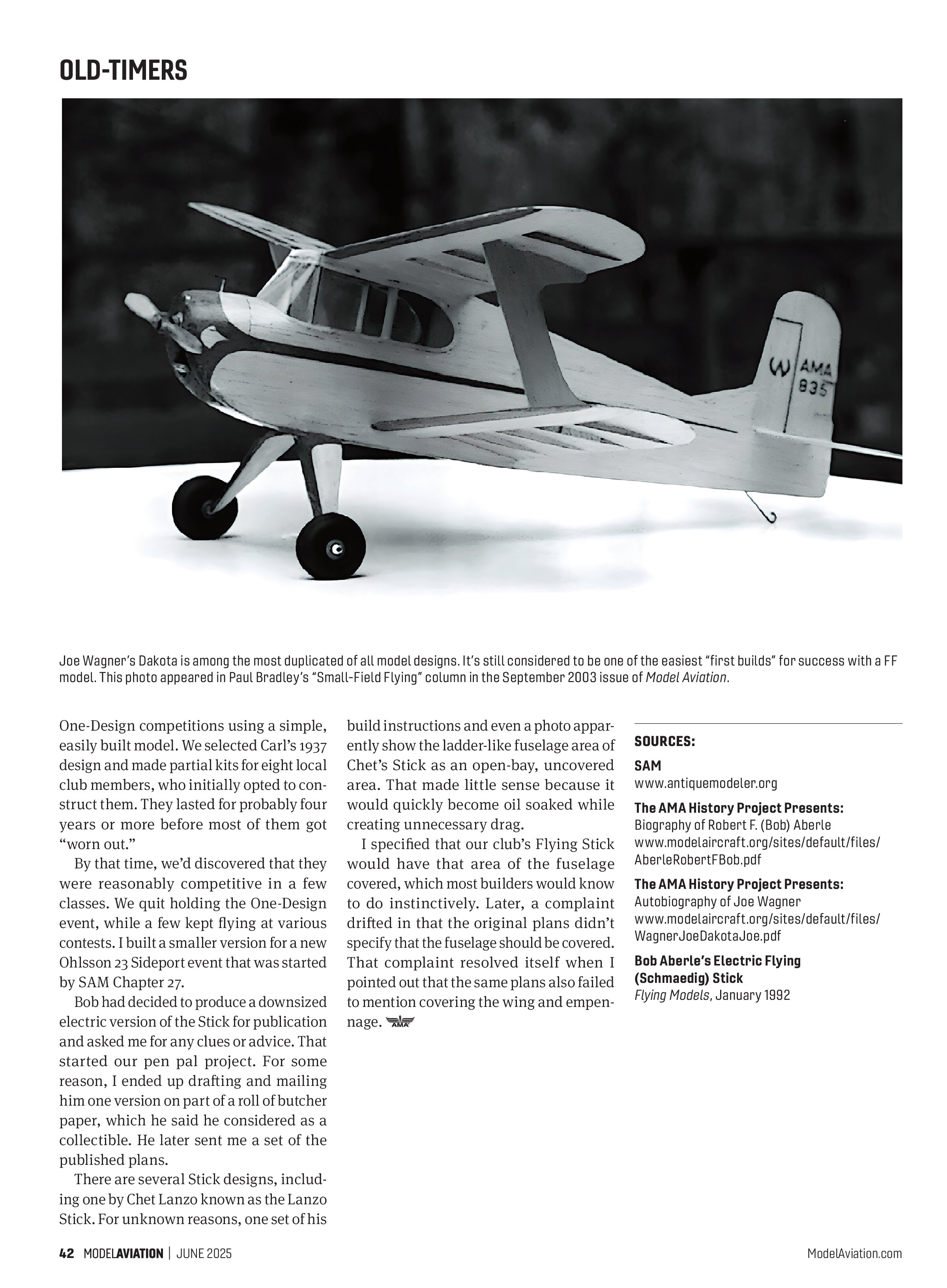
HOF members are listed alphabetically by surname, so it’s not surprising to see Bob’s last name as the very first entry that heads the current list. Bob wrote most of his biography himself in first-person format. He’d lived within walking distance of the abandoned Curtiss Airport in Valley Stream, New York, when some friends invited him along to watch the Free Flight (FF) and Control Line (CL) models that were being flown there. He was hooked. He joined AMA circa 1950 at the age of 12. His first build was a simple, little FF kit, a 1/2A Dakota, designed by Joe Wagner.
To this day, the Dakota happens to be one of the more successful first-build designs for a prospective FF modeler, especially if they’re in a remote area with little or no connection to a club or mentor. The Dakota is designed for stability, not high performance. It’s not normally built with a determalizer installed. Should you lose it in a flyaway thermal, you might be considered a hero by other modelers. Incidentally, Joe’s Dakota design earned him the permanent nickname of “Dakota Joe.”
Bob flew his Dakota most of one summer before finally losing it. It wasn’t lost to a thermal, however, but to some tall swamp grass on the edge of the large field. It was a relatively inexpensive way to be introduced not only to FF but also to a harsh reality of modeling: Be prepared to occasionally lose or crash a model.
Bob graduated from Brooklyn Technical High School in Brooklyn, New York, in 1955. I researched and found that the school has high ratings among the nation’s top high schools. The sole requirement for admission is through a rigorous 3-hour test known as the Specialized High School Admissions Test. Out of approximately 30,000 test applicants, roughly 5% (or about 1,500) are admitted to Brooklyn Tech each year.
Bob’s “real life” work was mainly with the Grumman Corporation on Long Island, where he became an engineering manager and retired after 30 years. In his biography, he only mentioned Brooklyn Tech and his work at Grumman very briefly, probably so that he could dig right into his numerous modeling accomplishments. I saw no mention of college; however, in the earlier days, it wasn’t unusual for talented people to move into engineering based directly on progressive experience and job performance.
After getting his start with FF, Bob didn’t mention CL flying, although it’s hard to imagine that he did not at least “dabble” in that part of the hobby along the way. Bob quickly became interested in the more technical challenges of RC. RC was indeed much more technical then since you couldn’t just buy a box containing a ready-to-install transmitter, receiver, and servos. You constructed a heavier, more complicated set of equipment that, in many cases, controlled just a single channel.
In the 1970s, AMA Executive Director John Worth invited Bob to join the RC Frequency Committee as the chairman. RC was expanding rapidly, and more frequencies were needed to conduct events fairly without having to wait for the “luck of the draw” while others flew in the good air on your frequency. Little by little, the committee successfully dealt with the Federal Communications Commission to progressively open more channels for our exclusive RC use.
The Flying Stick
The Flying Stick was a design popularized for a short time by the Society of Antique Modelers (SAM) Chapter 26’s home club project. We decided to run a series of


One-Design competitions using a simple, easily built model. We selected Carl’s 1937 design and made partial kits for eight local club members, who initially opted to construct them. They lasted for probably four years or more before most of them got “worn out.”
By that time, we’d discovered that they were reasonably competitive in a few classes. We quit holding the One-Design event, while a few kept flying at various contests. I built a smaller version for a new Ohlsson 23 Sideport event that was started by SAM Chapter 27.
Bob had decided to produce a downsized electric version of the Stick for publication and asked me for any clues or advice. That started our pen pal project. For some reason, I ended up drafting and mailing him one version on part of a roll of butcher paper, which he said he considered as a collectible. He later sent me a set of the published plans.
There are several Stick designs, including one by Chet Lanzo known as the Lanzo Stick. For unknown reasons, one set of his build instructions and even a photo apparently show the ladder-like fuselage area of Chet’s Stick as an open-bay, uncovered area. That made little sense because it would quickly become oil soaked while creating unnecessary drag.
I specified that our club’s Flying Stick would have that area of the fuselage covered, which most builders would know to do instinctively. Later, a complaint drifted in that the original plans didn’t specify that the fuselage should be covered. That complaint resolved itself when I pointed out that the same plans also failed to mention covering the wing and empennage.
SOURCES:
The AMA History Project Presents:
Biography of Robert F. (Bob) Aberle
www.modelaircraft.org/sites/default/files/AberleRobertFBob.pdf
The AMA History Project Presents:
Autobiography of Joe Wagner
www.modelaircraft.org/sites/default/files/WagnerJoeDakotaJoe.pdf
Bob Aberle’s Electric Flying (Schmaedig) Stick
Flying Models, January 1992