LEARNING FROM OTHERS’ MISTAKES, PART TWO
By Dave Scott | 1usrcfs@gmail.com

THIS COLUMN FEATURES part two of my article from the March 2025 issue of Model Aviation that is based on my experience training a group of experienced RC pilots, in which they learned the solutions to several bad habits that trip up many pilots.
Fourth Bad Habit
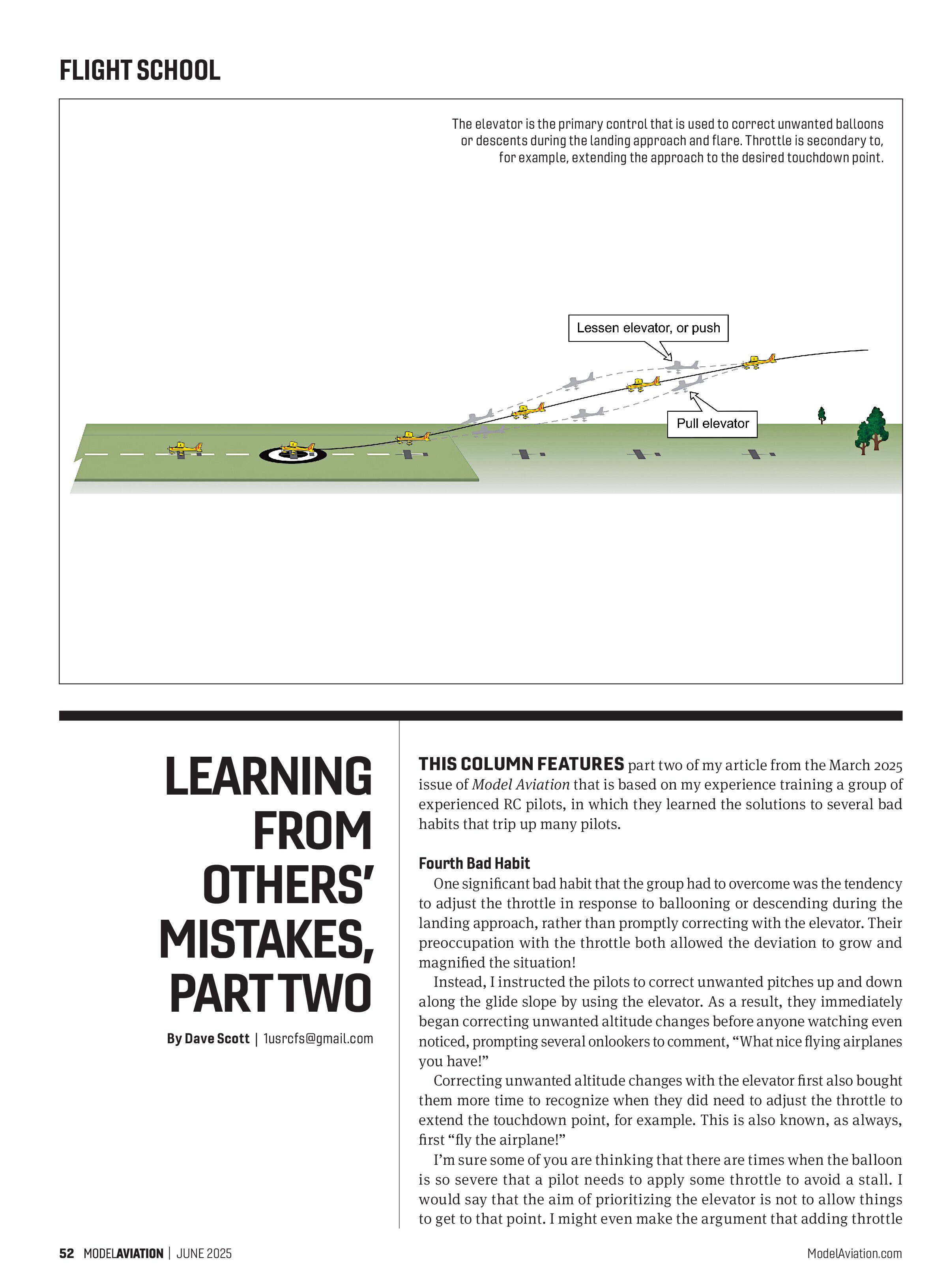
One significant bad habit that the group had to overcome was the tendency to adjust the throttle in response to ballooning or descending during the landing approach, rather than promptly correcting with the elevator. Their preoccupation with the throttle both allowed the deviation to grow and magnified the situation!
Instead, I instructed the pilots to correct unwanted pitches up and down along the glide slope by using the elevator. As a result, they immediately began correcting unwanted altitude changes before anyone watching even noticed, prompting several onlookers to comment, “What nice flying airplanes you have!”
Correcting unwanted altitude changes with the elevator first also bought them more time to recognize when they did need to adjust the throttle to extend the touchdown point, for example. This is also known, as always, first “fly the airplane!”
I’m sure some of you are thinking that there are times when the balloon is so severe that a pilot needs to apply some throttle to avoid a stall. I would say that the aim of prioritizing the elevator is not to allow things to get to that point. I might even make the argument that adding throttle is the last thing a pilot who is losing control of the airplane should be thinking about.
Regarding the fear of stalling, earlier in the week, I had each pilot practice slow flight at a comfortable altitude. They discovered that their airplanes flew much slower than they thought possible. When the aircraft did stall, the stall proved mild or mushy, thus giving them time to recover.
The club members said that in all of their years of flying, the slow flight exercise was the most beneficial and they wondered why no one had ever suggested trying it before. The exercise then gave them the confidence to let the airplane slow down during landing.
One of the members had an airplane that did not like to fly slow. Rather than the owner becoming spooked, he stated that his confidence was boosted because, at least now, he knew what to expect.
Fifth Bad Habit
Finally, the class encountered crosswinds all week that they normally wouldn’t have flown in. This exposed the flaw in their thinking. They had been told to use the rudder to steer the airplane during landing and to use the aileron to keep the wings level. That incorrect thinking resulted in several exciting go-arounds and close calls with the safety fence the first day!
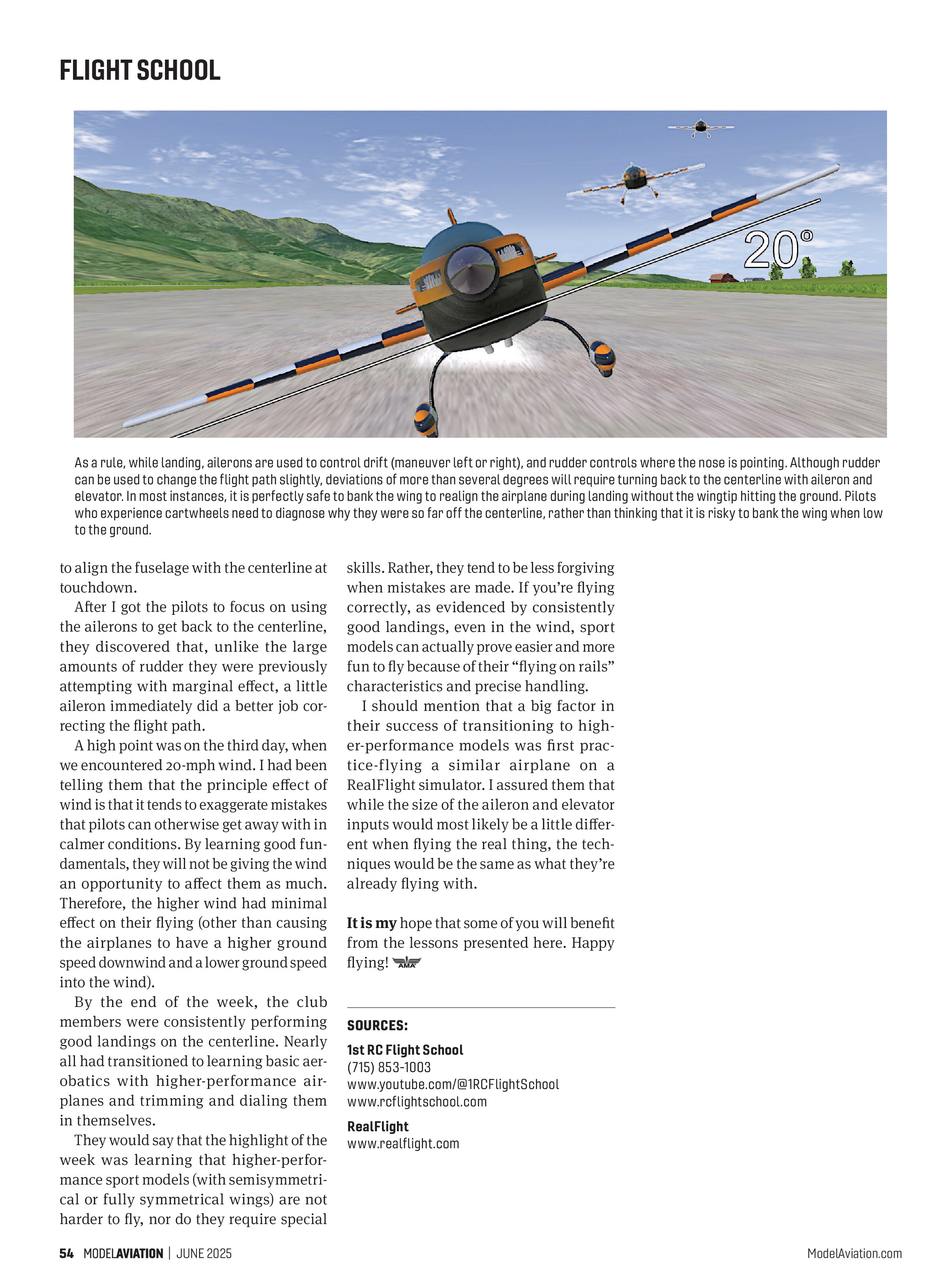
This advice is often born out of someone’s experience of catching a wingtip and cartwheeling. Rather than thinking that banking the wing low to the ground was a bad thing, they should have been looking at why they were so far off the centerline that they ended up overreacting. What is dangerous is inputting a lot of rudder when the airplane is low and slow.
Although good pilots might use a little rudder for minor course adjustments, deviations more than a few degrees require using the aileron to bank the wing back toward the centerline. Full-scale instructors, especially those who instruct in tail-draggers, teach that the ailerons are used to control drift and that rudder is used

As a rule, while landing, ailerons are used to control drift (maneuver left or right), and rudder controls where the nose is pointing. Although rudder can be used to change the flight path slightly, deviations of more than several degrees will require turning back to the centerline with aileron and elevator. In most instances, it is perfectly safe to bank the wing to realign the airplane during landing without the wingtip hitting the ground. Pilots who experience cartwheels need to diagnose why they were so far off the centerline, rather than thinking that it is risky to bank the wing when low to the ground.
to align the fuselage with the centerline at touchdown.
After I got the pilots to focus on using the ailerons to get back to the centerline, they discovered that, unlike the large amounts of rudder they were previously attempting with marginal effect, a little aileron immediately did a better job correcting the flight path.
A high point was on the third day, when we encountered 20-mph wind. I had been telling them that the principle effect of wind is that it tends to exaggerate mistakes that pilots can otherwise get away with in calmer conditions. By learning good fundamentals, they will not be giving the wind an opportunity to affect them as much. Therefore, the higher wind had minimal effect on their flying (other than causing the airplanes to have a higher ground speed downwind and a lower ground speed into the wind).
By the end of the week, the club members were consistently performing good landings on the centerline. Nearly all had transitioned to learning basic aerobatics with higher-performance airplanes and trimming and dialing them in themselves.
They would say that the highlight of the week was learning that higher-performance sport models (with semisymmetrical or fully symmetrical wings) are not harder to fly, nor do they require special skills. Rather, they tend to be less forgiving when mistakes are made. If you’re flying correctly, as evidenced by consistently good landings, even in the wind, sport models can actually prove easier and more fun to fly because of their “flying on rails” characteristics and precise handling.
I should mention that a big factor in their success of transitioning to higher-performance models was first practice-flying a similar airplane on a RealFlight simulator. I assured them that while the size of the aileron and elevator inputs would most likely be a little different when flying the real thing, the techniques would be the same as what they’re already flying with.
It is my hope that some of you will benefit from the lessons presented here. Happy flying!
SOURCES:
1st RC Flight School
(715) 853-1003
www.youtube.com/@1RCFlightSchool
www.rcflightschool.com
RealFlight
www.realflight.com