SPECIAL ELECTION IN DISTRICT III
THERE WILL BE a special election for the position of AMA vice president in District III, as well as regular elections for AMA president and vice presidents in Districts I, V, and IX. Nominations are due at the Headquarters of the Academy of Model Aeronautics by June 19, 2025. Any AMA Adult member may submit a nomination. All nominations must be electronically submitted to AMA Headquarters via email to Katie Perry at katiep@modelaircraft.org.
To be eligible to discharge the duties of AMA vice president, a nominee must be a Leader Member of the AMA and must reside in the district.
To be eligible to discharge the duties of AMA president or executive vice president, a nominee must be a Leader Member of the AMA and must previously have served as a member of the Executive Council, associate vice president, or as a Contest Board member for at least one year.
A letter of acceptance from the nominee must be submitted by July 4, 2025, 15 days prior to the published Nominating Committee meeting. A résumé of professional qualifications and model aviation experience from the nominee must be on file at AMA Headquarters by July 9, 2025, 10 days prior to the published Nominating Committee meeting.
For more information, visit www.modelaircraft.org/nominations-due.
TYLER DOBBS NAMED AS NEW AMA EXECUTIVE DIRECTOR
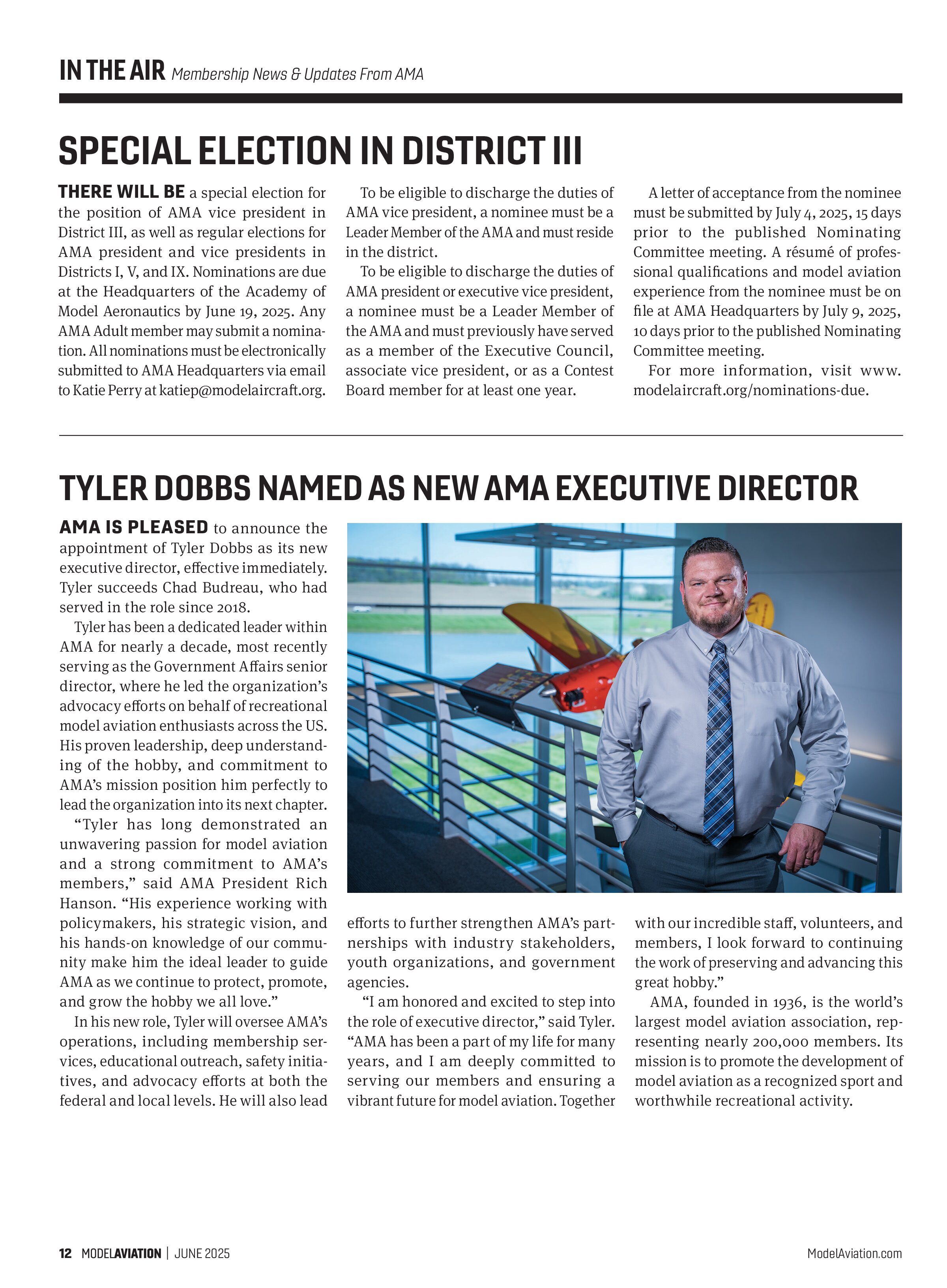
AMA IS PLEASED to announce the appointment of Tyler Dobbs as its new executive director, effective immediately. Tyler succeeds Chad Budreau, who had served in the role since 2018.
Tyler has been a dedicated leader within AMA for nearly a decade, most recently serving as the Government Affairs senior director, where he led the organization’s advocacy efforts on behalf of recreational model aviation enthusiasts across the US. His proven leadership, deep understanding of the hobby, and commitment to AMA’s mission position him perfectly to lead the organization into its next chapter.
“Tyler has long demonstrated an unwavering passion for model aviation and a strong commitment to AMA’s members,” said AMA President Rich Hanson. “His experience working with policymakers, his strategic vision, and his hands-on knowledge of our community make him the ideal leader to guide AMA as we continue to protect, promote, and grow the hobby we all love.”
In his new role, Tyler will oversee AMA’s operations, including membership services, educational outreach, safety initiatives, and advocacy efforts at both the federal and local levels. He will also lead

efforts to further strengthen AMA’s partnerships with industry stakeholders, youth organizations, and government agencies.
“I am honored and excited to step into the role of executive director,” said Tyler. “AMA has been a part of my life for many years, and I am deeply committed to serving our members and ensuring a vibrant future for model aviation. Together with our incredible staff, volunteers, and members, I look forward to continuing the work of preserving and advancing this great hobby.”
AMA, founded in 1936, is the world’s largest model aviation association, representing nearly 200,000 members. Its mission is to promote the development of model aviation as a recognized sport and worthwhile recreational activity.
AMA FOUNDATION AWARDED IDDC GRANT FOR THE IAC IMPROVEMENT PROJECT!
By Clarissa Poston, AMA Foundation Communications Specialist | clarissap@modelaircraft.org
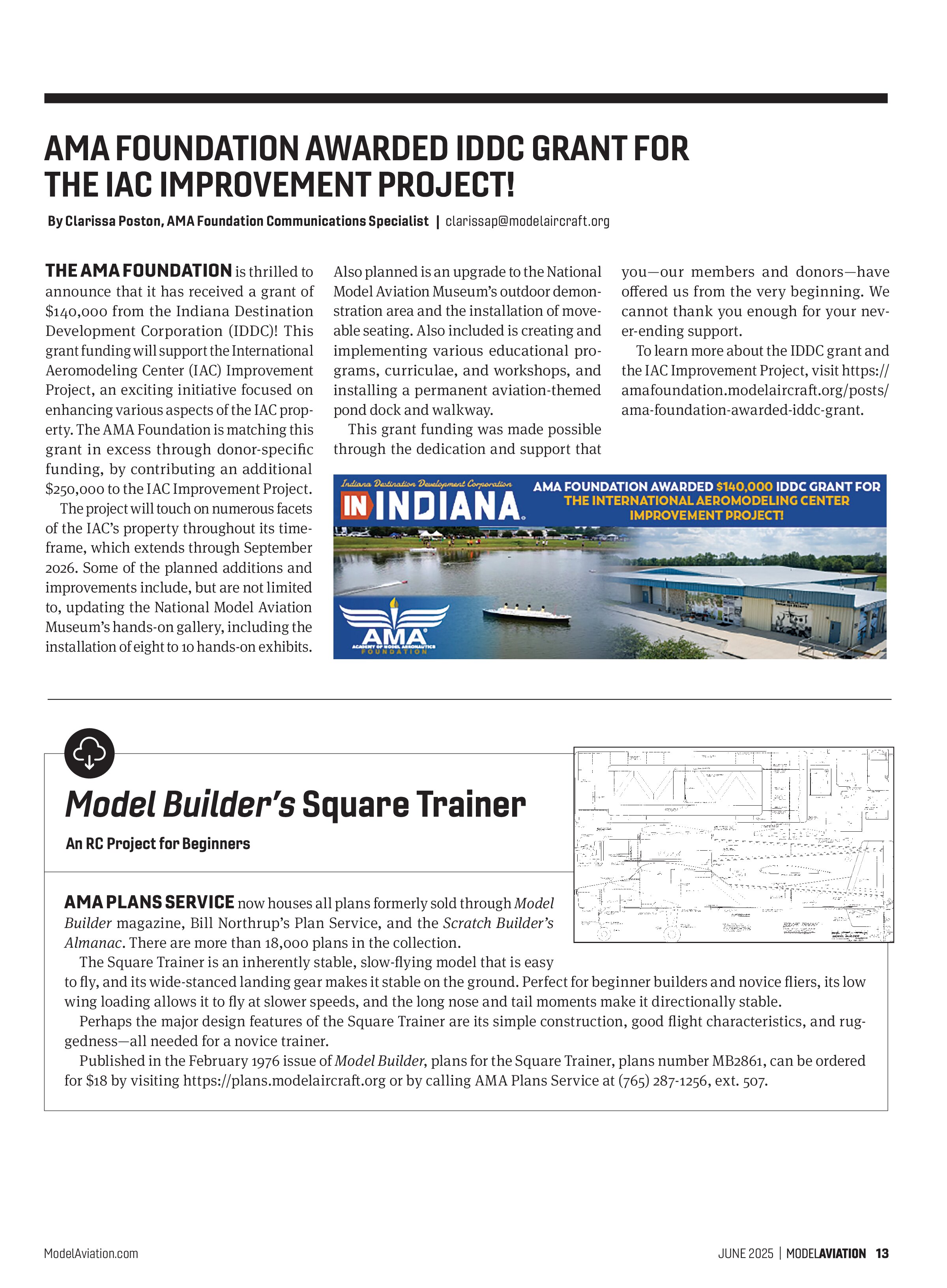
THE AMA FOUNDATION is thrilled to announce that it has received a grant of $140,000 from the Indiana Destination Development Corporation (IDDC)! This grant funding will support the International Aeromodeling Center (IAC) Improvement Project, an exciting initiative focused on enhancing various aspects of the IAC property. The AMA Foundation is matching this grant in excess through donor-specific funding, by contributing an additional $250,000 to the IAC Improvement Project.
The project will touch on numerous facets of the IAC’s property throughout its timeframe, which extends through September 2026. Some of the planned additions and improvements include, but are not limited to, updating the National Model Aviation Museum’s hands-on gallery, including the installation of eight to 10 hands-on exhibits.
Also planned is an upgrade to the National Model Aviation Museum’s outdoor demonstration area and the installation of moveable seating. Also included is creating and implementing various educational programs, curriculae, and workshops, and installing a permanent aviation-themed pond dock and walkway.
This grant funding was made possible through the dedication and support that

you—our members and donors—have offered us from the very beginning. We cannot thank you enough for your never-ending support.
To learn more about the IDDC grant and the IAC Improvement Project, visit https://amafoundation.modelaircraft.org/posts/ama-foundation-awarded-iddc-grant.
Model Builder’s Square Trainer
An RC Project for Beginners
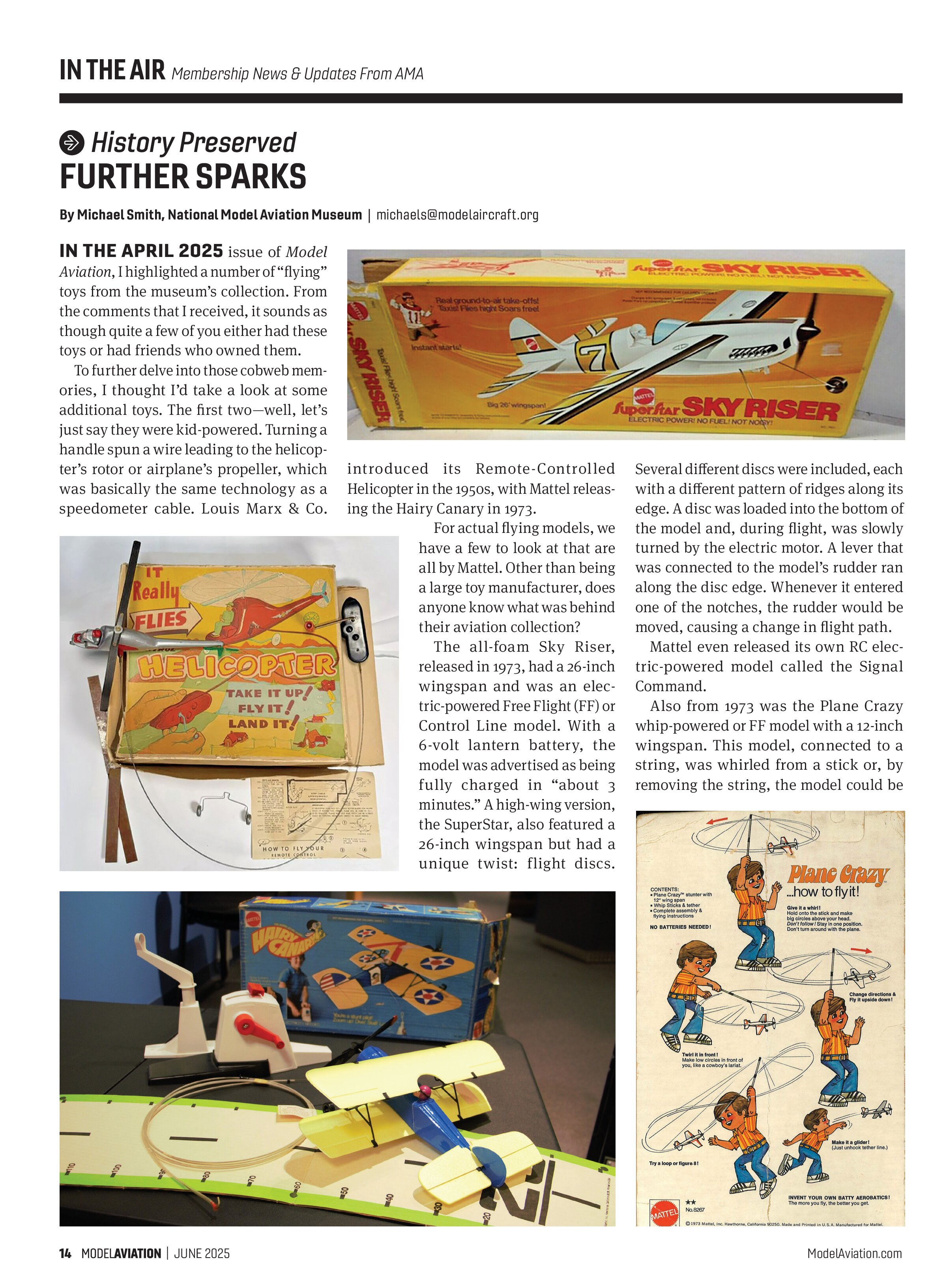
AMA PLANS SERVICE now houses all plans formerly sold through Model Builder magazine, Bill Northrup’s Plan Service, and the Scratch Builder’s Almanac. There are more than 18,000 plans in the collection.
The Square Trainer is an inherently stable, slow-flying model that is easy to fly, and its wide-stanced landing gear makes it stable on the ground. Perfect for beginner builders and novice fliers, its low wing loading allows it to fly at slower speeds, and the long nose and tail moments make it directionally stable.
Perhaps the major design features of the Square Trainer are its simple construction, good flight characteristics, and ruggedness—all needed for a novice trainer.
Published in the February 1976 issue of Model Builder, plans for the Square Trainer, plans number MB2861, can be ordered for $18 by visiting https://plans.modelaircraft.org or by calling AMA Plans Service at (765) 287-1256, ext. 507.

History Preserved
FURTHER SPARKS
By Michael Smith, National Model Aviation Museum | michaels@modelaircraft.org
IN THE APRIL 2025 issue of Model Aviation, I highlighted a number of “flying” toys from the museum’s collection. From the comments that I received, it sounds as though quite a few of you either had these toys or had friends who owned them.
To further delve into those cobweb memories, I thought I’d take a look at some additional toys. The first two—well, let’s just say they were kid-powered. Turning a handle spun a wire leading to the helicopter’s rotor or airplane’s propeller, which was basically the same technology as a speedometer cable. Louis Marx & Co.

introduced its Remote-Controlled Helicopter in the 1950s, with Mattel releasing the Hairy Canary in 1973.
For actual flying models, we have a few to look at that are all by Mattel. Other than being a large toy manufacturer, does anyone know what was behind their aviation collection?
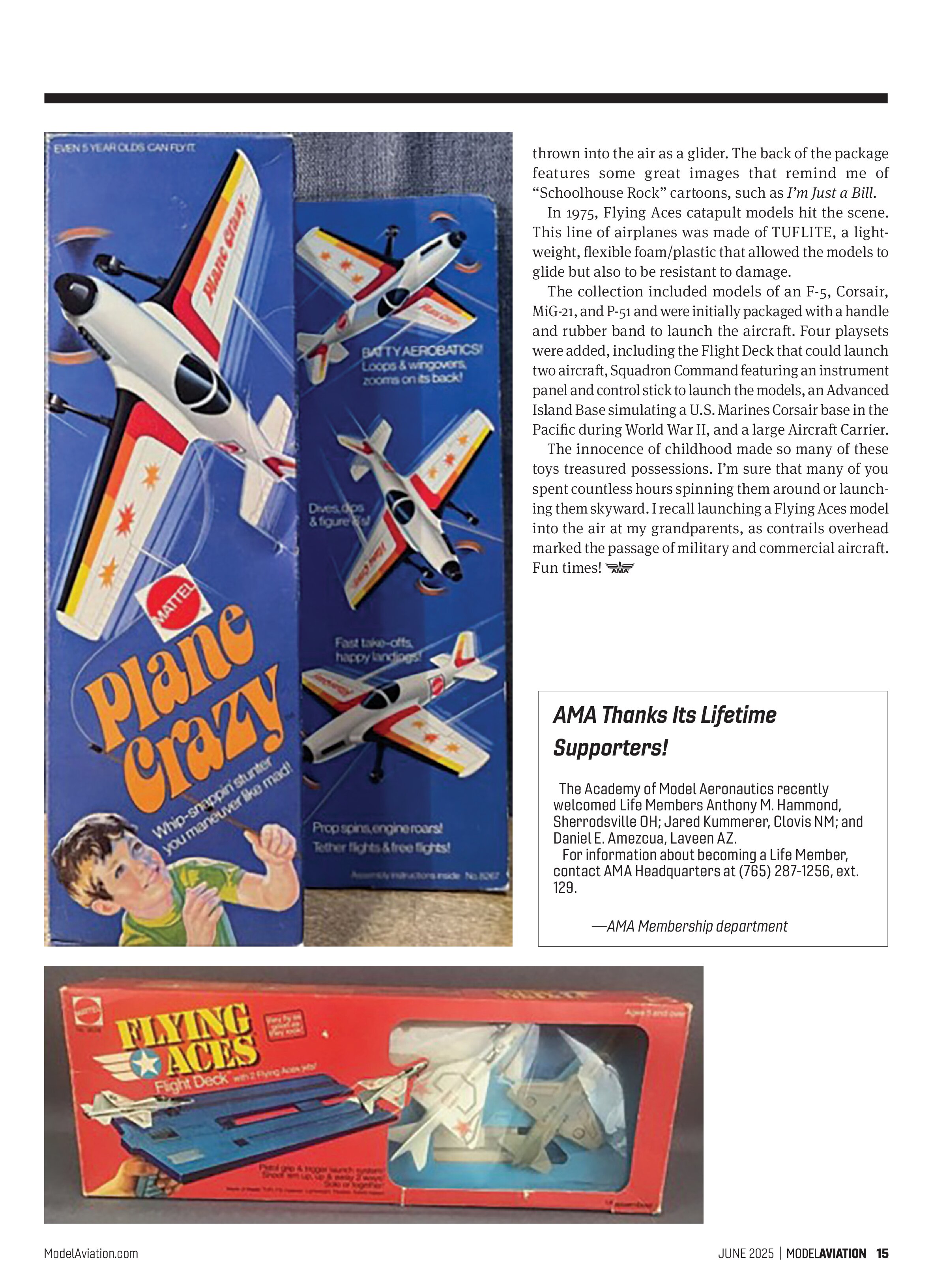
The all-foam Sky Riser, released in 1973, had a 26-inch wingspan and was an electric-powered Free Flight (FF) or Control Line model. With a 6-volt lantern battery, the model was advertised as being fully charged in “about 3 minutes.” A high-wing version, the SuperStar, also featured a 26-inch wingspan but had a unique twist: flight discs.


Several different discs were included, each with a different pattern of ridges along its edge. A disc was loaded into the bottom of the model and, during flight, was slowly turned by the electric motor. A lever that was connected to the model’s rudder ran along the disc edge. Whenever it entered one of the notches, the rudder would be moved, causing a change in flight path.
Mattel even released its own RC electric-powered model called the Signal Command.
Also from 1973 was the Plane Crazy whip-powered or FF model with a 12-inch wingspan. This model, connected to a string, was whirled from a stick or, by removing the string, the model could be thrown into the air as a glider.

The back of the package features some great images that remind me of “Schoolhouse Rock” cartoons, such as I’m Just a Bill.
In 1975, Flying Aces catapult models hit the scene. This line of airplanes was made of TUFLITE, a lightweight, flexible foam/plastic that allowed the models to glide but also to be resistant to damage.
The collection included models of an F-5, Corsair, MiG-21, and P-51 and were initially packaged with a handle and rubber band to launch the aircraft. Four playsets were added, including the Flight Deck that could launch two aircraft, Squadron Command featuring an instrument panel and control stick to launch the models, an Advanced Island Base simulating a U.S. Marines Corsair base in the Pacific during World War II, and a large Aircraft Carrier.
The innocence of childhood made so many of these toys treasured possessions. I’m sure that many of you spent countless hours spinning them around or launching them skyward. I recall launching a Flying Aces model into the air at my grandparents, as contrails overhead marked the passage of military and commercial aircraft. Fun times!