SAFETY COMES FIRST

POWERLESS
PROPELLER
PREDICAMENT
By Dave Gee | safetycolumn@cs.com
MIKE KLINTWORTH reported an incident that confirming that just when we think we are in a safe situation, some hazard will swoop in and prove otherwise. He wrote:
“One early evening, I was returning from the flying field with a small 1/2A-size electric airplane. It was a little bit windy. I had the airplane in one hand and the transmitter in the other on my walk up the very long driveway to my house. All was well until I felt a slight nick on the inside of my arm. There it was again. And another time. What the heck was that?
“I looked down at my arm and there were three very delicate, little cuts on the inside of my arm beginning to bleed. The sharp, little propeller was still spinning slowly, but as I turned it away from the wind, it stopped. The cuts were minor, but they still bled and needed first aid and a bandage. Go figure!
“I learned a lesson to carry the plane in a way that you can keep the propeller away from you.”
Fate had it in for poor Mike! He was strolling up his driveway without a care and got tagged by a windmilling propeller. The larger lesson is to stay aware of modern, sharp propeller blades and remember to treat them as cutting implements when handling a model. I’ve seen snappy, fabric blade covers in use to protect the aircrews and any skin that might be nearby. Not a bad idea!
That’s a Kick in the Head
Here’s a story from glider pilot Donn Schifano:
“Some years ago, I was at an RC glider field on a college campus. My friend, Mark, was close by flying his glider. Another pilot was flying a Gentle Lady glider at about 10 mph. The plane hit Mark in the left temple. He never saw it coming.
“Mark was knocked out and dropped to his knees, still holding his transmitter. He was out for about 5 to 10 seconds. His plane crashed. He came to and was a bit shaken but not cut—just bruised. The other pilot was pretty upset but helped Mark and paid for his crashed plane.
“Remember, it doesn’t take much speed to do a lot of damage. Even a lightweight, slow model can carry a lot of kinetic energy.”
Of course, the question arises about how and why a glider was flying through the pilots’ area. This incident is a reminder to take extra care to keep people and airborne models separate. A heavier or faster-powered model could have made this a much more serious situation.
Casual flying at an informal RC field requires a clear arrangement of where aircraft should go and where pilots will stay. Shout a warning when things start to go wrong. My friends know to stay undercover the entire time my model is airborne, but most pilots only rarely need to give such notice.
Rookie Mistake by an Old Hand
Walt Stewart wrote:
“I decided to get back into the hobby after a 20-year hiatus. The local hobby shop supplied an E-flite Timber, a six-channel radio, a couple of batteries, and a charger. I began setting the radio as outlined in the manual. The plane was sitting on my dining table in front of me as I programmed the various switches on the radio. The throttle disable switch had not been activated yet.
“I put the radio down on the table and accidentally hit the throttle stick. The plane came off the table toward me, but I was able to catch it and quickly returned the throttle to the off position. As I sat back in my chair, I noticed a puddle of liquid on the floor, which I discovered was blood. Looking at my arm, I found several lacerations that were bleeding profusely.
“The wound needed a tight wrap of gauze to stem the bleeding. Since I lived alone, I drove myself to the nearest ER. You can imagine the wide-eyed looks when I told the receptionist that my arm had been cut by an airplane propeller! There were four deep lacerations that required 16 stitches to close. I still have the scars. I assure you that the first thing I do now when setting up a new plane is to set up the throttle disconnect switch and use it!”
Walt sure kept his cool in a serious predicament! He very kindly sent his story hoping that we can learn from it and avoid trouble. This was a classic propeller strike situation, with several things coming together at once to let danger have its way: an unsecured airplane with power to the motor, working in a confined area, and the pilot had no help available when

things went sideways. Be cautious any time you’re dealing with an energized power system!
Forcibly Repurposed
I was summoned to the kitchen by my spousal unit, Sweet Diedra, who was getting ready to chop some onions. This particular job couldn’t be done in her usual covered chopping bowl gadget, so she asked me for some safety goggles to protect her eyes from the weepy tear-gas fumes.
Chemical goggles would be just the thing, but a pair of regular, mid-grade safety glasses turned up first and she grabbed them. After a few minutes, she reported that they worked just fine and were now impounded as kitchen tools and that I should buy more if I wanted a pair for myself.
This isn’t really a story about domestic bliss; it’s actually me urging all modelers to get and use eye protection. Eye irritation from onions is temporary, but this sport can involve risks to our vision that are serious and permanent. Building, servicing, and flying model aircraft call for proper personal protective equipment (PPE) in the form of safety glasses. Use the right type for whatever task you’re doing.
Protect yourself from flying shards at the workbench, sun glare outside, paint, fuel, or anything harmful. Eye injuries are easy to get but even easier to prevent. Furthermore, I suggest that you buy the best safety glasses that you can afford. Cheap ones can do the job, but high-quality PPE is always a good investment.
A Very Big Mystery Airplane
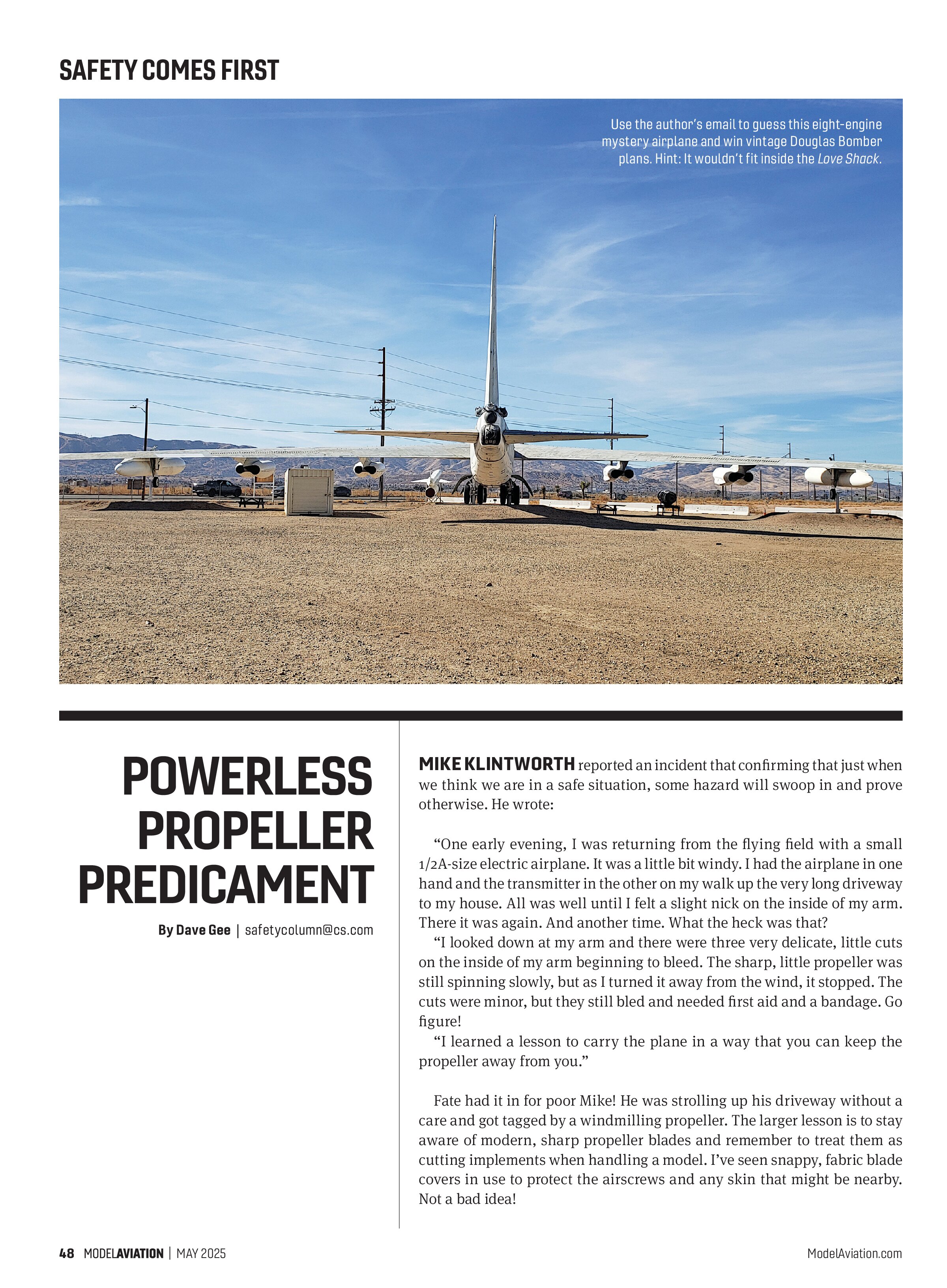
This month’s mystery airplane is an easy one, if you like airplanes with lots of engines. It’s a mighty bomber that has been frontline equipment for an absurdly long time and promises to remain in service into the future. There is even a pop music act named after it!
I snapped the picture at Joe Davies Heritage Airpark in Palmdale, California. This open-air display has some amazing airplanes. If you’re in the area, be sure to stop by.
Email me your mystery airplane guess using the address at the beginning of this column and receive digital plans for the vague but fun prize plans model.
Prize Plans of the Vague Vintage Variety
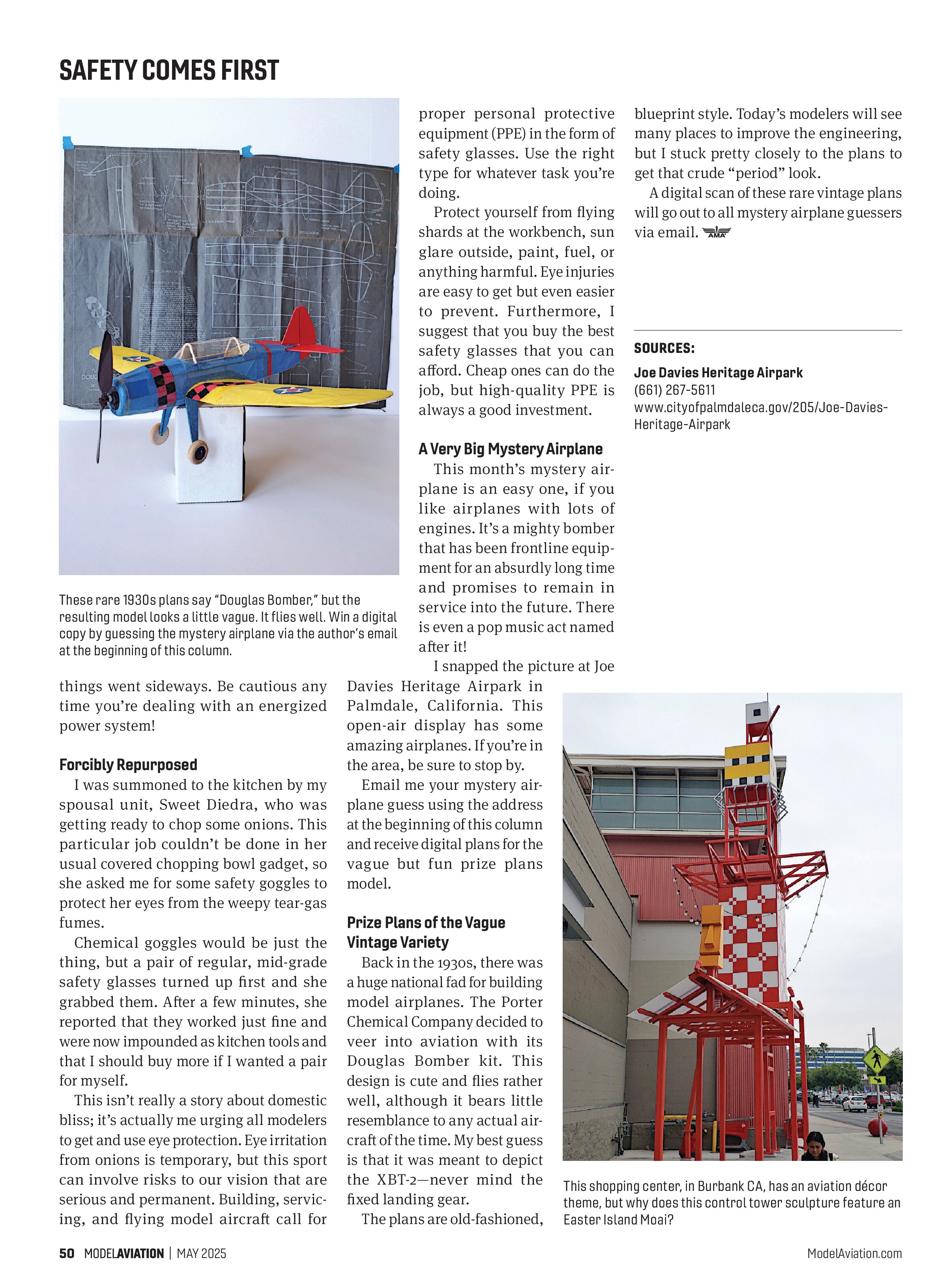
Back in the 1930s, there was a huge national fad for building model airplanes. The Porter Chemical Company decided to veer into aviation with its Douglas Bomber kit. This design is cute and flies rather well, although it bears little resemblance to any actual aircraft of the time. My best guess is that it was meant to depict the XBT-2—never mind the fixed landing gear.
The plans are old-fashioned, blueprint style. Today’s modelers will see many places to improve the engineering, but I stuck pretty closely to the plans to get that crude “period” look.
A digital scan of these rare vintage plans will go out to all mystery airplane guessers via email.
SOURCES:
Joe Davies Heritage Airpark
(661) 267-5611
www.cityofpalmdale.ca.gov/205/Joe-Davies-Heritage-Airpark