WHAT IS THE FSS?

By Gordon Buckland | gordon@gatorf3b.com
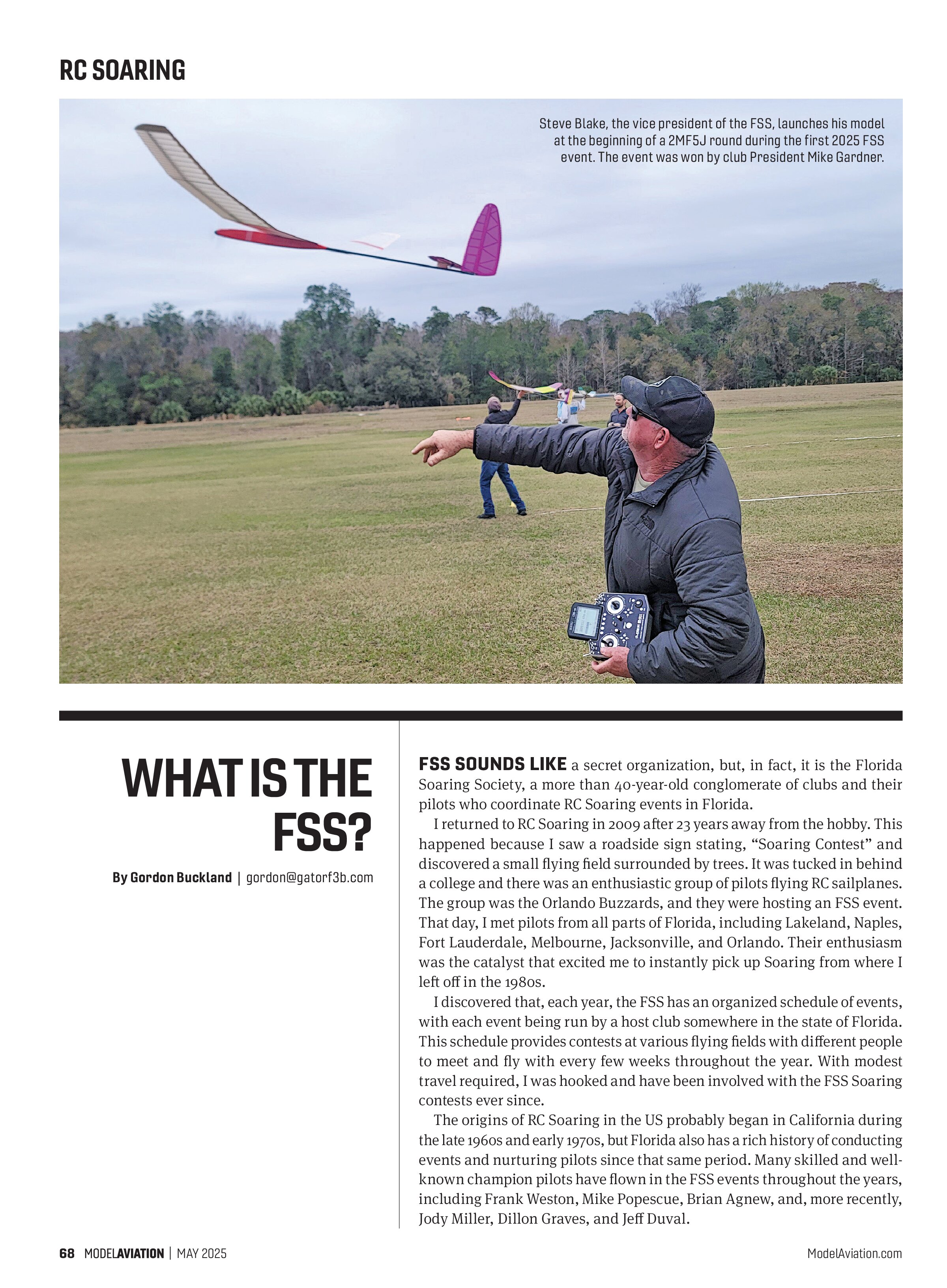
FSS SOUNDS LIKE a secret organization, but, in fact, it is the Florida Soaring Society, a more than 40-year-old conglomerate of clubs and their pilots who coordinate RC Soaring events in Florida.
I returned to RC Soaring in 2009 after 23 years away from the hobby. This happened because I saw a roadside sign stating, “Soaring Contest” and discovered a small flying field surrounded by trees. It was tucked in behind a college and there was an enthusiastic group of pilots flying RC sailplanes. The group was the Orlando Buzzards, and they were hosting an FSS event. That day, I met pilots from all parts of Florida, including Lakeland, Naples, Fort Lauderdale, Melbourne, Jacksonville, and Orlando. Their enthusiasm was the catalyst that excited me to instantly pick up Soaring from where I left off in the 1980s.
I discovered that, each year, the FSS has an organized schedule of events, with each event being run by a host club somewhere in the state of Florida. This schedule provides contests at various flying fields with different people to meet and fly with every few weeks throughout the year. With modest travel required, I was hooked and have been involved with the FSS Soaring contests ever since.
The origins of RC Soaring in the US probably began in California during the late 1960s and early 1970s, but Florida also has a rich history of conducting events and nurturing pilots since that same period. Many skilled and well-known champion pilots have flown in the FSS events throughout the years, including Frank Weston, Mike Popescue, Brian Agnew, and, more recently, Jody Miller, Dillon Graves, and Jeff Duval.

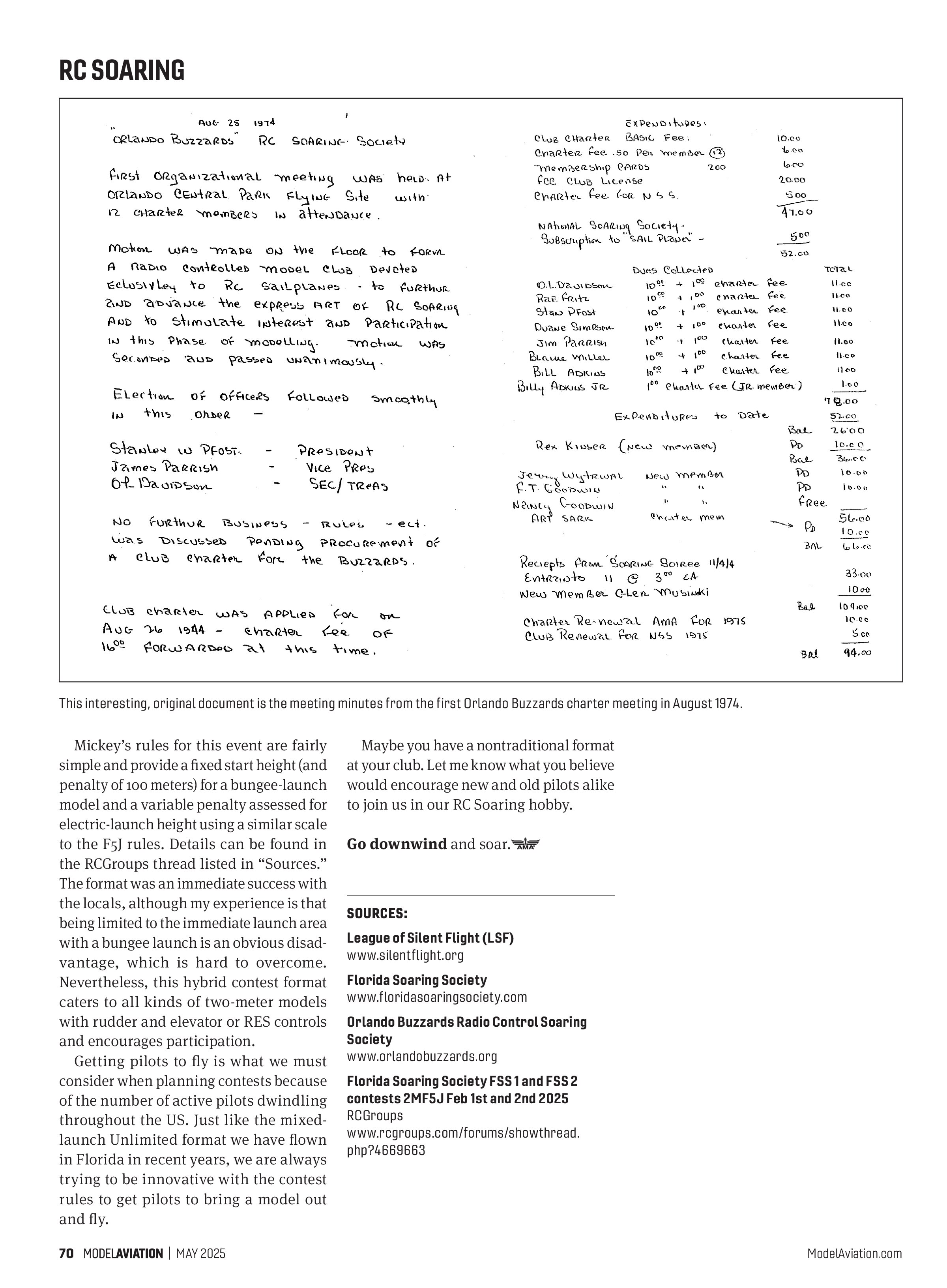
The Orlando Buzzards club is the second oldest chartered RC Soaring club in the US, with its first meeting held on August 25, 1974. Present at that first meeting were three pilots: Stan Pfost, Blaine Miller, and Kenny Goodwin. All were still flying FSS events when I joined in 2009. Each of them has since passed, but it was the dedication and efforts of these early pioneers and others that led to the formation of the FSS during the early 1980s.
One of the attractions of the FSS is the geographical location that provides excellent weather conditions all year round. It is often this same feature that lures folks from northern states to Florida for their retirement years. This brings regular newcomers to the state and, inevitably, new RC Soaring pilots to fly in various contests each year.
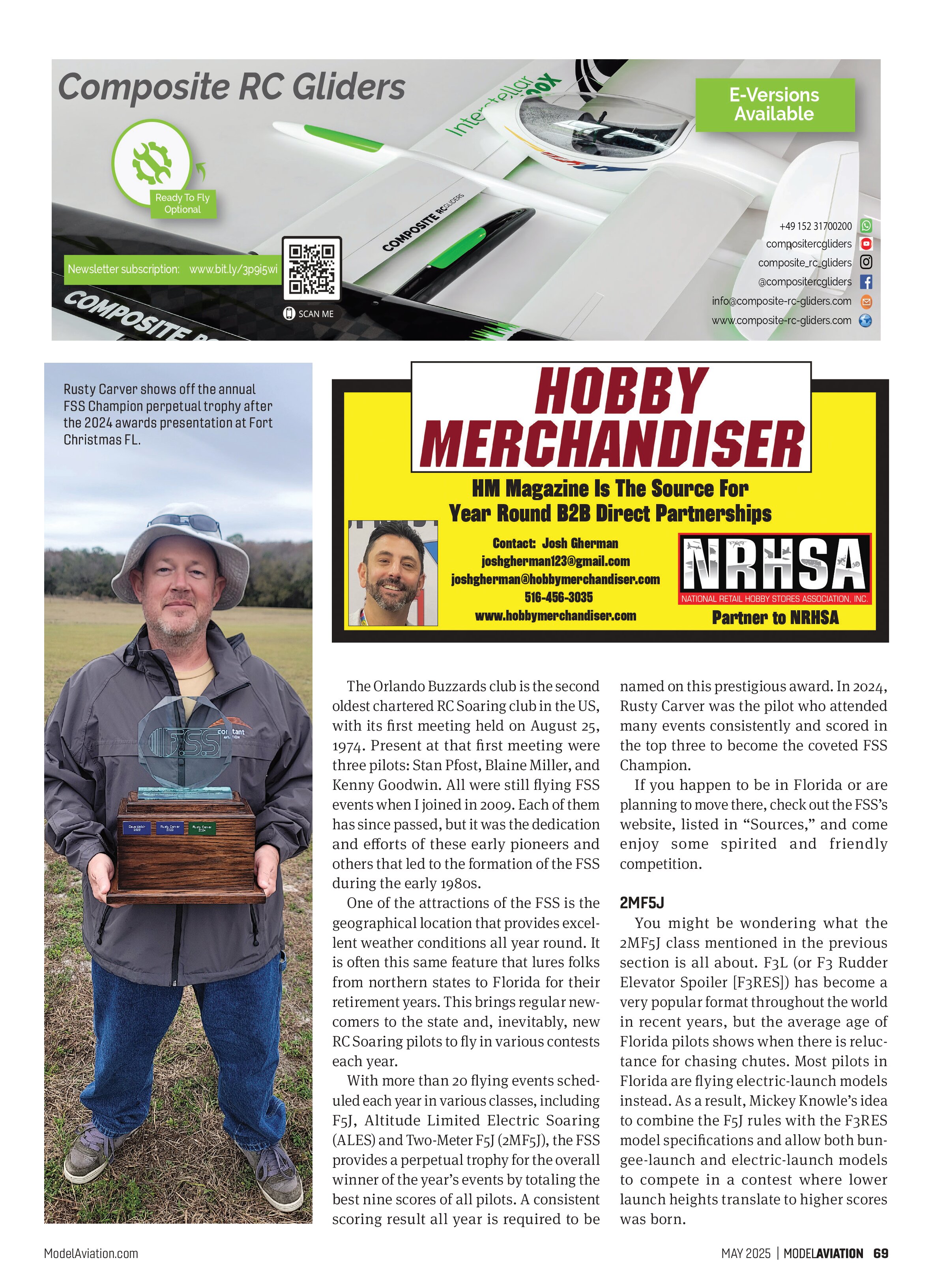
With more than 20 flying events scheduled each year in various classes, including F5J, Altitude Limited Electric Soaring (ALES) and Two-Meter F5J (2MF5J), the FSS provides a perpetual trophy for the overall winner of the year’s events by totaling the best nine scores of all pilots. A consistent scoring result all year is required to be named on this prestigious award. In 2024, Rusty Carver was the pilot who attended many events consistently and scored in the top three to become the coveted FSS Champion.
If you happen to be in Florida or are planning to move there, check out the FSS’s website, listed in “Sources,” and come enjoy some spirited and friendly competition.
2MF5J
You might be wondering what the 2MF5J class mentioned in the previous section is all about. F3L (or F3 Rudder Elevator Spoiler [F3RES]) has become a very popular format throughout the world in recent years, but the average age of Florida pilots shows when there is reluctance for chasing chutes. Most pilots in Florida are flying electric-launch models instead. As a result, Mickey Knowle’s idea to combine the F5J rules with the F3RES model specifications and allow both bungee-launch and electric-launch models to compete in a contest where lower launch heights translate to higher scores was born.

Mickey’s rules for this event are fairly simple and provide a fixed start height (and penalty of 100 meters) for a bungee-launch model and a variable penalty assessed for electric-launch height using a similar scale to the F5J rules. Details can be found in the RCGroups thread listed in “Sources.” The format was an immediate success with the locals, although my experience is that being limited to the immediate launch area with a bungee launch is an obvious disadvantage, which is hard to overcome. Nevertheless, this hybrid contest format caters to all kinds of two-meter models with rudder and elevator or RES controls and encourages participation.
Getting pilots to fly is what we must consider when planning contests because of the number of active pilots dwindling throughout the US. Just like the mixed-launch Unlimited format we have flown in Florida in recent years, we are always trying to be innovative with the contest rules to get pilots to bring a model out and fly.
Maybe you have a nontraditional format at your club. Let me know what you believe would encourage new and old pilots alike to join us in our RC Soaring hobby.
Go downwind and soar.
SOURCES:
League of Silent Flight (LSF)
www.silentflight.org
Florida Soaring Society
www.floridasoaringsociety.com
Orlando Buzzards Radio Control Soaring Society
www.orlandobuzzards.org
Florida Soaring Society FSS 1 and FSS 2 contests 2MF5J Feb 1st and 2nd 2025
RCGroups
www.rcgroups.com/forums/showthread.php?4669663