WINDSOCK DATA FILES
By Stan Alexander | onawing4602@att.net

BY EARLY SPRING, most of us have spent a good amount of time in our shops getting ready for flying season. Now is when you need to check the aircraft you plan to fly this year. Tighten those prop nuts and check all of the clevises and screws that hold important stuff on that Scale model. If it’s a new model, be sure to check the center of gravity so that you don’t stall on takeoff. I would check the airframe switches as well. Servo connectors, and especially batteries, are items to check on airframes. A good habit to start with batteries is to take a Sharpie marker and write the purchase date on them.
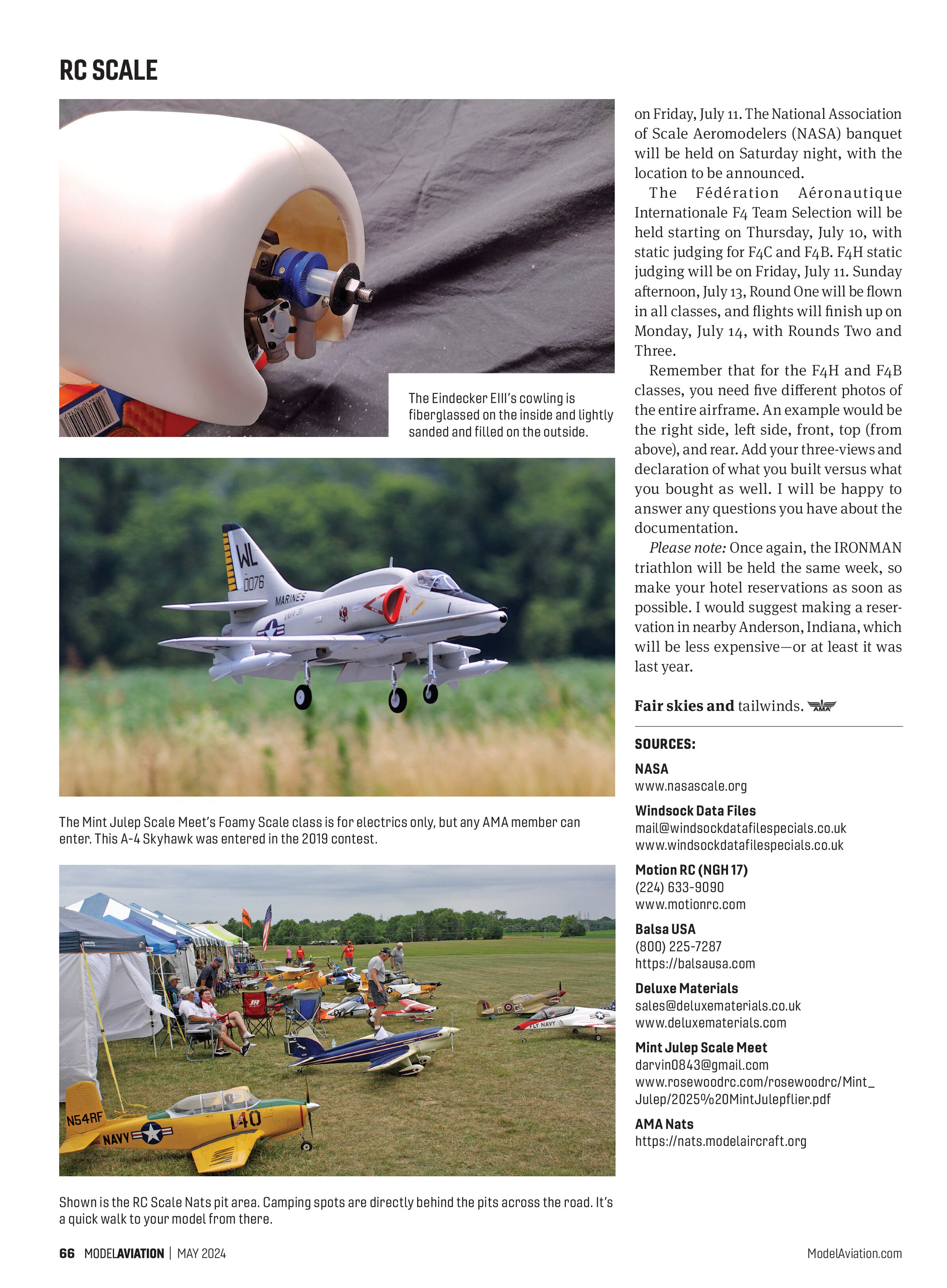
If you are interested in older World War I models, an excellent source of documentation is Windsock Data Files. This company produces what is considered the standard in exacting documentation for these mostly non-existent types of aircraft. For obscure 1914 aircraft through the end of WW I, Windsock is a great place to find resources in print—if they are not sold out.
Whether you are interested in the more mainstream types, such as the Fokker D.VII, Sopwith Pup, or the Sopwith Camel, or you prefer to scratch-build a DFW T.28 Floh, Ansaldo SVA .9 or .10, or an LVG C.VI, you can find information on all of these from Windsock, which is based in the U.K. Check out its website.
Engine for the Eindecker EIII
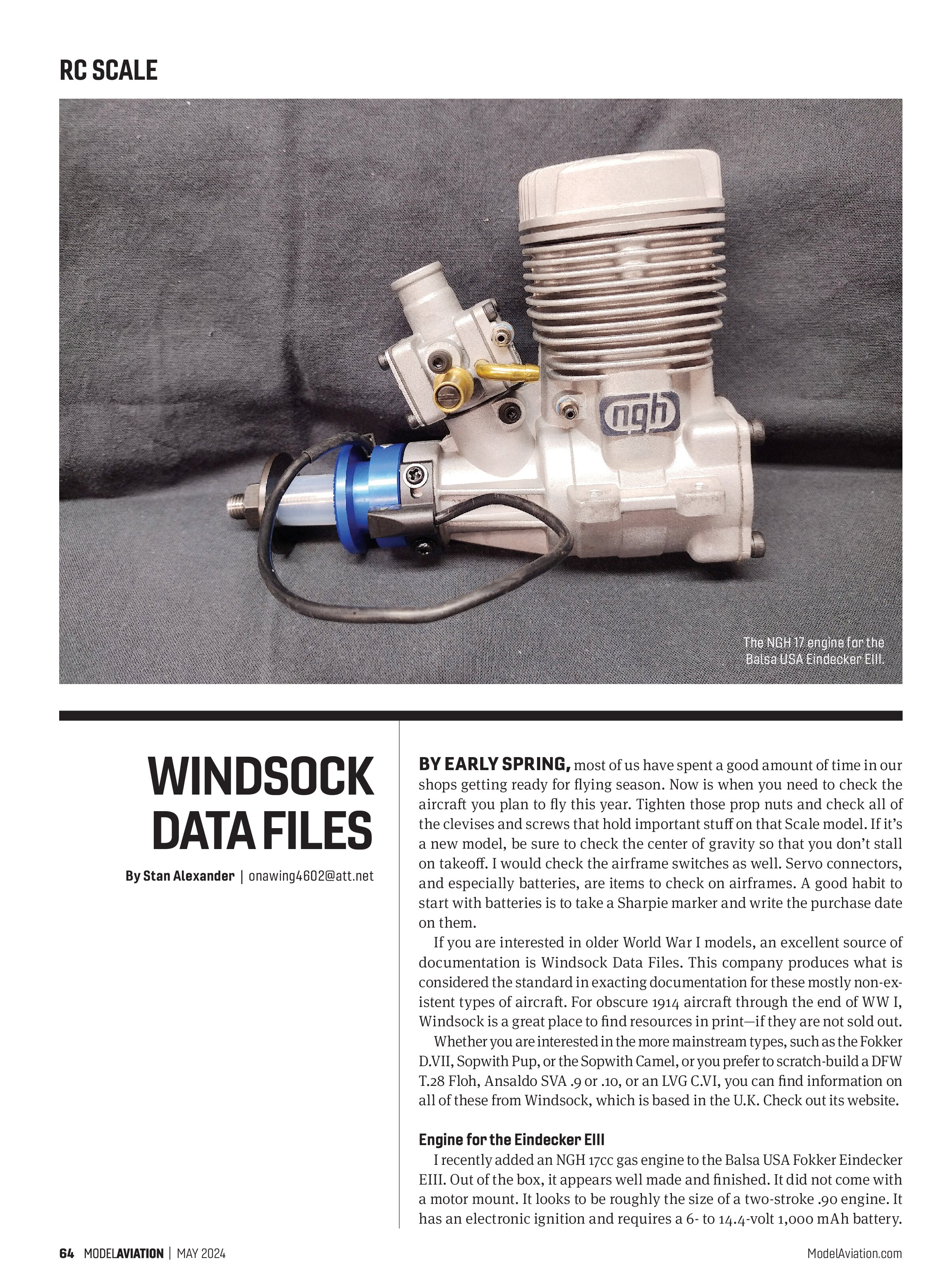
I recently added an NGH 17cc gas engine to the Balsa USA Fokker Eindecker EIII. Out of the box, it appears well made and finished. It did not come with a motor mount. It looks to be roughly the size of a two-stroke .90 engine. It has an electronic ignition and requires a 6- to 14.4-volt 1,000 mAh battery.
After digging around in my engine stash, an older Dave Brown Products .90-size engine mount appeared, so I’m using it with this engine.
The NGH 17 comes with a muffler, but it also has a muffler for mounting behind the engine, as many do now. The inline muffler doesn’t help with shortening the mount and the overall length of the engine assembly, so I’m planning to use the original muffler that came with it. Because of the way the muffler is assembled, you can reverse where the exhaust exits, which will shorten the assembly on your airframe. The suggested propeller sizes are 15 x 10, 16 x 8, 16 x 10, or 17 x 8. The engine and muffler weigh 1 pound, 9.3 ounces.
Using the cowling that comes with the kit is a plus; just tape it together on the outside and make the seams tight. Before cutting out the front of the cowling, I fiberglassed the inside, and then added a second coat to areas that have to be drilled through to mount it to the fuselage.
From the Shop
I’m using Balsa USA’s “fabric color” Solartex to cover the Eindecker. For the most part, this airplane was covered in a clear coat over the fabric, which is what I’ll do as well. I will seal the edges of the flying surfaces with Deluxe Materials Cover Grip to keep the seams tight on the leading and trailing edges.
53rd Annual Mint Julep Scale Meet
The Mint Julep Scale Meet is one of my favorite Scale contests anywhere. I’ve been going to it for more than 40 years now. It will be held June 13-15 at the Bill Beach Airfield in Rosewood, Indiana, by the Rosewood RC Flyers, with Dale and Jeremy Arvin serving as the contest directors.
One of the great things about any regional contest is the willingness to try a new class, such as the Foamy Scale class that will take place at the Mint Julep this year. There is no static judging, and you fly eight maneuvers and use one mechanical option. Any size of electric model can compete in this class.
There are classes for everyone, from the expert to the raw novice. Check it out!

FAI Scale Team Selection and Scale Nats
This year’s Scale Nats will be held at AMA’s International Aeromodeling Center in Muncie, Indiana, on July 10-13. All classes will be held in both RC and Control Line (CL) Scale, with CL classes starting

on Friday, July 11. The National Association of Scale Aeromodelers (NASA) banquet will be held on Saturday night, with the location to be announced.
The Fédération Aéronautique Internationale F4 Team Selection will be held starting on Thursday, July 10, with static judging for F4C and F4B. F4H static judging will be on Friday, July 11. Sunday afternoon, July 13, Round One will be flown in all classes, and flights will finish up on Monday, July 14, with Rounds Two and Three.
Remember that for the F4H and F4B classes, you need five different photos of the entire airframe. An example would be the right side, left side, front, top (from above), and rear. Add your three-views and declaration of what you built versus what you bought as well. I will be happy to answer any questions you have about the documentation.
Please note: Once again, the IRONMAN triathlon will be held the same week, so make your hotel reservations as soon as possible. I would suggest making a reservation in nearby Anderson, Indiana, which will be less expensive—or at least it was last year.
Fair skies and tailwinds.
SOURCES:
Windsock Data Files
mail@windsockdatafilespecials.co.uk
www.windsockdatafilespecials.co.uk
Motion RC (NGH 17)
(224) 633-9090
www.motionrc.com
Balsa USA
(800) 225-7287
https://balsausa.com
Deluxe Materials
sales@deluxematerials.co.uk
www.deluxematerials.com
Mint Julep Scale Meet
darvin0843@gmail.com
www.rosewoodrc.com/rosewoodrc/Mint_Julep/2025%20MintJulepflier.pdf
AMA Nats
https://nats.modelaircraft.org