RC JETS

HIGHVIZ RC
By Jim Hiller | jetmodeler@earthlink.net
AS WE KNOW BY NOW, Robart Manufacturing has moved out of manufacturing retractable landing gear, but the good news is that Jordan and Larry Peterson have acquired the line and opened a company called HighViz RC. At this time, they are building their production facilities to bring back this famous line of landing gear systems.
The Petersons are well known in the model flying community. Jordan is an award-winning builder who is known for her attention to details, such as her Skymaster T-33, Tomahawk F-86, and, recently, an Airworld F-100. All of these models are finished in Flite Metal, a time-consuming process that requires great patience to get it right. Larry is the flier in the family. I have watched him fly at many jet meets and can tell you that he is one of the best.
I had a conversation with the Petersons about the status of the new business. They are shipping inventory at this time and beginning to manufacture parts. They have made a major investment in equipment and a shop for this growing business. The plans include improving the areas where we now know of better methods and growing the tire and wheel line. Larry sent me the following information:
“When Robart announced they were going out of business last year, we decided it was a great opportunity to start our own company to fill the void they were going to leave behind. We spent a few months making plans and sourcing out machines. When the opportunity to purchase Robart’s landing gear line came, we decided to take a gamble with the investment to try to help support the hobby.
“We have spent the last few months going through all of Robart’s designs and trying to start gathering parts for the most popular designs. We have a lot of spare parts for the Robart designs in stock and we have been selling them through our email for now. Our website [is] still under construction. I’m hoping it’ll be live in the spring (around the Toledo RC Swap Meet), but that’s not set.
“In the future, we hope to expand into making our own design landing gear for warbirds and jets. We have some of these designs started, but it will be a long process for development and testing before we are ready to sell them.”
Let’s wish the Petersons great success and support them as they ramp up production and sales with HighViz RC. Should you need anything, contact them via email. The email, Facebook, and website addresses are listed in “Sources.”
F3S Jet Aerobatics Nats
Did you know that the F3S Jet Aerobatics Nats has moved to Logan County Airport in Russellville, Kentucky, just west of Bowling Green? The Jet Aerobatics Nats is a traditional precision aerobatics competition for turbine- and EDF-powered models, with an emphasis on bringing in competitors to grow the event. Practice is August 19-20, followed by the competition on August 21-24.
The competition classes allow for a wide variety of turbine models and pilot skills. The traditional RC Aerobatics (Pattern) competition has three classes: Basic, Silver, and Fédération Aéronautique Internationale (FAI) F3S.
Basic is a very straightforward series of aerobatic maneuvers in a non-turnaround sequence that can be easily accomplished. Silver reverts to a full turnaround sequence of more advanced maneuvers. The top skill-level event for experienced Pattern fliers is F3S, with maneuvers from the international FAI F3S sequences. There are a lot of models available on the market today that are very capable of flying the most complex of the F3S sequences.
In the Scale Jet class, a series of aerobatic maneuvers are also flown in a non-turn-around format, but the flight routines are more advanced than typical competition routines. You will develop your skills greatly, and when you go back to other Scale competitions, your flying will reflect how far you have advanced in your skills.
The next class, which is quite popular, is the EDF class. The pattern is a full turn-around sequence similar in complexity to the Silver class, but it is shortened to reflect the flight times of EDF models. The maneuvers will not stretch the performance of many of today’s sport EDFs, which allows a wide variety of models to participate. It’s low cost and a great way to develop your flying skills.
I am a big fan of Pattern-style flying to develop skills. The example of learning to fly a loop—not just pulling full up-elevator and waiting to see the airplane come back around to level flight but actually using elevator and throttle combined to control speed to perform a round loop—helps anyone’s flying skills develop. Pattern-style practice will teach you greater capabilities to control your model’s flight path and will be reflected in all aspects of your flying, not just with aerobatic maneuvers.
Take a look at this event on the Jet Precision Aerobatics website, listed in “Sources,” to learn more about not just this event but also what is going on in the world of jet aerobatics. This is an opportunity to fly with modelers who have a desire to improve their flying skills and share thoughts on developing skills. Another subject that is addressed by pilots is the setup and trimming of the models to perform at their highest level. Simply hanging out at a precision flying event such as this will improve your knowledge of flying. Come join the fun!
National Museum of the United States Air Force
I spent a day at the National Museum of the United States Air Force in Dayton, Ohio. What a place to see the largest collection of aircraft under one roof. The selection of jets is unreal.
There are three large buildings full of everything from fighters to bombers to transport and attack aircraft. There are also the X-series aircraft and many other experimental airplanes we have only seen pictures of. The latest building has a large collection of presidential aircraft dating back to the 1950s that are all restored to immaculate condition.

With the renewed interest in Scale F-15 jets, the National Museum of the United States Air Force has a selection to view, including the world record-setting Streak Eagle, a lightweight and performance-oriented aircraft that was built to show the F-15’s impressive performance.

This selection of X-series airplanes in the fourth building at the National Museum of the United States Air Force is impressive. On the opposite side is the collection of the presidential Air Force One aircraft from throughout the decades.
A visit to this museum leaves you with so many dreams for your next Scale model, and with its improved lighting, many quality photographs can be snapped of the intricate details to create that special model.
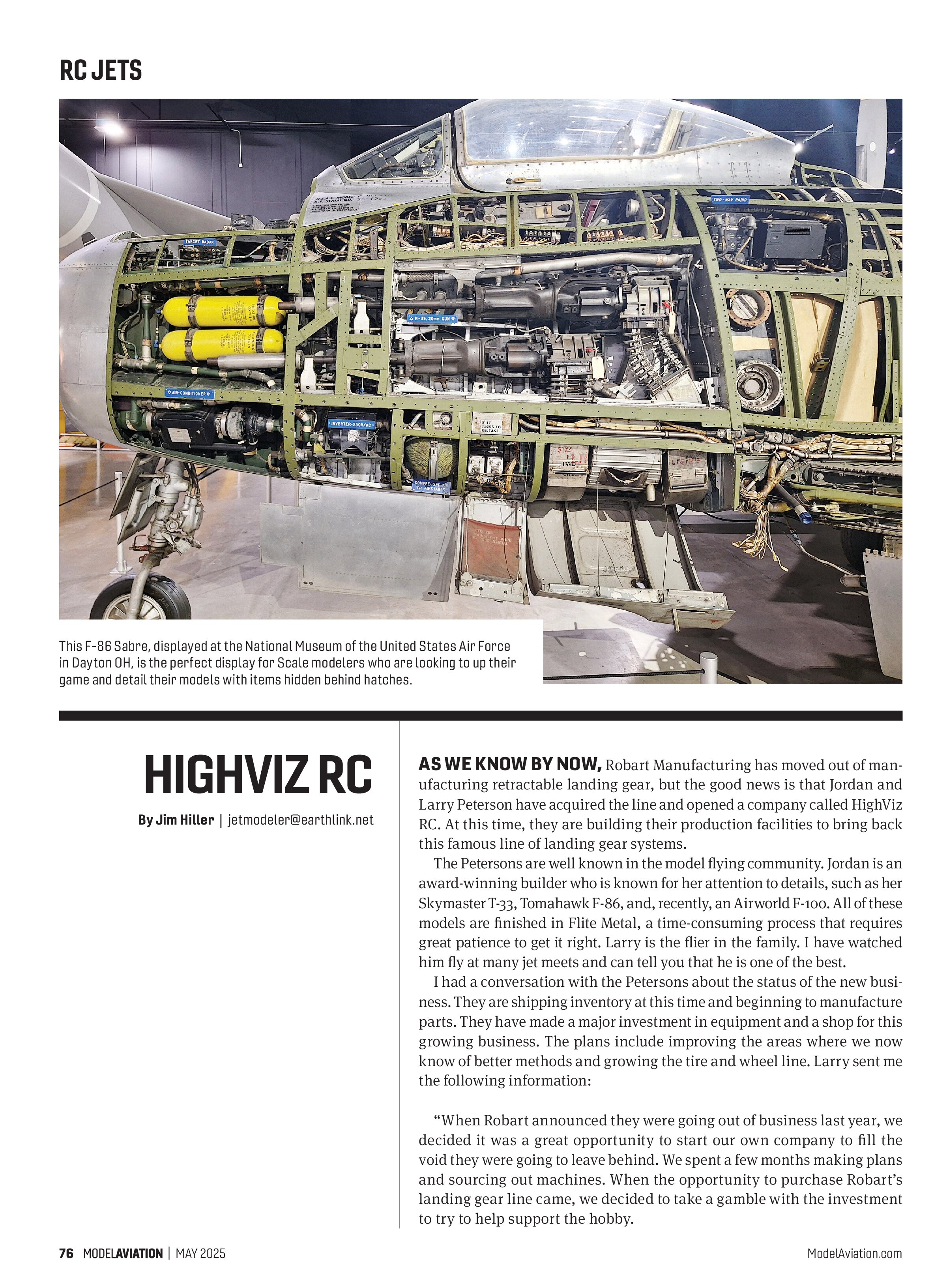
One of my favorite displays is of an F-86 Sabre with the fuselage skin removed to show the systems inside the aircraft. If you can identify where the removable panels are, you will know just what sits behind them. This display, along with the numerous other F-86s there, is a Scale modeler’s dream.
My excuse for visiting the museum was an invitation from some friends who traveled to Dayton to attend a Warbirds & Classics Alliance meeting to discuss the direction and continued future growth of the group. This group of modelers promotes large-scale, high-quality warbird and classic models that are flown together. These events have been growing in popularity in both attendance and the number of them. It takes quality leadership to make these events happen in a friendly and enjoyable manner.
In recent years, the variety of aircraft has increased, along with the differences in performance. In the meeting, the group covered this issue. There weren’t any solid answers, but the common theme was to fly together with respect and courtesy of your fellow modelers. Jet models are increasing in number at these events as well. Warbirds, and even World War I aircraft, require different skills and flight patterns to enjoyably fly together while minimizing the risks of collision.
Overall, this group is doing a great job. If you get a chance to attend one of these events and enjoy flying with avid and similarly minded modelers, this is it. Check the Warbirds & Classics Alliance website for additional information about events near you.
SOURCES:
- Jet Pilots Organization (JPO)
www.jetpilots.org - HighViz RC
info@highvizrc.com
www.facebook.com/profile.php?id=61566011711253
www.highvizrc.com - Jet Precision Aerobatics
www.jetaerobatics.org - Warbird & Classics Alliance
www.warbirdsandclassics.com