BUILDING ON THE STALL TURN: DOUBLE STALL TURN AND FIGURE M
By Justin Wells | justinwells@mac.com

TO EXPAND UPON my previous column about stall turns, I want to introduce two maneuvers that are built around the stall turn: the double stall turn and the Figure M. Both maneuvers are performed on center but executed differently.
The double stall turn is a good place to start, and you can build up to the Figure M. I tend to practice these with any airplane I have with me at the field, usually flying parallel to the runway, starting at one end of the field and finishing at the other. This builds good abilities and can also impress your fellow pilots.
Before I begin, I’ll lay out the roll directions in these maneuvers to show the top/canopy of the airplane on each leg. This is a personal preference; I always like to see the top of the airplane. There is no hard and fast rule about this, unless, of course, it is specified in a sequence. Once you get used to these, switch them up, do them all with the airplane facing away from you, and have fun with it!
Let’s dive in and get you doing something new and fun.
Double Stall Turn
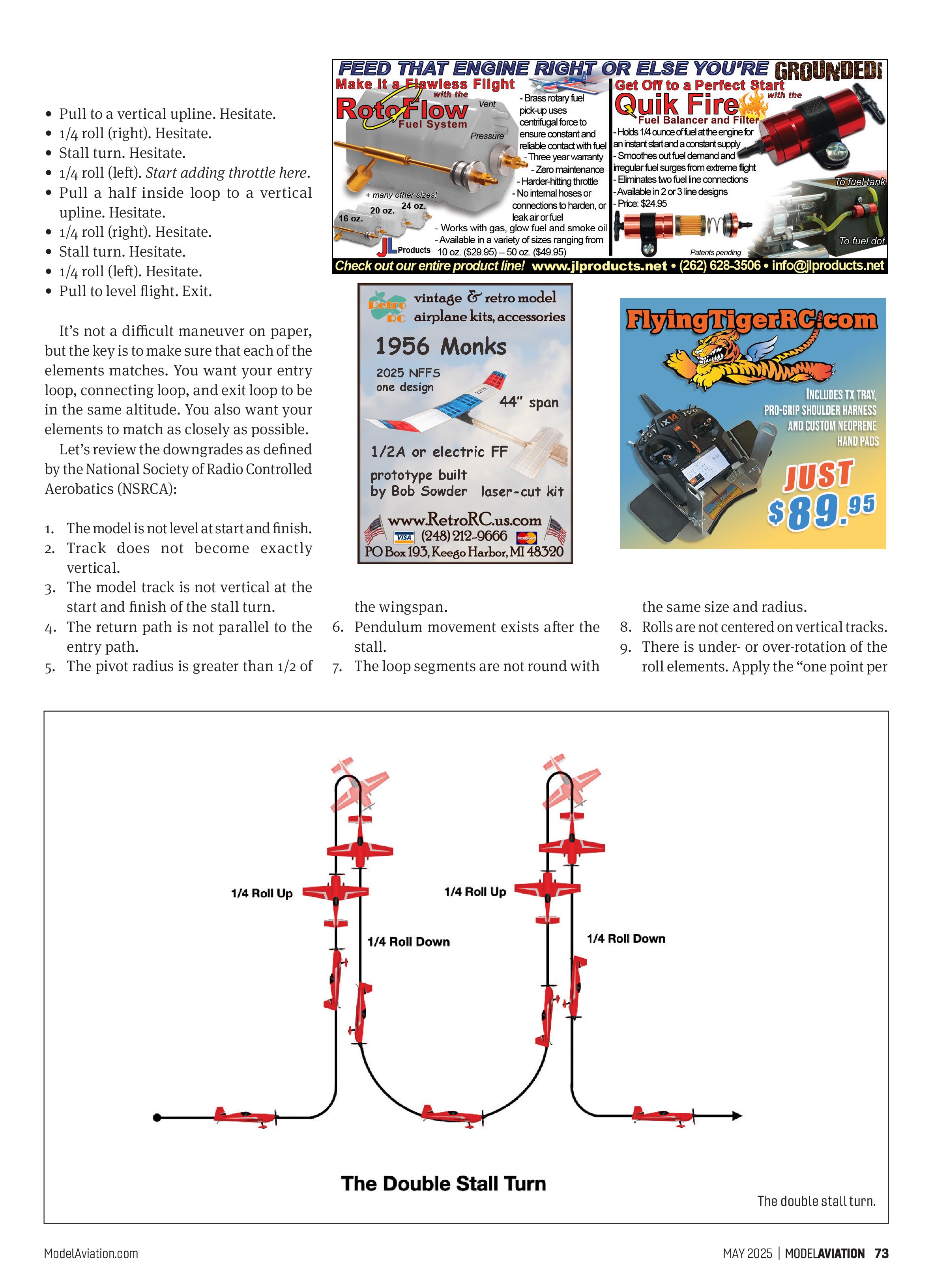
In short form, the double stall turn is just that: two stall turns with a half loop between them. Let’s step through it as you review the illustration.
One thing to watch is your speed. Although you are headed down, you’ll need to manage your throttle when approaching the half inside loop into the second vertical upline.
- Pull to a vertical upline. Hesitate.
- ¼ roll (right). Hesitate.
- Stall turn. Hesitate.
- ¼ roll (left). Start adding throttle here.
- Pull a half inside loop to a vertical upline. Hesitate.
- ¼ roll (right). Hesitate.
- Stall turn. Hesitate.
- ¼ roll (left). Hesitate.
- Pull to level flight. Exit.
It’s not a difficult maneuver on paper, but the key is to make sure that each of the elements matches. You want your entry loop, connecting loop, and exit loop to be in the same altitude. You also want your elements to match as closely as possible.
Let’s review the downgrades as defined by the National Society of Radio Controlled Aerobatics (NSRCA):
- The model is not level at start and finish.
- Track does not become exactly vertical.
- The model track is not vertical at the start and finish of the stall turn.
- The return path is not parallel to the entry path.
- The pivot radius is greater than ½ of the wingspan.
- Pendulum movement exists after the stall.
- The loop segments are not round with the same size and radius.
- Rolls are not centered on vertical tracks.
- There is under- or over-rotation of the roll elements. Apply the “one point per

15°” rule.
10. The bottom of the center half-inside loop and the entry and exit altitudes are not the same.

Figure M
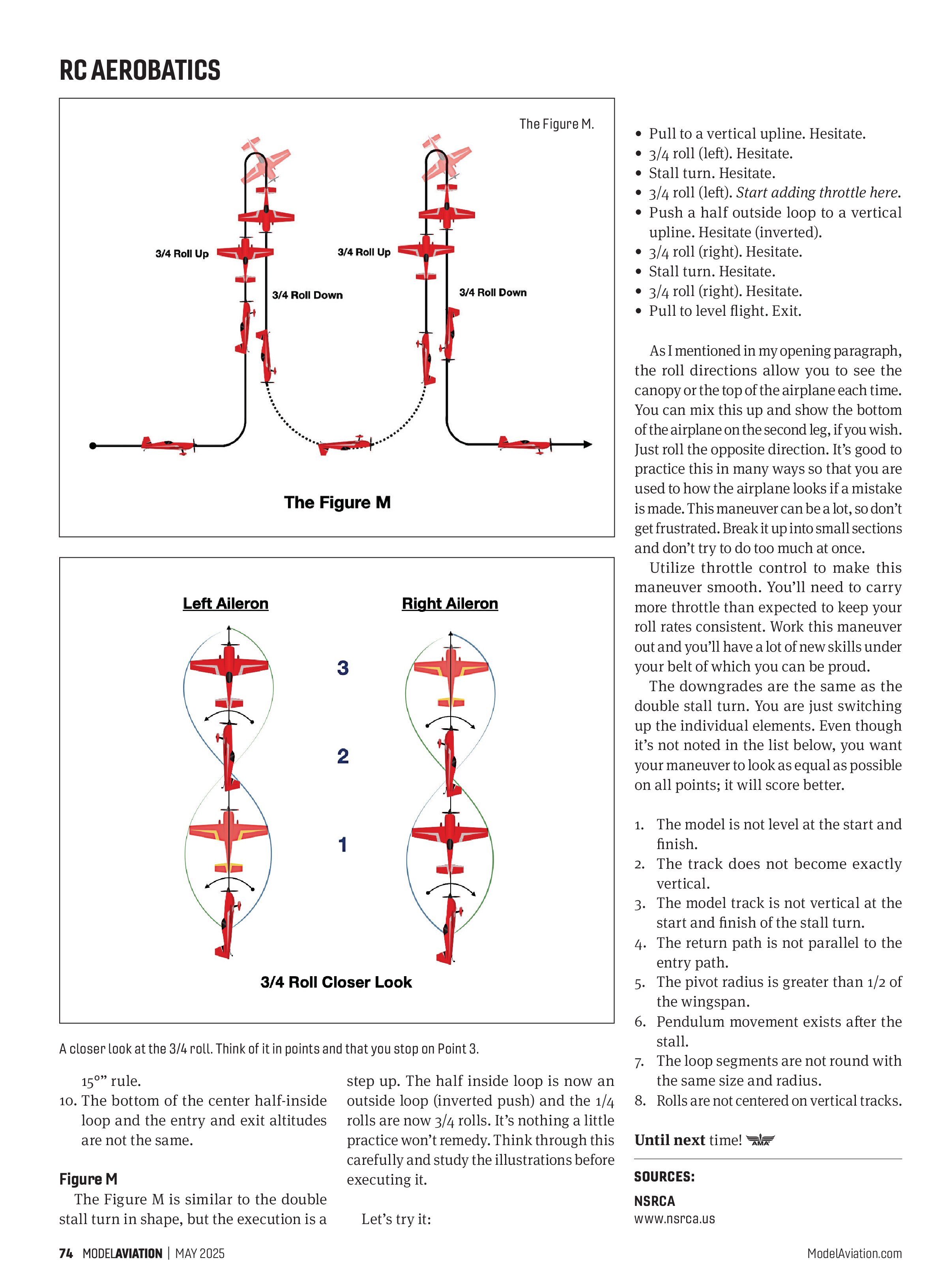
The Figure M is similar to the double stall turn in shape, but the execution is a step up. The half inside loop is now an outside loop (inverted push) and the 1/4 rolls are now 3/4 rolls. It’s nothing a little practice won’t remedy. Think through this carefully and study the illustrations before executing it.
Let’s try it:
- Pull to a vertical upline. Hesitate.
- 3/4 roll (left). Hesitate.
- Stall turn. Hesitate.
- 3/4 roll (left). Start adding throttle here.
- Push a half outside loop to a vertical upline. Hesitate (inverted).
- 3/4 roll (right). Hesitate.
- Stall turn. Hesitate.
- 3/4 roll (right). Hesitate.
- Pull to level flight. Exit.
As I mentioned in my opening paragraph, the roll directions allow you to see the canopy or the top of the airplane each time. You can mix this up and show the bottom of the airplane on the second leg, if you wish. Just roll the opposite direction. It’s good to practice this in many ways so that you are used to how the airplane looks if a mistake is made. This maneuver can be a lot, so don’t get frustrated. Break it up into small sections and don’t try to do too much at once.
Utilize throttle control to make this maneuver smooth. You’ll need to carry more throttle than expected to keep your roll rates consistent. Work this maneuver out and you’ll have a lot of new skills under your belt of which you can be proud.

The downgrades are the same as the double stall turn. You are just switching up the individual elements. Even though it’s not noted in the list below, you want your maneuver to look as equal as possible on all points; it will score better.
- The model is not level at the start and finish.
- The track does not become exactly vertical.
- The model track is not vertical at the start and finish of the stall turn.
- The return path is not parallel to the entry path.
- The pivot radius is greater than 1/2 of the wingspan.
- Pendulum movement exists after the stall.
- The loop segments are not round with the same size and radius.
- Rolls are not centered on vertical tracks.
Until next time!
SOURCES:
NSRCA
www.nsrca.us