FOCAL POINT
Interested in sharing your handiwork? Visit www.ModelAviation.com for submission guidelines.
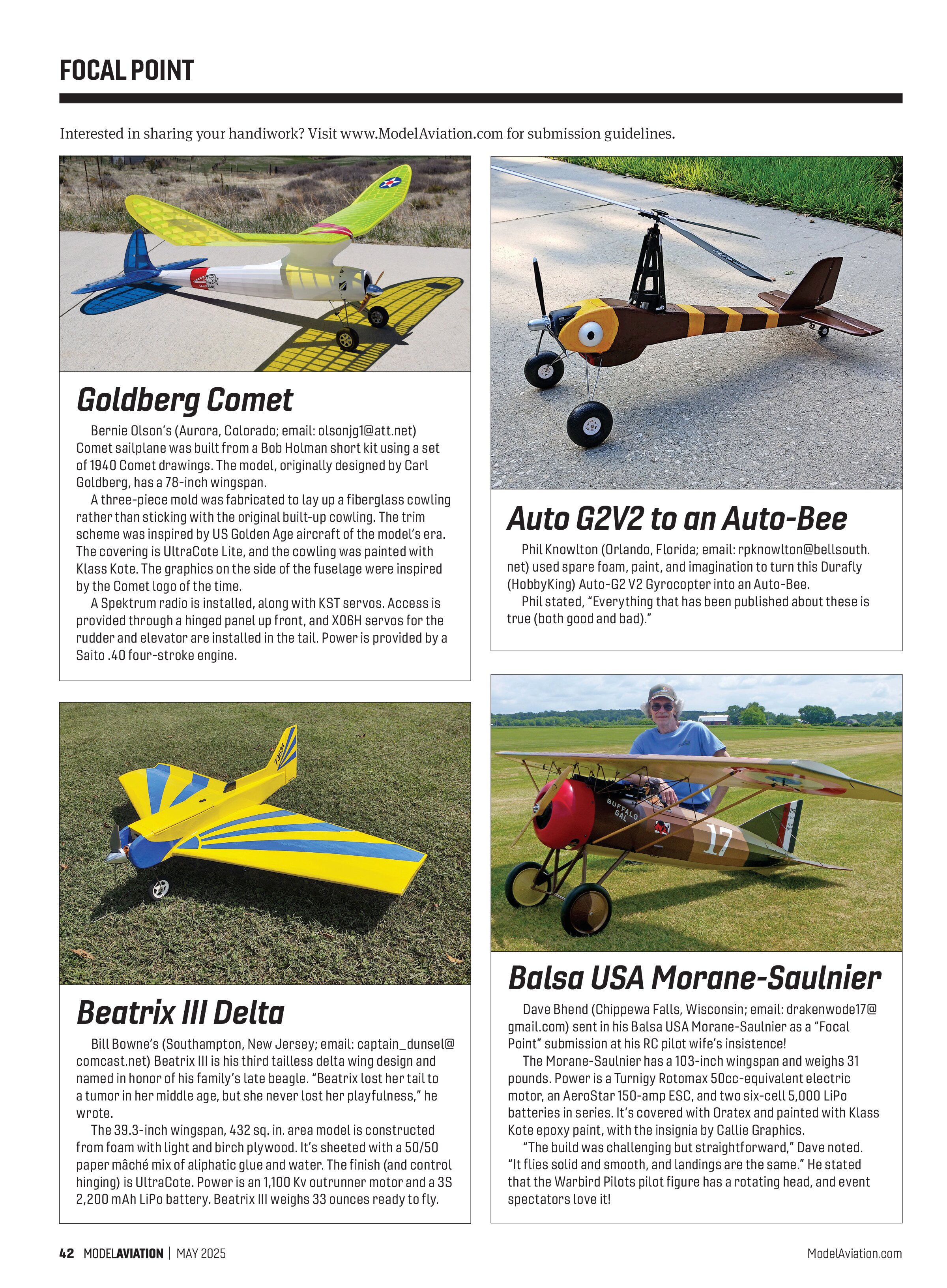
Goldberg Comet
Bernie Olson’s (Aurora, Colorado; email: olsonjg1@att.net) Comet sailplane was built from a Bob Holman short kit using a set of 1940 Comet drawings. The model, originally designed by Carl Goldberg, has a 78-inch wingspan.

A three-piece mold was fabricated to lay up a fiberglass cowling rather than sticking with the original built-up cowling. The trim scheme was inspired by US Golden Age aircraft of the model’s era. The covering is UltraCote Lite, and the cowling was painted with Klass Kote. The graphics on the side of the fuselage were inspired by the Comet logo of the time.
A Spektrum radio is installed, along with KST servos. Access is provided through a hinged panel up front, and X06H servos for the rudder and elevator are installed in the tail. Power is provided by a Saito .40 four-stroke engine.
Beatrix III Delta
Bill Bowne’s (Southampton, New Jersey; email: captain_dunsel@comcast.net) Beatrix III is his third tailless delta wing design and named in honor of his family’s late beagle. “Beatrix lost her tail to a tumor in her middle age, but she never lost her playfulness,” he wrote.

The 39.3-inch wingspan, 432 sq. in. area model is constructed from foam with light and birch plywood. It’s sheeted with a 50/50 paper mâché mix of aliphatic glue and water. The finish (and control hinging) is UltraCote. Power is a 1,100 Kv outrunner motor and a 3S 2,200 mAh LiPo battery. Beatrix III weighs 33 ounces ready to fly.
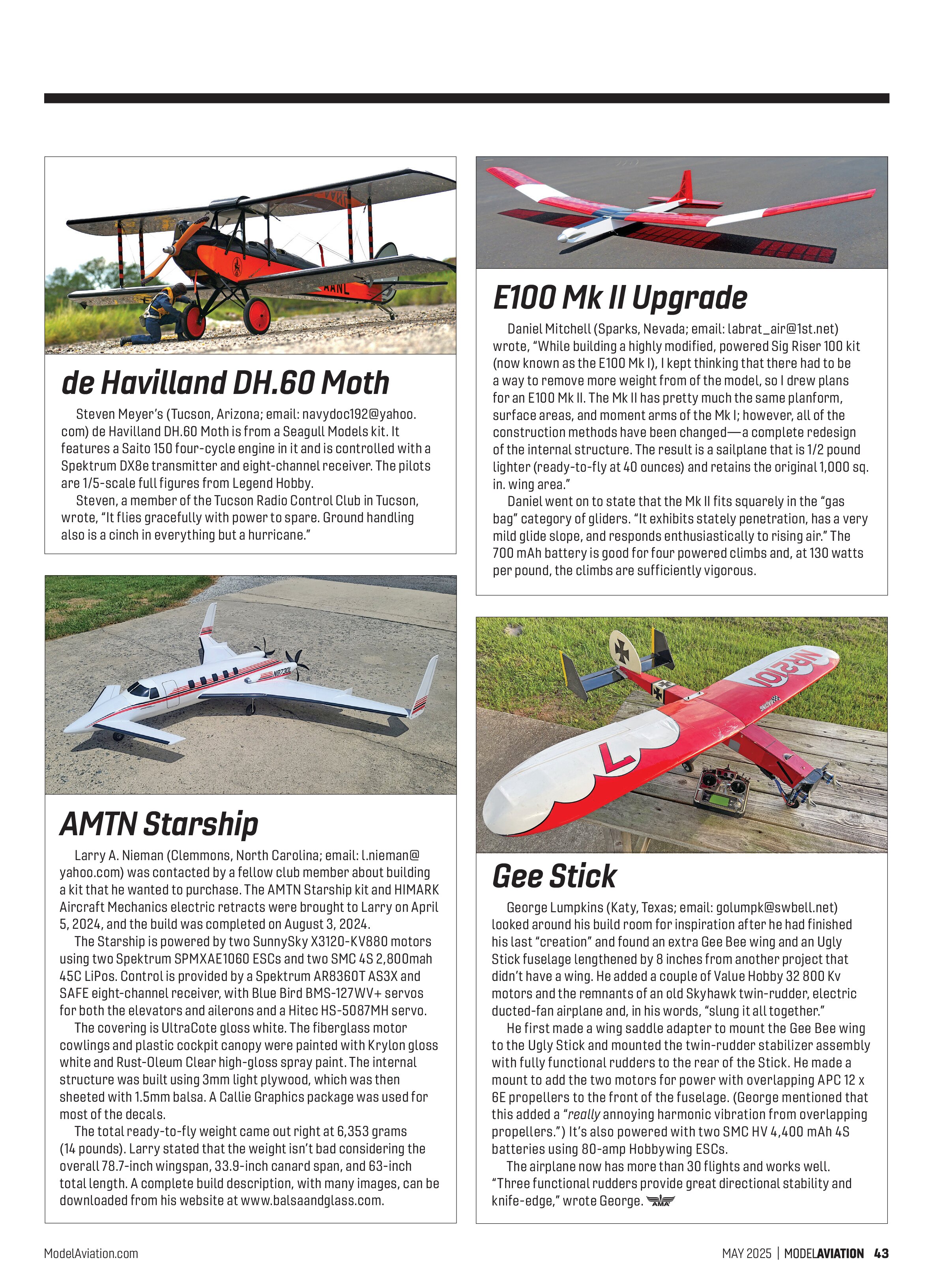
de Havilland DH.60 Moth
Steven Meyer’s (Tucson, Arizona; email: navydoc192@yahoo.com) de Havilland DH.60 Moth is from a Seagull Models kit. It features a Saito 150 four-cycle engine in it and is controlled with a Spektrum DX8e transmitter and eight-channel receiver. The pilots are 1/5-scale full figures from Legend Hobby.

Steven, a member of the Tucson Radio Control Club in Tucson, wrote, “It flies gracefully with power to spare. Ground handling also is a cinch in everything but a hurricane.”
AMTN Starship
Larry A. Nieman (Clemmons, North Carolina; email: l.nieman@yahoo.com) was contacted by a fellow club member about building a kit that he wanted to purchase. The AMTN Starship kit and HIMARK Aircraft Mechanics electric retracts were brought to Larry on April 5, 2024, and the build was completed on August 3, 2024.

The Starship is powered by two SunnySky X3120-KV880 motors using two Spektrum SPMXAE1060 ESCs and two SMC 4S 2,800mah 45C LiPos. Control is provided by a Spektrum AR8360T AS3X and SAFE eight-channel receiver, with Blue Bird BMS-127WV+ servos for both the elevators and ailerons and a Hitec HS-5087MH servo.
The covering is UltraCote gloss white. The fiberglass motor cowlings and plastic cockpit canopy were painted with Krylon gloss white and Rust-Oleum Clear high-gloss spray paint. The internal structure was built using 3mm light plywood, which was then sheeted with 1.5mm balsa. A Callie Graphics package was used for most of the decals.
The total ready-to-fly weight came out right at 6,353 grams (14 pounds). Larry stated that the weight isn’t bad considering the overall 78.7-inch wingspan, 33.9-inch canard span, and 63-inch total length. A complete build description, with many images, can be downloaded from his website at www.balsaandglass.com.
E100 Mk II Upgrade
Daniel Mitchell (Sparks, Nevada; email: labrat_air@1st.net) wrote, “While building a highly modified, powered Sig Riser 100 kit (now known as the E100 Mk I), I kept thinking that there had to be a way to remove more weight from of the model, so I drew plans for an E100 Mk II. The Mk II has pretty much the same planform, surface areas, and moment arms of the Mk I; however, all of the construction methods have been changed—a complete redesign of the internal structure. The result is a sailplane that is 1/2 pound lighter (ready-to-fly at 40 ounces) and retains the original 1,000 sq. in. wing area.”

Daniel went on to state that the Mk II fits squarely in the “gas bag” category of gliders. “It exhibits stately penetration, has a very mild glide slope, and responds enthusiastically to rising air.” The 700 mAh battery is good for four powered climbs and, at 130 watts per pound, the climbs are sufficiently vigorous.
Gee Stick
George Lumpkins (Katy, Texas; email: golumpk@swbell.net) looked around his build room for inspiration after he had finished his last “creation” and found an extra Gee Bee wing and an Ugly Stick fuselage lengthened by 8 inches from another project that didn’t have a wing. He added a couple of Value Hobby 32 800 Kv motors and the remnants of an old Skyhawk twin-rudder, electric ducted-fan airplane and, in his words, “slung it all together.”

He first made a wing saddle adapter to mount the Gee Bee wing to the Ugly Stick and mounted the twin-rudder stabilizer assembly with fully functional rudders to the rear of the Stick. He made a mount to add the two motors for power with overlapping APC 12 x 6E propellers to the front of the fuselage. (George mentioned that this added a “really annoying harmonic vibration from overlapping propellers.”) It’s also powered with two SMC HV 4,400 mAh 4S batteries using 80-amp Hobbywing ESCs.
The airplane now has more than 30 flights and works well. “Three functional rudders provide great directional stability and knife-edge,” wrote George.