THAT’S MY BAG, BABY!
By Patrick Sherman
lucidity@roswellflighttestcrew.com
ONE THING that is absolutely true of aviation—model or otherwise—is that there is always something new to learn. Stick with it long enough and you will discover that there are whole worlds of knowledge and understanding that you never even knew existed. This is a story about my discovery of one of those worlds, and the bag I put together as a result.
From my early, experimental flights with home-built small UAS (or drones as we know them today), I considered myself to be a safe pilot. As the years went on and my appreciation for what constitutes safety in the context of drone operations expanded, I realized that there was still more that I could do to be safe, and I did it.
This process kicked into overdrive when I was hired as an instructor at Embry-Riddle Aeronautical University and introduced to the concept of the “professional aviation mindset.” While I immediately grasped the concept and it reflected things I had already been doing—but without ever actually giving it a name—there was still plenty more that I had to learn and, likely, there still is.
The most recent bump in my knowledge came as a result of the software that we use in the Department of Flight to log our flying time and the requirement that I embrace a facet of it that I had previously ignored. It is easy enough to document an individual flight, but what I had been neglecting to do was create missions in the software that would house my individual flights. This primarily entailed completing several checklists that reflected my preparation for each mission. In most cases, this was just a trip to my local flying field to keep my skills sharp or maybe some aerial photography

to illustrate an article such as this one or for a commercial client.
One checklist in particular captured my imagination. It was a list of the gear that I had available at the flying site, including personal protective equipment—eye protection, gloves, and so forth, as well as a first aid kit, fire extinguisher, launch pad, and the like. To be sure, I long recognized the importance of having these items available, and sometimes, I did. However, more often, I did not, and most critical of all, the process wasn’t at all systematic.
It’s in the Bag
Thinking about it, I realized that as someone who called himself a professional aviator, let alone a professor in the Department of Flight at Embry-Riddle, this was simply unacceptable. Therefore, I set about developing a kit to always carry with me that would include not only safety equipment but also the tools and supplies that I could reasonably expect to be required during drone operations.
As it is at the outset of any such project, I thought that this would be easy at first. I’ve accumulated quite a few sturdy bags throughout the years, each purchased for some specific purpose. Most now sit empty and piled up in my garage. I selected some likely candidates from them and started packing them full of the gear that I had already accumulated, while increasing my store of hand tools and other items that I judged necessary.
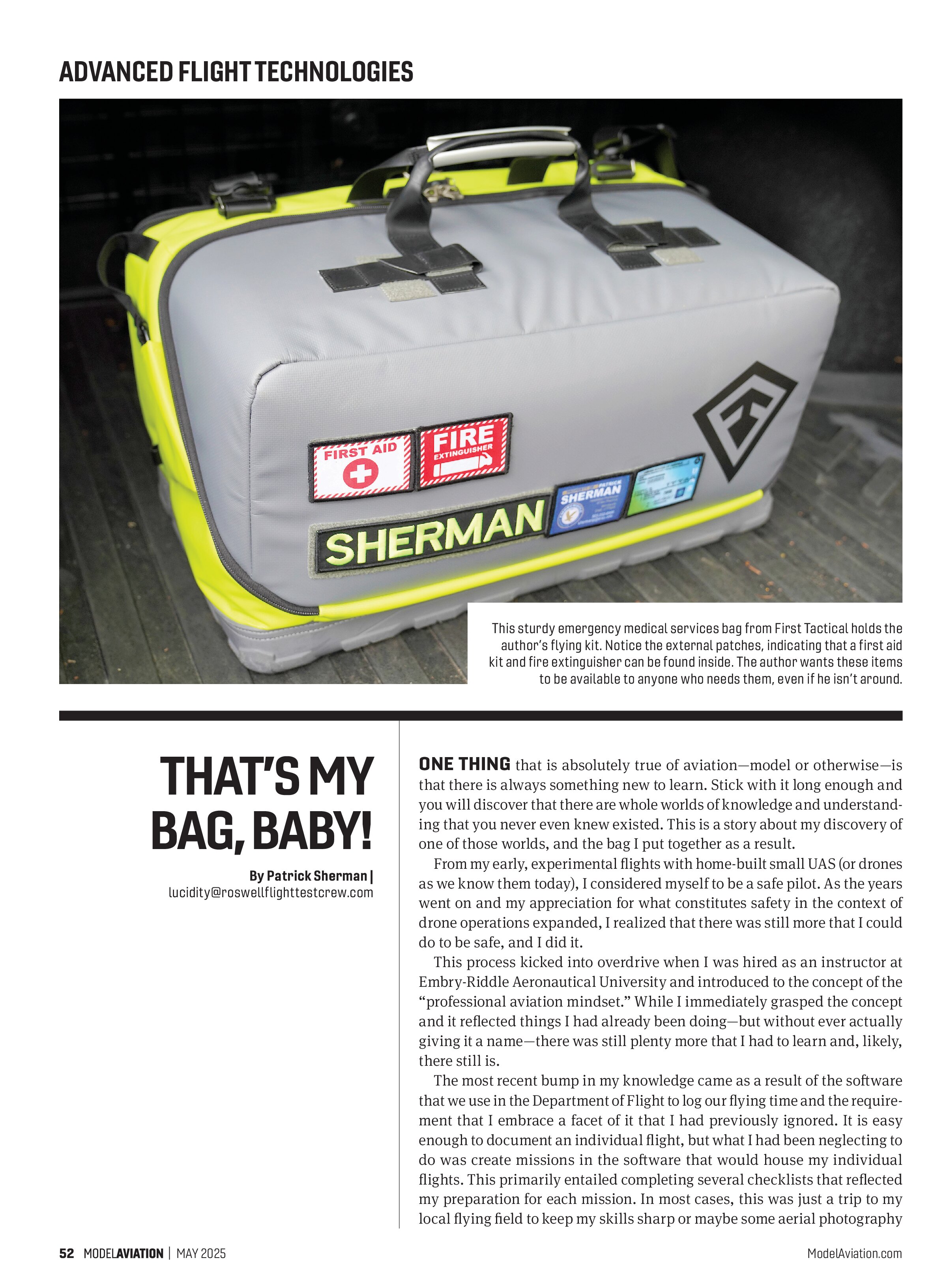
It turned out that none of the bags could contain the equipment I already had, let alone the new equipment that I was adding. Online research ensued and I settled on a bag for emergency medical technicians that is manufactured by a company called First Tactical.
There were three things about this bag that really stood out to me. First, the interior was carpeted with Velcro, which would allow for customized organization of its contents. Second, it opened unlike any other bag or backpack I’ve ever seen, providing easy access to everything it contained. Third, even by the standards of the tactical bags that I have spent a decade accumulating, it looked sturdy and well made.
Taking Inventory
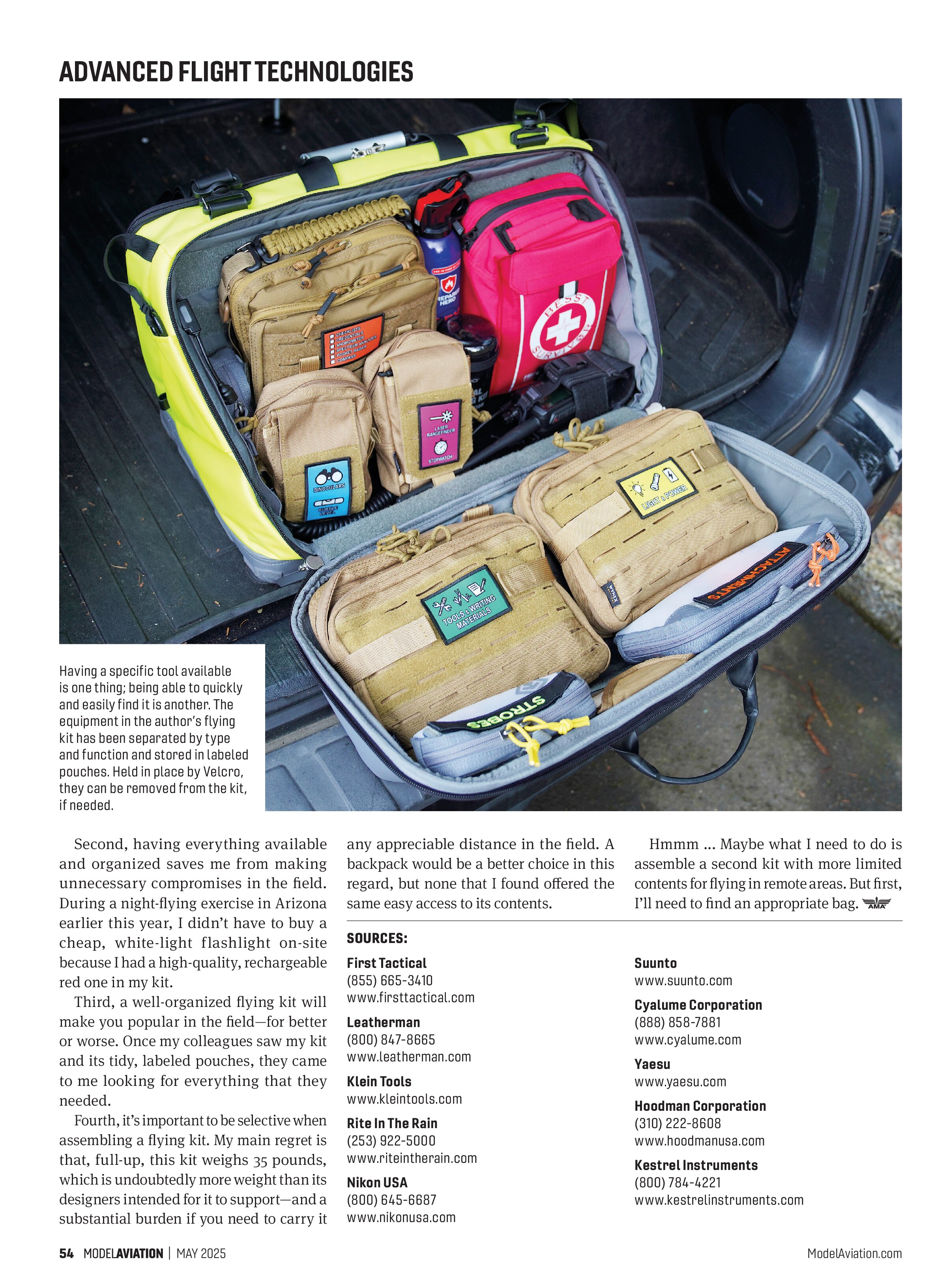
With the bag selected, I next turned my attention to what it would contain and how it would be organized. It’s one thing to possess a particular tool or piece of equipment; it’s quite another to know where it is and be able to retrieve it quickly. To address this need, I began to accumulate smaller pouches, adding Velcro backing and labels to each one so that I could find what I was looking for in the field.
I selected a well-stocked, commercially available first aid kit and a compact fire extinguisher as the cornerstone of my safety equipment. I also added a fire blanket. It turns out that you’re not allowed to bring fire extinguishers on commercial airline flights, even as checked baggage. I figured that having the blanket available would still provide me with some fire suppression capability, even when I’m on the road.
One pouch is dedicated to hand tools, starting out with my trusty Leatherman, of course. I also added a full-size precision screwdriver set with a selection of 46 individual bits in the handle that can also mount a collection of hex drivers that I acquired from the same manufacturer (Klein Tools). I also added imperial and metric hex key sets and precision tweezers. That same pouch also contains all-weather pens, permanent markers, pencils, and a small Rite In The Rain pad for taking notes in the field.
Another pouch, labeled “Light & Power,” includes red and white waterproof flashlights, a headlamp with selectable red or white output, a miniature battery-powered lantern, and a half-dozen Cyalume sticks, along with a USB charger and heavy-duty charging cables. A third pouch is largely given over to “sensors,” including a Kestrel anemometer, a palm-sized speed radar, a spectrum analyzer, a Nikon laser rangefinder and binoculars, a Suunto magnetic compass, a stopwatch, and a bubble level.
A pouch labeled “Attachments” (the best word I could come up with to describe its contents) contains zip ties, electrical tape, hockey tape, office tape, paper tape, adhesive-backed, heavy-duty Velcro, and a bottle of superglue. Another pouch contains strobe lights for night operations.
The kit also includes my Yaesu handheld aviation radio and charger, a lens cleaning kit, two pairs of gloves, business cards, a compact Hoodman launch pad, and a lightweight, collapsible tripod for my anemometer. There is also a 5-1/2 x 8-inch booklet with copies of my Part 107 certificate, The Recreational UAS Safety Test (TRUST) certificate, and recreational aircraft registration, plus other certification documents, checklists, and so forth.
Too Much Stuff?
So, what have I learned from the process of assembling this kit? First of all, it works! I’ve already had several instances where I encountered a problem in the field that I was able to correct almost immediately because I had the right tools and materials available. Even at home on my bench, it helps to have everything organized and in one place.

Second, having everything available and organized saves me from making unnecessary compromises in the field. During a night-flying exercise in Arizona earlier this year, I didn’t have to buy a cheap, white-light flashlight on-site because I had a high-quality, rechargeable red one in my kit.
Third, a well-organized flying kit will make you popular in the field—for better or worse. Once my colleagues saw my kit and its tidy, labeled pouches, they came to me looking for everything that they needed.
Fourth, it’s important to be selective when assembling a flying kit. My main regret is that, full-up, this kit weighs 35 pounds, which is undoubtedly more weight than its designers intended for it to support—and a substantial burden if you need to carry it any appreciable distance in the field. A backpack would be a better choice in this regard, but none that I found offered the same easy access to its contents.
SOURCES:
First Tactical
(855) 665-3410
www.firsttactical.com
Leatherman
(800) 847-8665
www.leatherman.com
Klein Tools
www.kleintools.com
Rite In The Rain
(253) 922-5000
www.riteintherain.com
Nikon USA
(800) 645-6687
www.nikonusa.com
Suunto
www.suunto.com
Cyalume Corporation
(888) 858-7881
www.cyalume.com
Yaesu
www.yaesu.com
Hoodman Corporation
(310) 222-8608
www.hoodmanusa.com
Kestrel Instruments
(800) 784-4221
www.kestrelinstruments.com
Hmmm ... Maybe what I need to do is assemble a second kit with more limited contents for flying in remote areas. But first, I’ll need to find an appropriate bag.