SMALL-FIELD FLYING
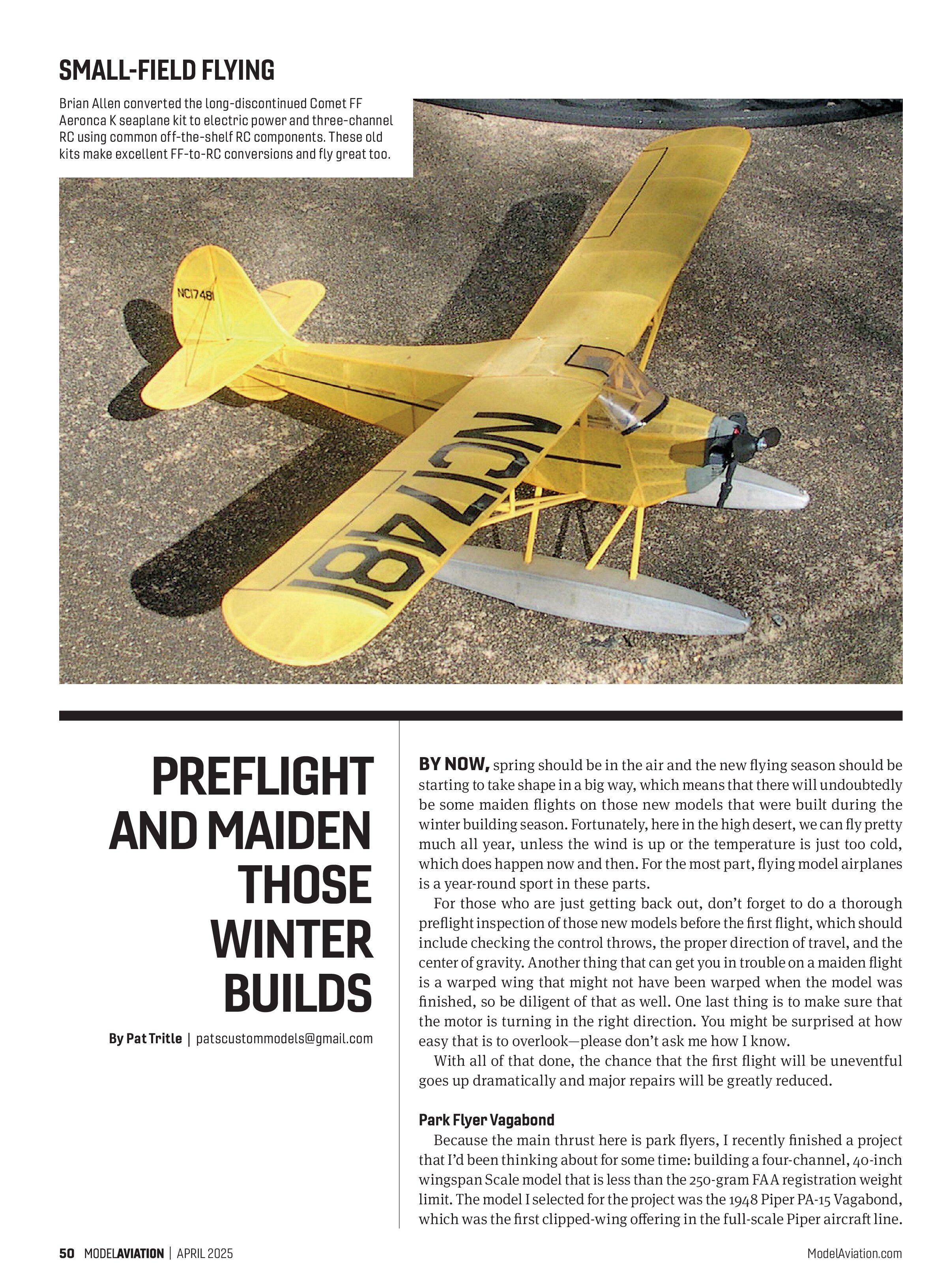
Brian Allen converted the long-discontinued Comet FF Aeronca K seaplane kit to electric power and three-channel RC using common off-the-shelf RC components. These old kits make excellent FF-to-RC conversions and fly great too.

PREFLIGHT AND MAIDEN THOSE WINTER BUILDS
By Pat Trittle | patscustommodels@gmail.com
BY NOW, spring should be in the air and the new flying season should be starting to take shape in a big way, which means that there will undoubtedly be some maiden flights on those new models that were built during the winter building season. Fortunately, here in the high desert, we can fly pretty much all year, unless the wind is up or the temperature is just too cold, which does happen now and then. For the most part, flying model airplanes is a year-round sport in these parts.
For those who are just getting back out, don’t forget to do a thorough preflight inspection of those new models before the first flight, which should include checking the control throws, the proper direction of travel, and the center of gravity. Another thing that can get you in trouble on a maiden flight is a warped wing that might not have been warped when the model was finished, so be diligent of that as well. One last thing is to make sure that the motor is turning in the right direction. You might be surprised at how easy that is to overlook—please don’t ask me how I know.
With all of that done, the chance that the first flight will be uneventful goes up dramatically and major repairs will be greatly reduced.
Park Flyer Vagabond
Because the main thrust here is park flyers, I recently finished a project that I’d been thinking about for some time: building a four-channel, 40-inch wingspan Scale model that is less than the 250-gram FAA registration weight limit. The model I selected for the project was the 1948 Piper PA-15 Vagabond, which was the first clipped-wing offering in the full-scale Piper aircraft line.
I know that achieving the 250-gram target weight was a lofty goal with a model that large, but it did happen. In the end, the model, without the battery, tipped the scales at exactly 8 ounces. With a 400 mAh 2S LiPo battery, the flying weight came in at 247 grams—just 3 grams under the limit—but, in this case, a miss is as good as a mile.
The best part is that the model was done in a scale outline with scale rib spacing. I will say that every precaution was taken to keep the weight down while using (nearly) all off-the-shelf components. The only exception to the off-the-shelf rule was to use MicroLite for the covering. It was definitely a fun exercise, and it’s nice to know that it can be done.
Cover Grip
A couple of columns ago, I mentioned trying Cover Grip from Deluxe Materials as a possible adhesive for attaching Polyspan. Well, I did try it and it works great. One coat was brushed onto the structure with an additional coat over the edges of the Polyspan, where the next piece overlapped.
The big advantage of using Cover Grip rather than nitrate dope was the time spent in preparing for the covering. Unlike the need for three to five coats of dope, a single coat of Cover Grip is all that’s required. The overlaps iron down nicely, with no fuzz along the edges.
I also did a test panel before the Polyspan was sealed with dope, just to be sure that the dope didn’t affect the adhesion and allow the Polyspan to pull loose. I found no adverse effects in any way.
From here on, Cover Grip will be my go-to adhesive on models covered with any non-self-adhesive covering.
Starting Small
I’ve always been fascinated with Brian Allen’s ability to turn a small, rubber Free Flight (FF) kit into a great-flying RC model, and this one is no exception. This time around, Brian built a 25-inch wingspan Aeronca K on floats from the long-discontinued Comet kit. Power for the three-channel model is a 5-gram outrunner motor system from Buzzard Models.
An integrated ESC/receiver with a pair of 1.7-gram servos provide the guidance. Power is supplied using a 300 mAh 1S LiPo battery. The 62-gram model is covered with tissue from Easy Built Models and sealed with non-tautening nitrate dope.

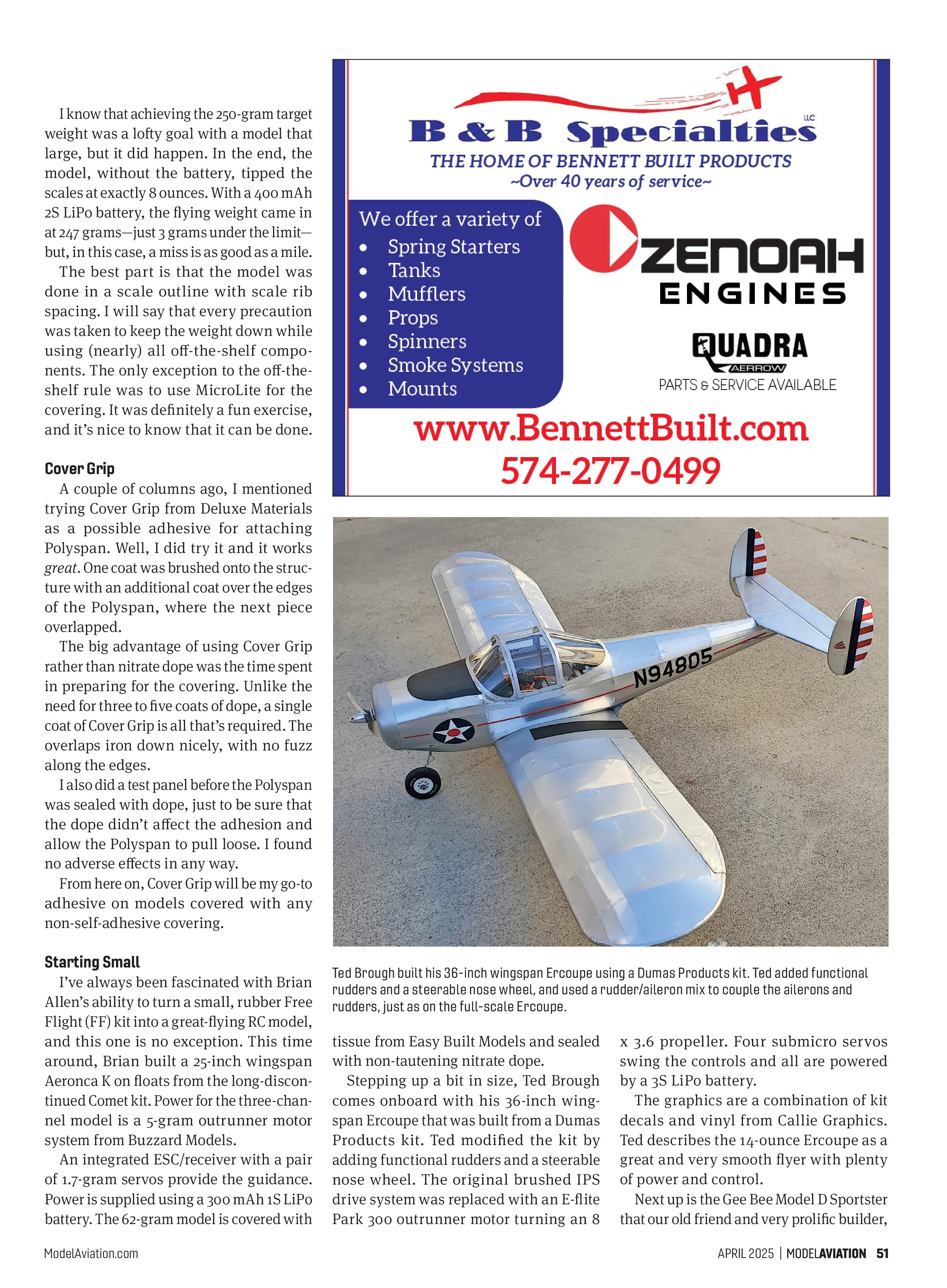
Stepping up a bit in size, Ted Brough comes onboard with his 36-inch wingspan Ercoupe that was built from a Dumas Products kit. Ted modified the kit by adding functional rudders and a steerable nose wheel. The original brushed IPS drive system was replaced with an E-flite Park 300 outrunner motor turning an 8 x 3.6 propeller. Four submicro servos swing the controls and all are powered by a 3S LiPo battery.
The graphics are a combination of kit decals and vinyl from Callie Graphics. Ted describes the 14-ounce Ercoupe as a great and very smooth flyer with plenty of power and control.
Next up is the Gee Bee Model D Sportster that our old friend and very prolific builder,
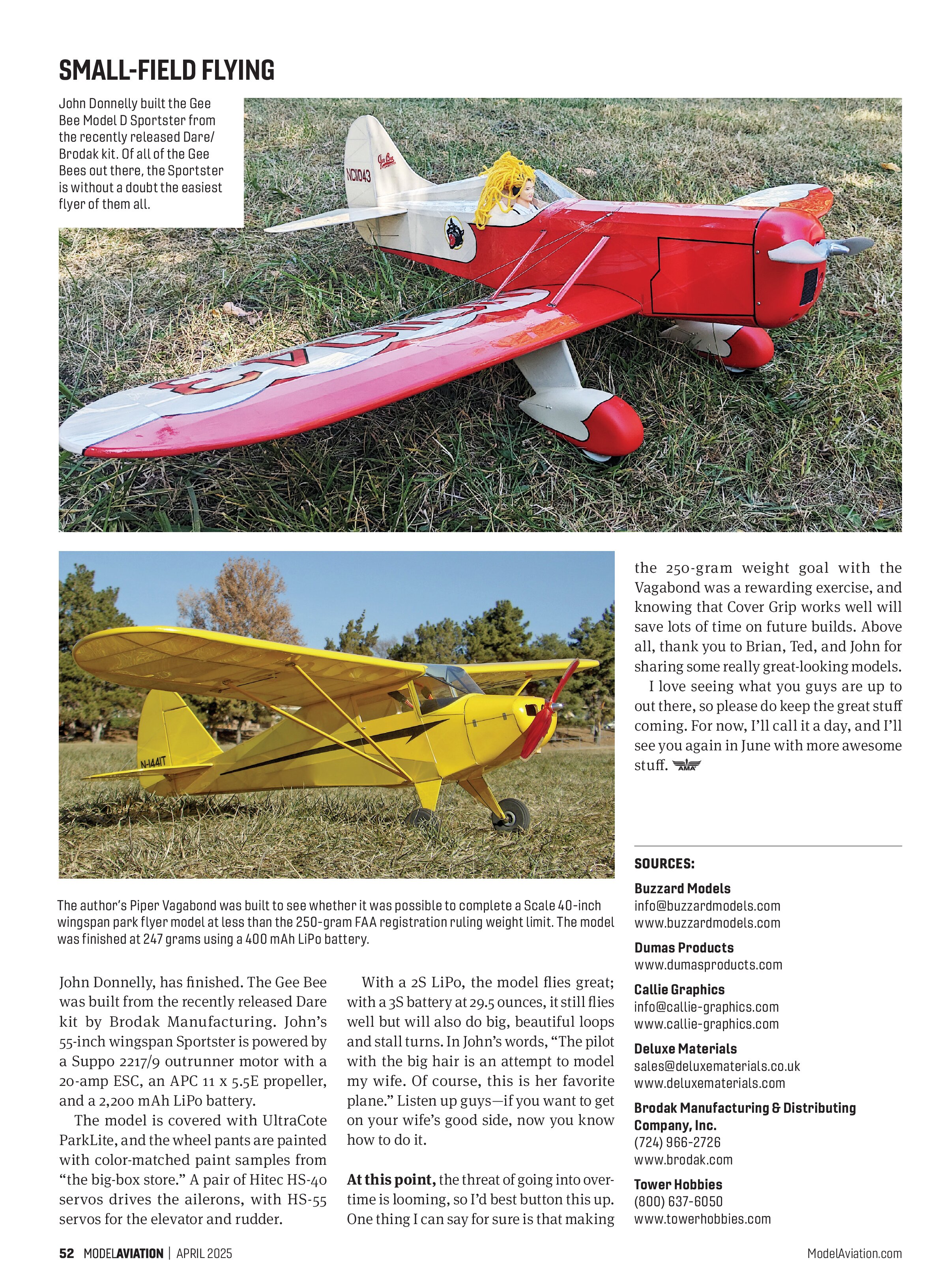
John Donnelly built the Gee Bee Model D Sportster from the recently released Dare Brodak kit. Of all of the Gee Bees out there, the Sportster is without a doubt the easiest flyer of them all.

The author’s Piper Vagabond was built to see whether it was possible to complete a Scale 40-inch wingspan park flyer model at less than the 250-gram FAA registration ruling weight limit. The model was finished at 247 grams using a 400 mAh LiPo battery.

John Donnelly, has finished. The Gee Bee was built from the recently released Dare kit by Brodak Manufacturing. John’s 55-inch wingspan Sportster is powered by a Suppo 2217/9 outrunner motor with a 20-amp ESC, an APC 11 x 5.5E propeller, and a 2,200 mAh LiPo battery.
The model is covered with UltraCote ParkLite, and the wheel pants are painted with color-matched paint samples from “the big-box store.” A pair of Hitec HS-40 servos drives the ailerons, with HS-55 servos for the elevator and rudder.
With a 2S LiPo, the model flies great; with a 3S battery at 29.5 ounces, it still flies well but will also do big, beautiful loops and stall turns. In John’s words, “The pilot with the big hair is an attempt to model my wife. Of course, this is her favorite plane.” Listen up guys—if you want to get on your wife’s good side, now you know how to do it.
At this point, the threat of going into overtime is looming, so I’d best button this up. One thing I can say for sure is that making the 250-gram weight goal with the Vagabond was a rewarding exercise, and knowing that Cover Grip works well will save lots of time on future builds. Above all, thank you to Brian, Ted, and John for sharing some really great-looking models. I love seeing what you guys are up to out there, so please do keep the great stuff coming. For now, I’ll call it a day, and I’ll see you again in June with more awesome stuff.
SOURCES:
Buzzard Models
info@buzzardmodels.com
www.buzzardmodels.com
Dumas Products
www.dumasproducts.com
Callie Graphics
info@callie-graphics.com
www.callie-graphics.com
Deluxe Materials
sales@deluxematerials.co.uk
www.deluxematerials.com
Brodak Manufacturing & Distributing Company, Inc.
(724) 966-2726
www.brodak.com
Tower Hobbies
(800) 637-6050
www.towerhobbies.com