RC SCALE AEROBATICS

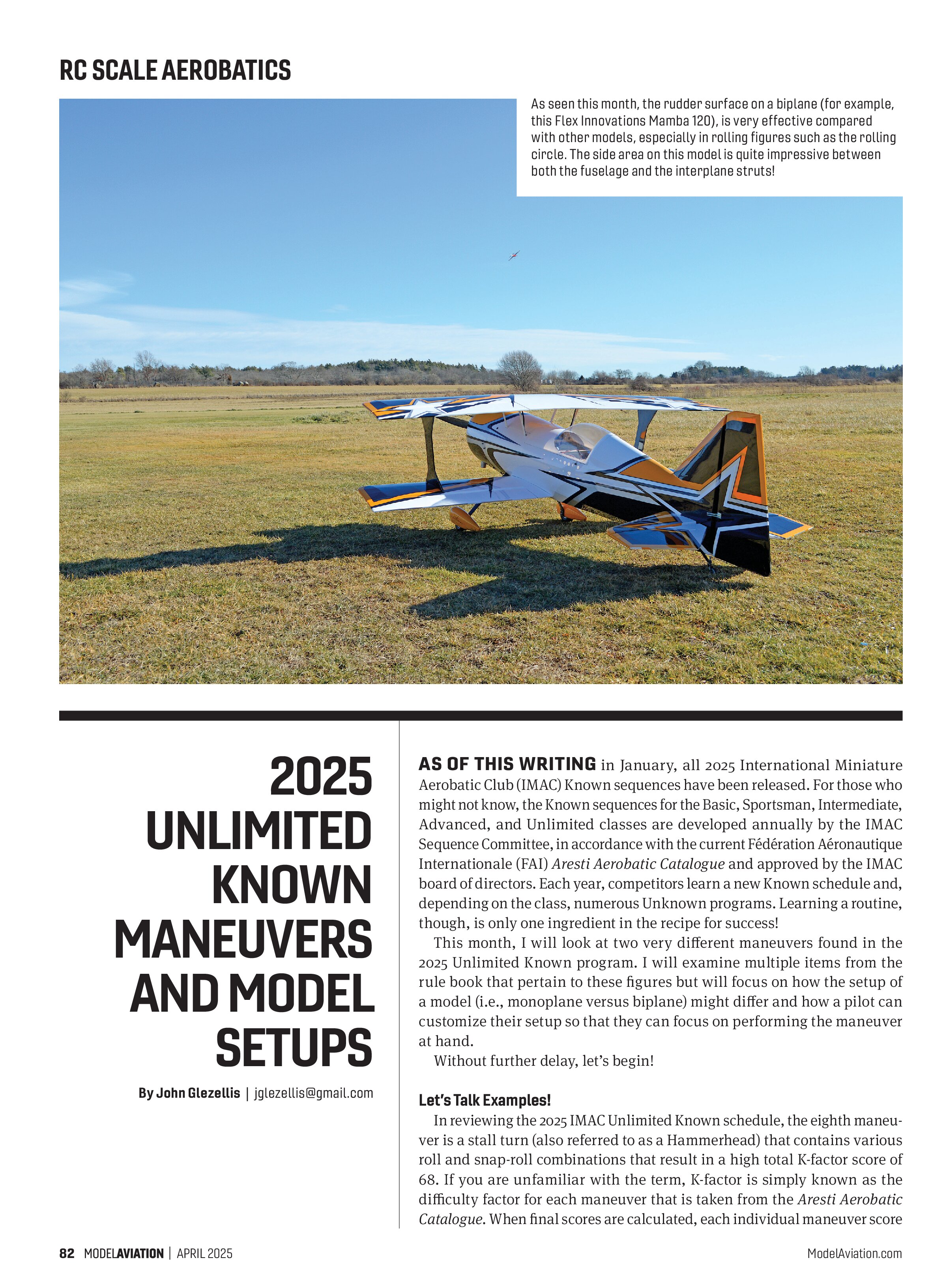
As seen this month, the rudder surface on a biplane (for example, this Flex Innovations Mamba 120), is very effective compared with other models, especially in rolling figures such as the rolling circle. The side area on this model is quite impressive between both the fuselage and the interplane struts!
2025
UNLIMITED
KNOWN
MANEUVERS
AND MODEL
SETUPS
By John Glezellis | jglezellis@gmail.com
AS OF THIS WRITING in January, all 2025 International Miniature Aerobatic Club (IMAC) Known sequences have been released. For those who might not know, the Known sequences for the Basic, Sportsman, Intermediate, Advanced, and Unlimited classes are developed annually by the IMAC Sequence Committee, in accordance with the current Fédération Aéronautique Internationale (FAI) Aresti Aerobatic Catalogue and approved by the IMAC board of directors. Each year, competitors learn a new Known schedule and, depending on the class, numerous Unknown programs. Learning a routine, though, is only one ingredient in the recipe for success!
This month, I will look at two very different maneuvers found in the 2025 Unlimited Known program. I will examine multiple items from the rule book that pertain to these figures but will focus on how the setup of a model (i.e., monoplane versus biplane) might differ and how a pilot can customize their setup so that they can focus on performing the maneuver at hand.
Without further delay, let’s begin!
Let’s Talk Examples!
In reviewing the 2025 IMAC Unlimited Known schedule, the eighth maneuver is a stall turn (also referred to as a Hammerhead) that contains various roll and snap-roll combinations that result in a high total K-factor score of 68. If you are unfamiliar with the term, K-factor is simply known as the difficulty factor for each maneuver that is taken from the Aresti Aerobatic Catalogue. When final scores are calculated, each individual maneuver score is multiplied by its K-factor, where the flight score is the direct result of summing the K-factored scores.
For comparison, the total K-factor for the stall turn that follows is 45. If a pilot received an individual score of 9 for the figure, the total score would be 405 (9 x 45 = 405). The reason I highlight this is because not all maneuvers are equal. Although you might feel that you flew a great flight and might not understand general ranking, a competitor could have made fewer mistakes on higher K figures. While the competition pilot should work to perfect the entire flight, certain maneuvers play a larger role compared with others because of this!
For the stall turn, you must enter upright, pull to a vertical upline, and perform four points of an eight-point roll followed by 1-1/2 opposite negative snap rolls. During the pull, partial loops must be round and vertical lines must be perpendicular to the horizon. For the snap-roll element, the aircraft will need to show a pitch departure toward the wheels and, either immediately following or simultaneously with the pitch input, it must enter an autorotation.
A common error during a snap roll is to exit the rotation early and complete the snap with ailerons because it is easier to control the exit of the snap. Should this occur, a downgrade of 0.5 points for each 5° of rotation remaining or any overrotation performed will be applied. The stall-turn 180° pivot is a stalled condition and no downgrade shall be applied for wind drift during that time. After the rotation is complete, a new reference point shall be established for the perfect vertical downline. If the flight path on the downline is 10° off, the downgrade should then be one point.
Personally, I use my two-position switch (the rate switch closest to me) for the pull to vertical and the four points of an eight-point roll, switch to position one for the 1-1/2 opposite negative snap roll, and then switch back to position two for the 180° pivot. On the downline, the pilot is to perform two points of a four-point roll, followed by an opposite-direction negative half snap roll to an upright level exit.
I will remain on position two for the rolling segment but will switch to position one for the half negative snap roll and back to position two for the remaining line segment and 90° pull to upright. (Note:
Switch positions are for a Spektrum radio, with position 0 being only used for 3D maneuvers and/or tailslides.)
The maneuver that follows—a rolling circle with three alternating rolls, with the first roll to the inside—is a challenging figure to perform properly because perspective and wind severity can impact the overall presentation. Should the pilot hesitate during a roll, each stoppage is a deduction of one point. Additionally, one-point penalties exist for each variation in rate of a turn and roll-rate change. A variation in altitude or degrees of the turn that remains will receive a deduction of 0.5 points per 5°. As for rates, I prefer to fly this

entire figure on my position two settings, which I will now look at.
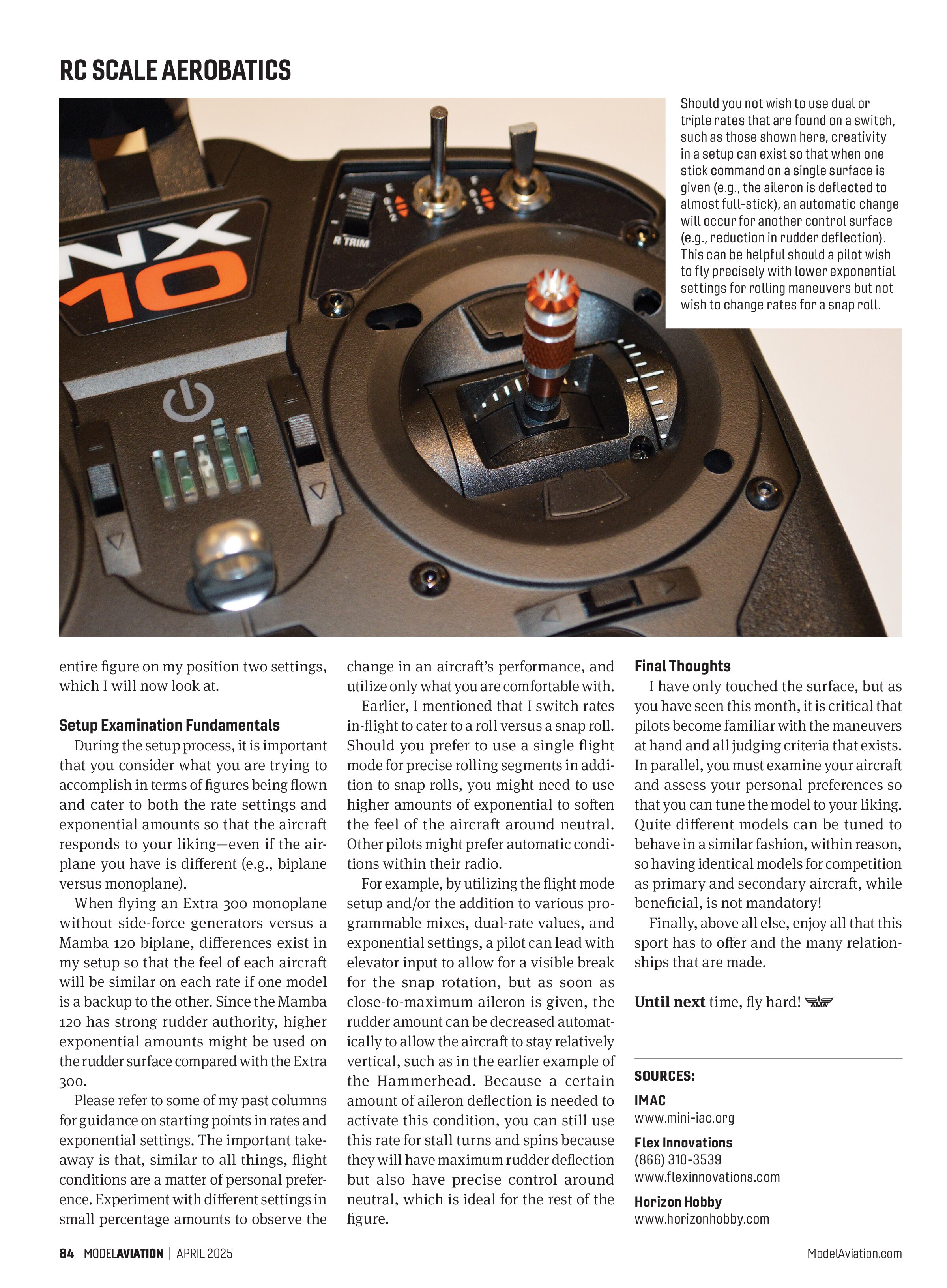
Should you not wish to use dual or triple rates that are found on a switch, such as those shown here, creativity in a setup can exist so that when one stick command on a single surface is given (e.g., the aileron is deflected to almost full-stick), an automatic change will occur for another control surface (e.g., reduction in rudder deflection). This can be helpful should a pilot wish to fly precisely with lower exponential settings for rolling maneuvers but not wish to change rates for a snap roll.
Setup Examination Fundamentals
During the setup process, it is important that you consider what you are trying to accomplish in terms of figures being flown and cater to both the rate settings and exponential amounts so that the aircraft responds to your liking—even if the airplane you have is different (e.g., biplane versus monoplane).
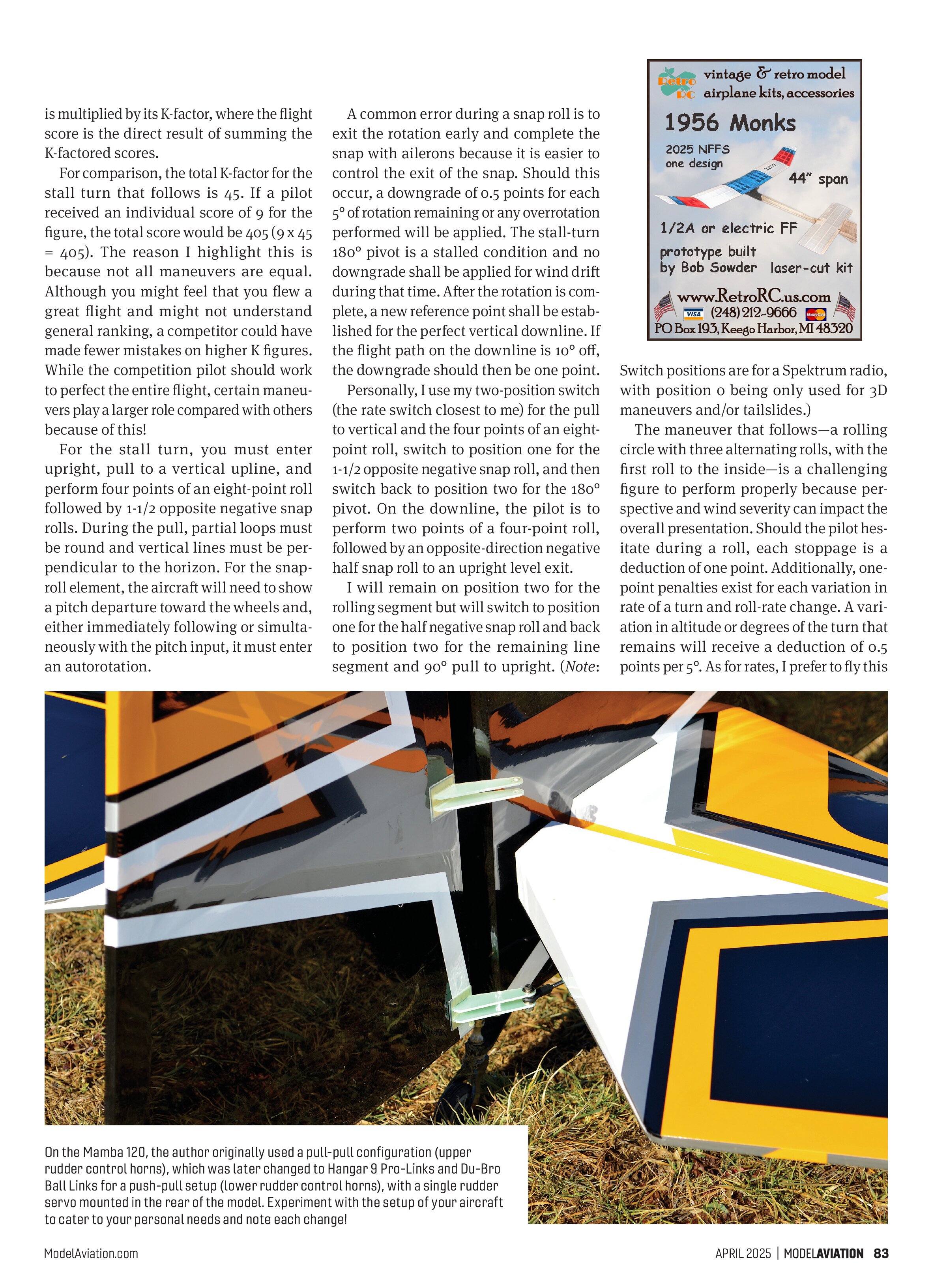
When flying an Extra 300 monoplane without side-force generators versus a Mamba 120 biplane, differences exist in my setup so that the feel of each aircraft will be similar on each rate if one model is a backup to the other. Since the Mamba 120 has strong rudder authority, higher exponential amounts might be used on the rudder surface compared with the Extra 300.
Please refer to some of my past columns for guidance on starting points in rates and exponential settings. The important take-away is that, similar to all things, flight conditions are a matter of personal preference. Experiment with different settings in small percentage amounts to observe the change in an aircraft’s performance, and utilize only what you are comfortable with.
Earlier, I mentioned that I switch rates in-flight to cater to a roll versus a snap roll. Should you prefer to use a single flight mode for precise rolling segments in addition to snap rolls, you might need to use higher amounts of exponential to soften the feel of the aircraft around neutral. Other pilots might prefer automatic conditions within their radio.
For example, by utilizing the flight mode setup and/or the addition to various programmable mixes, dual-rate values, and exponential settings, a pilot can lead with elevator input to allow for a visible break for the snap rotation, but as soon as close-to-maximum aileron is given, the rudder amount can be decreased automatically to allow the aircraft to stay relatively vertical, such as in the earlier example of the Hammerhead. Because a certain amount of aileron deflection is needed to activate this condition, you can still use this rate for stall turns and spins because they will have maximum rudder deflection but also have precise control around neutral, which is ideal for the rest of the figure.
Final Thoughts
I have only touched the surface, but as you have seen this month, it is critical that pilots become familiar with the maneuvers at hand and all judging criteria that exists. In parallel, you must examine your aircraft and assess your personal preferences so that you can tune the model to your liking. Quite different models can be tuned to behave in a similar fashion, within reason, so having identical models for competition as primary and secondary aircraft, while beneficial, is not mandatory!
Finally, above all else, enjoy all that this sport has to offer and the many relationships that are made.
Until next time, fly hard!
SOURCES:
IMAC
www.mini-iac.org
Flex Innovations
(866) 310-3539
www.flexinnovations.com
Horizon Hobby
www.horizonhobby.com