OK ENGINES
By Bob Angel | samrcflier@verizon.net

CHARLES BREBECK’S OK Engines became fairly dominant during a period starting near the beginning of World War II and lasting until approximately five years after the war ended in 1945.
During that relatively short period, OK began producing the greatest variety and largest total volume of model engines, with more than a thousand being made daily. Like many other machine shops, model engine makers were often awarded government contracts for war-related items, such as special-purpose small engines to power target drones, small generators, etc.
OK participated in those contracts and, after the war, the company joined other manufacturers in expanding into the smaller engine sizes that were becoming popular. OK engines were also known by various sub names, such as Herkimer-OK and Mohawk, and the smaller ones were known as OK Cubs. Charles started the Herkimer Tool and Model Company in Herkimer, New York, in 1938.
I’d planned to review the history of OK Engines in this column, along with Charles’ AMA History Project and AMA Model Aviation Hall of Fame biography, but I might have waited a bit long to collect complete background data. I recall the slow withdrawal of OK Engines from the market after production ceased. A few more engines were slowly assembled and sold, along with the remaining spare parts. That took place throughout several years and wasn’t as well documented as other engine makers’ activities.
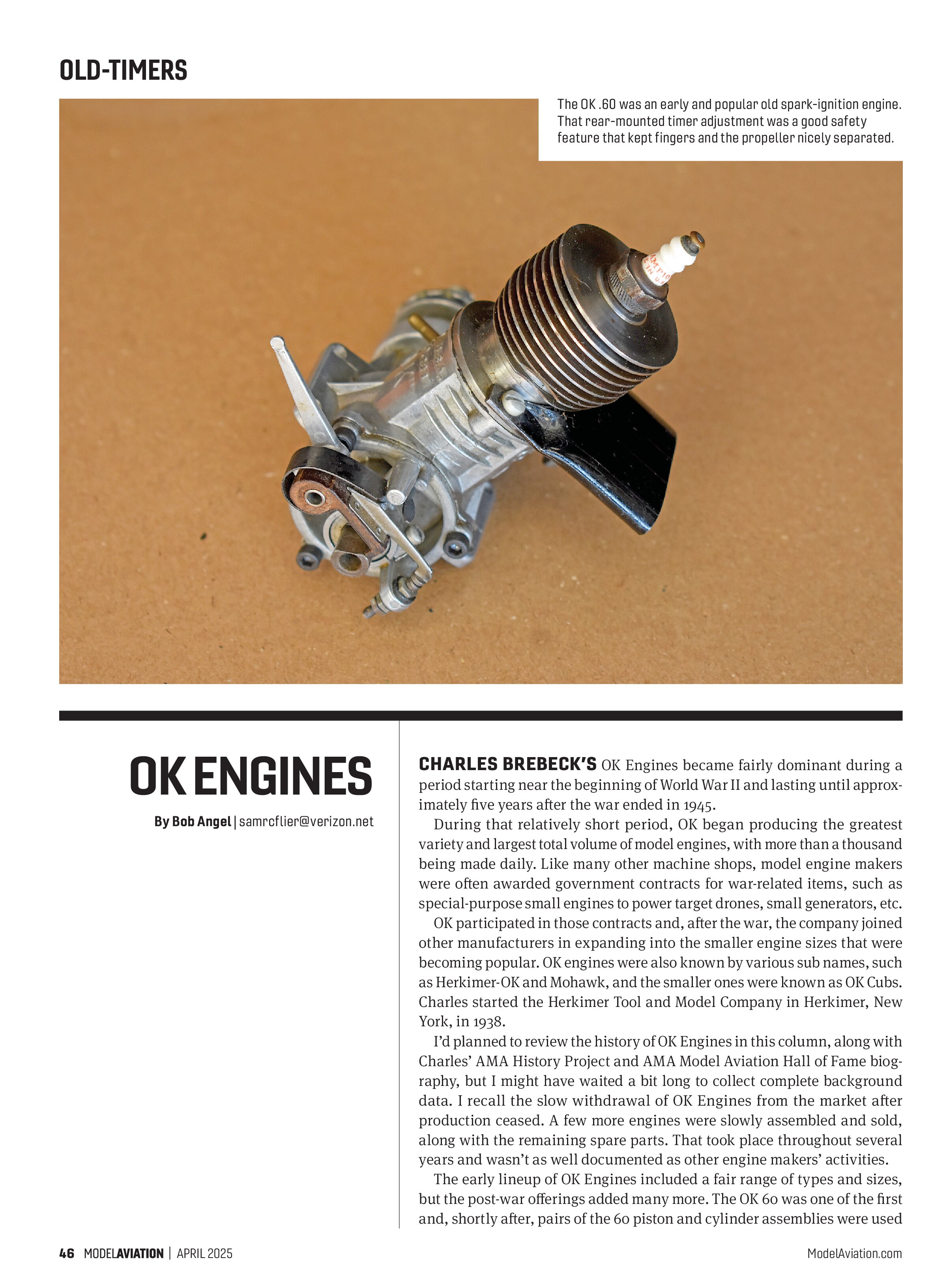
The early lineup of OK Engines included a fair range of types and sizes, but the post-war offerings added many more. The OK 60 was one of the first and, shortly after, pairs of the 60 piston and cylinder assemblies were used

to produce 1.20-size opposed twin engines. Two identical, split crankcase halves were fastened together, right and left, with a cylinder assembly attached to each.
The total range of types, models, and versions within each size of OK engines seems to be almost overkill at times. The following are cubic-inch engine sizes that were manufactured:
- 1.20 twin
- .616
- .604
- .493 or OK 49
- .35
- .299
- .19
- .149 or diesel 15
- .14
- .099
- .075 diesel
- .074
- .060 glow and diesel
- .049 (in at least 16 models or variations)
- .039
- .024
- .019 CO2
- .0178 CO2
I counted 16 different models of just the .049s that are listed. Additionally, there were many minor .049 options produced for small, ready-to-fly (RTF) aircraft that weren’t considered separate models. Those engines were made not only for Herkimer’s own RTF models, but for the Comet as well—and possibly for others. Some of the Ben Shereshaw-designed Bantam .19 engines were farmed out to Herkimer-OK for production as well.
I’m not satisfied with the scarce information about Mr. Brebeck, so I’ll shelve that biography for now. I would welcome any reader information about him for possible future use. At just two pages, Charles Brebeck’s AMA biography might be the shortest in the collection. Test-flying isn’t necessarily a requirement for being a good engine designer, but I’d be interested to know whether Charles ever actually built and flew models.
OK Vs. Cox Engines
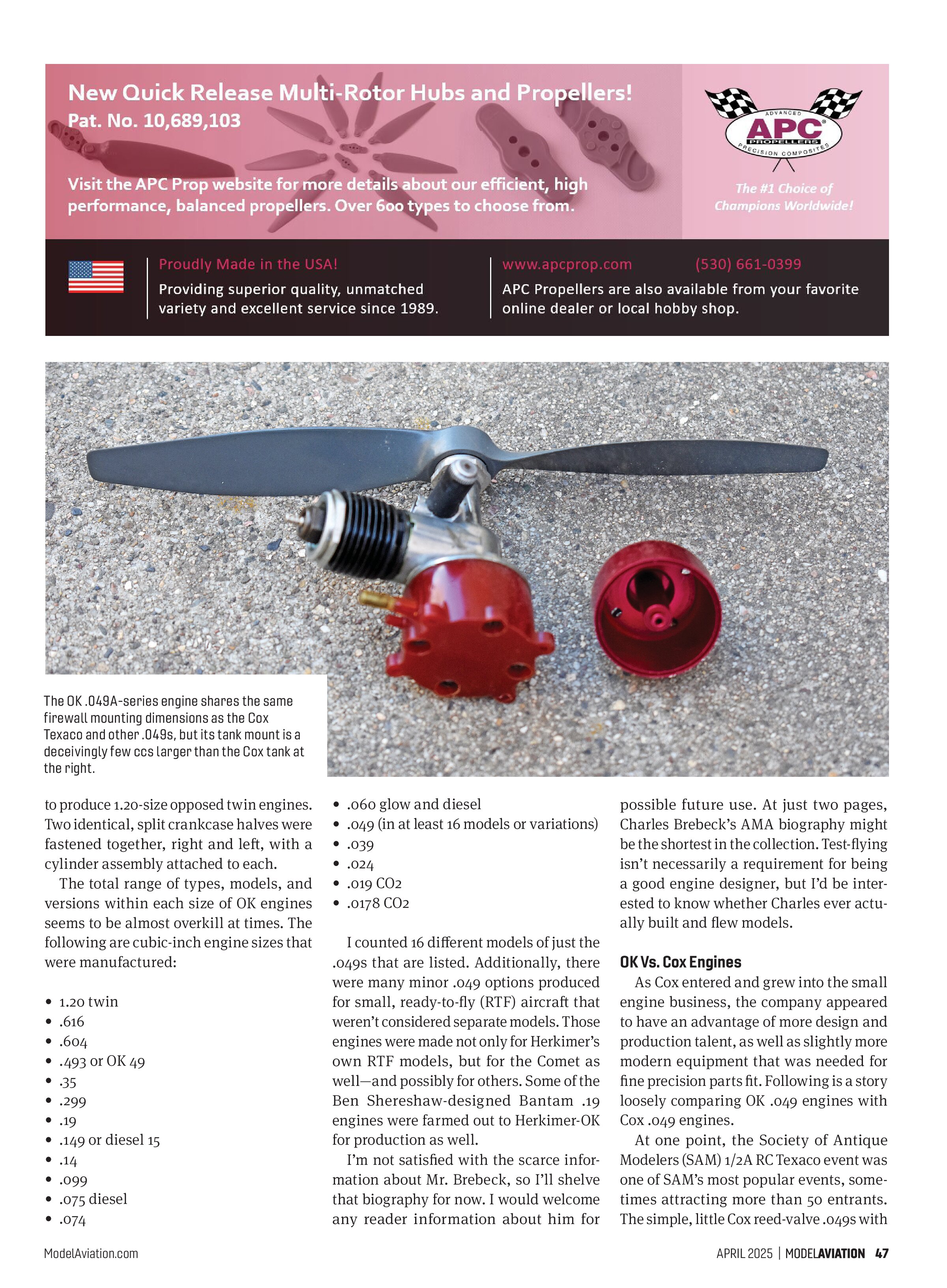
As Cox entered and grew into the small engine business, the company appeared to have an advantage of more design and production talent, as well as slightly more modern equipment that was needed for fine precision parts fit. Following is a story loosely comparing OK .049 engines with Cox .049 engines.
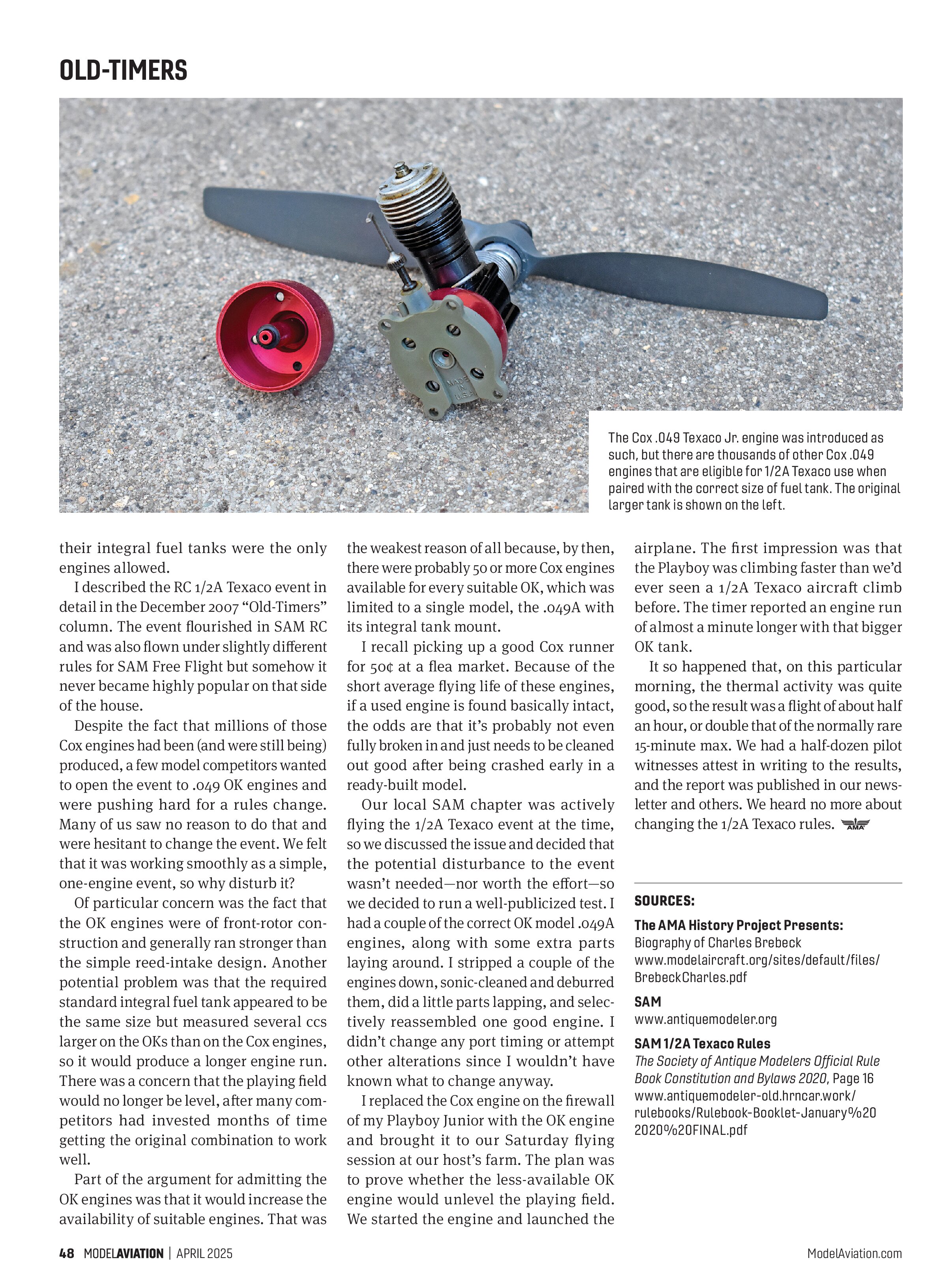
At one point, the Society of Antique Modelers (SAM) 1/2A RC Texaco event was one of SAM’s most popular events, sometimes attracting more than 50 entrants. The simple, little Cox reed-valve .049s with
their integral fuel tanks were the only engines allowed.
I described the RC 1/2A Texaco event in detail in the December 2007 “Old-Timers” column. The event flourished in SAM RC and was also flown under slightly different rules for SAM Free Flight but somehow it never became highly popular on that side of the house.
Despite the fact that millions of those Cox engines had been (and were still being) produced, a few model competitors wanted to open the event to .049 OK engines and were pushing hard for a rules change. Many of us saw no reason to do that and were hesitant to change the event. We felt that it was working smoothly as a simple, one-engine event, so why disturb it?
Of particular concern was the fact that the OK engines were of front-rotor construction and generally ran stronger than the simple reed-intake design. Another potential problem was that the required standard integral fuel tank appeared to be the same size but measured several ccs larger on the OKs than on the Cox engines, so it would produce a longer engine run. There was a concern that the playing field would no longer be level, after many competitors had invested months of time getting the original combination to work well.
Part of the argument for admitting the OK engines was that it would increase the availability of suitable engines. That was the weakest reason of all because, by then, there were probably 50 or more Cox engines available for every suitable OK, which was limited to a single model, the .049A with its integral tank mount.
I recall picking up a good Cox runner for 50¢ at a flea market. Because of the short average flying life of these engines, if a used engine is found basically intact, the odds are that it’s probably not even fully broken in and just needs to be cleaned out good after being crashed early in a ready-built model.
Our local SAM chapter was actively flying the 1/2A Texaco event at the time, so we discussed the issue and decided that the potential disturbance to the event wasn’t needed—nor worth the effort—so we decided to run a well-publicized test. I had a couple of the correct OK model .049A engines, along with some extra parts laying around. I stripped a couple of the engines down, sonic-cleaned and deburred them, did a little parts lapping, and selectively reassembled one good engine. I didn’t change any port timing or attempt other alterations since I wouldn’t have known what to change anyway.
I replaced the Cox engine on the firewall of my Playboy Junior with the OK engine and brought it to our Saturday flying session at our host’s farm. The plan was to prove whether the less-available OK engine would unlevel the playing field. We started the engine and launched the airplane. The first impression was that the Playboy was climbing faster than we’d ever seen a 1/2A Texaco aircraft climb before. The timer reported an engine run of almost a minute longer with that bigger OK tank.
It so happened that, on this particular morning, the thermal activity was quite good, so the result was a flight of about half an hour, or double that of the normally rare 15-minute max. We had a half-dozen pilot witnesses attest in writing to the results, and the report was published in our newsletter and others. We heard no more about changing the 1/2A Texaco rules.

SOURCES:
The AMA History Project Presents:
Biography of Charles Brebeck
www.modelaircraft.org/sites/default/files/
BrebeckCharles.pdf
SAM 1/2A Texaco Rules
The Society of Antique Modelers Official Rule Book Constitution and Bylaws 2020, Page 16
www.antiquemodeler-old.hnrncar.work/
rulebooks/Rulebook-Booklet-January%20
2020%20FINAL.pdf