FOCAL POINT
Interested in sharing your handiwork? Visit www.ModelAviation.com for submission guidelines.
Swamp Fishing Buggy

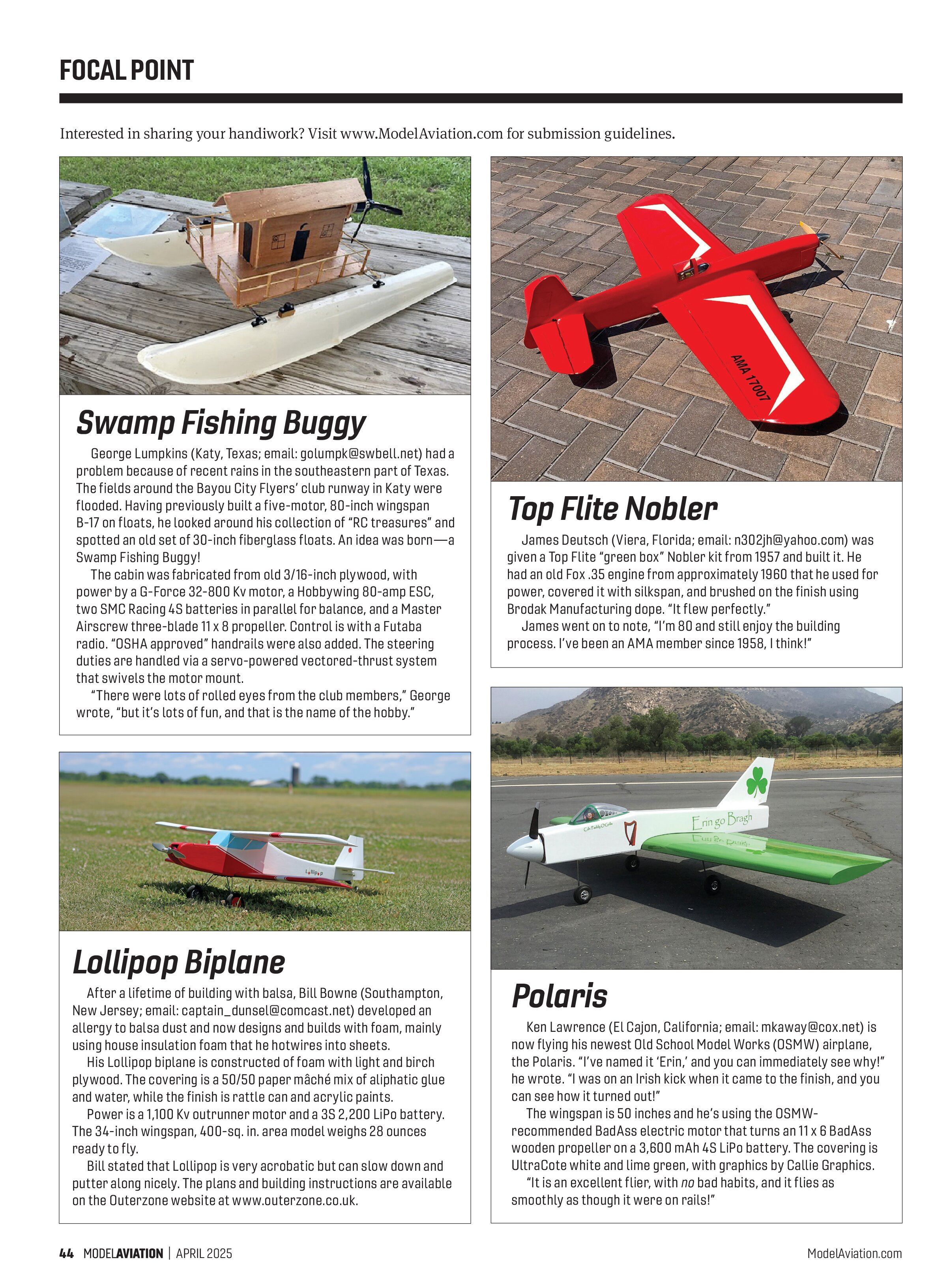
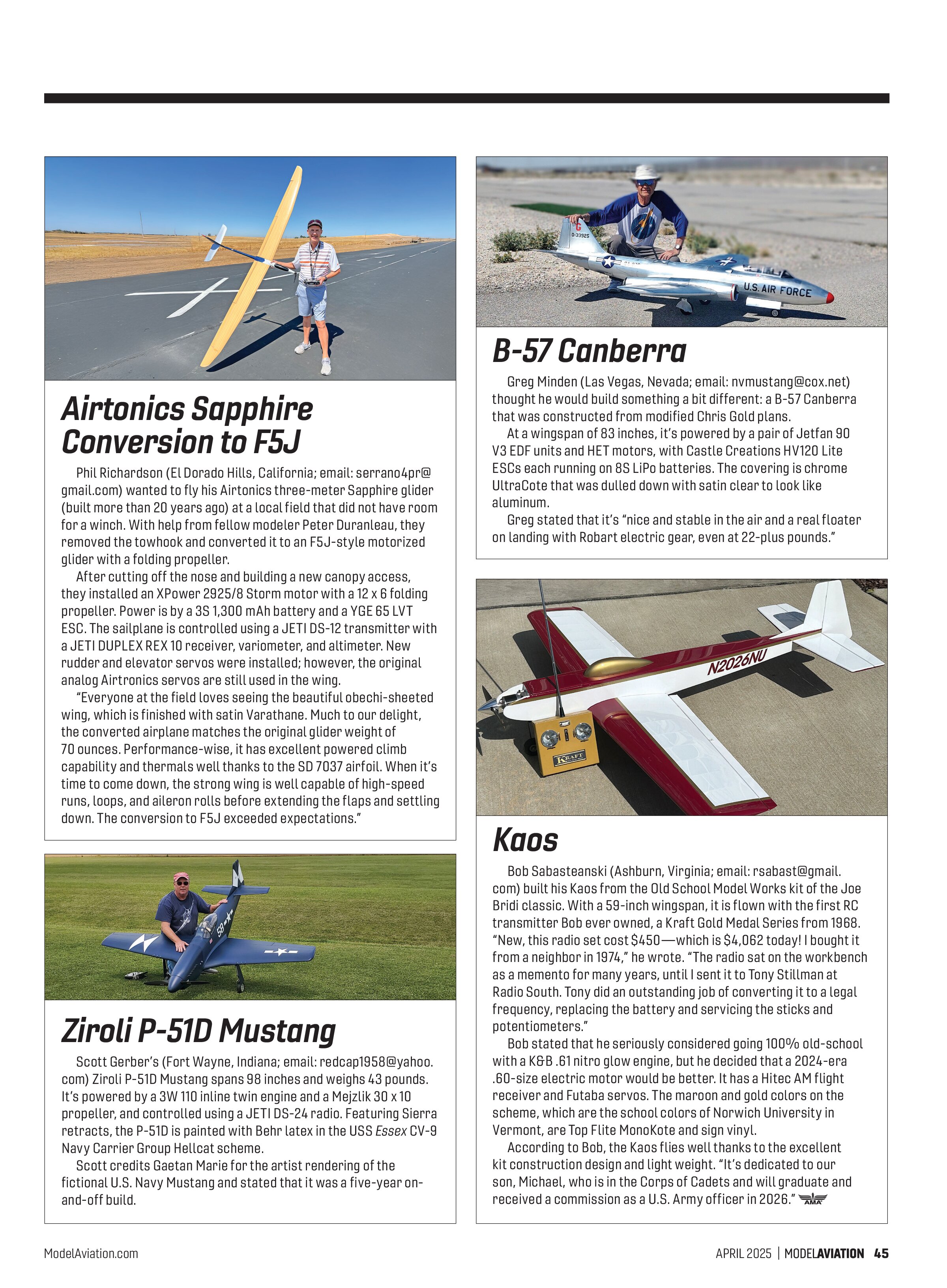
George Lumpkins (Katy, Texas; email: golumpk@swbell.net) had a problem because of recent rains in the southeastern part of Texas. The fields around the Bayou City Flyers’ club runway in Katy were flooded. Having previously built a five-motor, 80-inch wingspan B-17 on floats, he looked around his collection of “RC treasures” and spotted an old set of 30-inch fiberglass floats. An idea was born—a Swamp Fishing Buggy!
The cabin was fabricated from old 3/16-inch plywood, with power by a G-Force 32-800 Kv motor, a Hobbywing 80-amp ESC, two SMC Racing 4S batteries in parallel for balance, and a Master Airscrew three-blade 11 x 8 propeller. Control is with a Futaba radio. “OSHA approved” handrails were also added. The steering duties are handled via a servo-powered vectored-thrust system that swivels the motor mount.
“There were lots of rolled eyes from the club members,” George wrote, “but it’s lots of fun, and that is the name of the hobby.”
Lollipop Biplane

After a lifetime of building with balsa, Bill Bowne (Southampton, New Jersey; email: captain_dunsel@comcast.net) developed an allergy to balsa dust and now designs and builds with foam, mainly using house insulation foam that he hotwires into sheets.
His Lollipop biplane is constructed of foam with light and birch plywood. The covering is a 50/50 paper mâché mix of aliphatic glue and water, while the finish is rattle can and acrylic paints.
Power is a 1,100 Kv outrunner motor and a 3S 2,200 LiPo battery. The 34-inch wingspan, 400-sq. in. area model weighs 28 ounces ready to fly.
Bill stated that Lollipop is very acrobatic but can slow down and putter along nicely. The plans and building instructions are available on the Outerzone website at www.outerzone.co.uk.
Top Flite Nobler

James Deutsch (Viera, Florida; email: n302ih@yahoo.com) was given a Top Flite “green box” Nobler kit from 1957 and built it. He had an old Fox .35 engine from approximately 1960 that he used for power, covered it with silkspan, and brushed on the finish using Brodak Manufacturing dope. “It flew perfectly.”
James went on to note, “I’m 80 and still enjoy the building process. I’ve been an AMA member since 1958, I think!”
Polaris

Ken Lawrence (El Cajon, California; email: mkaway@cox.net) is now flying his newest Old School Model Works (OSMW) airplane, the Polaris. “I’ve named it ‘Erin,’ and you can immediately see why!” he wrote. “I was on an Irish kick when it came to the finish, and you can see how it turned out!”
The wingspan is 50 inches and he’s using the OSMW-recommended BadAss electric motor that turns an 11 x 6 BadAss wooden propeller on a 3,600 mAh 4S LiPo battery. The covering is UltraCote white and lime green, with graphics by Callie Graphics. “It is an excellent flier, with no bad habits, and it flies as smoothly as though it were on rails!”
Airtronics Sapphire Conversion to F5J

Phil Richardson (El Dorado Hills, California; email: serrano4pr@gmail.com) wanted to fly his Airtronics three-meter Sapphire glider (built more than 20 years ago) at a local field that did not have room for a winch. With help from fellow modeler Peter Duranteau, they removed the tow-hook and converted it to an F5J-style motorized glider with a folding propeller.
After cutting off the nose and building a new canopy access, they installed an XPower 2925/8 Storm motor with a 12 x 6 folding propeller. Power is by a 3S 1,300 mAh battery and a YGE 65 LVT ESC. The sailplane is controlled using a JETI DS-12 transmitter with a JETI DUPLEX REX 10 receiver, variometer, and altimeter. New rudder and elevator servos were installed; however, the original analog AIntrics servos are still used in the wing.
“Everyone at the field loves seeing the beautiful obechi-sheeted wing, which is finished with satin Varathane. Much to our delight, the converted airplane matches the original glider weight of 70 ounces. Performance-wise, it has excellent powered climb capability and thermals well thanks to the SD 7037 airfoil. When it’s time to come down, the strong wing is well capable of high-speed runs, loops, and aileron rolls before extending the flaps and settling down. The conversion to F5J exceeded expectations.”
Zirol P-51D Mustang

Scott Gerber’s (Fort Wayne, Indiana; email: redcap1958@yahoo.com) Ziroli P-51D Mustang spans 98 inches and weighs 43 pounds. It’s powered by a 3W 110 inline twin engine and a Mejzlik 30 x 10 propeller, and controlled using a JETI DS-24 radio. Featuring Sierra retracts, the P-51D is painted with Behr latex in the USS Essex CV-9 Navy Carrier Group Hellcat scheme.
Scott credits Gaetan Marie for the artist rendering of the fictional U.S. Navy Mustang and stated that it was a five-year on-and-off build.
B-57 Canberra

Greg Minden (Las Vegas, Nevada; email: nvmustang@cox.net) thought he would build something a bit different: a B-57 Canberra that was constructed from modified Chris Gold plans.
At a wingspan of 83 inches, it’s powered by a pair of Jetfan 90 V3 EDF units and HET motors, with Castle Creations HV120 Lite ESCs each running on 8S LiPo batteries. The covering is chrome UltraCote that was dulled down with satin clear to look like aluminum.
Greg stated that it’s “nice and stable in the air and a real floater on landing with Robart electric gear, even at 22-plus pounds.”
Kaos

Bob Sabasteanski (Ashburn, Virginia; email: rsabast@gmail.com) built his Kaos from the Old School Model Works kit of the Joe Bridi classic. With a 59-inch wingspan, it is flown with the first RC transmitter Bob ever owned, a Kraft Gold Medal Series from 1968. “New, this radio set cost $450—which is $4,062 today! I bought it from a neighbor in 1974,” he wrote. “The radio sat on the workbench as a memento for many years, until I sent it to Tony Stillman at Radio South. Tony did an outstanding job of converting it to a legal frequency, replacing the battery and servicing the sticks and potentiometers.”
Bob stated that he seriously considered going 100% old-school with a K&B .61 nitro glow engine, but he decided that a 2024-era .60-size electric motor would be better. It has a Hitec AM flight receiver and Futaba servos. The maroon and gold colors on the scheme, which are the school colors of Norwich University in Vermont, are Top Flite MonoKote and sign vinyl.
According to Bob, the Kaos flies well thanks to the excellent kit construction design and light weight. “It’s dedicated to our son, Michael, who is in the Corps of Cadets and will graduate and received a commission as a U.S. Army officer in 2026.”