EXPERIMENTING WITH
LI-ION CELLS
By Terry Dunn | terrydunn74@gmail.com
I NORMALLY TRY to make the content of this column applicable to electric aircraft pilots of all skill levels. This month, however, is an exception. I will be discussing experiments that I have been conducting with Li-Ion batteries. Although I think that many of you will find my results interesting, the actual testing involves a not-insignificant element of risk.
All types of batteries are inherently dangerous. Batteries, by design, have a lot of stored energy in a tight, sometimes fragile, package. Experiments are especially risky with lithium-based battery cells. They have more energy per volume than most other battery chemistries. They are also less tolerant of mistakes and abuse.
For my testing, I built battery packs by applying solder directly to battery cells. That process can be abusive to the cells—especially if it’s done incorrectly or if the wrong equipment is used. There is a pretty narrow margin for soldering lithium cells safely and effectively.
I invite everyone to read the column this month. I hope you will learn a thing or two; however, only those of you who are experts at soldering and lithium battery care should even consider replicating similar tests yourself. I’m not winking or crossing my fingers as I type this. It is a sincere warning with your safety in mind.
Discharge Rate
When choosing a battery for any application, it is important to consider its maximum discharge rate. This is often referred to as the C-rating. The C-rating of a battery tells you the maximum electrical current that it can continuously provide. Actually, the C-rating is one piece of the equation that you need to calculate the maximum discharge current. You must multiply the battery capacity by the discharge rate.
Let’s examine a three-cell 3,000 mAh LiPo battery with a 40C discharge rate:
3,000 mAh x 40C = 120,000 mA = 120 amps
Theoretically, that battery should be applicable in any setup that demands 120 amps or less of current. Note that the voltage of the battery is not a factor in the calculation.
Compare that to a similar battery with a 60C discharge rate:
3,000 mAh x 60C = 180,000 mA = 180 amps
All batteries experience a drop in voltage when they are under load (voltage sag). When you push a battery past its maximum discharge rate, this voltage sag will be much more pronounced. You will likely notice a significant decrease in your model’s performance.
Keep in mind that batteries degrade with use. This is especially true for batteries that are regularly used at or near their maximum discharge abilities. A battery that worked great in your EDF last season could be a total dud this year.
It is also worth noting that not all batteries have an accurate C rating. Some battery dealers stretch the truth more than others. You might find that a 30C battery from one dealer outperforms a 40C battery from another. If the battery is hot when you land, that is typically a good indicator that you are pushing it beyond its maximum discharge abilities.
High-Discharge Li-Ion
LiPo batteries were introduced to the RC hobby approximately 25 years ago. The discharge rates of those early LiPo cells were rather weak. Rates of 2C or 5C were common. A 10C battery was exceptional. This limited the practical applications of those cells. Placing multiple packs in parallel was often necessary to achieve adequate discharge currents. Even so, LiPo batteries offered tremendous weight savings over the NiCd and NiMH batteries of the time.

LiPo batteries have evolved throughout the years to have very high discharge rates. No workarounds are necessary anymore. Most modelers would not even consider using anything other than a LiPo battery these days. Why would they? Well, maybe if they’re a former aerospace engineer who loves to tinker. Bear with me.
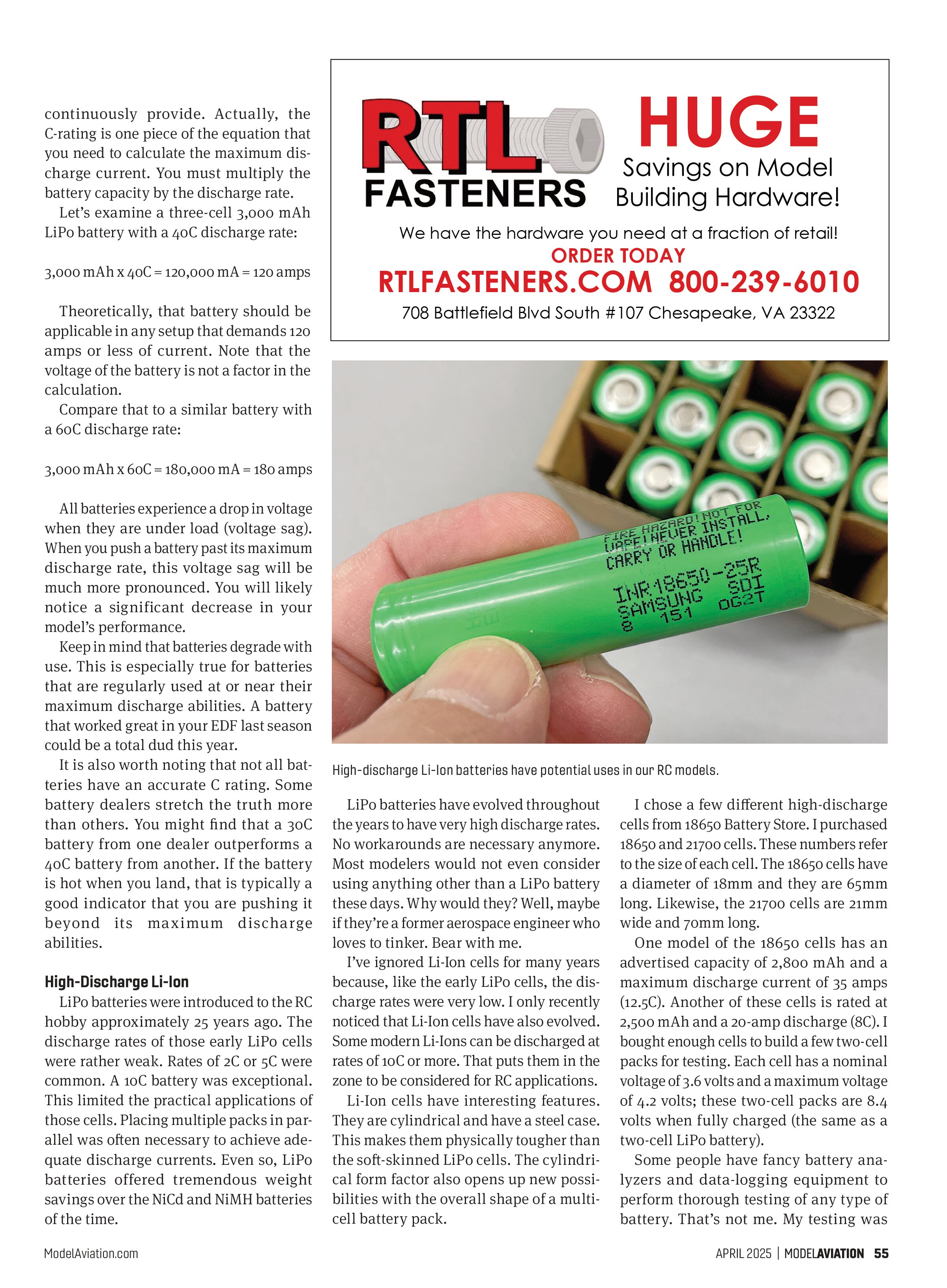
I’ve ignored Li-Ion cells for many years because, like the early LiPo cells, the discharge rates were very low. I only recently noticed that Li-Ion cells have also evolved. Some modern Li-Ions can be discharged at rates of 10C or more. That puts them in the zone to be considered for RC applications.
Li-Ion cells have interesting features. They are cylindrical and have a steel case. This makes them physically tougher than the soft-skinned LiPo cells. The cylindrical form factor also opens up new possibilities with the overall shape of a multicell battery pack.
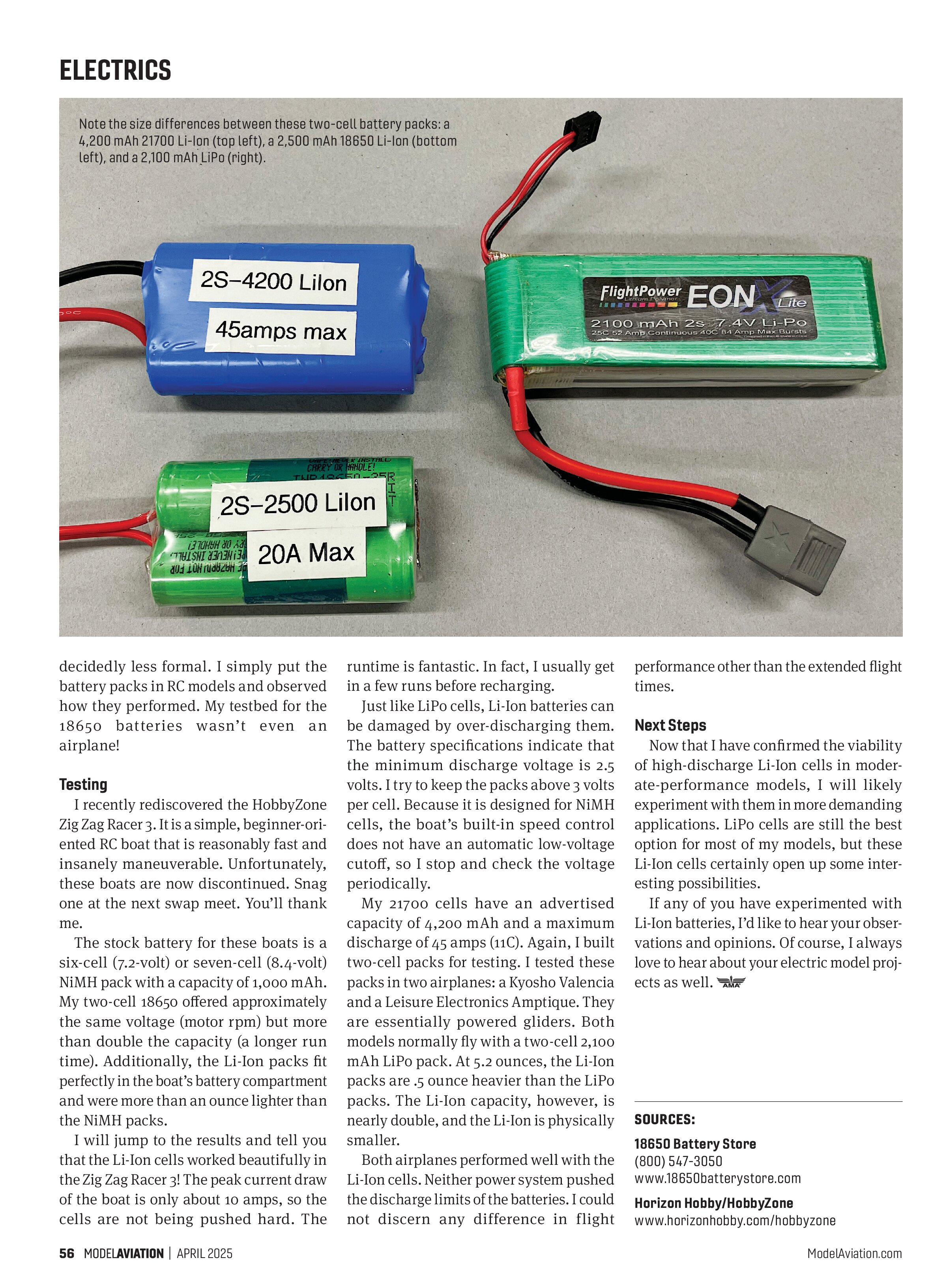
I chose a few different high-discharge cells from 18650 Battery Store. I purchased 18650 and 21700 cells. These numbers refer to the size of each cell. The 18650 cells have a diameter of 18mm and they are 65mm long. Likewise, the 21700 cells are 21mm wide and 70mm long.
One model of the 18650 cells has an advertised capacity of 2,800 mAh and a maximum discharge current of 35 amps (12.5C). Another of these cells is rated at 2,500 mAh and a 20-amp discharge (8C). I bought enough cells to build a few two-cell packs for testing. Each cell has a nominal voltage of 3.6 volts and a maximum voltage of 4.2 volts; these two-cell packs are 8.4 volts when fully charged (the same as a two-cell LiPo battery).
Some people have fancy battery analyzers and data-logging equipment to perform thorough testing of any type of battery. That’s not me. My testing was

Testing
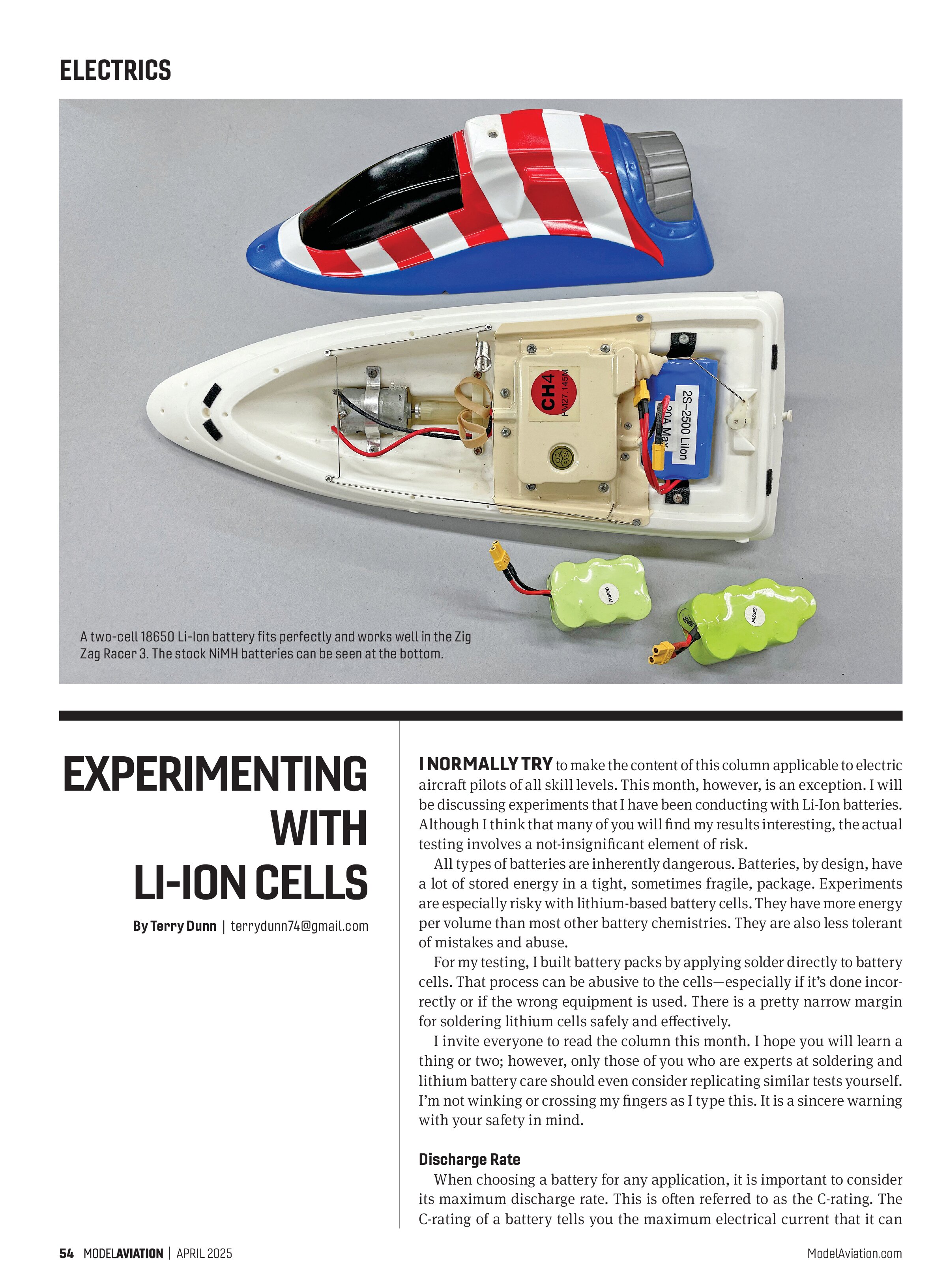
I recently rediscovered the HobbyZone Zig Zag Racer 3. It is a simple, beginner-oriented RC boat that is reasonably fast and insanely maneuverable. Unfortunately, these boats are now discontinued. Snag one at the next swap meet. You’ll thank me.
The stock battery for these boats is a six-cell (7.2-volt) or seven-cell (8.4-volt) NiMH pack with a capacity of 1,000 mAh. My two-cell 18650 offered approximately the same voltage (motor rpm) but more than double the capacity (a longer run time). Additionally, the Li-Ion packs fit perfectly in the boat’s battery compartment and were more than an ounce lighter than the NiMH packs.
I will jump to the results and tell you that the Li-Ion cells worked beautifully in the Zig Zag Racer 3! The peak current draw of the boat is only about 10 amps, so the cells are not being pushed hard. The runtime is fantastic. In fact, I usually get in a few runs before recharging.
Just like LiPo cells, Li-Ion batteries can be damaged by over-discharging them. The battery specifications indicate that the minimum discharge voltage is 2.5 volts. I try to keep the packs above 3 volts per cell. Because it is designed for NiMH cells, the boat’s built-in speed control does not have an automatic low-voltage cutoff, so I stop and check the voltage periodically.
My 21700 cells have an advertised capacity of 4,200 mAh and a maximum discharge of 45 amps (11C). Again, I built two-cell packs for testing. I tested these packs in two airplanes: a Kyosho Valencia and a Leisure Electronics Amptique. They are essentially powered gliders. Both models normally fly with a two-cell 2,100 mAh LiPo pack. At 5.2 ounces, the Li-Ion packs are .5 ounce heavier than the LiPo packs. The Li-Ion capacity, however, is nearly double, and the Li-Ion is physically smaller.
Both airplanes performed well with the Li-Ion cells. Neither power system pushed the discharge limits of the batteries. I could not discern any difference in flight performance other than the extended flight times.
Next Steps
Now that I have confirmed the viability of high-discharge Li-Ion cells in moderate-performance models, I will likely experiment with them in more demanding applications. LiPo cells are still the best option for most of my models, but these Li-Ion cells certainly open up some interesting possibilities.
If any of you have experimented with Li-Ion batteries, I’d like to hear your observations and opinions. Of course, I always love to hear about your electric model projects as well.

SOURCES:
18650 Battery Store
(800) 547-3050
www.18650batterystore.com
Horizon Hobby/HobbyZone
www.horizonhobby.com/hobbyzone