Carden Aircraft
A company dedicated to the sport of Giant Scale Aerobatics
By Ed Rogala
erogala2@comcast.net
Photos by the author

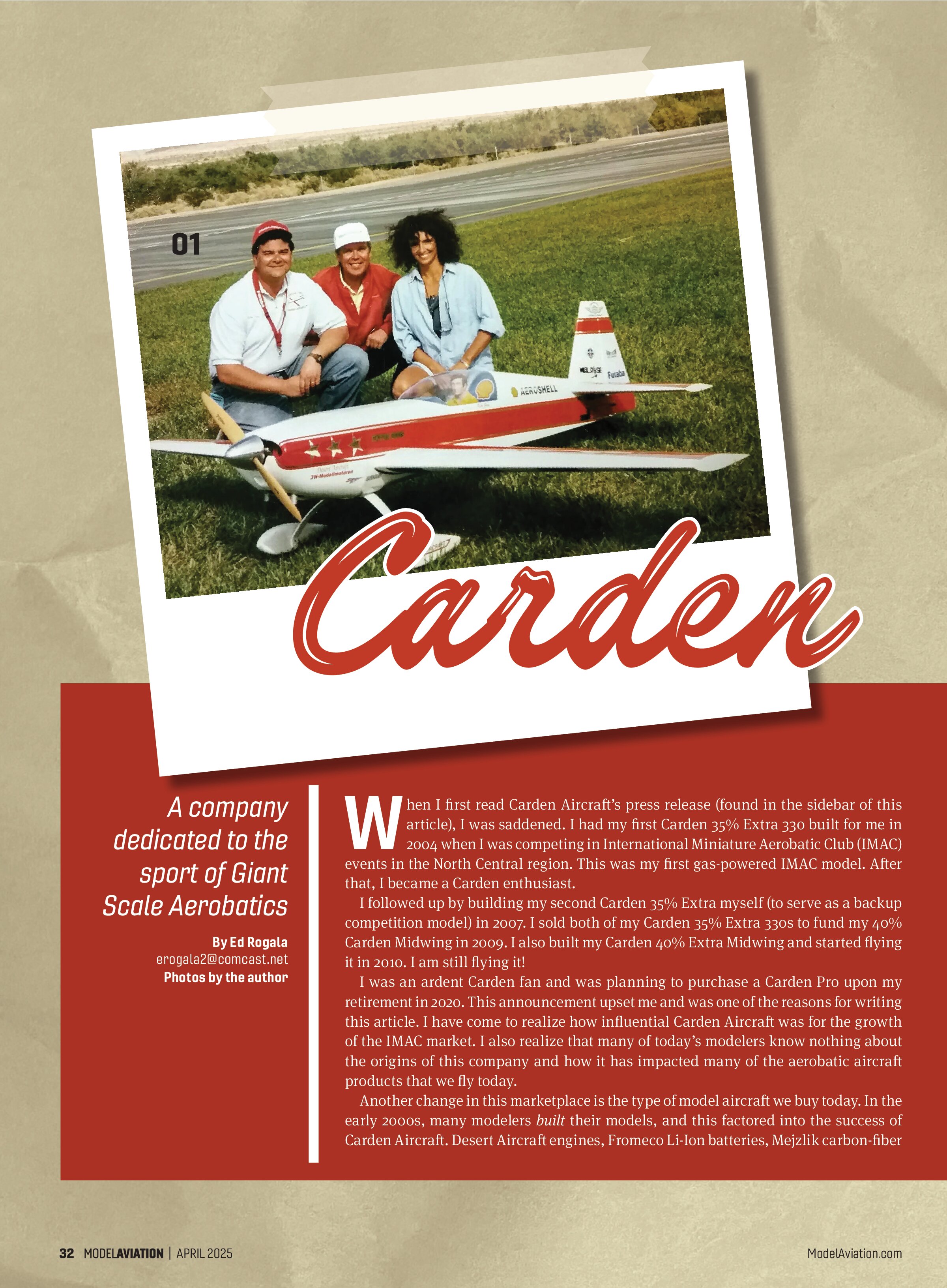
When I first read Carden Aircraft’s press release (found in the sidebar of this article), I was saddened. I had my first Carden 35% Extra 330 built for me in 2004 when I was competing in International Miniature Aerobatic Club (IMAC) events in the North Central region. This was my first gas-powered IMAC model. After that, I became a Carden enthusiast.
I followed up by building my second Carden 35% Extra myself (to serve as a backup competition model) in 2007. I sold both of my Carden 35% Extra 330s to fund my 40% Carden Midwing in 2009. I also built my Carden 40% Extra Midwing and started flying it in 2010. I am still flying it!
I was an ardent Carden fan and was planning to purchase a Carden Pro upon my retirement in 2020. This announcement upset me and was one of the reasons for writing this article. I have come to realize how influential Carden Aircraft was for the growth of the IMAC market. I also realize that many of today’s modelers know nothing about the origins of this company and how it has impacted many of the aerobatic aircraft products that we fly today.
Another change in this marketplace is the type of model aircraft we buy today. In the early 2000s, many modelers built their models, and this factored into the success of Carden Aircraft. Desert Aircraft engines, Fromeco Li-Ion batteries, Mejzlik carbon-fiber propellers, Tru-Turn spinners, and canister exhaust systems were all by-products of the surge of interest in Giant Scale aerobatic kits driven by Carden Aircraft. This was certainly the “Golden Age” for IMAC and I am sure IMAC’s membership numbers from this era will support this statement.
So, what is Carden Aircraft, and how did this independent kit manufacturer become known worldwide for its designs and high-quality kits?
Part One: Origin of Carden Aircraft
After a successful career in the media business, Dennis and Caroline Gergits chose early retirement at age 40 and decided to enter the model airplane kit business. They developed several different sizes and model designs before taking a look at the then-new Giant Scale aerobatic kit market. Here is the story in Dennis’ words:


“At one fly-in, a flying buddy asked me to wiggle the sticks of his Giant Scale Hots with a Quadra gas engine for power. Immediately, I was hooked on big birds and knew that Giant Scale airplanes were for me. I also believed that the Giant Scale kit market had huge growth potential!
“Over the first three years attending flying events, I’d become friends with Bob Godfrey and Don Lowe. In 1992, Bob invited me to spend the day with him at his home shop and showed me how he made his Giant Scale kits and ARCs [almost-ready-to-cover models]. Precision Aviation Design airplanes were among the best IMAC and TOC [Tournament of Champions] choices available.
“I mentioned to Bob that I wanted to design and market a Giant Scale aerobatic airplane but didn’t have the knowledge to make fiberglass cowlings. He suggested that I could use his 1/3-scale Laser cowling as long as I didn’t kit a Laser. I agreed, and Bob set me up to buy the cowlings direct from his supplier.
“My interest was in designing a model of the new full-scale Extra 300S that I saw on the cover of the November 1992 issue of Private Pilot magazine. This would become the second design I would kit as a Giant Scale model.
“The Giant Scale plane I would kit first would be a learning opportunity to build a fuselage and tail group structure with double-tapered, solid foam-core wing panels, hatch, and turtledeck that would be capable of handling the larger flight loads of a giant aerobat.
“I was familiar with the evolution history of the full-scale Laser. I made a call to Bobby Budde in Hollister, California. He was the current owner and raced the 100 hp Formula One Pylon Race, El Bandito. Bobby told me that when he bought this bird, it was named the Frenzel Special, but he changed the name to El Bandito after the Frito Bandito TV commercial.
“This mid-wing Pylon racer design had been used as the basic design configuration concept for the Stevens Acro aerobatic plane that evolved into the Laser. After this phone call, I decided to design a way-

far-off ‘squint scale’ aerobatic El Bandito, using Bob’s Laser cowling and a Lance RV3 Giant Scale canopy.
“I used fuselage and tail construction similar to the Wayne Ulery-designed Laser that Bob was kitting. This would also be the type of truss fuselage structure that would work well on a Giant Scale Extra 300S. I planned to design this second Giant Scale kit to be smaller than Bob’s 37% Extra so I wouldn’t compromise his kindness and compete for the same customers. I hoped I could sell my El Bandito customers a 30% Extra 300S as their second Carden Giant.
“I designed El Bandito’s symmetrical root airfoil to have the center of lift slightly aft of those currently being used on Giant models. I purposely sized it so

that the same foam-cutting phenolic template could be used to cut the future 30% Extra 300S’ wing core. I designed and built the equipment needed to cut the wing cores, hatch, and turtledeck. I built the prototype El Bandito in 2002, using a Walker Machine-Sachs 4.2 engine for power.
“It turned out to be more powerful than I needed, but it flew quite well. I passed the transmitter around to numerous pilots at the field. After taking deposits on a few kits yet to be produced, I knew I was on the right track. A magazine ad was placed that led to the first phone order. To my surprise, the call was from Bill Bennett’s secretary. He was a modeler and part owner of Circus Circus—the man behind the TOCs in Las Vegas!
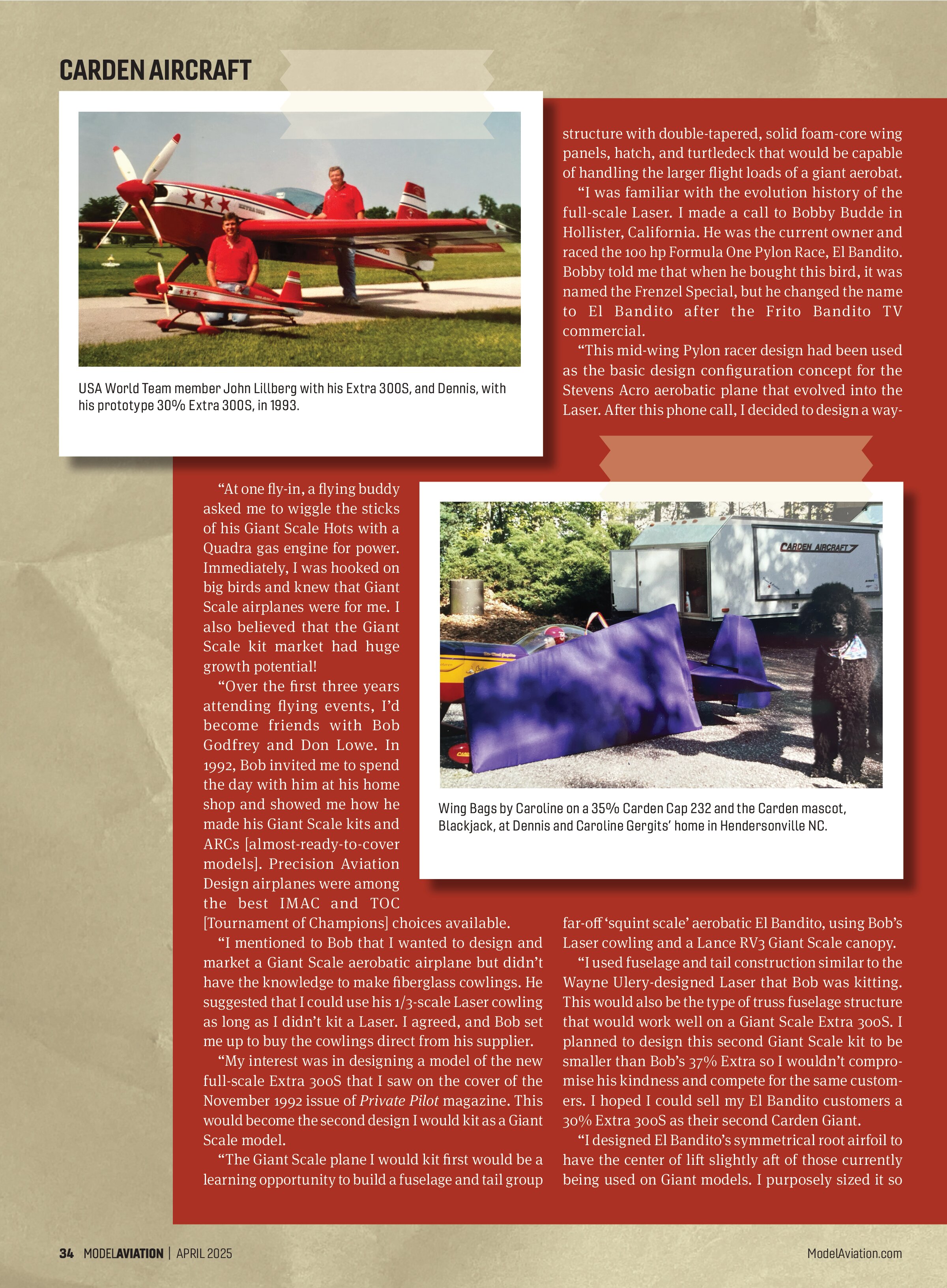
“Prior to designing the prototype 30% Extra 300S in early 1993, I called U.S. Aerobatics team member John Lillberg, who competed with his Extra 300S. I met with John and took detailed pictures and measurements of his plane. He also gave me a 300S three-view to help with the design process of my model. I proceeded to design and draw the plans for a 30% Extra 300S. After hand-carving a cowling, wheel pants, and canopy plug, I found a supplier to make an epoxy fiberglass cowling and wheel pants set, and another supplier to make the canopy.
“At that point, I made the templates for the foam-core turtledeck, hatch, tail feathers, and wood parts. I used the same wing template and tube cavity jig that had worked so well for El Bandito. The prototype kit was complete, so I built the model using a Zenoah G-62 for power.
“After adding film covering and painting, it looked quite similar to John’s Extra 300S! The icing on the cake was that the model flew well. The kit was put into production in late 1993 and sales were excellent.
“Growing a loyal customer base to build more of my kit offerings was a concept I knew would work. I continued to fly and promote the Extra in tandem with the ad campaign. I started to compete in a few IMAC contests in the area.
“More 30% kits were sold, but I kept hearing that most people wanted a larger Extra 300S. I knew that the IMAC market, as well as the sport market, was limited in Giant Scale aerobatic builder kits. To expand sales, create customer evolution in terms of model size, and increase brand loyalty, I needed to kit multiple sizes of each successful design.
“In 1994, I designed and built the prototype for a 35%-scale Extra 300S, powered by a Walker Machine-Sachs 5.8 engine. This model flew great! Caroline and I drove it to Las Vegas and set up a booth at the QSAA [Quarter-Scale Airplane Association], south of where the TOC was to be held a couple of weeks later.
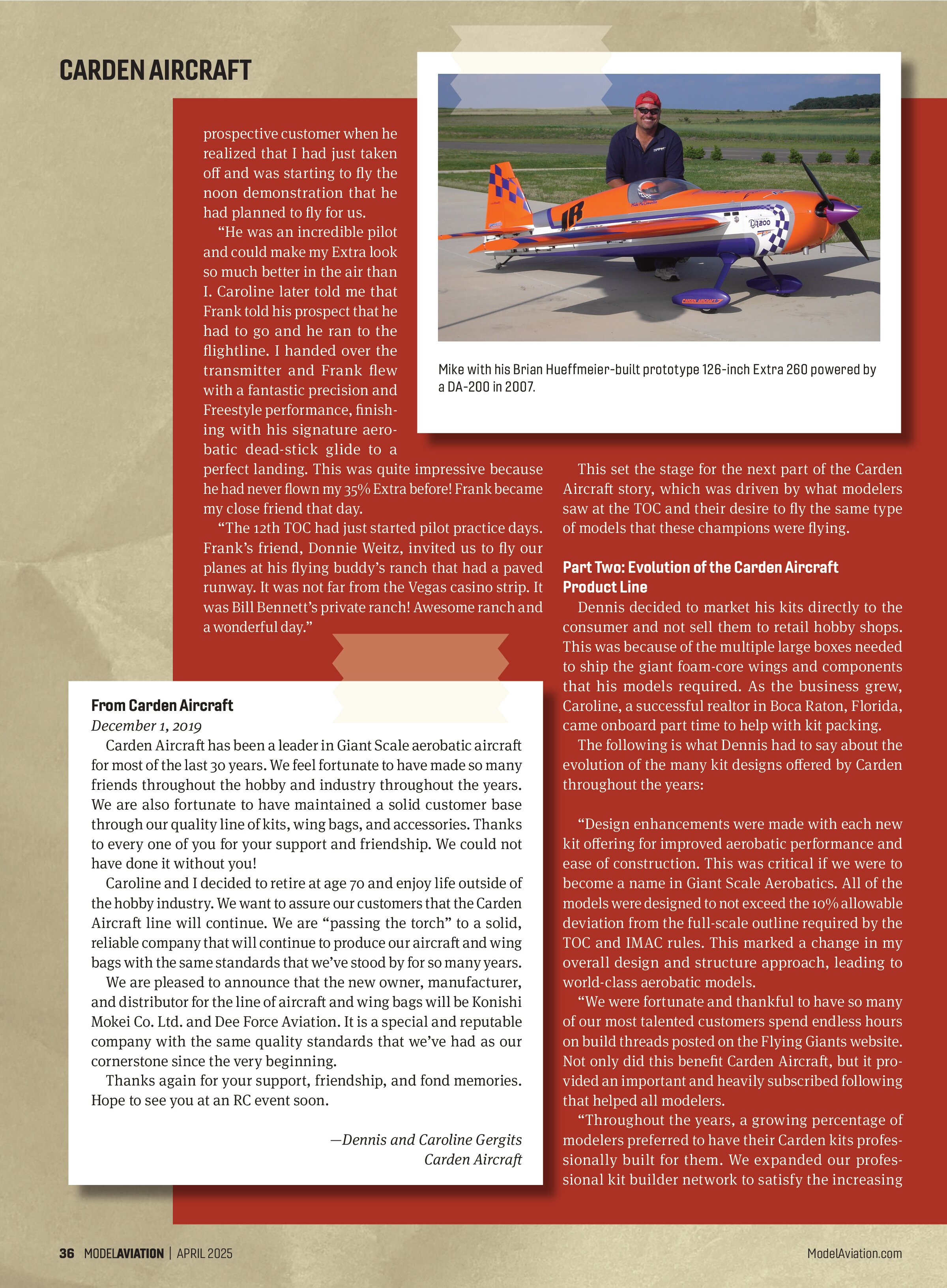
“Frank Noll was there with his Christen Eagle that he was kitting. We put our table displays next to each other. On the first day, Frank was talking to a

prospective customer when he realized that I had just taken off and was starting to fly the noon demonstration that he had planned to fly for us.
“He was an incredible pilot and could make my Extra look so much better in the air than I. Caroline later told me that Frank told his prospect that he had to go and he ran to the flightline. I handed over the transmitter and Frank flew with a fantastic precision and Freestyle performance, finishing with his signature aerobatic dead-stick glide to a perfect landing. This was quite impressive because he had never flown my 35% Extra before! Frank became my close friend that day.
“The 12th TOC had just started pilot practice days. Frank’s friend, Donnie Weitz, invited us to fly our planes at his flying buddy’s ranch that had a paved runway. It was not far from the Vegas casino strip. It was Bill Bennett’s private ranch! Awesome ranch and a wonderful day.”

This set the stage for the next part of the Carden Aircraft story, which was driven by what modelers saw at the TOC and their desire to fly the same type of models that these champions were flying.
Part Two: Evolution of the Carden Aircraft Product Line
Dennis decided to market his kits directly to the consumer and not sell them to retail hobby shops. This was because of the multiple large boxes needed to ship the giant foam-core wings and components that his models required. As the business grew, Caroline, a successful realtor in Boca Raton, Florida, came onboard part time to help with kit packing.
The following is what Dennis had to say about the evolution of the many kit designs offered by Carden throughout the years:
“Design enhancements were made with each new kit offering for improved aerobatic performance and ease of construction. This was critical if we were to become a name in Giant Scale Aerobatics. All of the models were designed to not exceed the 10% allowable deviation from the full-scale outline required by the TOC and IMAC rules. This marked a change in my overall design and structure approach, leading to world-class aerobatic models.
“We were fortunate and thankful to have so many of our most talented customers spend endless hours on build threads posted on the Flying Giants website. Not only did this benefit Carden Aircraft, but it provided an important and heavily subscribed following that helped all modelers.
“Throughout the years, a growing percentage of modelers preferred to have their Carden kits professionally built for them. We expanded our professional kit builder network to satisfy the increasing demand from this part of the market. During the 30 years of owning Carden, we had more than 60 builders spread out geographically across the US and some in Canada, Mexico, and Japan. This allowed us to recommend a builder close enough for a customer to drive and pick up their professionally built Carden Giant Scale model. Our talented builders were a key part of Carden’s success throughout the years.
“In early 1996, Caroline left her real estate career and became a full-time partner in our growing business. We put our home up for sale and rented a larger shop in Hendersonville, North Carolina, which was only a one-day drive to the Toledo Show, the JR Challenge, The Dayton DOGS [Dayton Ohio Giant Scalers] Air Show, Joe Nall, and many other events.
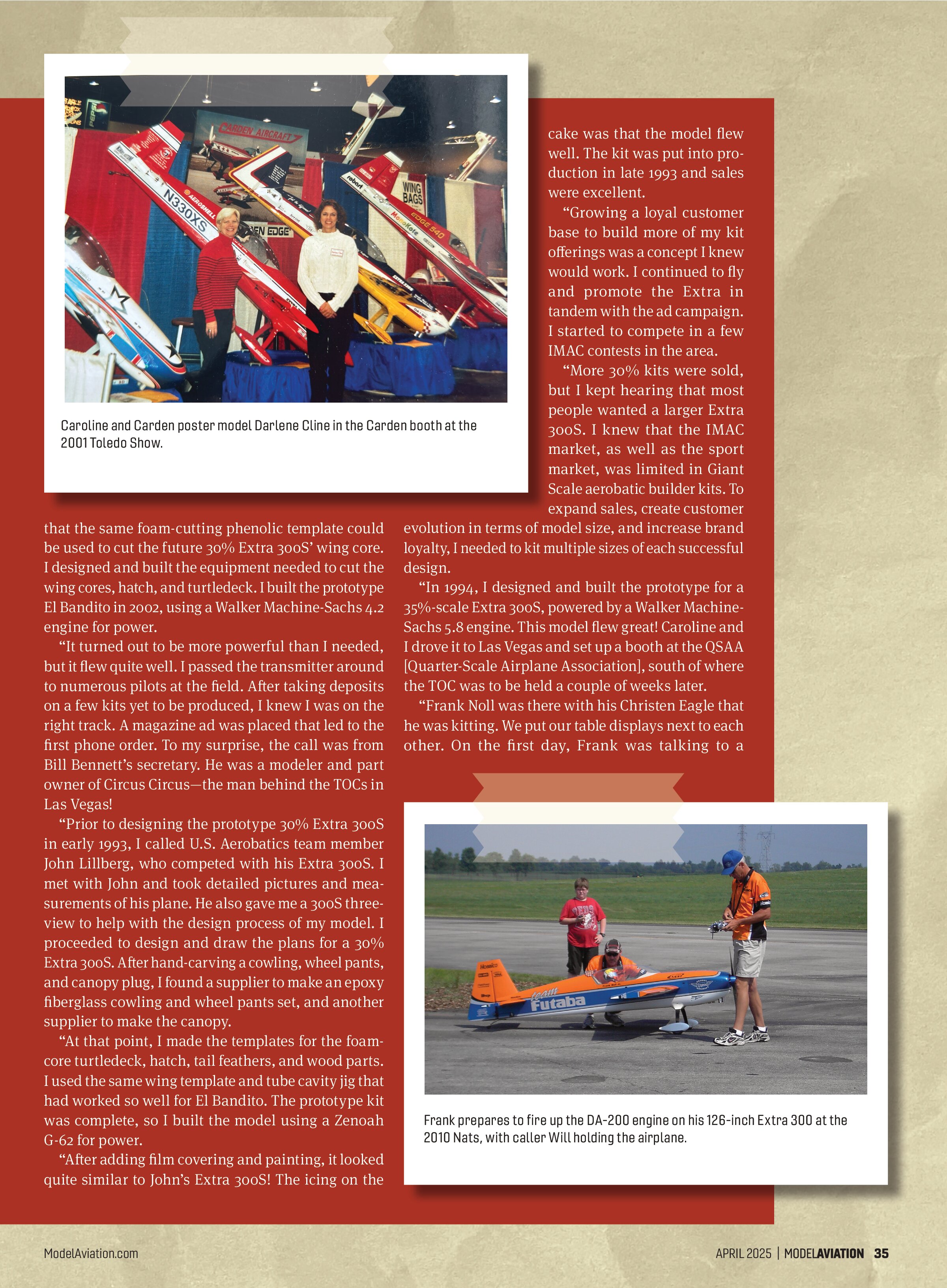
“We purchased a used industrial sewing machine that could sew thick, three-ply, padded wing bags, and bought a used industrial binding machine to properly finish the bags. These wing bags could store and transport large wing panels. We opened Wing Bags by Caroline and our products were met with great enthusiasm and excellent sales. This became a successful business that complemented the Carden kit line and increased overall profit.
“Wing Bags by Caroline eventually added stabilizer bags, rudder covers, propeller covers, propeller storage bags, custom work, canopy helmets, airplane covers, pilots, tail wheels, hardware packages, and instrument panels to the growing line of products.
“Many more Giant Scale aerobatic kits were introduced, sales boomed, and profits soared. After a few years, we needed a larger shop.”
At this stage of the story, Carden Aircraft enjoyed the reputation of producing the finest aerobatic wood airplane model kits that modelers could buy. Several competitors entered the market, but none would surpass Carden Aircraft’s reputation!
Part Three: Expansion and Growth of Carden Aircraft
As a result of this explosive growth in Giant Scale aircraft and products, as well as the growing interest in IMAC, Dennis and Caroline made the decision to expand their manufacturing operation. Here are Dennis’ remarks about this:
“In 2003, Carden Aircraft moved to Tellico Plains, Tennessee. We had a 7,200-sq. ft., climate-controlled Morton Building ‘barndominium,’ built by Morton company crews. It was placed in the rear corner of a 23-acre hay farm property. We cut a model airplane grass runway in the middle of a 20-acre hay field to test prototypes and fly my RC designs.
“We sold products at our booth for 15 years at the Toledo Show. During these years, we had multiple airplanes on display and most of them were built by customers who had become good friends. They brought their Cardens to Toledo, specifically to display in the Carden Aircraft booth and help by talking to the crowds that stopped by the booth. A large part of our success was a direct result of our Toledo crew.”

Part Four: The TOC Years
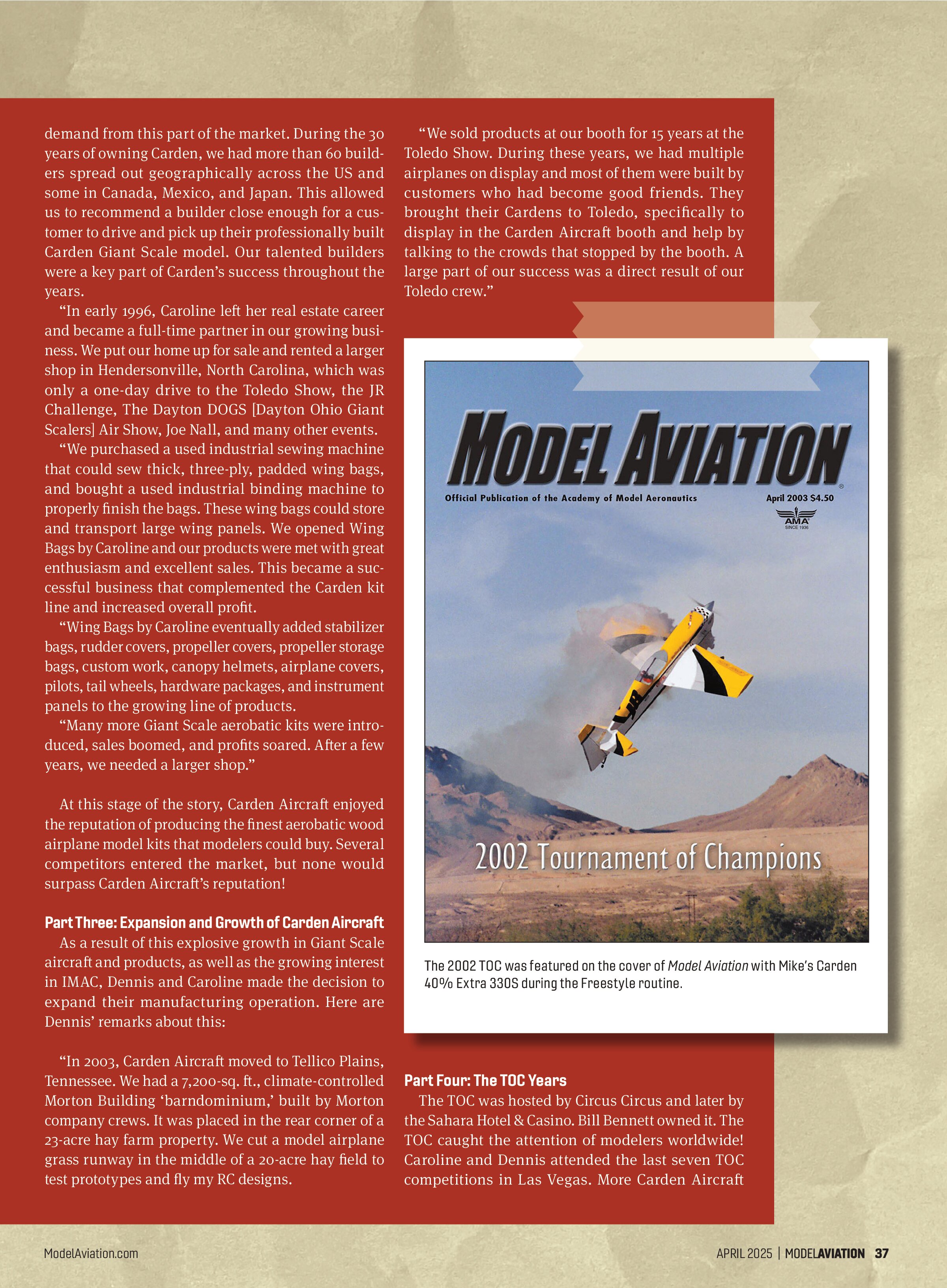
The TOC was hosted by Circus Circus and later by the Sahara Hotel & Casino. Bill Bennett owned it. The TOC caught the attention of modelers worldwide! Caroline and Dennis attended the last seven TOC competitions in Las Vegas. More Carden Aircraft
From Carden Aircraft
December 1, 2019
Carden Aircraft has been a leader in Giant Scale aerobatic aircraft for most of the last 30 years. We feel fortunate to have made so many friends throughout the hobby and industry throughout the years. We are also fortunate to have maintained a solid customer base through our quality line of kits, wing bags, and accessories. Thanks to every one of you for your support and friendship. We could not have done it without you!
Caroline and I decided to retire at age 70 and enjoy life outside of the hobby industry. We want to assure our customers that the Carden Aircraft line will continue. We are “passing the torch” to a solid, reliable company that will continue to produce our aircraft and wing bags with the same standards that we’ve stood by for so many years.
We are pleased to announce that the new owner, manufacturer, and distributor for the line of aircraft and wing bags will be Konishi Mokei Co. Ltd. and Dee Force Aviation. It is a special and reputable company with the same quality standards that we’ve had as our cornerstone since the very beginning.
Thanks again for your support, friendship, and fond memories. Hope to see you at an RC event soon.
—Dennis and Caroline Gergits
Carden Aircraft
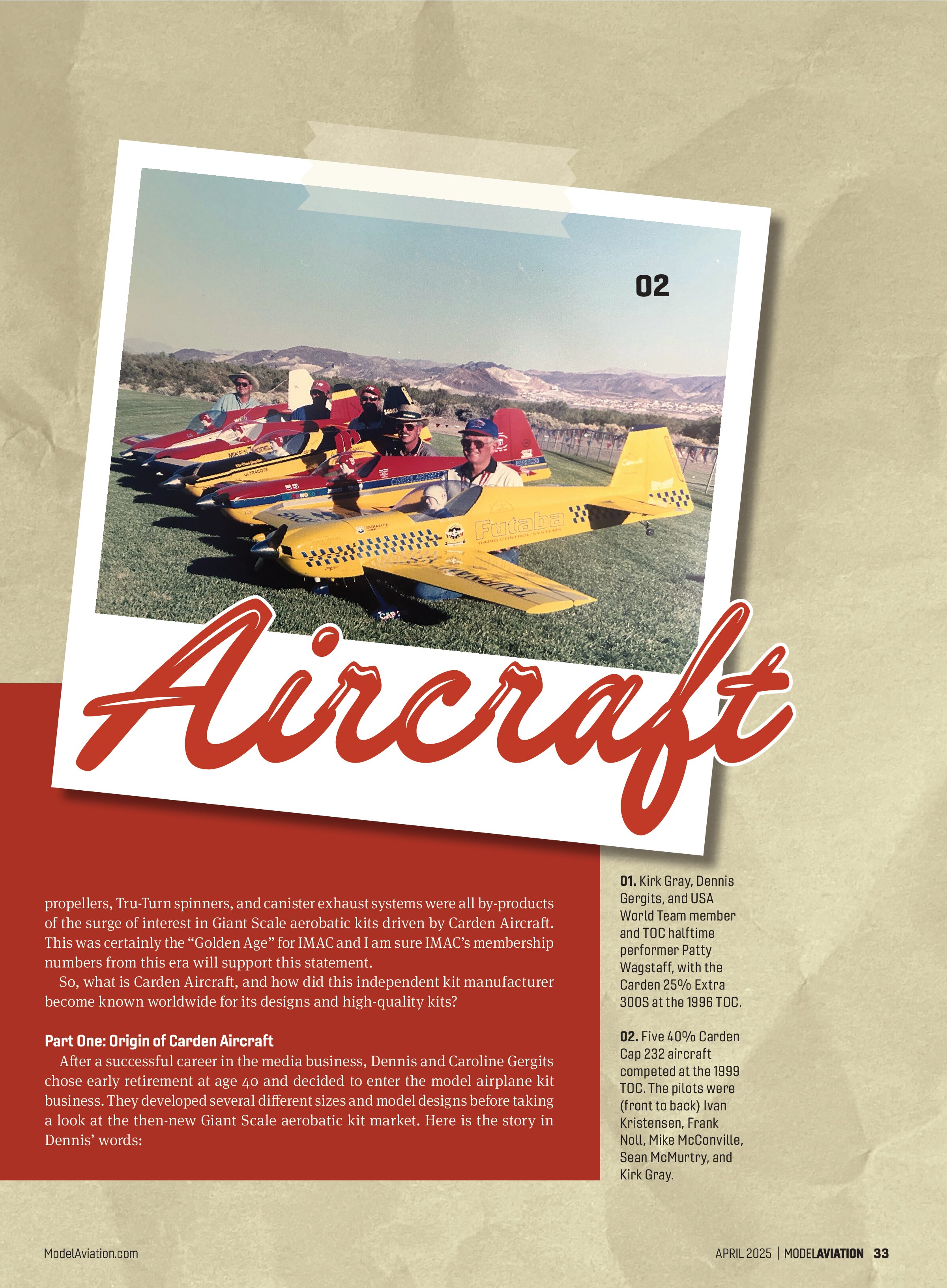
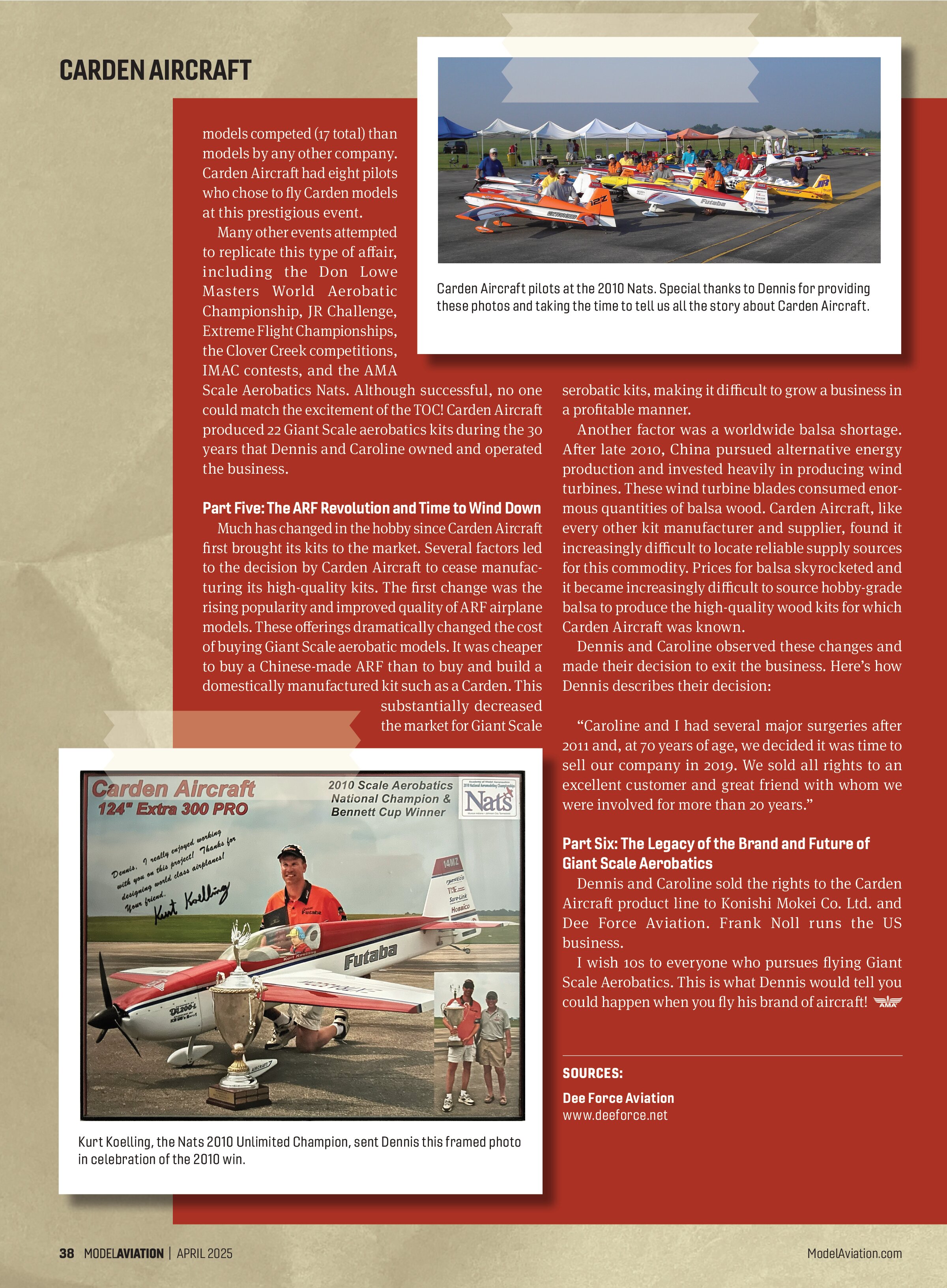
models competed (17 total) than models by any other company. Carden Aircraft had eight pilots who chose to fly Carden models at this prestigious event. Many other events attempted to replicate this type of affair, including the Don Lowe Masters World Aerobatic Championship, JR Challenge, Extreme Flight Championships, the Clover Creek competitions, IMAC contests, and the AMA Scale Aerobatics Nats. Although successful, no one could match the excitement of the TOC! Carden Aircraft produced 22 Giant Scale aerobatics kits during the 30 years that Dennis and Caroline owned and operated the business.

Part Five: The ARF Revolution and Time to Wind Down
Much has changed in the hobby since Carden Aircraft first brought its kits to the market. Several factors led to the decision by Carden Aircraft to cease manufacturing its high-quality kits. The first change was the rising popularity and improved quality of ARF airplane models. These offerings dramatically changed the cost of buying Giant Scale aerobatic models. It was cheaper to buy a Chinese-made ARF than to buy and build a domestically manufactured kit such as a Carden. This
substantially decreased the market for Giant Scale aerobatic kits, making it difficult to grow a business in a profitable manner.
Another factor was a worldwide balsa shortage. After late 2010, China pursued alternative energy production and invested heavily in producing wind turbines. These wind turbine blades consumed enormous quantities of balsa wood. Carden Aircraft, like every other kit manufacturer and supplier, found it increasingly difficult to locate reliable supply sources for this commodity. Prices for balsa skyrocketed and it became increasingly difficult to source hobby-grade balsa to produce the high-quality wood kits for which Carden Aircraft was known.
Dennis and Caroline observed these changes and made their decision to exit the business. Here’s how Dennis describes their decision:
“Caroline and I had several major surgeries after 2011 and, at 70 years of age, we decided it was time to sell our company in 2019. We sold all rights to an excellent customer and great friend with whom we were involved for more than 20 years.”
Part Six: The Legacy of the Brand and Future of Giant Scale Aerobatics
Dennis and Caroline sold the rights to the Carden Aircraft product line to Konishi Mokei Co. Ltd. and Dee Force Aviation. Frank Noll runs the US business.
I wish 10S to everyone who pursues flying Giant Scale Aerobatics. This is what Dennis would tell you could happen when you fly his brand of aircraft!

SOURCES:
Dee Force Aviation
www.deeforce.net