SAFETY COMES FIRST

SAD
SOLDERING
SAGA
By Dave Gee | safetycolumn@cs.com
READERS OFTEN SEND ME stories about safety situations from their hobby activities, but this time, I have one of my own. Count the many mistakes I made, and please avoid making them yourself!
My big, old office desk is loaded with character and makes a fine worktable. The task at hand was soldering a replacement switch into a circuit. The parts were small, and I hadn’t soldered in a long time. Hey, it’s like riding a bike, right?
A “third-hand” tool with three alligator clips was deployed to hold everything in place while I worked the soldering iron. I had a cradle to hold the iron when needed, to avoid burning the table. My magnifying, hands-free safety glasses headband was in place. Okay, plug ’er in!
Clean and tin the tip, arrange the solder, and, oops, the parts have shifted. Set the iron down and rearrange the wires again. Be careful not to damage the switch with too much heat. Say, those wires sure are small! Nope, that’s a lousy joint—try again. I used to be pretty good at this. What happened? Well, let’s scoot the chair closer to the table and make another try at this. Remove the old solder and ... now, what should I do with that big blob of liquid solder?
As I looked around for a safe place to put it, the hot blob saw a chance to escape from the iron’s tip. Off it fell, missing the table and heading for my leg. I was wearing gym shorts, which turned out to be a poor fashion choice. The hot, molten solder blob landed on the bare skin of my leg.
A wisp of smoke and the smell of barbecue—as well as the severe burning sensation—tipped me off that something was amiss. Both hands were full of hot, dangerous soldering tools, and it seemed to take a long, painful time to get things safely put in their place. By then, the damage was done, and I had a spiffy second-degree burn, as well as strained vocal cords from yelping in pain.
Let’s list my errors, shall we?
- Poor preparation of the work area. This was a basic goof. There was no place to dump excess drips of hot solder. I figured that I’d ace the job on the first try, which was not how it went.
- Inadequate personal protective equipment (PPE). Sure, I was wearing eye protection, but a pair of jeans would have been mighty handy PPE for this task.
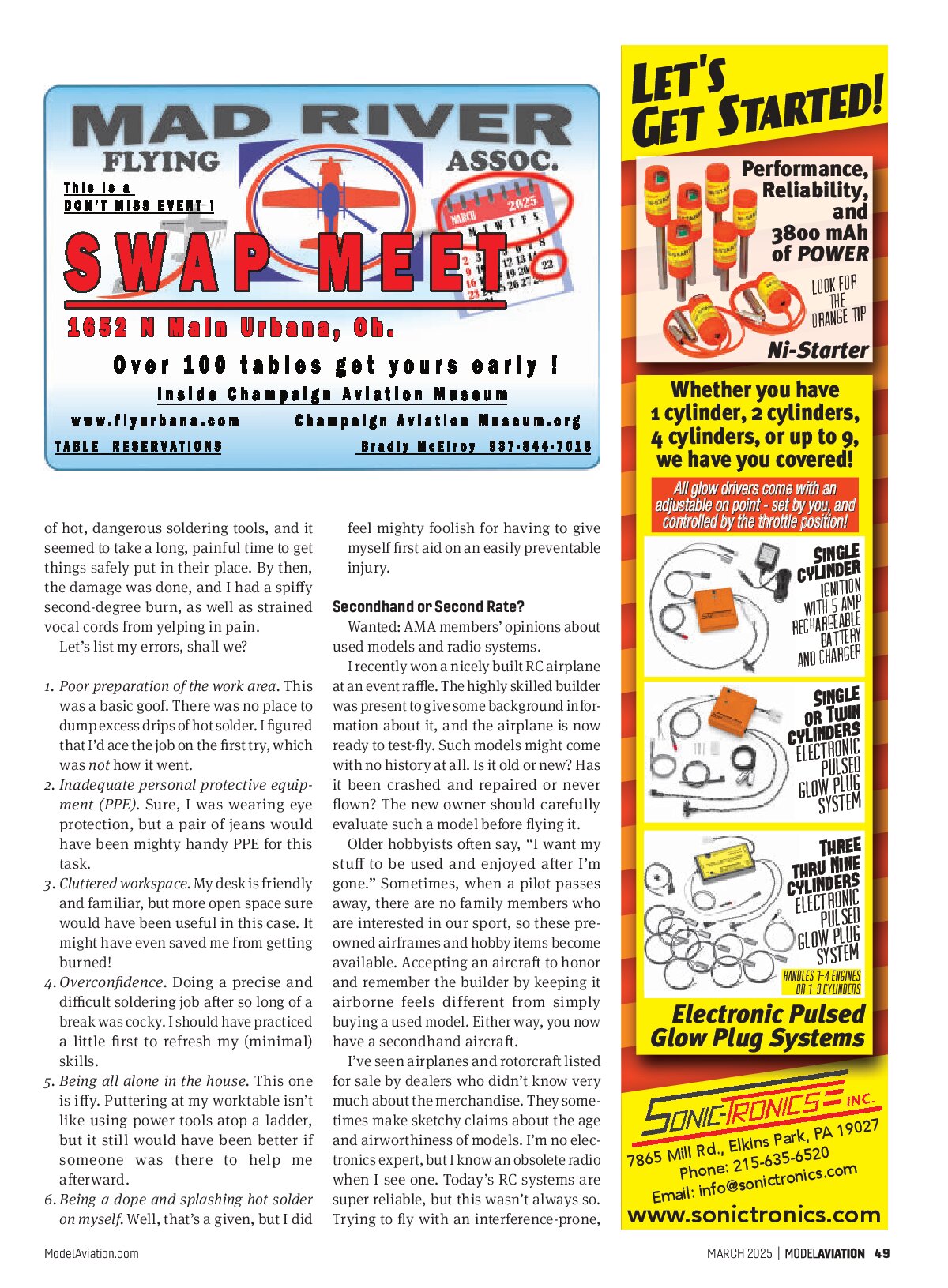
- Cluttered workspace. My desk is friendly and familiar, but more open space sure would have been useful in this case. It might have even saved me from getting burned!
- Overconfidence. Doing a precise and difficult soldering job after so long of a break was cocky. I should have practiced a little first to refresh my (minimal) skills.
- Being all alone in the house. This one is iffy. Puttering at my worktable isn’t like using power tools atop a ladder, but it still would have been better if someone was there to help me afterward.
- Being a dope and splashing hot solder on myself. Well, that’s a given, but I did feel mighty foolish for having to give myself first aid on an easily preventable injury.
Secondhand or Second Rate?
Wanted: AMA members’ opinions about used models and radio systems.
I recently won a nicely built RC airplane at an event raffle. The highly skilled builder was present to give some background information about it, and the airplane is now ready to test-fly. Such models might come with no history at all. Is it old or new? Has it been crashed and repaired or never flown? The new owner should carefully evaluate such a model before flying it.
Older hobbyists often say, “I want my stuff to be used and enjoyed after I’m gone.” Sometimes, when a pilot passes away, there are no family members who are interested in our sport, so these pre-owned airframes and hobby items become available. Accepting an aircraft to honor and remember the builder by keeping it airborne feels different from simply buying a used model. Either way, you now have a secondhand aircraft.
I’ve seen airplanes and rotorcraft listed for sale by dealers who didn’t know very much about the merchandise. They sometimes make sketchy claims about the age and airworthiness of models. I’m no electronics expert, but I know an obsolete radio when I see one. Today’s RC systems are super reliable, but this wasn’t always so. Trying to fly with an interference-prone,


outdated RC system could lead to serious trouble!
What precautions should be taken with used models? Do you have any special airframe inspection tips? I’ve seen glue joints in older models hold up well throughout the years and others that separated at critical locations. Can an older or obsolete RC system be swapped out if the airframe is still sound? How do servos tolerate not being used for long periods of time?
Old covering material might detach or refuse to come loose when you want to re-cover the wing. A gas-powered model will likely have fuel residue soaked into the engine compartment. How does this affect an electric-power conversion?
Please share the lessons you’ve learned about reactivating hand-me-down items. The results will be printed here for the benefit of all.
Mystery Airplane ... Fragment
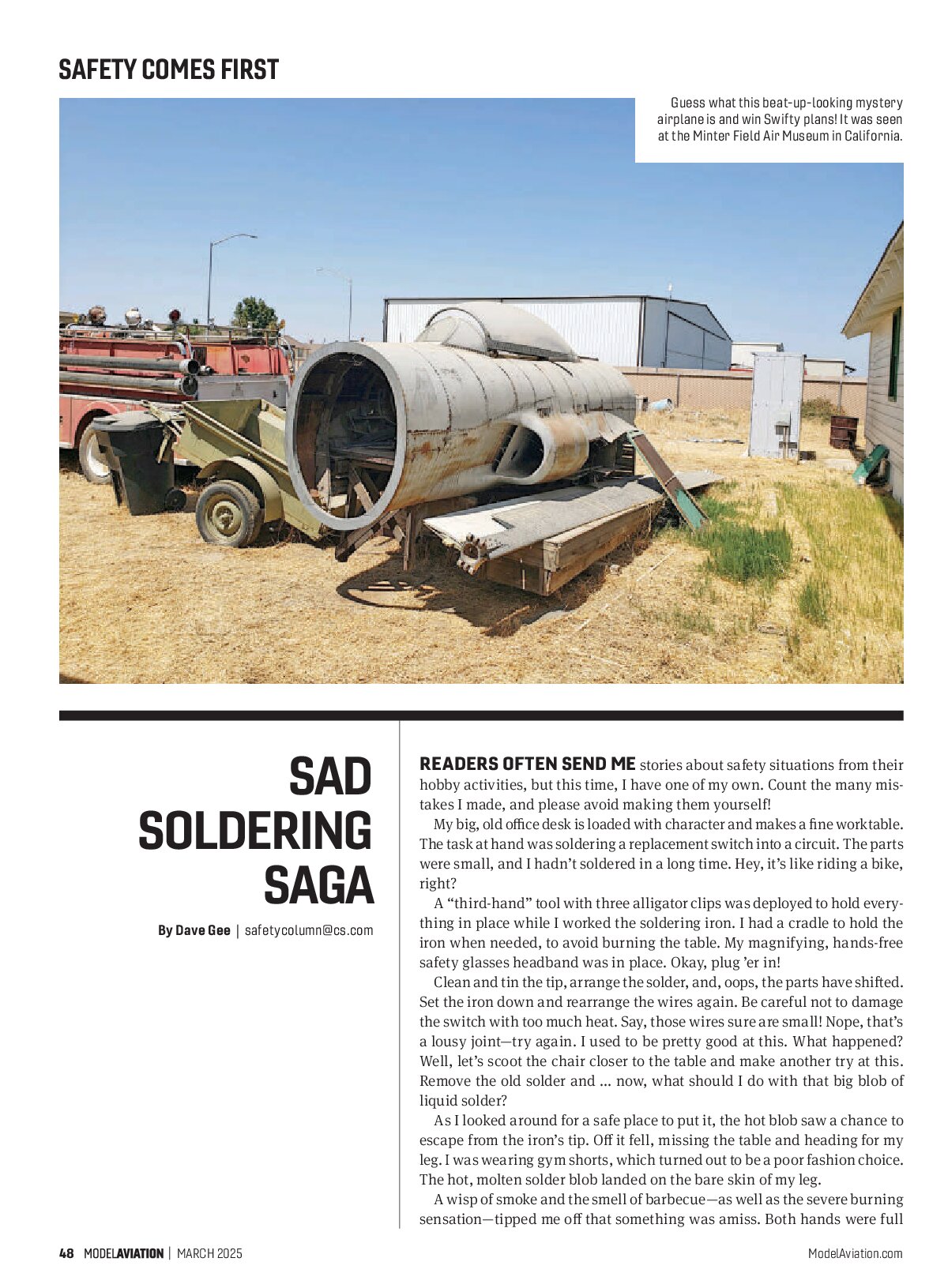
So, it’s not a whole airplane this time, but some readers say that these puzzles are getting too easy. The canopy and air intake alone are distinctive enough to identify it.
The beat-up fuselage in the photograph was once a famous pioneering jet that was used around the world in combat and as a trainer. I visited the excellent Minter Field Air Museum in Shafter, California, and sneaked out the back door to snap a photo of this airframe. It had been modified years ago for use as a movie prop and was finally semi-abandoned in the weeds.
Use my email address at the beginning of this column to take a guess as to the name or designation of it. Win or lose, you’ll receive digital plans for a swell model.
Ever Heard of a Swifty?
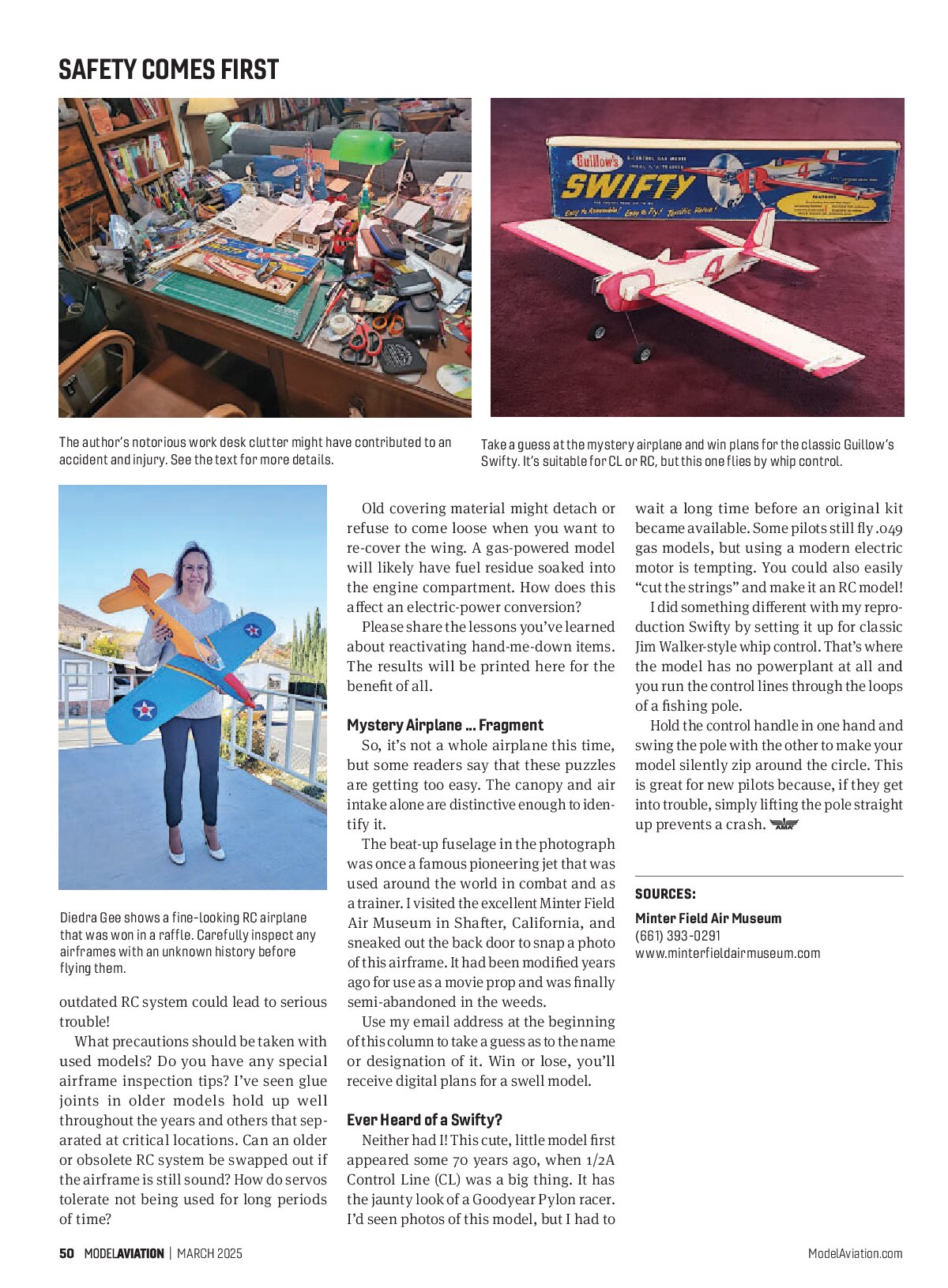
Neither had I! This cute, little model first appeared some 70 years ago, when 1/2A Control Line (CL) was a big thing. It has the jaunty look of a Goodyear Pylon racer. I’d seen photos of this model, but I had to wait a long time before an original kit became available. Some pilots still fly .049 gas models, but using a modern electric motor is tempting. You could also easily “cut the strings” and make it an RC model!
I did something different with my reproduction Swifty by setting it up for classic Jim Walker-style whip control. That’s where the model has no powerplant at all and you run the control lines through the loops of a fishing pole.
Hold the control handle in one hand and swing the pole with the other to make your model silently zip around the circle. This is great for new pilots because, if they get into trouble, simply letting the pole straight up prevents a crash.
SOURCES:
Minter Field Air Museum
(661) 393-0291
www.minterfieldairmuseum.com