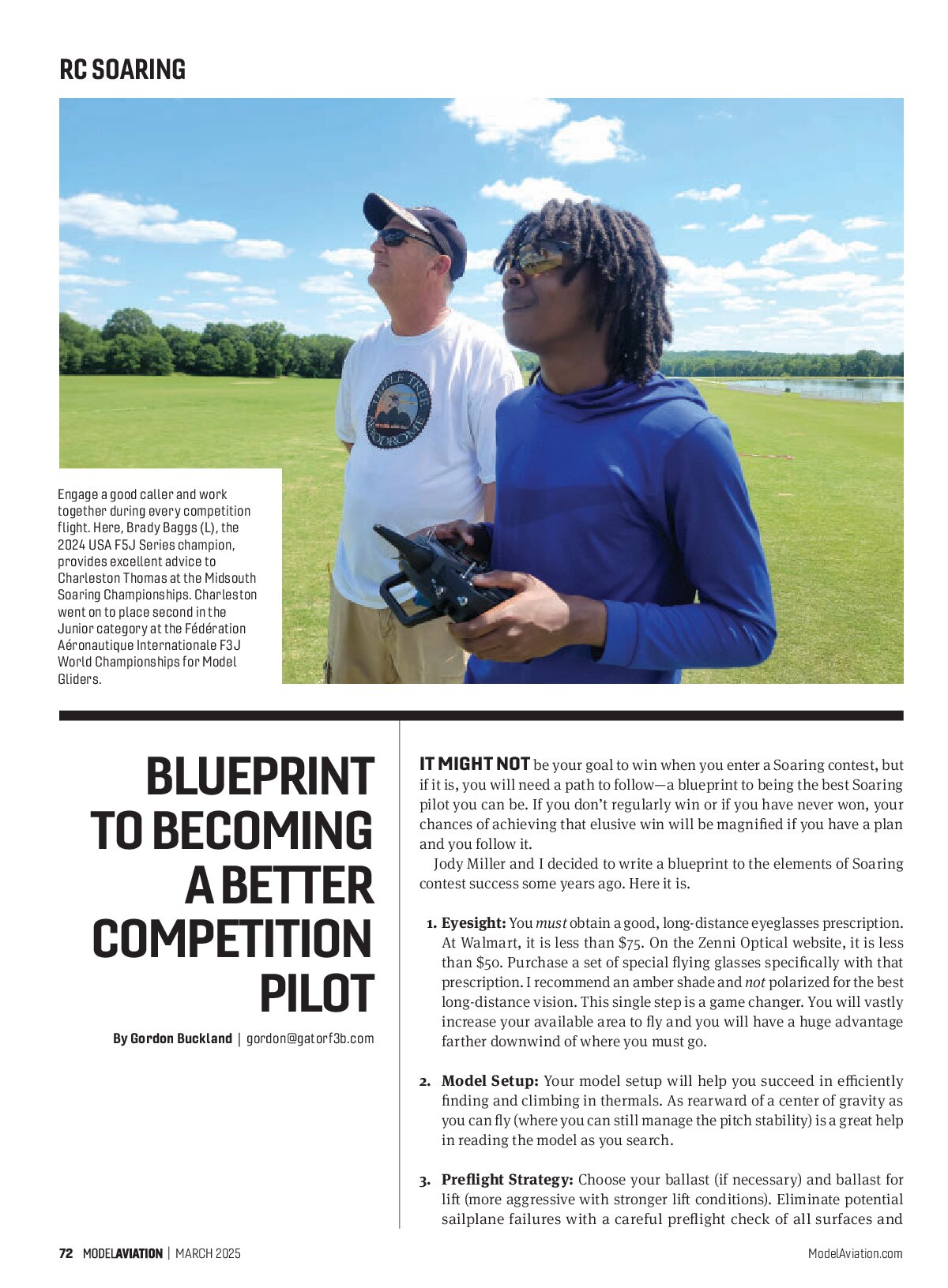
RC SOARING
BLUEPRINT
TO BECOMING
A BETTER
COMPETITION
PILOT
By Gordon Buckland | gordon@gatorf3b.com

IT MIGHT NOT be your goal to win when you enter a Soaring contest, but if it is, you will need a path to follow—a blueprint to being the best Soaring pilot you can be. If you don’t regularly win or if you have never won, your chances of achieving that elusive win will be magnified if you have a plan and you follow it.
Jody Miller and I decided to write a blueprint to the elements of Soaring contest success some years ago. Here it is.
1. Eyesight: You must obtain a good, long-distance eyeglasses prescription. At Walmart, it is less than $75. On the Zenni Optical website, it is less than $50. Purchase a set of special flying glasses specifically with that prescription. I recommend an amber shade and not polarized for the best long-distance vision. This single step is a game changer. You will vastly increase your available area to fly and you will have a huge advantage farther downwind of where you must go.
2. Model Setup: Your model setup will help you succeed in efficiently finding and climbing in thermals. As rearward of a center of gravity as you can fly (where you can still manage the pitch stability) is a great help in reading the model as you search.
3. Preflight Strategy: Choose your ballast (if necessary) and ballast for lift (more aggressive with stronger lift conditions). Eliminate potential sailplane failures with a careful preflight check of all surfaces and controls. Especially with electric launch, be sure to listen for the correct tones, use a canopy sleeve, and check that the propeller is free to turn. Follow the same routine with every flight.
4. Develop Plan A Before Launching:
- Before your flight, watch the previous group to see what worked for them. Keep your eyes on the sky. What is going up? Bugs, dust, spider webs, birds ...
- Always be conscious of the prevailing wind. The wind speed or directional changes must be monitored constantly to know when lift has passed by and how far away it will be by launch time. This is a skill you can hone anytime, anywhere, while you are outside. Gardening, fixing the car, or while you work, practice by thinking where lift is by feeling the wind changes and validate your thoughts by looking to see its effect (birds thermaling, etc.).
- Observe the trees moving in the wind, long grass, flags, windsocks, and any streamers to look for the wind direction and strengths that are inconsistent with the prevailing wind to show the evidence of lift.
- Watch all birds—not just those that thermal. There is much that can be learned about where air is from seeing birds traverse the area (e.g., whether they are flapping, gliding, or diving). Look and listen for any small feeding birds because they are excellent lift indicators.
Base decisions on all of these signs to where the lift will most likely be and make that Plan A.
5. Launch and Plan B: Be prepared to change your plan during the launch based on how the model feels enroute to Plan A. The liveliness of the model or a bump, a wing drop, the model not wanting to turn, or simply how fast you are climbing can often indicate the presence of rising air, so being tunnel visioned on Plan A can cause you to miss this opportunity.
6. Plan C: During the first minute or two of your flight, you and your timer can observe all of the new objects in the sky (sailplanes). Consciously decide whether they are going up or down, and use that information to formulate Plan C, if necessary.
7. Manage Your Camber: Use cruise while searching and slow down with thermal camber when your aircraft is in good air, while switching camber to speed when you’re in sink to quickly escape it.
8. Efficient Thermaling: After you have found lift, concentrate on maintaining a constant bank angle and constant speed right around every circle. Center the lift by adjusting half a circle (or less) at a time toward the side of the circle where the lift feels or appears the strongest.
9. Drift With the Lift: Remember that thermal lift doesn’t stay in one place. It will drift with the prevailing wind, so you must drift with it. If you lose it and need to reacquire it, it often pays to search downwind a little first because you might not have drifted with the good air.
10. Simmering the Frog: Jody had a good analogy. The story goes that when you put a frog in a pan of boiling water, the frog quickly jumps out, but when you put a frog in cold water and boil the water over time, the frog just boils to death. The change in temperature is slow, so the frog does not realize it’s boiling to death.
In thermaling, it can be just like that analogy because you slowly circle down in sink if you are not paying attention (particularly if you are turning in air upwind). Be sure that

you are going up! Your timer can help a lot by looking away at other models for 30 seconds then looking back at your model to assess and report whether you are higher or not.
11. Buying Your Ride: Assess whether your climb rate provides sufficient altitude to get home. Thermals often increase in strength as you get higher. This often leads us to persist in soft lift downwind in the hope that it will evolve. It is imperative that you constantly assess whether you are buying your ride and where you can “bail” if it isn’t working. Your timer can be a great help with this by reporting other areas of positive air.
12. The Route Home: Your timer (and you) should be planning your route home by observing other models during the flight. It is a huge advantage to leave the thermal last by maximizing height. The other pilots who are leaving lift early show you where to fly (or not) on the way home. This is where your new long-distance prescription glasses become essential because you can range farther out. Always try to fly home through lift. Often, the most direct path is not the best.
13. Speed Camber Returning From Downwind: Be sure that your model has been set up with a strong centering elevator servo to ensure a consistently
14. Seeing the Model: It is absolutely normal for your model to “disappear” the moment you start for home. The wing is thin, so there isn’t a lot to see when it’s pointed right at you. It’s okay! Be patient and concentrate on where it is. A “tacking” path home at a slight angle helps, rather than flying straight at you. You can occasionally pull momentarily on the elevator to help see it, but this negatively affects your return speed and progress, so resist the temptation to pull up too much and too often.
15. Landing Setup: Use plenty of elevator exponential to allow gentle control on the approach, but lots of down-elevator authority for hitting the spot. Make sure that your elevator compensation is carefully adjusted to prevent ballooning or diving with a sudden application of flap at various speeds. Greater control travel (with exponential) for rudder and aileron also allows aggressive control at slower speeds in the landing zone.
16. Landing Pattern: Follow the same pattern every time. The late Gordy Stahl taught me the 20-second pattern. At 50 seconds, be loitering in the immediate upwind area overhead to stake your
space while avoiding other aircraft. Descend gradually and approach downwind to position your model directly overhead at twice a telephone pole height at 20 seconds. Apply 1/4 flap to slow the model during the downwind leg. Turn a 180° base at 14 seconds to line up by 10 seconds with the wing level. A sufficient height at the base turn is crucial, and having enough height equals success. Use down-elevator to descend and flaps to slow as you bring the model to the tape. Concentrate on being wings-level and hitting the spot while ignoring the clock.
17. Practice Makes Perfect: Every flight you make is practice. Instead of aimlessly flying around during practice sessions, have the discipline to make a 10-minute contest Soaring flight every time. Practice with other pilots who are always flying and landing to a clock.
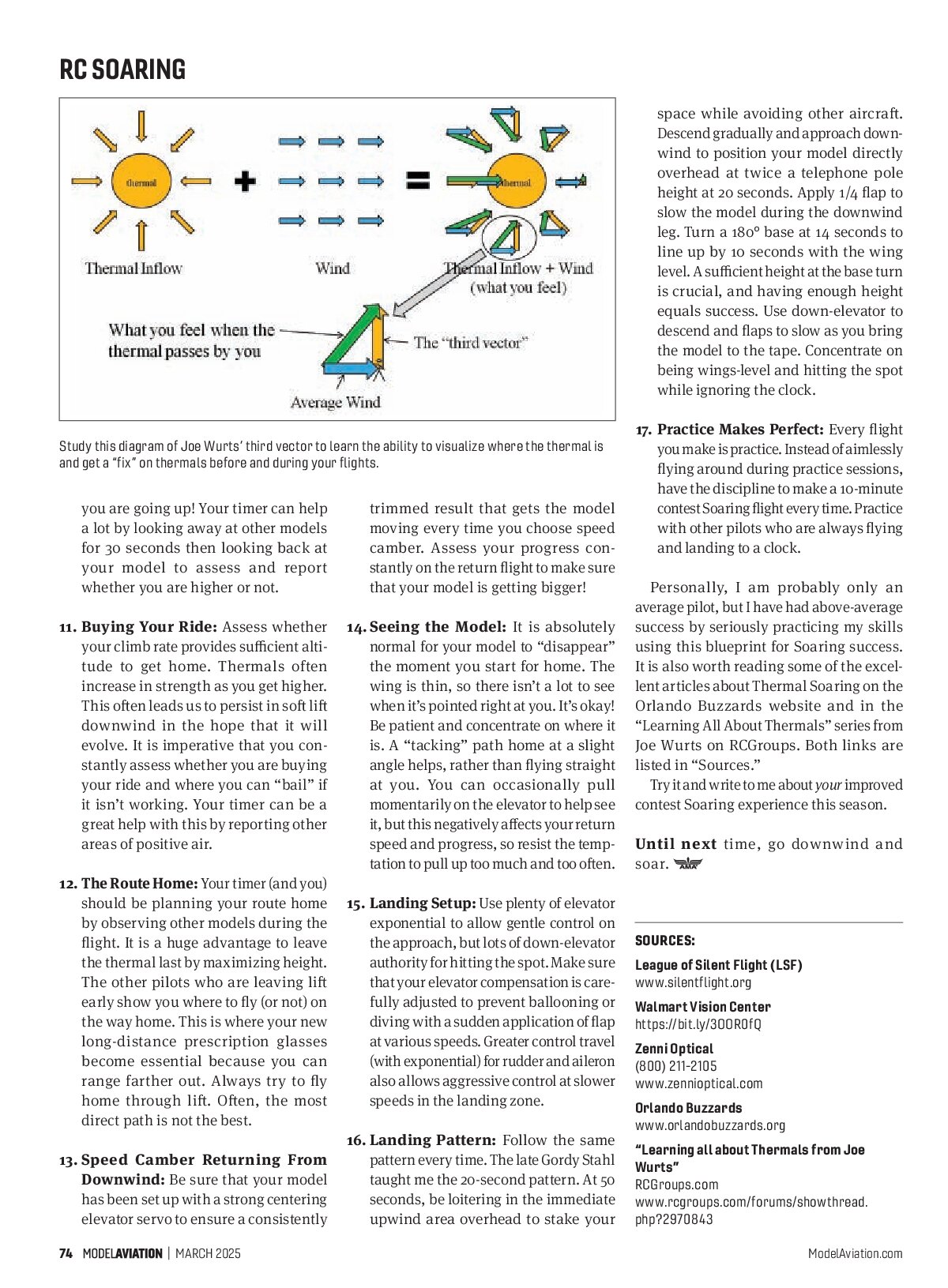
Personally, I am probably only an average pilot, but I have had above-average success by seriously practicing my skills using this blueprint for Soaring success. It is also worth reading some of the excellent articles about Thermal Soaring on the Orlando Buzzards website and in the “Learning All About Thermals” series from Joe Wurts on RCGroups. Both links are listed in “Sources.”
Try it and write to me about your improved contest Soaring experience this season.
Until next time, go downwind and soar.
SOURCES:
League of Silent Flight (LSF)
www.silentflight.org
Walmart Vision Center
https://bit.ly/300R0fQ
Zenni Optical
(800) 211-2105
www.zennioptical.com
Orlando Buzzards
www.orlandobuzzards.org
“Learning all about Thermals from Joe Wurts”
RCGroups.com
www.rcgroups.com/forums/showthread.php?2970843