PYLON RACING PROPELLERS
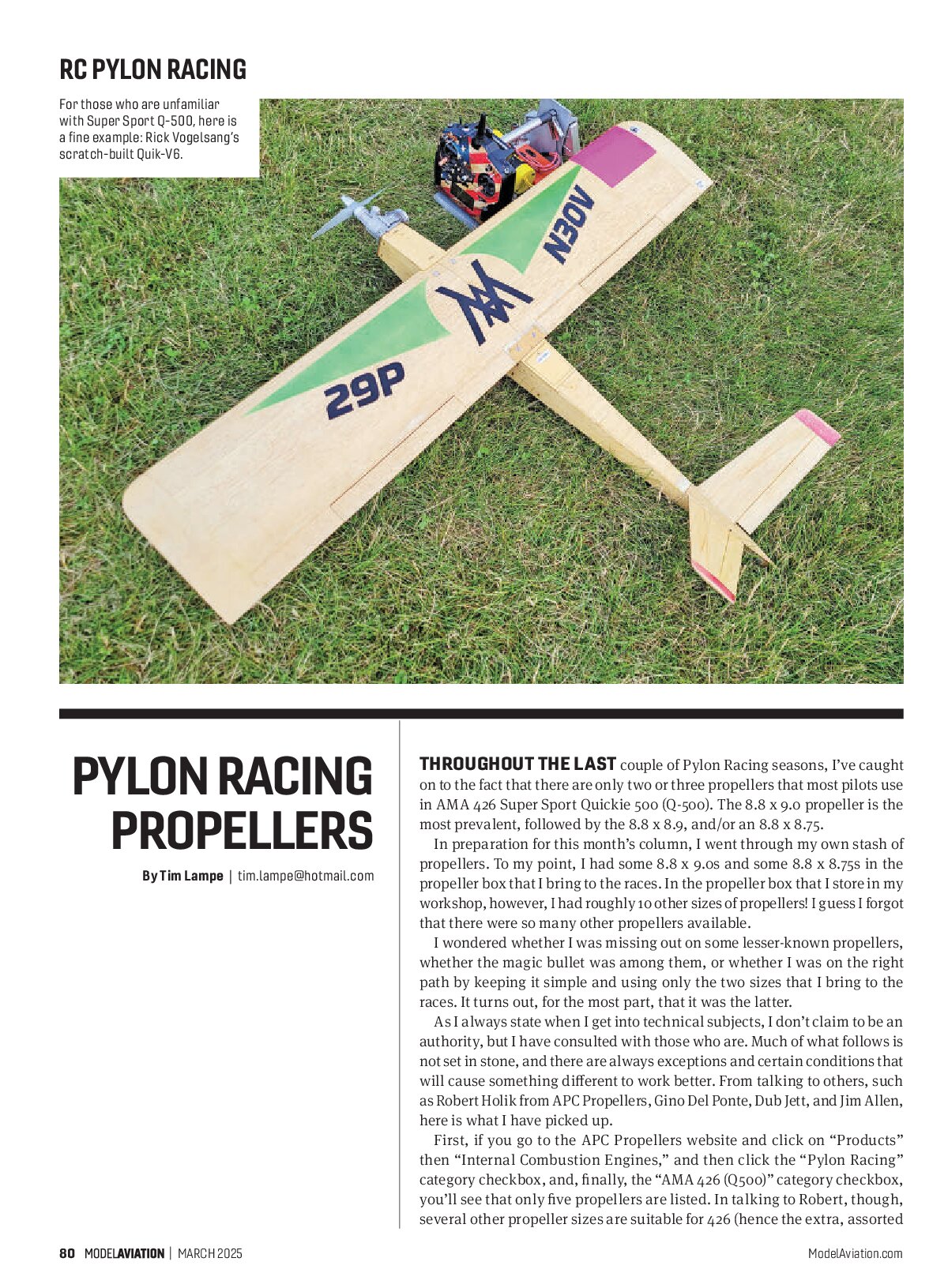
For those who are unfamiliar with Super Sport Q-500, here is a fine example: Rick Vogelsang’s scratch-built Quik-V8.

By Tim Lampe | tim.lampe@hotmail.com
THROUGHOUT THE LAST couple of Pylon Racing seasons, I’ve caught on to the fact that there are only two or three propellers that most pilots use in AMA 426 Super Sport Quickie 500 (Q-500). The 8.8 x 9.0 propeller is the most prevalent, followed by the 8.8 x 8.9, and/or an 8.8 x 8.75.
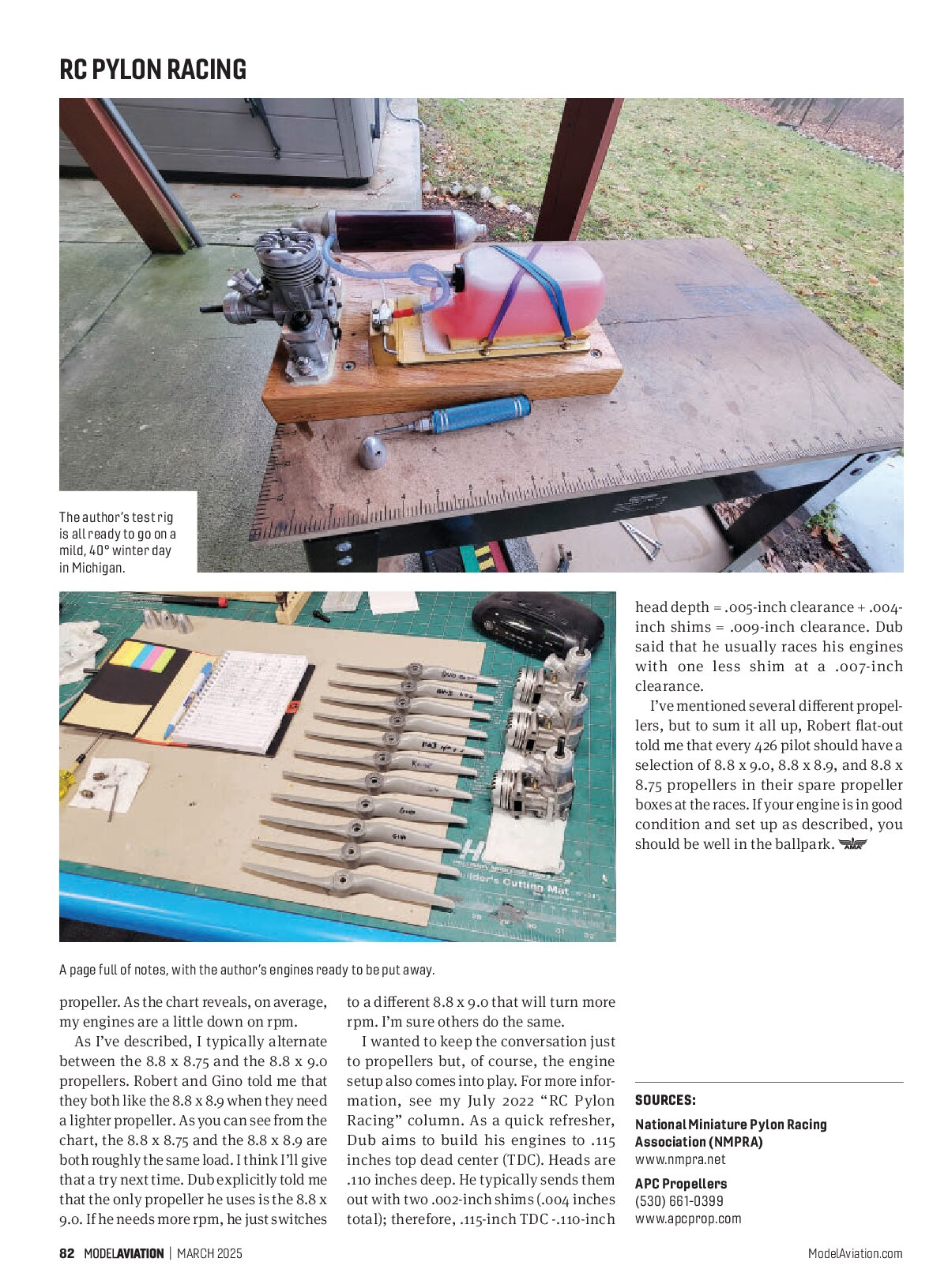
In preparation for this month’s column, I went through my own stash of propellers. To my point, I had some 8.8 x 9.0s and some 8.8 x 8.75s in the propeller box that I bring to the races. In the propeller box that I store in my workshop, however, I had roughly 10 other sizes of propellers! I guess I forgot that there were so many other propellers available.
I wondered whether I was missing out on some lesser-known propellers, whether the magic bullet was among them, or whether I was on the right path by keeping it simple and using only the two sizes that I bring to the races. It turns out, for the most part, that it was the latter.
As I always state when I get into technical subjects, I don’t claim to be an authority, but I have consulted with those who are. Much of what follows is not set in stone, and there are always exceptions and certain conditions that will cause something different to work better. From talking to others, such as Robert Holik from APC Propellers, Gino Del Ponte, Dub Jett, and Jim Allen, here is what I have picked up.
First, if you go to the APC Propellers website and click on “Products” then “Internal Combustion Engines,” and then click the “Pylon Racing” category checkbox, and, finally, the “AMA 426 (Q500)” category checkbox, you’ll see that only five propellers are listed. In talking to Robert, though, several other propeller sizes are suitable for 426 (hence the extra, assorted sizes in my storage box), some of which were developed for AMA 428, an older class with a different engine that is no longer run.
If you wanted to take the time to experiment, you might find that in certain conditions, some of these other propellers could provide great performance on a 426 engine. In fact, Dub mentioned the 8.75 x 9.0W because it is among the “lightest” propellers rpm-wise, allowing your engine to unload and rev high. The five shown on the 426 website page, however, are typically the most preferred for that class, so let’s stick to just those.
Second, I intended to bench-test each of my three 426 engines on a few 8.8 x 8.75 and 8.8 x 9.0 propellers just for my own information, but I threw in a couple of “Gino” propellers just for the heck of it. In talking with Gino before my testing, he suggested that I also try out the 8.8 x 8.9 because it’s another of the favored propellers. I added the two that I happened to have on hand to my testing rotation.
During my conversation with Robert after the testing, he confirmed that the 8.8 x 8.9 is definitely a popular propeller. I didn’t test the 8.8 x 9.25, which is also listed on the 426 page of the APC website, although he told me that this is the company’s third bestselling propeller in the range.
In the table are the averaged results from my propeller testing on the bench.
PropellerAverage, peak rpm8.8 x 8.7518,5008.8 x 8.918,4008.8 x 9.018,1008.75 x 8.5N(Gino propeller)18,100
Although it’s interesting and helpful for me to see the condition of each of my engines according to how they compare with each other in rpm on the same propeller, the main point here is that, as you can see, the load increases as you go down the list. What does this mean? Well, everyone I talked with has confirmed that although the 8.8 x 9.0 is their go-to propeller, sometimes a propeller with a lighter load that turns higher rpm might work better. It is also generally stated that a healthy 426 engine should turn any of these propellers a minimum of approximately 18,200 peak rpm, but a strong engine might turn a 8.8 x 9.0 up to 18,500 rpm or more.
For practice, or on the first test flight, I usually start out with an 8.8 x 8.75 propeller because I know it will turn a good rpm on my engines. I’ve had an 8.8 x 8.75 peak well above 18,500 rpm and this simply gives me a good feeling to start out with. When it’s time to race, I might continue with that propeller, or I might try an 8.8 x 9.0 and see how it goes. I know that the 8.8 x 9.0 will peak at lower rpm on the ground, but the airplane still might be faster.
One or two of my engines might not be the strongest, so I used the 8.8 x 8.75 most of the year and had pretty good results with some 1:03 times here and there. If you’re not satisfied, try a lighter propeller that works with your engine. It might be a temporary fix for a less-than-optimal engine or in weather conditions that don’t provide the fastest air.
Note to self: I should probably rebuild at least one of my engines so that it will turn at least 18,200 rpm on an 8.8 x 9.0


propeller. As the chart reveals, on average, my engines are a little down on rpm.
As I’ve described, I typically alternate between the 8.8 x 8.75 and the 8.8 x 9.0 propellers. Robert and Gino told me that they both like the 8.8 x 8.9 when they need a lighter propeller. As you can see from the chart, the 8.8 x 8.75 and the 8.8 x 8.9 are both roughly the same load. I think I’ll give that a try next time. Dub explicitly told me that the only propeller he uses is the 8.8 x 9.0. If he needs more rpm, he just switches to a different 8.8 x 9.0 that will turn more rpm. I’m sure others do the same.
I wanted to keep the conversation just to propellers but, of course, the engine setup also comes into play. For more information, see my July 2022 “RC Pylon Racing” column. As a quick refresher, Dub aims to build his engines to .115 inches top dead center (TDC). Heads are .110 inches deep. He typically sends them out with two .002-inch shims (.004 inches total); therefore, .115-inch TDC - .110-inch head depth = .005-inch clearance + .004-inch shims = .009-inch clearance. Dub said that he usually races his engines with one less shim at a .007-inch clearance.
I’ve mentioned several different propellers, but to sum it all up, Robert flat-out told me that every 426 pilot should have a selection of 8.8 x 9.0, 8.8 x 8.9, and 8.8 x 8.75 propellers in their spare propeller boxes at the races. If your engine is in good condition and set up as described, you should be well in the ballpark.
SOURCES:
National Miniature Pylon Racing Association (NMPRA)
www.nmpra.net
APC Propellers
(530) 661-0399
www.apcprop.com