INSTALLING AND SETTING
UP GYROS
By Jim Hiller | jetmodeler@earthlink.net

LET’S GO BACK to my discussion in the January 2025 issue about the installation and use of gyros in model airplanes. They are now actively used in many of our models—not exclusively jets. You will find that almost all jet modelers install a gyro during the initial build of a model. It’s not just an afterthought that is added at a later time.
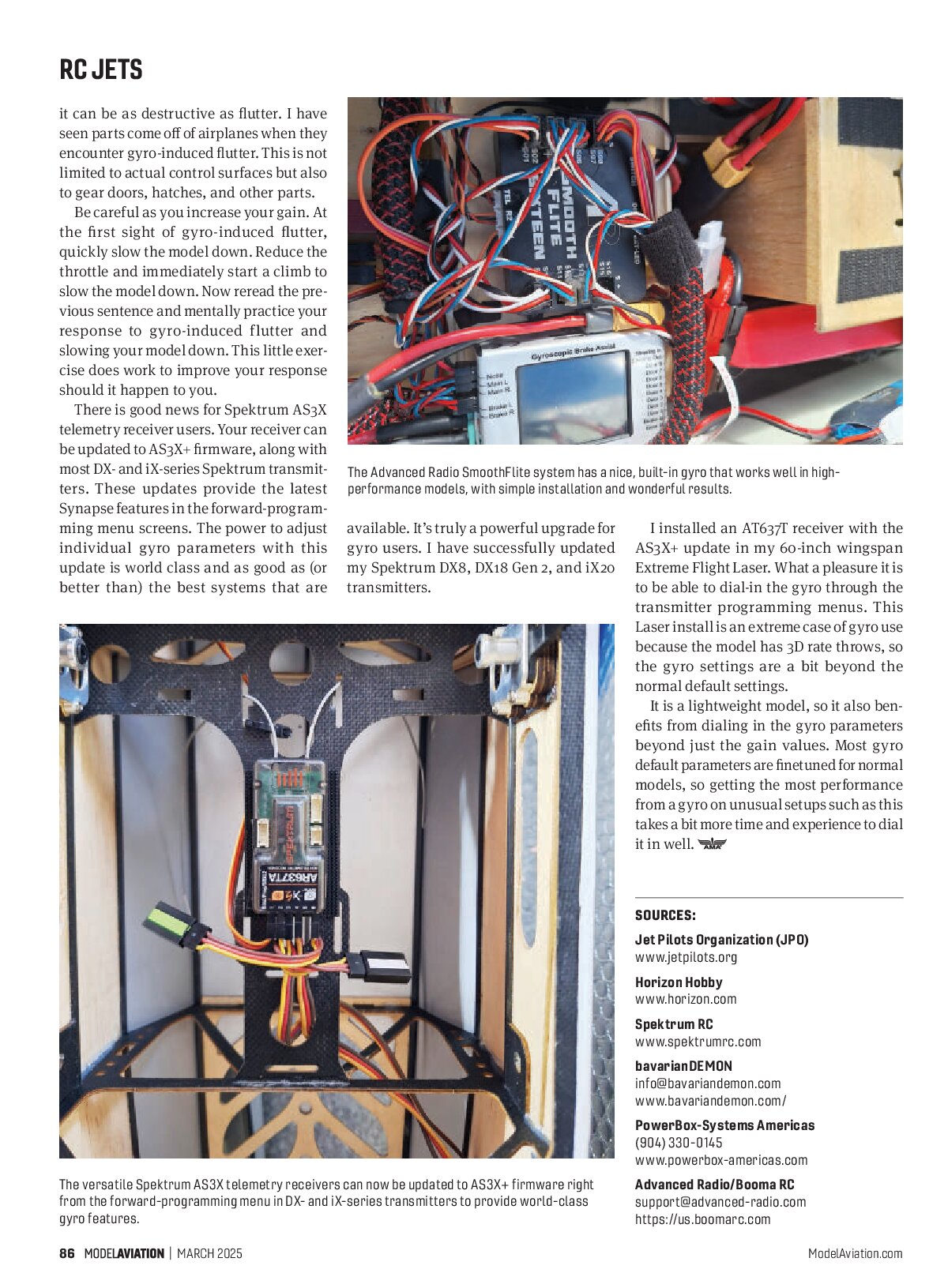
The available selection of gyros is extensive. You can find anything from built-in gyros with the receiver to built-in gyros with the power distribution panel as a separate unit, all at different price ranges and associated performance capabilities.
A good starter setup for simple aircraft when you are flying Spektrum-brand systems is with the AS3X series of receivers. I have them in some smaller sport propeller airplanes, and they are a good way to develop your skills at setting up a gyro and learning the proper technique to adjust gyro gain settings for optimal performance. These AS3X receivers are not high-performance gyros for high-speed airplanes, but they are great at developing an understanding of the use of gyros and realizing the benefits at a reasonable cost.
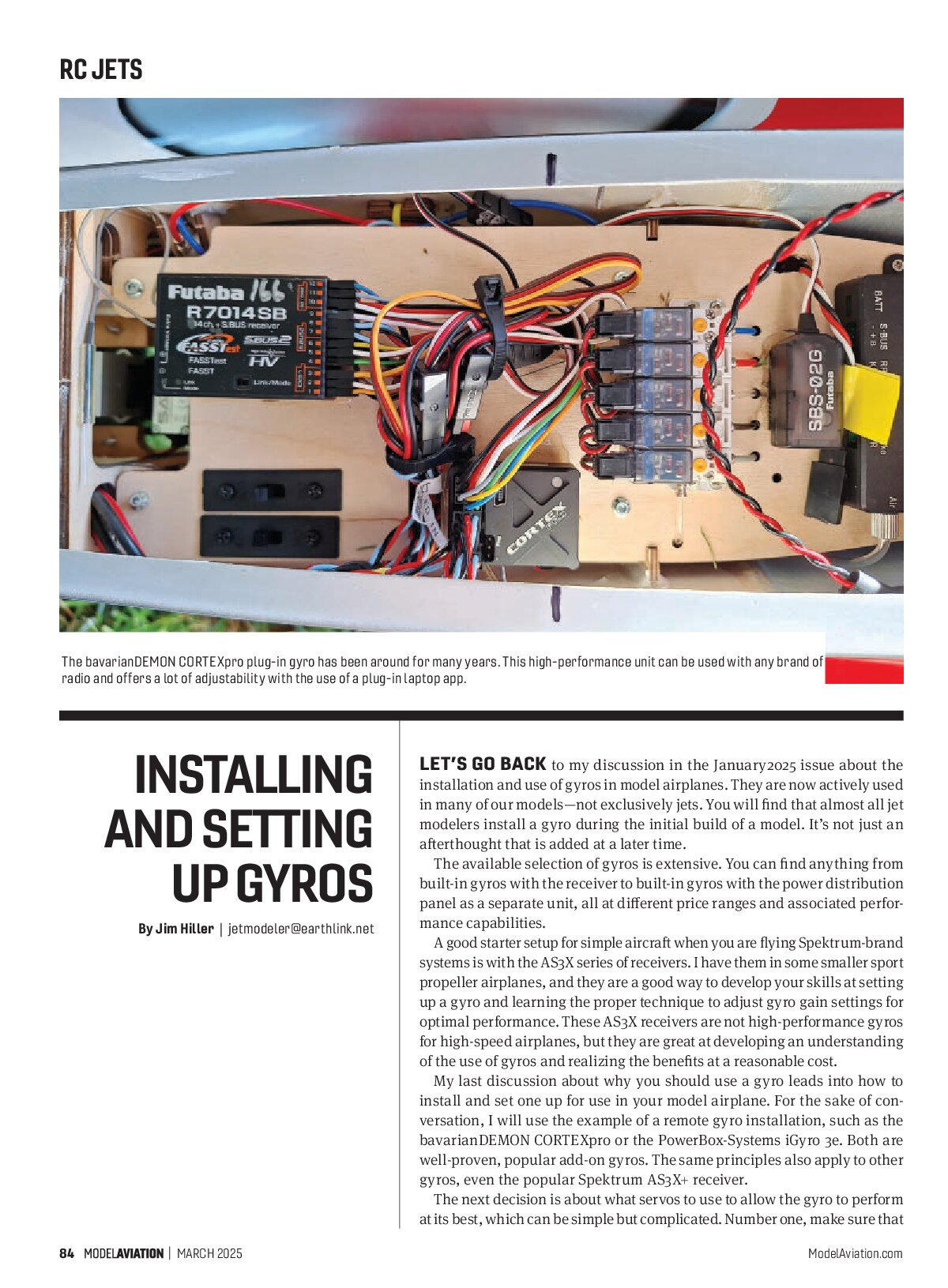
My last discussion about why you should use a gyro leads into how to install and set one up for use in your model airplane. For the sake of conversation, I will use the example of a remote gyro installation, such as the bavarianDEMON CORTEXpro or the PowerBox-Systems iGyro 3e. Both are well-proven, popular add-on gyros. The same principles also apply to other gyros, even the popular Spektrum AS3X+ receiver.
The next decision is about what servos to use to allow the gyro to perform at its best, which can be simple but complicated. Number one, make sure that your servo has the power that is required for your application. Number two is the speed. Fast servos that match fast gyro corrections work the best. Accurate servos also make for a more precise airplane and improve the performance of any gyro. Why spend the money on a quality gyro if you are going to hamper it with low-quality, slow servos?
The mechanical setup of your linkages to maximize the servo travel to close to 100% is normal for the default parameter settings in most gyros. Follow good practice to ease the setup of your first gyro by taking your time on servo linkage setup. A gyro can be adjusted to handle unusual setups, such as 3D extreme control throws, but it comes at performance and ease-of-setup costs. I know because I have a gyro on my 3D airplane.
With your gyro installed, carefully follow the manufacturer’s instructions for proper alignment, gyro control response direction, and control throw calibration. I set my gain to 100% to increase the response when I am confirming the gyro response direction. I then immediately reduce the gain to a much more normal value. The normal recommendation is to move the gain to a rotary knob for in-flight adjustment.
Take the aircraft off with zero gain (this is very important) and climb to a safe altitude before increasing the gain to avoid a crash should you have the gyro response reversed. That is as bad as taking off with your ailerons reversed.

While the model is in flight, increase the gain in small increments until you are satisfied with the results. My routine is to cruise at high speed and bump each axis, aileron, elevator, and rudder while observing how the model stops rotating from the bump of the control. Too much gain and it will overshoot the response and bounce back mildly following the release of the control.
As you increase the gain on heavy airplanes, such as jets and warbirds, you can actually see it return to straight flight slightly quicker. This takes an astute eye, but it does happen. I personally do not want any bounce back as the airplane’s rotation stops. Some pilots like the look of some backstop on rolls as it stops hard, but that is personal preference.
In the case of too much gain, the airplane will encounter gyro-response runaway. I refer to it as gyro-induced flutter because, on heavy and high-speed models,
it can be as destructive as flutter. I have seen parts come off of airplanes when they encounter gyro-induced flutter. This is not limited to actual control surfaces but also to gear doors, hatches, and other parts.
Be careful as you increase your gain. At the first sight of gyro-induced flutter, quickly slow the model down. Reduce the throttle and immediately start a climb to slow the model down. Now reread the previous sentence and mentally practice your response to gyro-induced flutter and slowing your model down. This little exercise does work to improve your response should it happen to you.
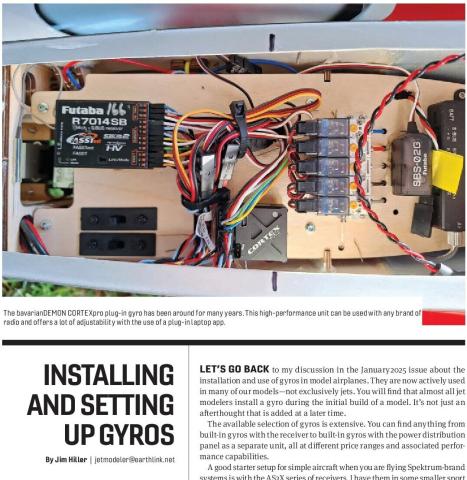
There is good news for Spektrum AS3X telemetry receiver users. Your receiver can be updated to AS3X+ firmware, along with most DX- and iX-series Spektrum transmitters. These updates provide the latest Synapse features in the forward-programming menu screens. The power to adjust individual gyro parameters with this update is world class and as good as (or better than) the best systems that are

available. It’s truly a powerful upgrade for gyro users. I have successfully updated my Spektrum DX8, DX18 Gen 2, and iX20 transmitters.

I installed an AT637T receiver with the AS3X+ update in my 60-inch wingspan Extreme Flight Laser. What a pleasure it is to be able to dial-in the gyro through the transmitter programming menus. This Laser install is an extreme case of gyro use because the model has 3D rate throws, so the gyro settings are a bit beyond the normal default settings.
It is a lightweight model, so it also benefits from dialing in the gyro parameters beyond just the gain values. Most gyro default parameters are finetuned for normal models, so getting the most performance from a gyro on unusual setups such as this takes a bit more time and experience to dial it in well.
SOURCES:
- Jet Pilots Organization (JPO)
www.jetpilots.org - Horizon Hobby
www.horizon.com - Spektrum RC
www.spektrumrc.com - bavarianDEMON
info@bavariandemon.com
www.bavariandemon.com/ - PowerBox-Systems Americas
(904) 330-0145
www.powerbox-americas.com - Advanced Radio/Booma RC
support@advanced-radio.com
https://us.boomarc.com
The versatile Spektrum AS3X telemetry receivers can now be updated to AS3X+ firmware right from the forward-programming menu in DX- and iX-series transmitters to provide world-class gyro features.